


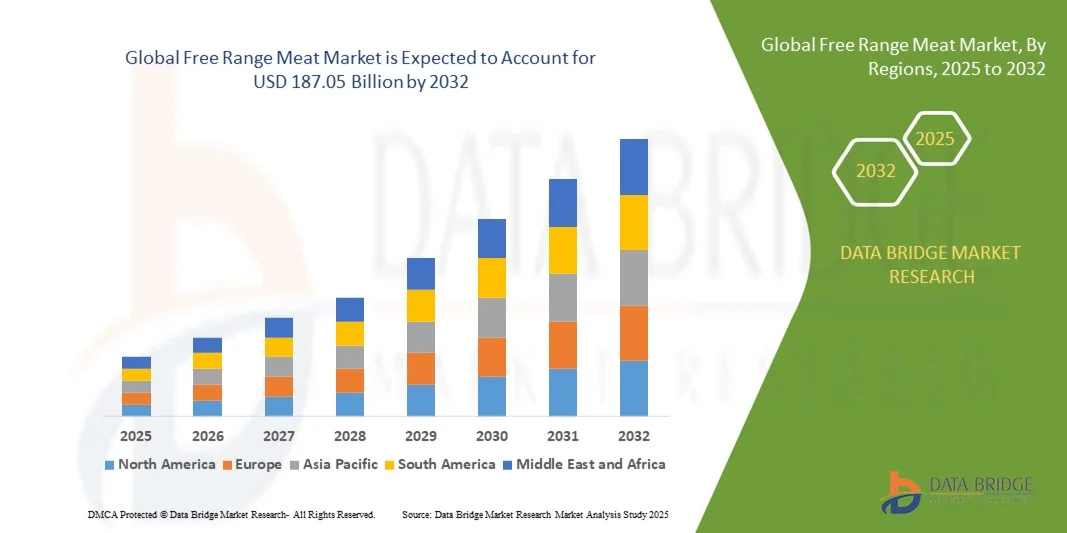
Global Free Range Meat Market Size
- The global free range meat market size was valued at USD 131.53 billion in 2024 and is expected to reach USD 187.05 billion by 2032, growing at a CAGR of 4.50% during the forecast period
- Market growth is primarily driven by increasing consumer awareness regarding animal welfare, environmental sustainability, and the health benefits of hormone-free, antibiotic-free meat alternatives
- Additionally, rising demand for ethically sourced and organic food products is prompting retailers and producers to expand their free-range offerings, thereby fueling market expansion across both developed and emerging economies
Global Free Range Meat Market Analysis
- Free range meat, produced from animals raised in open, natural environments without the use of hormones or antibiotics, is becoming a key component in the ethical and sustainable food movement, gaining traction in both residential and commercial food service sectors due to its health benefits, ethical sourcing, and environmental impact
- The rising demand for free range meat is primarily driven by increasing consumer awareness around animal welfare, growing health consciousness, and a shift toward organic and sustainable food consumption
- North America dominated the global free range meat market with the largest revenue share of 38.01% in 2024, supported by high consumer demand for organic and ethically sourced meat, advanced supply chains, and strong presence of leading market players, with the U.S. leading in adoption due to robust retail and foodservice distribution channels
- Asia-Pacific is expected to be the fastest growing region in the Global Free Range Meat Market during the forecast period due to rising disposable incomes, rapid urbanization, and increasing awareness of health and sustainability among middle-class consumers
- The chicken segment dominated the market with the largest revenue share of 43.2% in 2024, primarily due to its global consumption, lower production cost, and healthier nutritional profile.
Report Scope and Global Free Range Meat Market Segmentation
|
Attributes |
Free Range Meat Key Market Insights |
|
Segments Covered |
|
|
Countries Covered |
North America
Europe
Asia-Pacific
Middle East and Africa
South America
|
|
Key Market Players |
|
|
Market Opportunities |
|
|
Value Added Data Infosets |
In addition to the insights on market scenarios such as market value, growth rate, segmentation, geographical coverage, and major players, the market reports curated by the Data Bridge Market Research also include in-depth expert analysis, pricing analysis, brand share analysis, consumer survey, demography analysis, supply chain analysis, value chain analysis, raw material/consumables overview, vendor selection criteria, PESTLE Analysis, Porter Analysis, and regulatory framework. |
Global Free Range Meat Market Trends
Rising Demand for Transparency, Traceability, and Clean Labeling
- A significant and accelerating trend in the global Free Range Meat Market is the growing consumer demand for transparency in food sourcing, traceability in supply chains, and clean labeling practices. Consumers are increasingly interested in understanding where their food comes from, how animals are raised, and what production methods are used.
- For Instance, companies like Applegate and ButcherBox provide detailed sourcing information, including farm locations, animal welfare certifications, and antibiotic-free guarantees, directly on their packaging or online platforms. This level of transparency builds consumer trust and reinforces brand loyalty.
- Traceability technologies, such as blockchain and QR code-enabled labeling, are being adopted to allow customers to track meat products from farm to table. This not only ensures food safety and quality but also aligns with ethical and environmental values. Brands like Tyson Foods and JBS are investing in digital traceability systems to provide end-to-end supply chain visibility and meet evolving regulatory and consumer expectations.
- Clean labeling is another core element of this trend, with free range meat producers emphasizing minimal processing, absence of artificial additives, and clear labeling of nutritional and sourcing information. Terms like "grass-fed," "pasture-raised," and "antibiotic-free" are now critical to product positioning in the premium meat segment.
- The integration of transparency and traceability into marketing and product development strategies is becoming a competitive differentiator. Retailers and foodservice providers are prioritizing suppliers who can deliver verified and ethically sourced free range meat products.
- This shift is fundamentally reshaping consumer expectations, pushing the industry toward higher standards in sustainability, animal welfare, and supply chain integrity. As a result, the demand for free range meat that is fully traceable and cleanly labeled continues to grow across global markets, particularly among health-conscious and ethically minded consumers.
Global Free Range Meat Market Dynamics
Driver
Growing Demand Driven by Health Awareness and Ethical Consumption
- The increasing global awareness of health and wellness, combined with growing concerns about animal welfare and environmental sustainability, is significantly driving demand for free range meat products. Consumers are actively seeking alternatives to conventionally raised meat, favoring options that align with their values and dietary goals.
- For Instance, in 2024, Whole Foods Market expanded its range of certified free range meat products across North America and Europe, reflecting strong consumer interest in ethically sourced, hormone-free, and antibiotic-free meat. Retailers and foodservice providers are responding by diversifying their offerings and highlighting welfare certifications such as Global Animal Partnership (GAP) and Certified Humane.
- Free range meat offers multiple health benefits, including higher levels of omega-3 fatty acids, fewer harmful residues, and leaner cuts — attributes that are increasingly prioritized by health-conscious consumers. The clean-label movement and preference for minimally processed foods are also playing a role in boosting this trend.
- Furthermore, the rise in flexitarian and semi-vegetarian diets is fueling the market, as consumers reduce their overall meat consumption but opt for higher-quality, ethically produced options when they do eat meat.
- With expanding urban middle-class populations and improved access to organic and specialty food products in emerging markets, free range meat is increasingly viewed as a premium but accessible category. Innovations in supply chain logistics and cold storage, especially through online grocery platforms, are further contributing to its availability and popularity.
Restraint/Challenge
High Cost and Supply Chain Complexity Limiting Mass Adoption
- Despite the growing popularity of free range meat, high production costs and complex supply chains remain significant barriers to broader market adoption. Raising animals under free range conditions requires more land, labor, and time, all of which contribute to higher prices compared to conventionally farmed meat.
- For instance, many small and mid-sized producers face difficulties in scaling operations due to land use regulations, feed costs, and stringent animal welfare standards — challenges that often result in inconsistent supply and limited product availability in mainstream retail outlets.
- Additionally, maintaining transparency and traceability throughout the supply chain is both logistically demanding and cost-intensive. Ensuring compliance with certification bodies and verifying animal welfare standards require extensive documentation and monitoring, which may deter some producers from entering the market.
- From the consumer perspective, the premium pricing of free range meat can be a deterrent, particularly in price-sensitive or developing regions where cost remains a top consideration. While affluent consumers in developed countries may be willing to pay a premium for ethical and health-related benefits, mass-market adoption is still limited.
- Overcoming these challenges will require strategic investment in infrastructure, policy support for sustainable agriculture, and innovations in cost-effective production and distribution. As the market matures, increasing economies of scale and consumer education may help reduce price gaps and enhance accessibility.
Global Free Range Meat Market Scope
The free range meat market is segmented on the basis of meat, end-use, application and distribution channel.
- By Meat
On the basis of meat type, the Global Free Range Meat Market is segmented into beef, chicken, pork, lamb, fish, and others. The chicken segment dominated the market with the largest revenue share of 43.2% in 2024, primarily due to its global consumption, lower production cost, and healthier nutritional profile. Chicken is widely perceived as a lean, high-protein option and is more affordable than other free range meats, making it popular across income groups. Its rapid growth cycle and ease of integration into various cuisines also support its dominance.
The lamb segment is projected to witness the fastest CAGR from 2025 to 2032, fueled by increasing demand in high-end culinary and health-focused markets. Consumers are showing growing interest in premium and ethically raised red meats, and lamb fits this niche with its grass-fed reputation and nutritional richness. The segment is also gaining traction in the Middle East, Europe, and parts of Asia where lamb holds cultural significance.
- By End-Use
On the basis of end-use, the Global Free Range Meat Market is segmented into the food and beverage industry and lab testing. The food and beverage industry segment accounted for the largest market revenue share in 2024, driven by the rising demand from restaurants, hotels, institutional catering, and household consumption. Consumers are increasingly choosing menus and brands that offer ethically sourced, hormone-free meat, pushing the F&B sector to expand its free range meat offerings. Large chains and boutique food outlets alike are showcasing free range options to attract health-conscious and environmentally aware customers.
The lab testing segment is expected to witness the fastest growth from 2025 to 2032, driven by the growing need for quality assurance, traceability, and compliance with food safety standards. As consumers demand transparency in meat sourcing, producers and distributors are investing in third-party lab testing for verification of organic, non-GMO, and animal welfare claims—supporting a robust, data-driven approach to labeling and certification.
- By Application
On the basis of application, the Global Free Range Meat Market is segmented into industrial and commercial uses. The commercial segment dominated the market with the highest revenue share in 2024, supported by strong demand from restaurants, hotels, institutional food services, and specialty butcher shops. With consumers increasingly seeking out ethical dining options, commercial kitchens and foodservice businesses are responding by prioritizing free range meat in their menus. This segment benefits from large-volume purchases and strategic partnerships with certified meat suppliers.
The industrial segment is projected to witness the fastest CAGR from 2025 to 2032, as food manufacturers integrate free range meat into packaged products such as ready-to-eat meals, gourmet sausages, deli meats, and pet food. Rising demand for clean-label and ethically sourced processed food options is driving industrial-scale adoption. Additionally, innovations in cold chain logistics and automated meat processing systems are making it more feasible for industrial players to scale their use of free range meat inputs.
- By Distribution Channel
On the basis of distribution channel, the Global Free Range Meat Market is segmented into B2B, B2C, hypermarkets/supermarkets, grocery stores, retail stores, online, and others. The B2C segment held the largest market share in 2024, driven by the increasing availability of free range meat in retail settings, growing consumer awareness, and shifting dietary preferences. Consumers now prioritize convenience, transparency, and ethical sourcing when shopping for meat, and brands are responding by offering a wider variety of free range options directly to households through traditional and digital retail formats.
The online segment is anticipated to witness the fastest CAGR from 2025 to 2032, fueled by the rapid expansion of e-commerce platforms and direct-to-consumer meat delivery services. Subscription-based services like ButcherBox and online organic grocery platforms offer consumers access to certified free range meats with full traceability. Improved logistics and the growing popularity of online shopping—especially post-pandemic—are expected to significantly accelerate growth in this segment.
Global Free Range Meat Market Regional Analysis
- North America dominated the Global Free Range Meat Market with the largest revenue share of 38.01% in 2024, driven by rising consumer awareness about animal welfare, sustainable food practices, and health benefits associated with antibiotic-free and hormone-free meat products
- Consumers in the region highly value transparency in sourcing, clean labeling, and the assurance of humane animal treatment, leading to increased demand for certified free range meat across retail and foodservice sectors
- This strong market performance is further supported by high disposable incomes, a well-established organic and natural food retail network, and the growing popularity of flexitarian and health-conscious diets, positioning free range meat as a preferred choice among ethically and nutritionally aware consumers in both the U.S. and Canada
U.S. Free Range Meat Market Insight
The U.S. Global Free Range Meat Market captured the largest revenue share of 82% in 2024 within North America, fueled by growing consumer awareness around animal welfare, clean eating, and sustainable agriculture. Consumers are increasingly prioritizing ethically raised, hormone-free, and antibiotic-free meat products, particularly in urban and health-conscious markets. The rise of flexitarian and organic food trends has further strengthened the demand for free range meat in retail and foodservice. Additionally, strong distribution networks, clear labeling standards, and the presence of leading organic and natural food brands contribute to the U.S. market's dominance. Online retail and subscription-based meat delivery services are also expanding rapidly, making free range meat more accessible to consumers nationwide.
Europe Free Range Meat Market Insight
The Europe Global Free Range Meat Market is projected to grow at a substantial CAGR throughout the forecast period, driven by stringent animal welfare regulations and increasing consumer demand for sustainable and traceable food sources. European consumers are particularly drawn to certifications such as Organic, Certified Humane, and Global Animal Partnership (GAP), which promote transparency and ethical farming practices. Additionally, the rise in environmental consciousness and demand for local, pasture-raised meat is influencing purchasing decisions. Countries like Germany, France, and the Netherlands are seeing increased availability of free range meat through both traditional retail and e-commerce channels, supporting market expansion across residential and foodservice segments.
U.K. Free Range Meat Market Insight
The U.K. Global Free Range Meat Market is anticipated to grow at a noteworthy CAGR during the forecast period, driven by rising public interest in ethical food consumption and sustainable farming. Increasing concerns about factory farming, coupled with a growing preference for clean-label and transparent meat sourcing, are encouraging consumers to shift toward free range options. The presence of strong organic food certification systems and national retailers promoting responsibly sourced meat is further driving this trend. Moreover, the rise in vegetarianism and flexitarian diets is fostering a preference for lower but higher-quality meat intake, benefiting the free range meat segment in both retail and dining sectors.
Germany Free Range Meat Market Insight
The Germany Global Free Range Meat Market is expected to expand at a considerable CAGR during the forecast period, supported by a strong regulatory framework, widespread environmental awareness, and demand for transparency in food sourcing. German consumers are highly conscious of animal welfare and sustainable agriculture, making free range meat a preferred option. Retailers and producers are increasingly investing in certified and traceable meat supply chains to meet consumer expectations. Additionally, the growth of organic markets and government backing for sustainable farming practices are promoting the adoption of free range meat in both household consumption and foodservice applications.
Asia-Pacific Free Range Meat Market Insight
The Asia-Pacific Global Free Range Meat Market is poised to grow at the fastest CAGR of 24% from 2025 to 2032, driven by rapid urbanization, rising middle-class incomes, and growing health and environmental awareness. Countries such as China, Japan, India, and Australia are experiencing rising demand for higher-quality, ethically sourced meat. Government initiatives promoting sustainable agriculture and food safety are also supporting the shift toward free range products. E-commerce platforms and cold-chain logistics improvements are making premium meat more accessible to consumers across urban and semi-urban areas. As dietary preferences shift towards clean eating, the market for free range meat is expanding rapidly across the region.
Japan Free Range Meat Market Insight
The Japan Global Free Range Meat Market is gaining momentum, fueled by a health-conscious population and increasing interest in premium, sustainably sourced foods. Japanese consumers place high importance on food safety, quality, and origin, driving demand for traceable and ethically produced meat. The country’s aging population also contributes to the preference for leaner, high-quality protein sources such as pasture-raised chicken and pork. Retailers are highlighting certifications and detailed sourcing information to meet consumer expectations. Additionally, the hospitality sector is incorporating free range meat to align with rising demand for high-standard, responsible dining experiences.
China Free Range Meat Market Insight
The China Global Free Range Meat Market accounted for the largest revenue share in Asia-Pacific in 2024, driven by its rapidly expanding middle class, increasing health consciousness, and growing demand for safer, traceable food products. As food safety remains a critical issue, Chinese consumers are turning toward free range meat as a more trustworthy alternative. The proliferation of online grocery platforms, rising interest in organic lifestyles, and government emphasis on domestic agricultural reform are accelerating the adoption of ethically raised meat. Additionally, local producers are scaling up operations to meet the demand for pasture-raised and hormone-free options, supporting strong domestic growth.
Global Free Range Meat Market Share
The Free Range Meat industry is primarily led by well-established companies, including:
- The Niman Ranch (U.S.)
- Perdue Farms (U.S.)
- Bell & Evans (U.S.)
- Coleman All-Natural Meats (U.S.)
- Organic Valley (U.S.)
- Applegate (U.S.).
- White Oak Pastures (U.S.)
- Joyce Farms (U.S.)
- Mary's Chickens (U.S.)
- Daylesford Organic Limited (U.K.)
What are the Recent Developments in Global Free Range Meat Market?
- In April 2023, Organic Valley, a leading cooperative of organic farmers in the U.S., launched a new initiative aimed at expanding free range meat production in South Africa. This program focuses on supporting sustainable farming practices and improving animal welfare standards tailored to local agricultural conditions. By leveraging their expertise in organic and pasture-raised meat, Organic Valley is helping to address the growing demand for ethically sourced meat products in emerging markets, while strengthening its global presence in the free range meat industry.
- In March 2023, Bell & Evans, a U.S.-based premium poultry producer, introduced a new line of antibiotic-free free range chicken products designed specifically for schools and foodservice operations. This initiative aims to provide healthier, high-quality protein options to children and institutional customers. Bell & Evans’ commitment to innovation in animal welfare and food safety underscores their leadership in offering trusted, sustainable meat products for sensitive consumer segments.
- In March 2023, WH Group, China’s largest pork producer, successfully launched a pasture-raised pork project in Bengaluru, India, aiming to meet rising demand for free range meat amid growing health awareness. This project promotes local sustainable farming practices combined with modern animal welfare standards, enhancing product quality and food safety. WH Group’s move reflects the increasing importance of free range meat in urbanizing markets and contributes to the development of healthier food systems.
- In February 2023, Farmer’s Fridge, a fast-growing food company in the U.S., announced a partnership with major grocery chains to expand the availability of free range meat products through refrigerated vending solutions. This collaboration aims to improve consumer access to fresh, ethically sourced meat with convenience, especially in urban areas. The initiative highlights Farmer’s Fridge’s dedication to innovation and sustainability in the fresh food distribution landscape.
- In January 2023, Niman Ranch, a leading American producer of naturally raised meat, unveiled its new range of free range lamb products at the Natural Products Expo West 2023. Featuring meat sourced from certified pasture-raised farms, this product line offers consumers premium, high-quality options that prioritize animal welfare and environmental sustainability. Niman Ranch’s launch reinforces its commitment to advancing responsible meat production and meeting growing consumer demand for transparency and quality.

- Interactive Data Analysis Dashboard
- Company Analysis Dashboard for high growth potential opportunities
- Research Analyst Access for customization & queries
- Competitor Analysis with Interactive dashboard
- Latest News, Updates & Trend analysis
- Harness the Power of Benchmark Analysis for Comprehensive Competitor Tracking
Global Free Range Meat Market, Supply Chain Analysis and Ecosystem Framework
To support market growth and help clients navigate the impact of geopolitical shifts, DBMR has integrated in-depth supply chain analysis into its Global Free Range Meat Market research reports. This addition empowers clients to respond effectively to global changes affecting their industries. The supply chain analysis section includes detailed insights such as Global Free Range Meat Market consumption and production by country, price trend analysis, the impact of tariffs and geopolitical developments, and import and export trends by country and HSN code. It also highlights major suppliers with data on production capacity and company profiles, as well as key importers and exporters. In addition to research, DBMR offers specialized supply chain consulting services backed by over a decade of experience, providing solutions like supplier discovery, supplier risk assessment, price trend analysis, impact evaluation of inflation and trade route changes, and comprehensive market trend analysis.
Data collection and base year analysis are done using data collection modules with large sample sizes. The stage includes obtaining market information or related data through various sources and strategies. It includes examining and planning all the data acquired from the past in advance. It likewise envelops the examination of information inconsistencies seen across different information sources. The market data is analysed and estimated using market statistical and coherent models. Also, market share analysis and key trend analysis are the major success factors in the market report. To know more, please request an analyst call or drop down your inquiry.
The key research methodology used by DBMR research team is data triangulation which involves data mining, analysis of the impact of data variables on the market and primary (industry expert) validation. Data models include Vendor Positioning Grid, Market Time Line Analysis, Market Overview and Guide, Company Positioning Grid, Patent Analysis, Pricing Analysis, Company Market Share Analysis, Standards of Measurement, Global versus Regional and Vendor Share Analysis. To know more about the research methodology, drop in an inquiry to speak to our industry experts.
Data Bridge Market Research is a leader in advanced formative research. We take pride in servicing our existing and new customers with data and analysis that match and suits their goal. The report can be customized to include price trend analysis of target brands understanding the market for additional countries (ask for the list of countries), clinical trial results data, literature review, refurbished market and product base analysis. Market analysis of target competitors can be analyzed from technology-based analysis to market portfolio strategies. We can add as many competitors that you require data about in the format and data style you are looking for. Our team of analysts can also provide you data in crude raw excel files pivot tables (Fact book) or can assist you in creating presentations from the data sets available in the report.













