


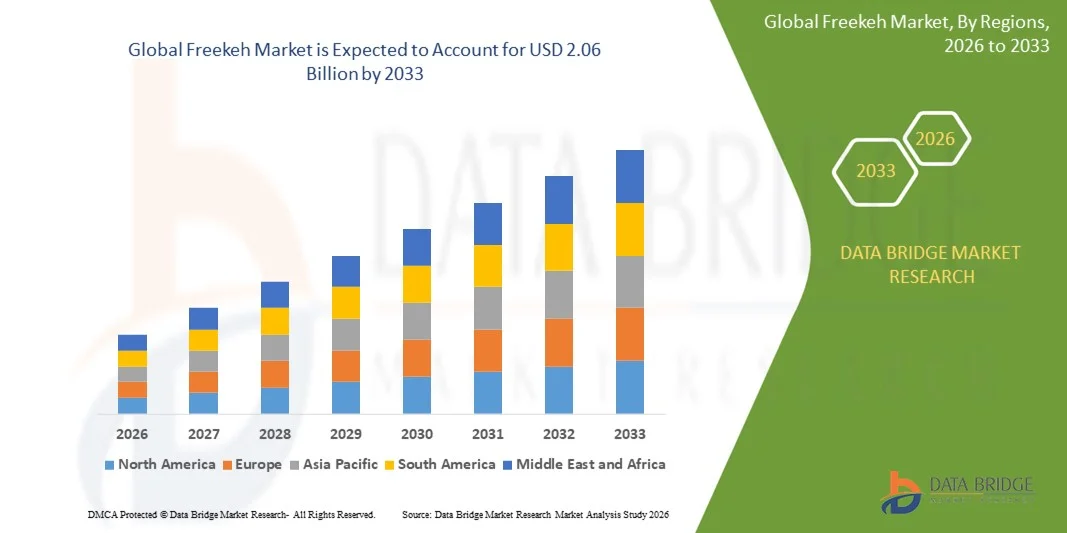
Freekeh Market Size
- The global freekeh market size was valued at USD 1.27 billion in 2025 and is expected to reach USD 2.06 billion by 2033, at a CAGR of 6.20% during the forecast period
- The market growth is largely fuelled by the rising consumer preference for nutrient-dense ancient grains and the increasing adoption of healthy, fiber-rich food products
- Growing demand from the food and beverage industry such as bakery, snacks, ready meals, and specialty foods is also supporting market expansion
Freekeh Market Analysis
- The global freekeh market is experiencing steady growth due to increasing awareness of its nutritional benefits, including high fiber, protein, and antioxidant content
- Manufacturers are focusing on product innovation and expanding distribution networks to cater to the rising demand for specialty grains across retail and foodservice channels
- North America dominated the freekeh market with the largest revenue share in 2025, driven by rising consumer preference for nutritious ancient grains and a growing shift toward healthier dietary patterns
- Asia-Pacific region is expected to witness the highest growth rate in the global freekeh market, driven by rising disposable incomes, evolving dietary preferences, and a growing shift toward premium functional grains
- Wholegrain freekeh held the largest market revenue share in 2025 due to its higher fiber content, strong demand among health-conscious consumers, and growing use in premium natural food products. Its nutritional profile and versatility in traditional recipes make it a preferred option across retail and foodservice channels
Report Scope and Freekeh Market Segmentation
|
Attributes |
Freekeh Key Market Insights |
|
Segments Covered |
|
|
Countries Covered |
North America
Europe
Asia-Pacific
Middle East and Africa
South America
|
|
Key Market Players |
Here are the companies in the same bullet format, with hyperlinks added only for the top 5 companies (company name only, not the country) and no change to the existing structure:
|
|
Market Opportunities |
|
|
Value Added Data Infosets |
In addition to the insights on market scenarios such as market value, growth rate, segmentation, geographical coverage, and major players, the market reports curated by the Data Bridge Market Research also include in-depth expert analysis, pricing analysis, brand share analysis, consumer survey, demography analysis, supply chain analysis, value chain analysis, raw material/consumables overview, vendor selection criteria, PESTLE Analysis, Porter Analysis, and regulatory framework. |
Freekeh Market Trends
Rise of High-Fiber and Nutrient-Rich Grain Consumption
- The rising preference for high-fiber, nutrient-dense grains is reshaping the freekeh market as consumers increasingly shift toward healthier and functional food options. Freekeh’s rich protein, fiber, and mineral content positions it as a desirable alternative to conventional grains. This growing focus on nutritional value is driving stronger demand among health-conscious buyers
- Demand is increasing across regions with limited access to premium whole grains, as freekeh offers versatility and affordability compared to other ancient grains. Its adaptability in soups, salads, snacks, and meal kits makes it suitable for diverse culinary applications. This flexibility is expanding freekeh’s presence across retail, foodservice, and specialty food categories
- Growing interest in clean-label and minimally processed foods is further accelerating adoption. Freekeh’s natural production process without extensive refinement appeals strongly to consumers seeking wholesome and sustainable grain choices. This aligns with the broader global shift toward transparency in sourcing and manufacturing
- For instance, by late 2023, several Mediterranean and Middle Eastern food brands reported a rise in freekeh-based ready meals due to increased consumer interest in nutrient-rich convenience foods. This contributed to improved product availability across retail channels. The expansion of ready-to-eat formats is expected to boost mainstream market penetration
- While the trend is supported by strong consumer demand, long-term growth will rely on supply consistency, competitive pricing, and product innovation to increase global awareness and consumption. Manufacturers must also focus on educating consumers about freekeh’s benefits. These efforts will help the grain compete effectively against other popular ancient grains
Freekeh Market Dynamics
Driver
Increasing Consumer Adoption of Healthy and Functional Grains
- The global shift toward healthier diets is significantly boosting demand for freekeh, driven by rising awareness of its nutritional advantages, such as high fiber, low glycemic index, and its suitability for weight management. This dynamic is creating strong momentum for the market. Freekeh’s alignment with wellness-focused diets enhances its long-term growth prospects
- Consumers are becoming increasingly aware of the role of functional foods in improving long-term wellness, prompting greater interest in grains that support digestive health and overall vitality. Freekeh aligns well with these evolving dietary preferences, encouraging frequent consumption. This trend is also supported by rising demand for plant-based and whole-grain diets
- Health-focused government initiatives and nutrition campaigns are also promoting fiber-rich grain alternatives. This has increased freekeh visibility in retail, restaurant, and online food-service channels as brands capitalize on shifting consumer habits. Growing inclusion of ancient grains in dietary guidelines further strengthens the market outlook
- For instance, in 2024, several European retail chains expanded their portfolios of ancient grains, including freekeh, following a surge in demand for high-fiber staples among fitness and wellness-oriented consumers. This expansion improved accessibility for mainstream shoppers. Retail diversification continues to drive category awareness
- Despite strong momentum, broader adoption will require enhanced market education, improved global supply networks, and strategic brand positioning to differentiate freekeh from other emerging grain options. Companies must communicate its unique value proposition. Greater consumer awareness will be essential to support sustained expansion
Restraint/Challenge
Limited Global Awareness and Supply Chain Inconsistencies
- Freekeh’s global market expansion is restrained by relatively low consumer awareness outside the Middle Eastern and Mediterranean regions, where it is traditionally consumed. Many consumers remain unfamiliar with its benefits, limiting demand in emerging markets. This knowledge gap makes it harder for brands to position freekeh competitively
- The supply chain for freekeh is still developing, with inconsistent production levels and limited large-scale processing facilities affecting availability in international markets. This leads to fluctuating prices and reduced reliability for major distributors and retailers. These inconsistencies hinder efforts to integrate freekeh into mainstream product portfolios
- Transport and sourcing challenges in regions with climate-sensitive agriculture further restrict market penetration. Seasonal production cycles and limited mechanization can disrupt supply during peak demand periods. This instability complicates forecasting and planning for manufacturers and retailers
- For instance, in 2023, several North American importers reported temporary stock shortages due to inconsistent supply from key producing regions, affecting retail availability and pricing stability. These shortages weakened consumer trust and impacted repeat purchases. Reliable sourcing will be critical to strengthening long-term demand
- While production capacity is gradually improving, establishing robust distribution networks, increasing farmer participation, and enhancing supply management practices will be crucial to unlocking long-term market growth. Collaboration across the value chain can improve efficiency and scalability. Strengthening the supply ecosystem will reduce volatility and enhance market confidence
Freekeh Market Scope
The market is segmented on the basis of product outlook, distribution channel, and application.
- By Product Outlook
On the basis of product outlook, the freekeh market is segmented into wholegrain freekeh and cracked freekeh. Wholegrain freekeh held the largest market revenue share in 2025 due to its higher fiber content, strong demand among health-conscious consumers, and growing use in premium natural food products. Its nutritional profile and versatility in traditional recipes make it a preferred option across retail and foodservice channels.
The cracked freekeh segment is expected to witness the fastest growth rate from 2026 to 2033, driven by its shorter cooking time and increasing preference among consumers seeking convenient meal solutions. Cracked freekeh is widely used in quick-preparation foods such as ready meals and salads, supporting adoption among busy households. Its adaptability across modern culinary applications continues to strengthen market penetration.
- By Distribution Channel
On the basis of distribution channel, the freekeh market is segmented into online and offline. Offline channels, including supermarkets, health food stores, and specialty grain retailers, dominated the market in 2025 supported by strong consumer trust and growing in-store promotions for ancient grain products. Expanding shelf space and improved product visibility also contributed to higher sales through brick-and-mortar outlets.
The online segment is expected to witness the fastest growth rate from 2026 to 2033, driven by rising e-commerce penetration and increasing consumer preference for convenient home delivery options. Digital platforms provide greater access to specialty grain varieties, subscription meal kits, and bulk purchasing options. The availability of product comparisons and expanded brand choices further boosts online adoption.
- By Application
On the basis of application, the freekeh market is segmented into soups, stews, salads, and pilafs. The soups segment held the largest market revenue share in 2025 owing to rising demand for high-fiber, nutrient-rich ingredients in packaged and homemade soup formulations. Freekeh’s texture and nutritional benefits make it a preferred choice among consumers seeking healthier meal options.
The salads and pilafs segment is expected to witness the fastest growth rate from 2026 to 2033 as freekeh gains traction in contemporary and fusion cuisines. Its versatility in cold and warm dishes, combined with growing interest in plant-based and Mediterranean diets, is driving adoption across restaurants and home cooking. Rising use in ready-to-eat and deli-style meals further supports segment expansion.
Freekeh Market Regional Analysis
- North America dominated the freekeh market with the largest revenue share in 2025, driven by rising consumer preference for nutritious ancient grains and a growing shift toward healthier dietary patterns
- Consumers in the region increasingly incorporate freekeh into everyday meals due to its high fiber, protein content, and suitability for clean-label and natural food products
- This strong adoption is further supported by a well-established health food industry, expanding retail availability, and growing demand for minimally processed grain products across both household and commercial food applications
U.S. Freekeh Market Insight
The U.S. freekeh market captured the largest revenue share in 2025 within North America, fuelled by the rising popularity of whole grains and increased consumer awareness regarding functional food ingredients. The growing presence of freekeh in supermarkets, health food chains, and restaurant menus supports its expanding consumption. In addition, the shift toward plant-based diets and interest in nutrient-dense meal components continue to accelerate the adoption of freekeh across the country.
Europe Freekeh Market Insight
The Europe freekeh market is expected to witness the fastest growth rate from 2026 to 2033, primarily driven by strong demand for specialty grains and the region’s emphasis on sustainable and organic food products. The growing trend of Mediterranean and Middle Eastern cuisines across European households and foodservice outlets is further promoting the use of freekeh. Rising interest in high-fiber, antioxidant-rich grains also supports the market’s expansion.
U.K. Freekeh Market Insight
The U.K. freekeh market is expected to witness the fastest growth rate from 2026 to 2033, driven by increasing consumer preference for healthy, versatile grains and rising adoption of plant-forward diets. The popularity of ethnic cuisines, supported by a strong retail and e-commerce ecosystem, is also contributing to growing freekeh consumption among households and food manufacturers.
Germany Freekeh Market Insight
The Germany freekeh market is expected to witness the fastest growth rate from 2026 to 2033, fuelled by heightened awareness surrounding functional foods and the country’s strong inclination toward natural, minimally processed ingredients. Germany’s advanced food production sector and emphasis on clean-label products further promote the integration of freekeh into packaged foods, bakery items, and ready-to-cook meals.
Asia-Pacific Freekeh Market Insight
The Asia-Pacific freekeh market is expected to witness the fastest growth rate from 2026 to 2033, driven by rising health consciousness, expanding urban populations, and growing acceptance of Western and Middle Eastern dietary trends. Increasing availability of imported ancient grains, supported by the rapid growth of specialty food stores and online retail platforms, is significantly boosting market adoption across the region.
Japan Freekeh Market Insight
The Japan freekeh market is expected to witness notable growth from 2026 to 2033 due to rising interest in nutrient-rich grains and the country’s strong demand for premium, health-oriented food products. The integration of freekeh into fusion cuisines, salads, and ready-meal offerings is contributing to its increased visibility, with consumers valuing its convenience and nutritional profile.
China Freekeh Market Insight
The China freekeh market accounted for one of the largest revenue shares in Asia-Pacific in 2025, attributed to rapid urbanization, rising disposable incomes, and growing demand for diversified grain-based foods. Increasing consumer interest in high-fiber and protein-rich ingredients, alongside the expansion of both domestic and international health food brands, is driving strong uptake of freekeh across retail, foodservice, and household consumption.
Freekeh Market Share
The Freekeh industry is primarily led by well-established companies, including:
• Leathams Ltd (U.K.)
• Greenwheat Freekeh Pty Ltd (Australia)
• Freekehlicious (U.S.)
• Freekeh Foods Inc. (U.S.)
• First Quality Foods (U.K.)
• Canaan (Palestine)
• Bocon Srl (Italy)
• Bobs Red Mill Natural Foods Inc. (U.S.)
• Royal Nut Company (Australia)
• Woodland Foods (U.S.)
• Ike Enterprises Inc. (U.S.)
• Tesco (U.K.)
• VESVES GIDA (Turkey)
• TurkishExporter (Turkey)
• Grains Research and Development Corporation (Australia)
• Specialty Food Association Inc. (U.S.)
• Bob’s Red Mill Natural Foods (U.S.)
• Walmart (U.S.)
• InHarvest Inc. (U.S.)
• The Kroger Co. (U.S.)
• The Source Bulk Foods UK (U.K.)

- Interactive Data Analysis Dashboard
- Company Analysis Dashboard for high growth potential opportunities
- Research Analyst Access for customization & queries
- Competitor Analysis with Interactive dashboard
- Latest News, Updates & Trend analysis
- Harness the Power of Benchmark Analysis for Comprehensive Competitor Tracking
Global Freekeh Market, Supply Chain Analysis and Ecosystem Framework
To support market growth and help clients navigate the impact of geopolitical shifts, DBMR has integrated in-depth supply chain analysis into its Global Freekeh Market research reports. This addition empowers clients to respond effectively to global changes affecting their industries. The supply chain analysis section includes detailed insights such as Global Freekeh Market consumption and production by country, price trend analysis, the impact of tariffs and geopolitical developments, and import and export trends by country and HSN code. It also highlights major suppliers with data on production capacity and company profiles, as well as key importers and exporters. In addition to research, DBMR offers specialized supply chain consulting services backed by over a decade of experience, providing solutions like supplier discovery, supplier risk assessment, price trend analysis, impact evaluation of inflation and trade route changes, and comprehensive market trend analysis.
Data collection and base year analysis are done using data collection modules with large sample sizes. The stage includes obtaining market information or related data through various sources and strategies. It includes examining and planning all the data acquired from the past in advance. It likewise envelops the examination of information inconsistencies seen across different information sources. The market data is analysed and estimated using market statistical and coherent models. Also, market share analysis and key trend analysis are the major success factors in the market report. To know more, please request an analyst call or drop down your inquiry.
The key research methodology used by DBMR research team is data triangulation which involves data mining, analysis of the impact of data variables on the market and primary (industry expert) validation. Data models include Vendor Positioning Grid, Market Time Line Analysis, Market Overview and Guide, Company Positioning Grid, Patent Analysis, Pricing Analysis, Company Market Share Analysis, Standards of Measurement, Global versus Regional and Vendor Share Analysis. To know more about the research methodology, drop in an inquiry to speak to our industry experts.
Data Bridge Market Research is a leader in advanced formative research. We take pride in servicing our existing and new customers with data and analysis that match and suits their goal. The report can be customized to include price trend analysis of target brands understanding the market for additional countries (ask for the list of countries), clinical trial results data, literature review, refurbished market and product base analysis. Market analysis of target competitors can be analyzed from technology-based analysis to market portfolio strategies. We can add as many competitors that you require data about in the format and data style you are looking for. Our team of analysts can also provide you data in crude raw excel files pivot tables (Fact book) or can assist you in creating presentations from the data sets available in the report.













