


Freeze-Drying (Lyophilization) Manufacturing Systems Market Overview
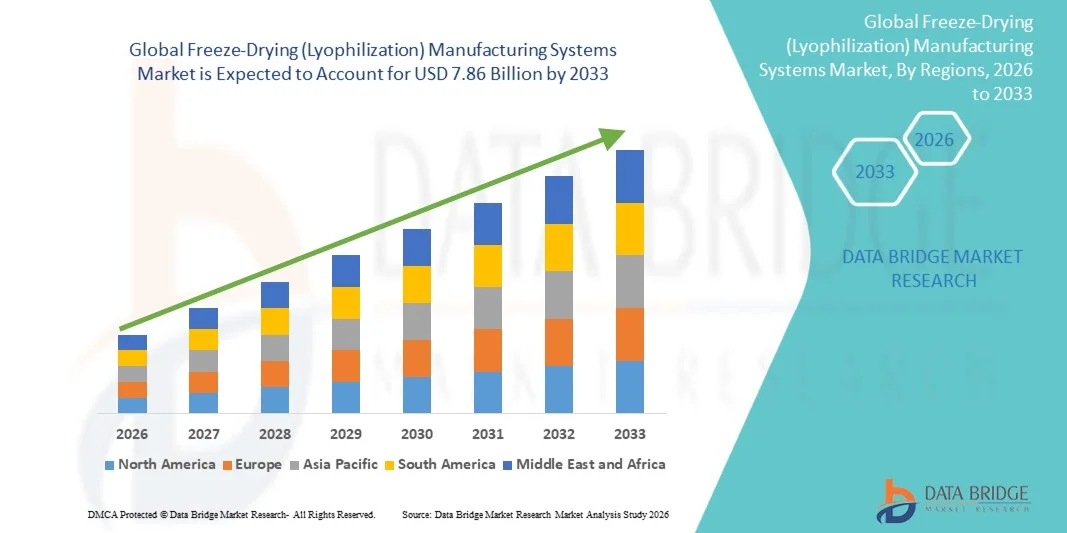
As per Data Bridge Market Research analysis The Freeze-Drying (Lyophilization) Manufacturing Systems Market was valued at USD 2.68 billion in 2025 and is projected to reach USD 7.86 billion by 2033, growing at a CAGR of 14.40% from 2026 to 2033. The market is experiencing steady growth driven by increasing demand for biologics, vaccines, and injectable pharmaceuticals, continuous advancements in lyophilization technologies, and expanding investments in pharmaceutical and biotechnology manufacturing infrastructure.
The growing need to enhance product stability, extend shelf life, and preserve the efficacy of temperature-sensitive drugs is encouraging pharmaceutical companies, contract manufacturing organizations (CMOs/CDMOs), and biotechnology firms to adopt advanced freeze-drying systems. Automated and continuous lyophilization platforms are increasingly replacing conventional batch processes in many facilities, offering improved process efficiency, higher production scalability, and compliance with stringent regulatory requirements for sterile drug manufacturing.
Key Market Trends & Insights
- North America dominated the Freeze-Drying (Lyophilization) Manufacturing Systems Market with the largest revenue share of 38.46% in 2025, supported by a strong biopharmaceutical manufacturing base, high adoption of advanced lyophilization technologies, and substantial investments in drug production infrastructure.
- The Industrial-Scale Freeze-Drying Systems segment led the market with a 48.62% share in 2025, driven by increasing commercial production of biologics, vaccines, injectable drugs, and high-value pharmaceutical products
- Asia-Pacific is expected to be the fastest-growing region at a CAGR of 8.1% from 2026 to 2033, fueled by expanding pharmaceutical manufacturing capabilities, rising biologics production, and growing healthcare investments across China, India, South Korea, and Japan.
- Pilot-Scale Freeze-Drying Systems are the fastest-growing product type, projected to register a CAGR of 8.3%, reflecting the surge in investments in drug development, clinical trials, and process optimization activities.
- The Fully Automatic Systems segment dominated the automation level category with a 61.24% revenue share in 2025, led by increasing demand for process consistency, regulatory compliance, and contamination control in pharmaceutical manufacturing.
- Pharmaceutical & Biotechnology Manufacturing accounted for 52.37% of the market, preferred by widespread use of lyophilization for vaccines, biologics, injectable drugs, and monoclonal antibodies.
- The Research & Development segment is the fastest-growing application category, with a CAGR of 8.5%, driven by increasing pharmaceutical innovation and expanding biologics development pipelines
Market Size & Forecast
- Global Market Value (2025): USD 2.68 Billion
- Expected Market Value (2033): USD 7.86 Billion
- Forecast CAGR (2026–2033): 14.40%
- Leading Region in 2025: North America
- Fastest Growing Region: Asia Pacific
Report Scope and Freeze-Drying (Lyophilization) Manufacturing Systems Market Segmentation
|
Attributes |
Freeze-Drying (Lyophilization) Manufacturing Systems Key Market Insights |
|
Segments Covered |
|
|
Countries Covered |
North America · U.S. · Canada · Mexico Europe · Germany · France · U.K. · Netherlands · Switzerland · Belgium · Russia · Italy · Spain · Turkey · Rest of Europe Asia-Pacific · China · Japan · India · South Korea · Singapore · Malaysia · Australia · Thailand · Indonesia · Philippines · Rest of Asia-Pacific Middle East and Africa · Saudi Arabia · U.A.E. · South Africa · Egypt · Israel · Rest of Middle East and Africa South America · Brazil · Argentina · Rest of South America |
|
Key Market Players |
· GEA Group Aktiengesellschaft (Germany) · IMA S.p.A. (Italy) · Tofflon Science and Technology Group Co., Ltd. (China) · Syntegon Technology GmbH (Germany) · Azbil Telstar, S.L.U. (Spain) · SP Industries, Inc. (U.S.) · Labconco Corporation (U.S.) · Millrock Technology, Inc. (U.S.) · OPTIMA packaging group GmbH (Germany) · HOF Sonderanlagenbau GmbH (Germany) · Martin Christ Gefriertrocknungsanlagen GmbH (Germany) · Zirbus technology GmbH (Germany) · Cuddon Freeze Dry (New Zealand) · MechaTech Systems Ltd (U.K.) · Hosokawa Micron B.V. (Netherlands) · PIGO S.r.l. (Italy) · Lyophilization Systems India Pvt. Ltd. (India) · Bionics Scientific Technologies (P) Ltd. (India) · Shanghai Tofflon Science and Technology Co., Ltd. (China) · Cryotec Anlagenbau GmbH (Germany) |
|
Market Opportunities |
· Expansion of biologics and cell & gene therapy pipelines · Growing adoption of continuous freeze-drying technology · Increasing pharmaceutical manufacturing investments in emerging markets |
|
Value Added Data Infosets |
In addition to the insights on market scenarios such as market value, growth rate, segmentation, geographical coverage, and major players, the market reports curated by the Data Bridge Market Research also include in-depth expert analysis, patient epidemiology, pipeline analysis, pricing analysis, and regulatory framework. |
Freeze-Drying (Lyophilization) Manufacturing Systems Market Trends
Trend: Rising Adoption of Continuous Lyophilization Technologies
Pharmaceutical manufacturers are increasingly adopting continuous freeze-drying systems to improve production efficiency, reduce cycle times, and enhance process consistency while maintaining stringent product quality standards. The integration of advanced automation, process analytical technologies, and real-time monitoring enables precise control of critical parameters throughout the drying process. Biopharmaceutical companies and CDMOs are similarly investing in continuous platforms to support growing biologics production volumes through scalable, data-driven manufacturing approaches, while modern system designs create optimized processing environments that closely align with regulatory and operational requirements.
For instance, in June 2024, SP Industries expanded its lyophilization technology portfolio with advanced automated solutions designed to improve throughput, process control, and manufacturing efficiency for pharmaceutical applications.
Freeze-Drying (Lyophilization) Manufacturing Systems Market Dynamics
Key Market Driver: Growing Demand for Biologics and Temperature-Sensitive Pharmaceuticals
The rapid expansion of biologics, vaccines, and injectable therapeutics has created substantial demand for advanced freeze-drying systems that can preserve product stability, efficacy, and shelf life across global distribution networks. Pharmaceutical manufacturers, biotechnology companies, and CDMOs are deploying lyophilization systems as a core component of their production infrastructure, reducing product degradation risks, supporting regulatory compliance, and improving supply chain flexibility. The increasing commercialization of monoclonal antibodies, recombinant proteins, and novel biologic therapies continues to accelerate investments in high-capacity manufacturing systems worldwide.
For instance, in February 2024, GEA Group introduced enhanced pharmaceutical lyophilization solutions focused on supporting large-scale biologics manufacturing and sterile drug production requirements.
Key Restraint/Challenge: High Capital and Operational Costs of Lyophilization Systems
A significant restraint in the global freeze-drying manufacturing systems market is the substantial upfront investment required for advanced lyophilization equipment. Modern systems integrate sophisticated vacuum technologies, automated loading mechanisms, sterile processing environments, and advanced control platforms, demanding considerable expenditure for acquisition, installation, and facility validation. The total cost of ownership extends to energy consumption, maintenance requirements, process optimization, and regulatory qualification activities, making adoption challenging for smaller pharmaceutical manufacturers, research organizations, and emerging-market producers.
For instance, in September 2024, several pharmaceutical facility expansion projects highlighted the considerable capital expenditure associated with installing commercial-scale lyophilization lines, reflecting the broader challenge of market entry and capacity expansion for budget-constrained organizations.
Key Market Opportunity: Expansion of Cell and Gene Therapy Manufacturing Infrastructure
The expansion of cell and gene therapy development presents a significant market opportunity. Advanced lyophilization platforms can improve product stability, facilitate long-term storage, and support global distribution of highly sensitive therapeutic products. The development of automated aseptic processing technologies and next-generation continuous freeze-drying systems is further enhancing manufacturing capabilities, opening growth opportunities across emerging biopharmaceutical hubs in Asia-Pacific, Latin America, and the Middle East.
For instance, in May 2024, Syntegon expanded its pharmaceutical processing portfolio with technologies aimed at supporting advanced biologics and next-generation therapy manufacturing requirements.
Freeze-Drying (Lyophilization) Manufacturing Systems Market Scope
The freeze-drying (lyophilization) manufacturing systems market is segmented on the basis of product type, automation level, application, and end user.
- By Product Type
On the basis of product type, the Freeze-Drying (Lyophilization) Manufacturing Systems Market is segmented into industrial-scale freeze-drying systems, pilot-scale freeze-drying systems, and laboratory-scale freeze-drying systems. The Industrial-Scale Freeze-Drying Systems segment dominated the market with a 48.62% share in 2025, driven by increasing commercial production of biologics, vaccines, injectable drugs, and high-value pharmaceutical products. These systems offer large batch capacities and high throughput, making them suitable for large-scale manufacturing facilities. Pharmaceutical companies are investing heavily in industrial lyophilizers to support growing global demand for temperature-sensitive therapeutics. The segment also benefits from advancements in automation, process control, and energy efficiency. Regulatory requirements for product stability and sterility further encourage adoption. Its ability to support continuous commercial manufacturing makes it the leading segment globally.
The Pilot-Scale Freeze-Drying Systems segment is projected to register the fastest growth at a CAGR of 8.3% from 2026 to 2033, driven by rising investments in drug development, clinical trials, and process optimization activities. These systems enable manufacturers to evaluate formulations and scale-up processes before commercial production. Growing biologics and cell therapy pipelines are increasing demand for flexible pilot-scale equipment. Pharmaceutical and biotechnology companies are utilizing these systems to reduce development risks and accelerate product launches. Their ability to simulate commercial manufacturing conditions while maintaining lower operating costs supports adoption. Expanding research activities and innovation in pharmaceutical formulations are further contributing to segment growth.
- By Automation Level
On the basis of automation level, the Freeze-Drying (Lyophilization) Manufacturing Systems Market is segmented into manual systems, semi-automatic systems, and fully automatic systems. The Fully Automatic Systems segment dominated the market with a 61.24% share in 2025, driven by increasing demand for process consistency, regulatory compliance, and contamination control in pharmaceutical manufacturing. These systems minimize human intervention and improve operational efficiency through advanced monitoring and control capabilities. Automated loading and unloading functions help reduce production downtime and labor costs. Pharmaceutical manufacturers prefer these solutions to meet stringent GMP and aseptic processing requirements. The integration of digital controls and real-time analytics further enhances productivity. Growing investments in smart manufacturing facilities continue to strengthen segment dominance.
The Fully Automatic Systems segment is also expected to witness the fastest growth at a CAGR of 8.0% from 2026 to 2033, supported by rapid adoption of Industry 4.0 technologies across pharmaceutical production facilities. Companies are increasingly implementing automated lyophilization systems to improve batch reproducibility and product quality. The need for higher throughput and reduced operational errors is accelerating deployment. Advanced automation also supports data integrity and regulatory documentation requirements. Rising demand for biologics manufacturing is creating opportunities for highly automated production environments. Continuous technological advancements are expected to sustain strong growth throughout the forecast period.
- By Application
On the basis of application, the Freeze-Drying (Lyophilization) Manufacturing Systems Market is segmented into pharmaceutical & biotechnology manufacturing, food & beverage processing, nutraceutical manufacturing, chemical processing, and research & development. The Pharmaceutical & Biotechnology Manufacturing segment dominated the market with a 52.37% share in 2025, driven by widespread use of lyophilization for vaccines, biologics, injectable drugs, and monoclonal antibodies. Freeze-drying plays a critical role in preserving product stability, potency, and shelf life. Growing global demand for advanced therapeutics continues to increase utilization of commercial lyophilization systems. Regulatory emphasis on product quality and sterility further supports adoption. Pharmaceutical companies are investing significantly in capacity expansion and manufacturing modernization. The segment remains the largest contributor to overall market revenue.
The Research & Development segment is projected to register the fastest growth at a CAGR of 8.5% from 2026 to 2033, driven by increasing pharmaceutical innovation and expanding biologics development pipelines. Research institutions and biotechnology companies are utilizing lyophilization systems to develop novel formulations and optimize manufacturing processes. Growing investments in cell and gene therapies are creating new opportunities for advanced freeze-drying technologies. The segment benefits from rising clinical trial activities and formulation research programs. Demand for pilot-scale and laboratory-scale systems is also increasing within R&D facilities. Continuous innovation in pharmaceutical sciences is expected to accelerate segment expansion.
- By End User
On the basis of end user, the Freeze-Drying (Lyophilization) Manufacturing Systems Market is segmented into pharmaceutical companies, biotechnology companies, contract manufacturing organizations, research institutes & academic laboratories, and food processing companies. The Pharmaceutical Companies segment dominated the market with a 46.18% share in 2025, driven by extensive deployment of lyophilization systems for commercial drug production. These organizations require large-scale freeze-drying capacity to manufacture sterile injectable products and biologics. Increasing prevalence of chronic diseases and growing demand for advanced therapeutics are supporting equipment investments. Pharmaceutical manufacturers are also expanding production facilities to strengthen global supply chains. Regulatory requirements related to product stability further increase adoption. Their substantial capital expenditure capabilities contribute significantly to segment leadership.
The Contract Manufacturing Organizations (CMOs/CDMOs) segment is expected to witness the fastest growth at a CAGR of 8.7% from 2026 to 2033, driven by increasing outsourcing of pharmaceutical manufacturing activities. Drug developers are partnering with specialized manufacturing providers to reduce costs and accelerate time-to-market. CMOs and CDMOs are investing in advanced lyophilization infrastructure to meet growing demand for biologics and sterile products. Their ability to provide flexible manufacturing capacity makes them attractive partners for pharmaceutical and biotechnology companies. Expansion of global outsourcing trends is creating significant opportunities for service providers. Rising demand for end-to-end development and manufacturing solutions is expected to drive sustained segment growth.
Freeze-Drying (Lyophilization) Manufacturing Systems Market Regional Analysis
North America dominated the Freeze-Drying (Lyophilization) Manufacturing Systems Market with the largest revenue share of 38.46% in 2025, supported by a strong biopharmaceutical manufacturing base, high adoption of advanced lyophilization technologies, and substantial investments in drug production infrastructure. The region also benefits from stringent regulatory standards, high adoption of automated lyophilization systems, and growing utilization of freeze-drying technologies across biologics, vaccines, and sterile injectable manufacturing applications. Increasing focus on biologic drug development, capacity expansion projects, and next-generation pharmaceutical manufacturing continues to strengthen North America's leadership position in the global market.
U.S. Freeze-Drying (Lyophilization) Manufacturing Systems Market Insight
The U.S. freeze-drying (lyophilization) manufacturing systems market is witnessing strong growth due to rising investments in biologics production, vaccine manufacturing, and advanced pharmaceutical processing technologies. The country’s mature pharmaceutical and biotechnology ecosystem, along with increasing adoption of automated, continuous, and digitally connected lyophilization systems, is driving demand across commercial manufacturing and research applications. In addition, growing emphasis on drug stability, sterile manufacturing standards, and expansion of biopharmaceutical production capacity is accelerating lyophilization system adoption across pharmaceutical companies and contract manufacturing organizations.
Europe Freeze-Drying (Lyophilization) Manufacturing Systems Market Insight
The Europe freeze-drying (lyophilization) manufacturing systems market remains a major contributor to global revenue, driven by strong pharmaceutical manufacturing capabilities, technological innovation, and high demand for advanced drug preservation solutions. The widespread use of commercial-scale lyophilization systems in biologics production, vaccine manufacturing, and research activities is supporting market expansion across the region. Increasing investments in automated processing technologies, coupled with strict regulatory requirements and a highly developed healthcare industry, continue to enhance the adoption of freeze-drying systems throughout Europe.
U.K. Freeze-Drying (Lyophilization) Manufacturing Systems Market Insight
The U.K. freeze-drying (lyophilization) manufacturing systems market is experiencing steady growth, supported by rising adoption of advanced pharmaceutical manufacturing technologies, biologics development activities, and contract manufacturing services. Increasing investments in lyophilization infrastructure and growing demand for efficient, compliant, and scalable drug production solutions are contributing to market growth. Furthermore, integration of automation, digital monitoring, and process analytical technologies is improving manufacturing efficiency and product quality, positioning the U.K. as a key innovation hub in the lyophilization systems industry.
Germany Freeze-Drying (Lyophilization) Manufacturing Systems Market Insight
The Germany freeze-drying (lyophilization) manufacturing systems market is expanding steadily due to the country’s strong pharmaceutical manufacturing base, advanced engineering capabilities, and increasing adoption of next-generation processing technologies. Pharmaceutical companies, biotechnology firms, and research institutions are increasingly utilizing lyophilization systems for biologics production, formulation development, and commercial drug manufacturing activities. Continuous advancements in automation, aseptic processing, and process control technologies, along with strong government support for pharmaceutical innovation, are further driving market growth in Germany.
Asia-Pacific Freeze-Drying (Lyophilization) Manufacturing Systems Market Insight
The Asia-Pacific freeze-drying (lyophilization) manufacturing systems market is expected to witness rapid growth, driven by expanding pharmaceutical production, increasing biologics manufacturing, and rising investments in healthcare infrastructure across countries such as China, India, and Japan. Growing awareness regarding drug stability, rising adoption of advanced freeze-drying technologies, and increasing demand for scalable and cost-effective manufacturing solutions are supporting regional market expansion. In addition, the growing presence of pharmaceutical production facilities and biotechnology research centers is accelerating lyophilization system adoption across commercial and academic sectors.
Japan Freeze-Drying (Lyophilization) Manufacturing Systems Market Insight
The Japan freeze-drying (lyophilization) manufacturing systems market is witnessing consistent growth due to rising investments in advanced pharmaceutical processing technologies, biologics development, and healthcare innovation initiatives. Pharmaceutical manufacturers, biotechnology companies, and research institutes are increasingly adopting high-performance lyophilization systems for drug preservation, formulation development, and manufacturing optimization purposes. Moreover, increasing integration of automation technologies and the country’s focus on high-quality pharmaceutical production are further contributing to market growth.
China Freeze-Drying (Lyophilization) Manufacturing Systems Market Insight
The China freeze-drying (lyophilization) manufacturing systems market is growing rapidly, driven by expanding pharmaceutical manufacturing capacity, increasing biotechnology investments, and rising government focus on healthcare modernization. Growing adoption of automated and high-capacity lyophilization platforms across pharmaceutical, biotechnology, and research sectors is significantly boosting market demand. In addition, rising investments in biologics production, increasing emphasis on pharmaceutical self-sufficiency, and rapid technological advancements are positioning China as one of the fastest-growing markets for freeze-drying manufacturing systems globally.
Freeze-Drying (Lyophilization) Manufacturing Systems Market Share
The freeze-drying (lyophilization) manufacturing systems industry is primarily led by well-established companies, including:
- GEA Group Aktiengesellschaft (Germany)
- IMA S.p.A. (Italy)
- Tofflon Science and Technology Group Co., Ltd. (China)
- Syntegon Technology GmbH (Germany)
- Azbil Telstar, S.L.U. (Spain)
- SP Industries, Inc. (U.S.)
- Labconco Corporation (U.S.)
- Millrock Technology, Inc. (U.S.)
- OPTIMA packaging group GmbH (Germany)
- HOF Sonderanlagenbau GmbH (Germany)
- Martin Christ Gefriertrocknungsanlagen GmbH (Germany)
- Zirbus technology GmbH (Germany)
- Cuddon Freeze Dry (New Zealand)
- MechaTech Systems Ltd (U.K.)
- Hosokawa Micron B.V. (Netherlands)
- PIGO S.r.l. (Italy)
- Lyophilization Systems India Pvt. Ltd. (India)
- Bionics Scientific Technologies (P) Ltd. (India)
- Shanghai Tofflon Science and Technology Co., Ltd. (China)
- Cryotec Anlagenbau GmbH (Germany)
Latest Developments in Freeze-Drying (Lyophilization) Manufacturing Systems Market
- In July 2025, GEA officially opened its new Pharmaceutical Technology Center for Freeze Drying in Elsdorf, Germany, following an investment of more than EUR 80 million. The new facility significantly expands GEA's manufacturing capacity for pharmaceutical freeze-drying systems while integrating research, production, and customer support under one roof to address rising global demand for biologics, vaccines, and sterile injectable manufacturing equipment
- In June 2024, GEA introduced new enhancements to its LYOVAC® pharmaceutical freeze-drying technology at ACHEMA 2024, including the LYOVAC® ECO Mode, which optimizes condenser temperature control and valve regulation to reduce energy consumption without compromising product quality. The development reinforces GEA's focus on sustainable and energy-efficient pharmaceutical lyophilization systems
- In June 2024, Syntegon showcased its expanded pharmaceutical processing technologies at ACHEMA 2024, highlighting integrated, modular bioprocessing solutions designed to streamline biologics manufacturing and complement downstream operations, including freeze-drying and sterile fill-finish processes. The development supports increasing demand for end-to-end pharmaceutical manufacturing solutions for biologics production
- In July 2021, SP Industries expanded its pharmaceutical lyophilization portfolio by launching two fully GMP-compliant freeze-dryer loading systems compatible with its SP Hull LyoConstellation® production freeze dryers. The automated loading solutions were developed to improve aseptic processing, reduce contamination risk, and increase manufacturing efficiency for pharmaceutical freeze-drying operations
- In June 2021, SP Industries announced the launch of the SP Hull LyoStar® 4.0 R&D Freeze Dryer, designed to accelerate biologics and pharmaceutical drug development through enhanced process analytical technologies, improved shelf mapping, rapid freezing capability, and easier scale-up from laboratory to commercial manufacturing. The launch strengthened SP Industries' portfolio of advanced lyophilization systems for pharmaceutical manufacturers

- Interactive Data Analysis Dashboard
- Company Analysis Dashboard for high growth potential opportunities
- Research Analyst Access for customization & queries
- Competitor Analysis with Interactive dashboard
- Latest News, Updates & Trend analysis
- Harness the Power of Benchmark Analysis for Comprehensive Competitor Tracking
Data collection and base year analysis are done using data collection modules with large sample sizes. The stage includes obtaining market information or related data through various sources and strategies. It includes examining and planning all the data acquired from the past in advance. It likewise envelops the examination of information inconsistencies seen across different information sources. The market data is analysed and estimated using market statistical and coherent models. Also, market share analysis and key trend analysis are the major success factors in the market report. To know more, please request an analyst call or drop down your inquiry.
The key research methodology used by DBMR research team is data triangulation which involves data mining, analysis of the impact of data variables on the market and primary (industry expert) validation. Data models include Vendor Positioning Grid, Market Time Line Analysis, Market Overview and Guide, Company Positioning Grid, Patent Analysis, Pricing Analysis, Company Market Share Analysis, Standards of Measurement, Global versus Regional and Vendor Share Analysis. To know more about the research methodology, drop in an inquiry to speak to our industry experts.
Data Bridge Market Research is a leader in advanced formative research. We take pride in servicing our existing and new customers with data and analysis that match and suits their goal. The report can be customized to include price trend analysis of target brands understanding the market for additional countries (ask for the list of countries), clinical trial results data, literature review, refurbished market and product base analysis. Market analysis of target competitors can be analyzed from technology-based analysis to market portfolio strategies. We can add as many competitors that you require data about in the format and data style you are looking for. Our team of analysts can also provide you data in crude raw excel files pivot tables (Fact book) or can assist you in creating presentations from the data sets available in the report.













