


Friction Materials Market Size
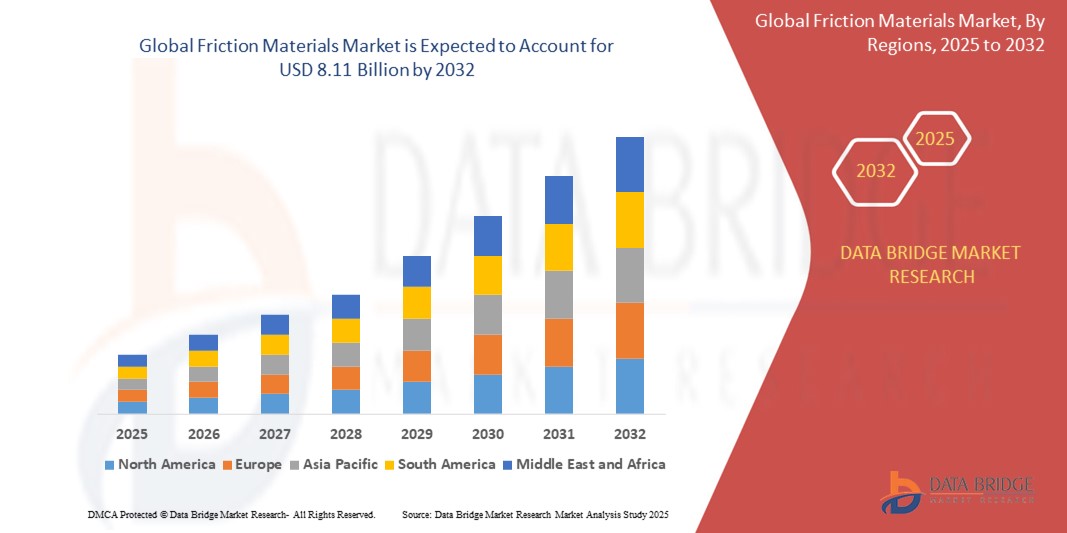
- The Global Friction Materials Market size was valued at USD 5.32 Billion in 2024 and is expected to reach USD 8.11 Billion by 2032, at a CAGR of4.8% during the forecast period
- This growth is driven by factors such as increase in demand for processed food across the globe
Friction Materials Market Analysis
- Friction materials are also termed as brake or clutch materials. They are usually applied to halt or decrease the speed of a vehicle by the process of changing kinetic into thermal energy with the help of friction.
- The materials are present with a rough texture that help in reduction of stopping distance and time when the brakes are applied. The focus is also on weight reduction of friction materials and brake.
- These friction materials can withstand high wear and tear along with high temperature which acts as the vital factor escalating the market growth
- Asia-Pacific is expected to dominate the Friction Materials market due to rising consumer demand for passenger and commercial vehicles, supported by favourable government policies and foreign investments in local manufacturing
- North America is expected to be the fastest growing region in the Friction Materials market during the forecast period due to increasing demand for electric vehicles (EVs), stringent safety regulations, and a rebound in automotive production post-COVID-19
- The enzymes and preservatives segment is expected to dominate the market with a market share of 56.22% due to the critical role of additives in maintaining freshness and preventing microbial spoilage in frozen products.
Report Scope and Friction Materials Market Segmentation
|
Attributes |
Friction Materials Key Market Insights |
|
Segments Covered |
|
|
Countries Covered |
North America
Europe
Asia-Pacific
Middle East and Africa
South America
|
|
Key Market Players |
|
|
Market Opportunities |
|
|
Value Added Data Infosets |
In addition to the insights on market scenarios such as market value, growth rate, segmentation, geographical coverage, and major players, the market reports curated by the Data Bridge Market Research also include import export analysis, production capacity overview, production consumption analysis, price trend analysis, climate change scenario, supply chain analysis, value chain analysis, raw material/consumables overview, vendor selection criteria, PESTLE Analysis, Porter Analysis, and regulatory framework. |
Friction Materials Market Trends
“Shift Toward Copper-Free and Eco-Friendly Brake Materials”
- One prominent trend in the Friction Materials market is the increasing shift toward copper-free and environmentally friendly brake materials due to stricter environmental regulations and sustainability goals
- Manufacturers are developing non-asbestos organic (NAO) and low-metallic friction materials that reduce particulate emissions without compromising braking performance
- For instance, Akebono Brake Corporation has expanded its range of copper-free brake pads that meet U.S. Environmental Protection Agency (EPA) guidelines aimed at reducing copper runoff from roadways.
- Growing awareness of environmental impact, coupled with global regulatory mandates such as the “Better Brakes Rule” in the U.S., continues to push the adoption of alternative raw materials and innovative formulations
Friction Materials Market Dynamics
Driver
“Expansion of Automotive and Railway Industries in Emerging Markets”
- Rapid urbanization and industrialization in emerging economies are fueling the expansion of the automotive and railway sectors, significantly boosting the demand for friction materials in braking systems
- Increased vehicle production, rising demand for public transportation, and infrastructure development in countries like India, China, and Brazil contribute to this growth
For instance,
- According to the International Organization of Motor Vehicle Manufacturers (OICA), India’s vehicle production grew by over 20% in 2023, driving demand for both OEM and aftermarket friction components.
- The growing mobility needs and investment in transport infrastructure across Asia-Pacific and South America are expected to sustain long-term demand for reliable and high-performance friction solutions
Opportunity
“Advancements in Lightweight and High-Performance Composite Materials”
- Rising demand for fuel efficiency and reduced vehicle weight is creating opportunities for the development of lightweight friction materials that maintain performance under high thermal stress
- Composite formulations using advanced fibers, ceramics, and resins are being designed to reduce wear, noise, and environmental impact
For instance,
- In 2024, Federal-Mogul introduced a next-generation lightweight brake lining that delivers improved friction stability and extended life for commercial vehicles.
- These innovations enable manufacturers to address both performance and regulatory requirements while differentiating their offerings in the competitive market.
Restraint/Challenge
“Volatility in Raw Material Prices and Supply Chain Disruptions”
- The friction materials industry faces challenges from fluctuating prices of key raw materials such as aramid fibers, phenolic resins, and metals, which impact cost stability and profitability.
- Global supply chain disruptions, particularly post-pandemic, have led to shortages and longer lead times, affecting timely production and delivery
For instance,
-
The European Brake Association reported in 2023 that delays in the supply of synthetic fibers caused production halts for several friction material manufacturers in Germany and Italy
-
Such disruptions and price volatility increase operational risks for companies, particularly those with limited sourcing flexibility or dependence on imports, thereby hindering consistent market supply and product availability
Friction Materials Market Scope
The market is segmented on the basis of product, business type, application, and end-use industry.
|
Segmentation |
Sub-Segmentation |
|
By Product |
|
|
By Business Type |
|
|
By Application |
|
|
By End-Use Industry |
|
In 2025, the automotive segment is projected to dominate the market with a largest share in application segment
The automotive segment is expected to dominate the Friction Materials market with the largest share of 41.2% in 2025 due to the high demand for brake pads, clutches, and transmissions in both passenger and commercial vehicles. The rapid growth in vehicle production, especially in emerging economies, along with increasing safety standards and rising replacement rates in the aftermarket, further support the segment’s leadership.
The railway segment is expected to account for the highest CAGR during the forecast period in application market
In 2025, the railway segment is expected to dominate the market with the largest market share of 17.6% due to increasing investments in rail infrastructure, urban metro expansions, and high-speed rail projects globally.
Friction Materials Market Regional Analysis
“Asia-Pacific Holds the Largest Share in the Friction Materials Market”
-
Asia-Pacific dominates the Friction Materials market with a share of 35.67%, driven by high vehicle production, rapid industrialization, and expanding railway and construction sectors
- The China accounts for the largest share due to strong OEM and aftermarket presence, growing infrastructure development, and increased adoption of friction components in automotive and heavy machinery
- Rising consumer demand for passenger and commercial vehicles, supported by favourable government policies and foreign investments in local manufacturing, further boosts regional market growth.
- Additionally, the presence of major brake system manufacturers and competitive labour costs contribute to the dominance of Asia-Pacific in the global friction materials supply chain
“North America is Projected to Register the Highest CAGR in the Friction Materials Market”
- North America region is expected to experience the fastest growth in the Friction Materials market, fuelled by increasing demand for electric vehicles (EVs), stringent safety regulations, and a rebound in automotive production post-COVID-19
- The U.S. leads in technology innovation for copper-free and low-metallic friction materials, aligned with strict EPA environmental regulations such as the “Better Brakes Rule.”
- Continued investments in defense, aerospace, and rail infrastructure, combined with the growing preference for performance-oriented and sustainable friction solutions, are driving the market forward.
- Furthermore, the region benefits from strong R&D capabilities, robust aftermarket networks, and rising adoption of lightweight and advanced composite friction materials for improved energy efficiency and safety
Friction Materials Market Share
The market competitive landscape provides details by competitor. Details included are company overview, company financials, revenue generated, market potential, investment in research and development, new market initiatives, global presence, production sites and facilities, production capacities, company strengths and weaknesses, product launch, product width and breadth, application dominance. The above data points provided are only related to the companies' focus related to market.
The Major Market Leaders Operating in the Market Are:
- AKEBONO BRAKE INDUSTRY CO. LTD. (Japan)
- Tenneco Inc (U.S.)
- Miba AG (Austria)
- Fras-le (Brazil)
- Nisshinbo Holdings Inc. (Japan)
- AISIN SEIKI Co. Ltd. (Japan)
- ANAND Group (India)
- Carlisle Brake & Friction (U.S.)
- Robert Bosch GmbH (Germany)
- ABS Friction (Canada)
- Knorr-Bremse AG (Germany)
- Brembo (Italy)
- BREMSKERL REIBBELAGWERKE Emmerling GmbH & CO. KG (Germany)
- ITT INC. (U.S.)
- General Aviation Manufacturers Association (U.S.)
- ICER BRAKES (Spain)
- Japan Brake Industrial Co. Ltd. (Japan)
- LUMAG GmbH (Germany)
- Trimat Limited (U.K.)
- ZF Friedrichshafen AG (Germany)
Latest Developments in Global Friction Materials Market
-
In August 2023, Nisshinbo Holdings divested TMD Friction Group—a company specializing in brake friction solutions—to AEQUITA SE & Co. KGaA, a subsidiary of an industrial group.
- In February 2022, Brakes India introduced ‘Elite,’ a high-performance friction brake pad line under the TVS Apache brand, signaling how new product launches are contributing to the growth of the friction materials market.
- In January 2022, Wabtec Corporation, a global supplier of equipment, acquired the railway friction materials division of Masu Brakes India. This acquisition aims to reinforce Wabtec’s leading position in the railway friction sector.
- In April 2021, Carlisle Brake & Friction, based in the U.S., developed a new generation of friction material to grow its presence in the off-highway brake disc and transmission segment, with additional focus on aerospace and military applications efficiency
- In November 2020, Brembo SpA entered into an agreement to acquire 100% ownership of SBS Friction AS, a producer of sintered and organic brake pads for motorcycles. The deal, aimed at strengthening Brembo’s product portfolio, was expected to be finalized by the first quarter of 2021

- Interactive Data Analysis Dashboard
- Company Analysis Dashboard for high growth potential opportunities
- Research Analyst Access for customization & queries
- Competitor Analysis with Interactive dashboard
- Latest News, Updates & Trend analysis
- Harness the Power of Benchmark Analysis for Comprehensive Competitor Tracking
Global Friction Materials Market, Supply Chain Analysis and Ecosystem Framework
To support market growth and help clients navigate the impact of geopolitical shifts, DBMR has integrated in-depth supply chain analysis into its Global Friction Materials Market research reports. This addition empowers clients to respond effectively to global changes affecting their industries. The supply chain analysis section includes detailed insights such as Global Friction Materials Market consumption and production by country, price trend analysis, the impact of tariffs and geopolitical developments, and import and export trends by country and HSN code. It also highlights major suppliers with data on production capacity and company profiles, as well as key importers and exporters. In addition to research, DBMR offers specialized supply chain consulting services backed by over a decade of experience, providing solutions like supplier discovery, supplier risk assessment, price trend analysis, impact evaluation of inflation and trade route changes, and comprehensive market trend analysis.
Data collection and base year analysis are done using data collection modules with large sample sizes. The stage includes obtaining market information or related data through various sources and strategies. It includes examining and planning all the data acquired from the past in advance. It likewise envelops the examination of information inconsistencies seen across different information sources. The market data is analysed and estimated using market statistical and coherent models. Also, market share analysis and key trend analysis are the major success factors in the market report. To know more, please request an analyst call or drop down your inquiry.
The key research methodology used by DBMR research team is data triangulation which involves data mining, analysis of the impact of data variables on the market and primary (industry expert) validation. Data models include Vendor Positioning Grid, Market Time Line Analysis, Market Overview and Guide, Company Positioning Grid, Patent Analysis, Pricing Analysis, Company Market Share Analysis, Standards of Measurement, Global versus Regional and Vendor Share Analysis. To know more about the research methodology, drop in an inquiry to speak to our industry experts.
Data Bridge Market Research is a leader in advanced formative research. We take pride in servicing our existing and new customers with data and analysis that match and suits their goal. The report can be customized to include price trend analysis of target brands understanding the market for additional countries (ask for the list of countries), clinical trial results data, literature review, refurbished market and product base analysis. Market analysis of target competitors can be analyzed from technology-based analysis to market portfolio strategies. We can add as many competitors that you require data about in the format and data style you are looking for. Our team of analysts can also provide you data in crude raw excel files pivot tables (Fact book) or can assist you in creating presentations from the data sets available in the report.













