


Front and Rear Air-Conditioning (AC) Thermal Systems Market Overview
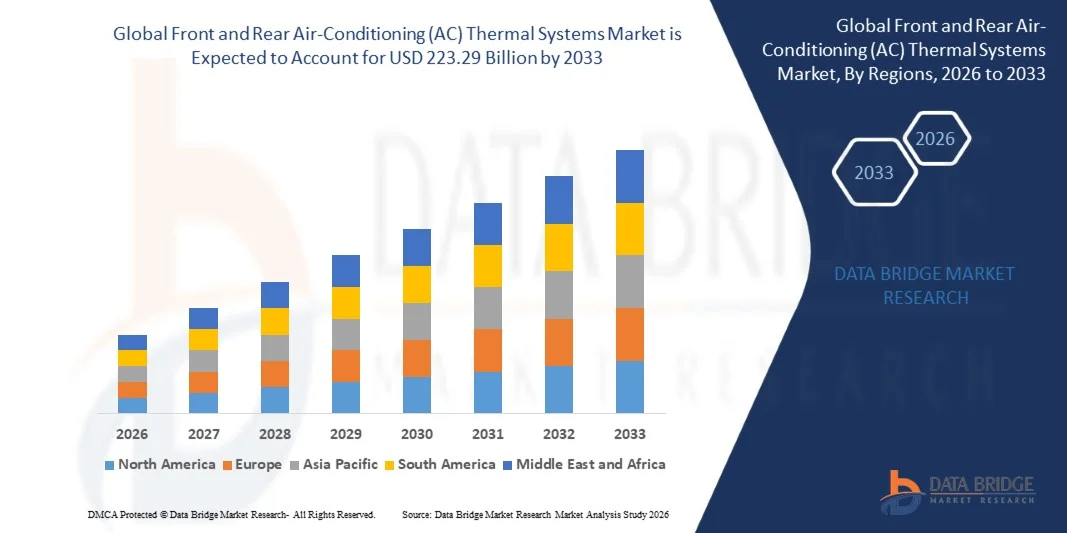
As per Data Bridge Market Research Analysis the front and rear air-conditioning (AC) thermal systems market was valued at USD 138 billion in 2025 and is projected to reach USD 223.29 billion by 2033, growing at a CAGR of 6.2% from 2026 to 2033. The market is experiencing steady growth driven by rising preference for luxury and comfort features in vehicles, increasing adoption of advanced thermal management technologies, and growing government initiatives around emission regulations such as BS-VI norms.
The rising demand for electric vehicles, coupled with increasing R&D activities in thermal management systems for batteries, power electronics, and passenger cabin comfort, is further propelling market growth. Automotive thermal management systems help reduce fuel consumption, recover waste heat, and improve overall vehicle efficiency, making them a critical component in both ICE and electric vehicle platforms.
Market Size & Forecast
- Global Market Value (2025): USD 138 Billion
- Expected Market Value (2033): USD 223.29 Billion
- Forecast CAGR (2026–2033): 6.2%
- Leading Region in 2025: Asia-Pacific
- Fastest Growing Region: Asia-Pacific
Key Market Trends & Insights
- Asia Pacific dominated the global market, holding the largest revenue share of approximately 59.69% in 2025. This dominance is supported by massive vehicle production volumes, robust automotive manufacturing infrastructure, and early, large-scale adoption of thermal management solutions across China, Japan, South Korea, and India. [MA2]
- Asia Pacific is also expected to be the fastest-growing region, projected to grow at an approximate CAGR of 7.5% to 8.2% over the forecast period. This rapid growth is heavily fueled by aggressive government incentives for electric vehicle (EV) production, surging demand for advanced cabin comfort features (including front and rear AC systems), and the rapid expansion of battery and thermal component supply chains across the region.
- The passenger car segment led the ICE Vehicle Type category, driven by rising consumer preference for enhanced cabin comfort and increasing integration of dual-zone front and rear climate control systems in mid-to-premium vehicle segments.
- The battery electric vehicle (BEV) segment is expected to be the fastest-growing Electric Vehicle Type, fuelled by the surging global shift toward electrification and the critical role of thermal systems in battery temperature regulation and range optimization.
- Reduced HVAC system loading is a key growth technology segment, supported by automakers' focus on improving energy efficiency and extending EV driving range through optimized climate-control power consumption.
- The compressor and condenser segments dominate the Component category, owing to their essential role in both conventional and electric vehicle AC thermal architectures, with Electric Compressor and Electric Water Pump emerging as high-growth sub-segments amid rising EV adoption.
- Growing demand for light commercial vehicles (LCVs) and trucks is contributing to segment expansion, driven by rising commercial fleet electrification and increasing focus on driver/passenger comfort in long-haul transportation.
- Increasing R&D investment in Thermoelectric Generators and Active Transmission Warm-Up technologies is expected to open new opportunities, as manufacturers seek to improve overall vehicle thermal efficiency while meeting stricter emission standards.
Report Scope and Front and Rear Air-Conditioning (AC) Thermal Systems Market Segmentation
|
Attributes |
Front and Rear Air-Conditioning (AC) Thermal Systems Key Market Insights |
|
Segments Covered |
|
|
Countries Covered |
North America
Europe
Asia-Pacific
Middle East and Africa
South America
|
|
Key Market Players |
|
|
Market Opportunities |
|
|
Value Added Data Infosets |
In addition to the market insights such as market value, growth rate, market segments, geographical coverage, market players, and market scenario, the market report curated by the Data Bridge Market Research team includes in-depth expert analysis, import/export analysis, pricing analysis, production consumption analysis, and pestle analysis. |
Front and Rear Air-Conditioning (AC) Thermal Systems Market Trends
Trend: Rising Integration of Thermal Systems in Electric and Hybrid Vehicle Architectures
Automakers are increasingly integrating front and rear AC thermal systems with battery thermal management modules in BEVs, HEVs, and PHEVs to optimize overall vehicle energy efficiency and extend driving range. This shift is being driven by OEMs seeking to reduce parasitic energy loss from cabin climate control, particularly in electric vehicles where HVAC loading directly impacts range performance. The growing adoption of 48V mild-hybrid architectures is also creating demand for compact, energy-efficient electric compressors and electric water pumps that can operate across both ICE-assist and electric-drive modes.
Front and Rear Air-Conditioning (AC) Thermal Systems Market Dynamics
Key Market Driver: Rising Preference for Luxury and Comfort Features Alongside Emission Regulation Compliance
The increasing consumer preference for luxury and comfort features in passenger vehicles is a primary driver of the front and rear AC thermal systems market. Simultaneously, growing government initiatives promoting emission regulation adoption, including BS-VI norms, are compelling automakers to integrate more efficient thermal management architectures. Rising disposable income, increasing urbanization, and surging demand for commercial vehicles are further propelling market growth, as thermal comfort features that were once premium-only are becoming standard across mid-range vehicle segments.
Key Restraint/Challenge: High System Cost and Lack of Standardization
A significant restraint in the global front and rear AC thermal systems market is the high cost associated with utilizing advanced thermal system technology, combined with a dearth of standardization across manufacturers and regions. The lack of awareness and shortage of skilled workforce needed to design, install, and maintain these increasingly complex thermal architectures pose additional challenges. Technological barriers, along with the lingering impact of COVID-19 on manufacturing and supply chain operations, continue to act as restraints on market growth.
Key Market Opportunity: Electrification-Driven Demand for Integrated Thermal Solutions
The upsurge in demand for electric vehicles, coupled with increasing R&D activity in thermal management systems, is creating substantial opportunities for market players. As the broader automotive thermal systems category grows from USD 49.79 billion in 2025 toward USD 72.60 billion by 2035, front and rear AC thermal system suppliers are well-positioned to capture value through integrated cabin and battery thermal solutions, particularly in fast-growing electric vehicle markets.
Front and Rear Air-Conditioning (AC) Thermal Systems Market Scope
The front and rear AC thermal systems market is segmented on the basis of ICE vehicle type, technology, electric vehicle type, and component.
- By ICE Vehicle Type
On the basis of ICE vehicle type, the global front and rear AC thermal systems market is segmented into passenger car, light commercial vehicle (LCV), truck, and bus. The passenger car segment holds a leading position in the market, driven by rising consumer demand for enhanced cabin comfort and the growing standard inclusion of dual-zone front and rear climate control systems across mid-to-premium vehicle trims globally.
- By Technology
On the basis of technology, the global front and rear AC thermal systems market is segmented into active transmission warm up, EGR, engine thermal mass reduction, reduced HVAC system loading, and others. reduced HVAC system loading technology is gaining significant traction, supported by automakers' focus on improving overall vehicle energy efficiency and reducing the parasitic power draw of climate control systems on both ICE and electrified powertrains.
- By Electric Vehicle Type
On the basis of electric vehicle type, the global front and rear AC thermal systems market is segmented into battery electric vehicle (BEV), hybrid electric vehicle (HEV), plug-in hybrid electric vehicle (PHE), fuel cell electric vehicle (FCEV) and 48v mild hybrid vehicle. The BEV segment is emerging as a key growth area within this category, fueled by the accelerating global shift toward full electrification and the critical role thermal systems play in battery temperature regulation, cabin comfort, and overall vehicle range optimization.
- By Component
On the basis of component, the global front and rear AC thermal systems market is segmented into air filter, condenser, compressor, water pump, motor, heat exchanger, heater control unit, thermoelectric generator, electric compressor, electric water pump, and electric motor. The compressor and condenser components represent core elements of both conventional and electric vehicle AC thermal architectures, while the electric compressor and electric water pump sub-segments are experiencing accelerated adoption growth, directly correlated with rising global BEV and HEV production volumes.
Front and Rear Air-Conditioning (AC) Thermal Systems Market Regional Analysis
Asia Pacific dominated the global front and rear air-conditioning (AC) thermal systems market and accounted for the largest revenue share of 48.25% in 2025, acting as the industry's volume engine on the back of large-scale vehicle production, dense component-supplier networks, and overlapping first-time and replacement demand for AC-equipped vehicles across India, China, and Southeast Asia. Daikin, Midea, and Gree Electric hold strong positions through scale compressor and thermal-component manufacturing, while Mitsubishi Electric competes on premium efficiency and controls integration for OEM platforms. Regional growth is further shaped by tightening energy-labelling and refrigerant regimes, local manufacturing incentives for compressors and heat exchangers, and fast-moving vehicle-assembly supply chains across the region's urban manufacturing hubs.
U.K. Front and Rear Air-Conditioning (AC) Thermal Systems Market Insight
The U.K. front and rear AC thermal systems market continues on a steady growth path, supported by the UK's retained EU-aligned F Gas Regulations 2015, as amended for domestic law post-Brexit), which mirror the EU's low-GWP refrigerant transition and directly shape component specification for vehicle climate-control systems. Rising demand for passenger comfort features, growth in light commercial vehicle production, and increasing adoption of electrified-vehicle thermal architectures are reinforcing market expansion. Growing collaboration between U.K. automotive R&D centres and global thermal-systems suppliers is also improving component efficiency and compliance readiness, positioning the U.K. as a meaningful contributor to Europe's overall thermal systems demand.
Germany Front and Rear Air-Conditioning (AC) Thermal Systems Market Insight
Germany's front and rear AC thermal systems market is expected to register a CAGR of 3.9% through 2036, supported by the country's role as Europe's largest vehicle-manufacturing base and rising integration of high-efficiency thermal components into next-generation platforms. Product eligibility for AC-related components is directly shaped by EU ecodesign requirements, which set minimum energy performance and information requirements for equipment placed on the market. Refrigerant selection is also tightening, as the European Commission has enforced prohibitions from 1 January 2025 on certain single split AC systems under the EU F-gas framework, pushing OEMs and Tier-1 suppliers toward lower-GWP alternatives such as R290 for front and rear thermal circuits. To navigate these mandates, leading suppliers are accelerating R&D investment in natural-refrigerant-compatible components to future-proof their thermal systems portfolios ahead of upcoming phase-out deadlines.
U.S. Front and Rear Air-Conditioning (AC) Thermal Systems Market Insight
Demand for front and rear AC thermal systems in the United States is set to grow at a CAGR of 4.4% through 2036. Refrigerant policy is a direct design constraint, as the EPA's HFC phasedown under the AIM Act steps allocations down to 15% of the historic baseline by 2036, directly affecting supply planning for vehicle comfort-cooling components. Efficiency compliance is also reshaping specifications across the broader refrigerant-based cooling equipment landscape, as the U.S. Department of Energy's shift to the more stringent EER2 rating standard for new equipment starting January 2023 has influenced qualification and channel inventory practices industry-wide. Component manufacturers are increasingly investing in smart, sensor-integrated thermal architectures, leveraging connectivity to offer real-time diagnostics for OEM and fleet customers.
Asia-Pacific Front and Rear Air-Conditioning (AC) Thermal Systems Market Insight
The Asia-Pacific front and rear AC thermal systems market is the industry's primary volume engine, where first-time vehicle-AC penetration and replacement-component demand overlap across a rapidly expanding production base. Daikin, Midea, and Gree hold strong positions through scale manufacturing and dense distributor and supplier networks, while Mitsubishi Electric competes through premium efficiency and controls integration for OEM platforms. Regional growth is shaped by tightening energy-labelling regimes, local manufacturing incentives for compressors, and fast-moving vehicle-production supply chains, with Vietnam and Indonesia emerging as increasingly lucrative hubs on the back of expanding middle-class vehicle ownership.
Japan Front and Rear Air-Conditioning (AC) Thermal Systems Market Insight
Japan's front and rear AC thermal systems market continues to post steady, technology-led growth, underpinned by the country's globally recognised leadership in compressor and heat-exchanger engineering through OEMs such as Daikin and Mitsubishi Electric, both headquartered domestically. Japan's Top Runner energy-efficiency programme continues to push component manufacturers toward progressively higher efficiency benchmarks for compressors and heat exchangers used across HEV, PHEV, and FCEV platforms. Continued emphasis on lightweight, energy-efficient thermal architecture and Japan's leadership in hybrid powertrain innovation further reinforce consistent, technology-driven market growth.
China Front and Rear Air-Conditioning (AC) Thermal Systems Market Insight
The China front and rear AC thermal systems revenue in China is anticipated to increase at a CAGR of 6.8% through 2036. Efficiency and stock-upgrade policy remain a central lever, with the national standard GB 21455-2019 setting minimum energy performance and graded efficiency requirements that influence which component suppliers can qualify for OEM programs at scale. On the demand side, government-led consumption stimulus is supporting replacement cycles, as the NDRC announced in January 2025 that China would expand eligible equipment categories under its consumer goods trade-in program from 8 in 2024 to 12 in 2025, reinforcing pull-through for higher-efficiency thermal components. Rapid expansion of new-energy vehicle production and precision-cooling requirements for advanced manufacturing are triggering parallel demand growth for ultra-efficient thermal management components.
Front and Rear Air-Conditioning (AC) Thermal Systems Market Share
The front and rear air-conditioning (AC) thermal systems industry is primarily led by well-established companies, including:
- DAIKIN INDUSTRIES, Ltd. (Japan)
- Carrier Global Corporation (US)
- Haier Group Corporation (China)
- Johnson Controls – Hitachi Air Conditioning Company (Japan)
- Lennox International Inc. (US)
- LG Electronics Inc. (South Korea)
- Midea Group Co., Ltd. (China)
- Mitsubishi Electric Corporation (Japan)
- Panasonic Corporation (Japan)
- Samsung Electronics Co., Ltd. (South Korea)
- ALFA LAVAL AB (Sweden)
- Electrolux AB (Sweden)
- Trane Technologies plc (Ireland)
- Whirlpool Corporation (US)
- Voltas Limited (Tata Group) (India)
- Gree Electric Appliances Inc. (China)
- Toshiba Carrier Corporation (Japan)
- Fujitsu General Limited (Japan)
- Blue Star Limited (India)
- Rheem Manufacturing Company (US)
Latest Developments in Market Front and Rear Air-Conditioning (AC) Thermal Systems Market
- In April 2026, MAHLE reported in its 2025 annual financial disclosures that it secured new OEM orders representing average annual sales of EUR 1.9 billion.The company’s thermal management modules, which function as both a heat pump and a cooler, are designed to increase EV driving range by up to 20% by optimizing cabin and battery thermal loads. This robust order intake underscores continued global demand for its integrated thermal management and AC-adjacent component portfolio across passenger and electrified vehicle platforms.
- In February 2026, Hanon Systems announced its full-year 2025 financial results, reporting annual revenue of KRW 10.88 trillion, which represents an 8.9% year-on-year growth. As a newly integrated subsidiary of Hankook & Company Group, the leading global automotive thermal management supplier noted that electrified-vehicle (BEV/HEV/EREV) sales accounted for 28% of total 2025 revenue. The company continued to diversify its OEM customer base in Asia and maintained technological leadership across ICE and EV thermal management platforms, including HVAC, powertrain cooling, and compressor product lines.
- In September 2025, Valeo showcased its full electrification and thermal comfort portfolio at IAA Mobility 2025 in Munich, positioning front and rear AC thermal systems as a core pillar of its vehicle-interior strategy for enhancing occupant wellbeing.Following this exhibition, Valeo disclosed its Q3 2025 financial results, reporting total sales of EUR 4,997 million, up 3.5% on a like-for-like basis, with original equipment sales growing by 3.7%. This financial momentum, alongside record order intakes for thermal systems, strengthens Valeo's position as a leading global supplier of automotive thermal management solutions.

- Interactive Data Analysis Dashboard
- Company Analysis Dashboard for high growth potential opportunities
- Research Analyst Access for customization & queries
- Competitor Analysis with Interactive dashboard
- Latest News, Updates & Trend analysis
- Harness the Power of Benchmark Analysis for Comprehensive Competitor Tracking
Data collection and base year analysis are done using data collection modules with large sample sizes. The stage includes obtaining market information or related data through various sources and strategies. It includes examining and planning all the data acquired from the past in advance. It likewise envelops the examination of information inconsistencies seen across different information sources. The market data is analysed and estimated using market statistical and coherent models. Also, market share analysis and key trend analysis are the major success factors in the market report. To know more, please request an analyst call or drop down your inquiry.
The key research methodology used by DBMR research team is data triangulation which involves data mining, analysis of the impact of data variables on the market and primary (industry expert) validation. Data models include Vendor Positioning Grid, Market Time Line Analysis, Market Overview and Guide, Company Positioning Grid, Patent Analysis, Pricing Analysis, Company Market Share Analysis, Standards of Measurement, Global versus Regional and Vendor Share Analysis. To know more about the research methodology, drop in an inquiry to speak to our industry experts.
Data Bridge Market Research is a leader in advanced formative research. We take pride in servicing our existing and new customers with data and analysis that match and suits their goal. The report can be customized to include price trend analysis of target brands understanding the market for additional countries (ask for the list of countries), clinical trial results data, literature review, refurbished market and product base analysis. Market analysis of target competitors can be analyzed from technology-based analysis to market portfolio strategies. We can add as many competitors that you require data about in the format and data style you are looking for. Our team of analysts can also provide you data in crude raw excel files pivot tables (Fact book) or can assist you in creating presentations from the data sets available in the report.













