


What is the Frozen Dairy Products Market Size and Growth Rate?
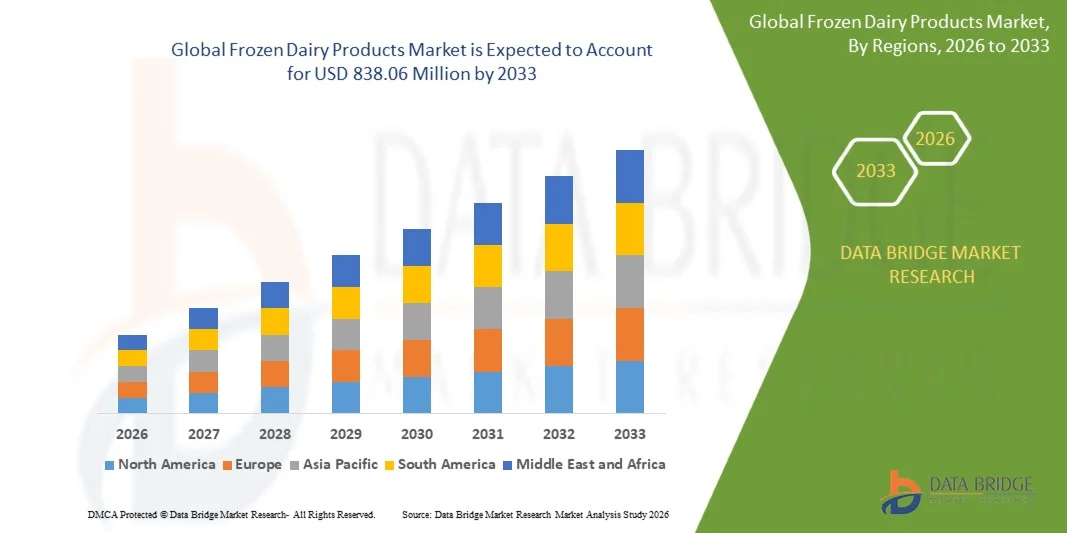
- As per Data Bridge Market Research analysis, the frozen dairy products market was valued at USD 529.80 Million in 2025 and is projected to reach USD 838.06 Million by 2033, growing at a CAGR of 5.90% from 2026 to 2033.
- The market is experiencing robust growth driven by rising consumer demand for indulgent and premium frozen desserts, rapid expansion of organized retail and cold-chain infrastructure, and growing popularity of plant-based and low-sugar frozen dairy alternatives.
- The increasing consumption of ice cream and frozen novelties as an everyday indulgence, combined with rising disposable incomes and evolving flavor preferences, is compelling manufacturers to expand product portfolios across premium, functional, and health-oriented categories. Frozen yogurt and low-fat frozen desserts are increasingly complementing traditional ice cream offerings in many markets, providing consumers with better-for-you options without compromising taste or texture.
Market Size & Forecast
- Global Market Value (2025): USD 529.80 Million
- Expected Market Value (2033): USD 838.06 Million
- Forecast CAGR (2026–2033): 5.90%
- Leading Region in 2025: North America
- Fastest Growing Region: Asia-Pacific
What are the Major Takeaways of the Frozen Dairy Products Market?
- North America dominated the global frozen dairy products market with the largest revenue share of 34.28% in 2025, supported by high per-capita ice cream consumption and strong presence of established manufacturers.
- Asia-Pacific is expected to be the fastest-growing region at a CAGR of 7.5% from 2026 to 2033, fueled by rising urbanization, expanding cold-chain infrastructure, and growing adoption of Western-style frozen desserts in China, India, and Japan.
- The ice cream segment led the market with a 46.72% share in 2025, driven by strong brand loyalty, continuous flavor innovation, and widespread availability across retail and foodservice channels.
- Plant-based/non-dairy frozen desserts are the fastest-growing ingredient source segment, projected to register a CAGR of 8.4%, reflecting rising demand for lactose-free and vegan indulgence options.
- The chocolate flavor segment dominated the flavor category with a 29.85% revenue share in 2025, led by its universal consumer appeal and strong performance across both retail and impulse-purchase channels.
- Supermarkets & hypermarkets accounted for 41.16% of the market share in 2025, preferred for their wide product assortment, promotional pricing, and integrated cold-storage facilities.
- The organic frozen dairy segment is the fastest-growing category, with a CAGR of 7.9%, driven by rising consumer preference for clean-label and naturally sourced indulgence products.
Report Scope and Frozen Dairy Products Market Segmentation
|
Attributes |
Frozen Dairy Products Key Market Insights |
|
Segments Covered |
|
|
Countries Covered |
North America
Europe
Asia-Pacific
Middle East and Africa
South America
|
|
Key Market Players |
|
|
Market Opportunities |
|
|
Value Added Data Infosets |
In addition to the insights on market scenarios such as market value, growth rate, segmentation, geographical coverage, and major players, the market reports curated by the Data Bridge Market Research also include in-depth expert analysis, geographically represented company-wise production and capacity, network layouts of distributors and partners, detailed and updated price trend analysis and deficit analysis of supply chain and demand. |
What is the Key Trend in the Frozen Dairy Products Market?
- Premium and artisanal ice cream brands are gaining significant traction as consumers increasingly seek indulgent frozen desserts made with high-quality ingredients, innovative textures, and unique flavor combinations.
- For instance, in April 2025, Unilever reported continued innovation across its Ice Cream business, including the launch of 25 new Ben & Jerry's flavor and format combinations, alongside expansion of premium Magnum Bon Bons and new Cornetto premium products across Europe and other markets. This highlights manufacturers' focus on premiumization and product differentiation.
- Rising health consciousness is accelerating demand for frozen dairy products with reduced sugar, higher protein, functional ingredients, and clean-label formulations while maintaining premium taste and texture.
- Manufacturers are also expanding plant-based frozen dessert portfolios to address growing vegan, lactose-intolerant, and flexitarian consumer segments.
- For instance, Häagen-Dazs (Nestlé Canada) introduced an oat-based plant-based frozen dessert collection featuring Chocolate Peanut Butter, Vanilla Raspberry Truffle, and Caramel Fudge Chip, demonstrating continued investment in dairy-free premium frozen desserts.
- As consumers increasingly balance indulgence with wellness and sustainability, manufacturers continue investing in premium ingredients, plant-based alternatives, and innovative frozen dessert formats, making product innovation one of the industry's primary competitive strategies.
What are the Key Drivers of the Frozen Dairy Products Market?
- Rapid expansion of organized retail, supermarket freezer capacity, quick-commerce platforms, and advanced cold-chain logistics has significantly improved frozen dairy product availability across developed and emerging markets.
- Growing disposable incomes and changing consumer lifestyles are increasing expenditure on premium ice cream, frozen yogurt, and specialty frozen desserts, particularly among younger urban consumers.
- For instance, Unilever reported that its digital commerce channel delivered double-digit growth during 2025, supported by improved retail execution and dedicated sales teams, while premium innovations across Magnum, Ben & Jerry's, and Cornetto contributed to Ice Cream business growth.
- Expansion of foodservice channels, cafés, quick-service restaurants, and delivery platforms continues to create additional consumption occasions for frozen dairy products beyond traditional retail sales.
- Increasing investments in product innovation, premiumization, and omnichannel distribution are expected to sustain long-term market growth.
Which Factors are Challenging the Growth of the Frozen Dairy Products Market?
- Frozen dairy products require substantial investment in refrigerated transportation, cold-storage warehouses, freezer cabinets, and temperature-controlled retail infrastructure to maintain product quality and food safety.
- These capital-intensive cold-chain requirements remain a significant barrier for small and regional manufacturers, particularly across developing economies.
- For instance, on October 29, 2024, the International Dairy Foods Association (IDFA), in collaboration with Americold, highlighted that ice cream manufacturers continue to face major supply chain challenges, including rising ingredient costs, workforce shortages, and transportation issues. The webinar emphasized the need for transportation and warehouse collaboration to improve cold-chain efficiency and reduce distribution costs for frozen dairy products
- In addition, volatility in raw milk, butterfat, sugar, cocoa, and packaging material prices continues to increase production costs. Combined with rising energy expenses required for continuous refrigeration throughout storage and transportation, these factors compress manufacturer margins and limit market expansion in price-sensitive regions.
How is the Frozen Dairy Products Market Segmented?
The frozen dairy products market is segmented on the basis of product type, flavor, category, packaging type, ingredient source, distribution channel, and end user.
- By Product Type
On the basis of product type, the global frozen dairy products market is segmented into ice cream, frozen yogurt, frozen desserts, frozen novelties, and sherbet & sorbet. The ice cream segment dominated the market with a 46.72% share in 2025, primarily due to its strong consumer acceptance across all age groups and its broad availability in both developed and emerging markets. Continuous product innovation, including premium formulations, seasonal flavors, reduced-sugar variants, and indulgent formats, has helped manufacturers maintain consumer interest. In addition, expanding retail freezer space and the growing popularity of take-home packs have further strengthened demand for ice cream globally.
The frozen yogurt segment is projected to register the fastest CAGR of 7.2% from 2026 to 2033, driven by increasing consumer preference for healthier indulgence options. Rising awareness of digestive health, demand for probiotic-rich foods, and growing interest in lower-fat frozen desserts are encouraging manufacturers to expand frozen yogurt offerings. The introduction of clean-label ingredients and high-protein formulations is also supporting market growth.
- By Flavor
On the basis of flavor, the market is segmented into chocolate, vanilla, fruit-based, nut-based, and others.The chocolate segment accounted for the largest market share of 29.85% in 2025, supported by its universal consumer appeal and consistent demand across premium, mainstream, and impulse product categories. Chocolate remains one of the most preferred flavors globally due to its versatility in combination with nuts, cookies, caramel, and other inclusions, while continuous product innovation has helped sustain repeat purchases.
The fruit-based segment is expected to grow at the fastest CAGR of 6.8% from 2026 to 2033, fueled by increasing demand for refreshing, naturally flavored frozen desserts. Consumers are increasingly seeking products made with real fruit, natural colors, and clean-label ingredients, particularly in premium and low-calorie product categories. Seasonal fruit flavors and tropical variants are also gaining popularity among younger consumers.
- By Category
On the basis of category, the market is segmented into regular, low-fat/reduced sugar, organic, and vegan/plant-based. The regular segment dominated the market with a 52.40% share in 2025, owing to its widespread affordability, extensive product availability, and long-established consumer preference. Conventional frozen dairy products continue to dominate retail shelves because they offer a broad range of flavors and formats at competitive price points. Strong brand recognition and high household penetration further reinforce the segment's leadership.
The vegan/plant-based segment is anticipated to witness the fastest CAGR of 8.4% from 2026 to 2033, driven by the rapid adoption of plant-based lifestyles and increasing awareness of lactose intolerance and dairy-free diets. Manufacturers are introducing innovative products made from oat, almond, coconut, and soy bases that closely replicate the taste and texture of conventional dairy products, while retailers continue expanding dedicated plant-based freezer sections.
- By Packaging Type
On the basis of packaging type, the market is segmented into tubs, cones, sticks & bars, sandwiches, and cups. The tubs segment held the largest market share of 38.60% in 2025, supported by growing demand for family-sized and multi-serving products, particularly following the rise in at-home consumption. Tub packaging offers better value for money and allows manufacturers to introduce premium flavors, mix-ins, and limited-edition varieties in larger pack sizes. Its strong presence across supermarkets and hypermarkets has also contributed to sustained demand.
The sticks & bars segment is expected to register the fastest CAGR of 6.9% from 2026 to 2033, driven by increasing demand for convenient, portion-controlled frozen snacks. Busy lifestyles, growing impulse purchases, and the popularity of premium chocolate-coated bars and protein-enriched frozen treats among younger consumers are expected to support segment growth.
- By Ingredient Source
On the basis of ingredient source, the market is segmented into dairy-based and plant-based/non-dairy.
The dairy-based segment dominated the market with a 81.35% share in 2025, owing to its rich taste, creamy texture, and long-standing consumer preference. Dairy remains the primary ingredient base for most traditional frozen desserts, supported by well-established milk supply chains and widespread product availability across global markets. The continued launch of premium dairy ice creams with high-quality ingredients has also supported market demand.
The plant-based/non-dairy segment is expected to witness the fastest CAGR of 8.4% from 2026 to 2033, driven by rising consumer awareness of lactose intolerance, growing vegan and flexitarian populations, and increasing demand for sustainable food choices. Continuous improvements in plant-based protein and fat formulations are enabling manufacturers to deliver products with taste and texture comparable to conventional dairy offerings.
- By Distribution Channel
On the basis of distribution channel, the market is segmented into supermarkets & hypermarkets, convenience stores, specialty stores, online retail, and foodservice/HoReCa. The supermarkets & hypermarkets segment accounted for the largest market share of 41.16% in 2025, owing to their extensive product assortment, reliable cold-chain infrastructure, and strong promotional activities. These retail formats provide consumers with access to both international and regional brands while offering competitive pricing, loyalty programs, and seasonal discounts that encourage higher purchase volumes.
The online retail segment is projected to expand at the fastest CAGR of 9.1% from 2026 to 2033, supported by the rapid growth of e-commerce grocery platforms and improvements in cold-chain logistics. Consumers increasingly value the convenience of home delivery, subscription services, and access to premium and artisanal frozen desserts that may not be readily available in physical stores. The expansion of quick-commerce platforms and direct-to-consumer sales channels is expected to further accelerate online frozen dairy product sales during the forecast period.
U.S. Frozen Dairy Products Market Insight
The U.S. frozen dairy products market is experiencing steady growth, supported by high per-capita ice cream consumption, strong brand presence, and rising demand for premium and plant-based frozen desserts. Increasing investments in flavor innovation and functional ingredient fortification are contributing to market growth. Furthermore, integration of e-commerce and direct-to-consumer delivery models is improving product accessibility, positioning the U.S. as a key innovation hub in the frozen dairy products industry. The U.S. market is also benefiting from rapid product innovation, including high-protein formulations, reduced-sugar recipes, functional ingredients, and plant-based frozen desserts made from oat, almond, and coconut milk. Major manufacturers are investing in direct-to-consumer channels, digital grocery platforms, and premium artisanal product lines to address evolving consumer preferences. Continuous investments in flavor innovation, sustainable packaging, and value-added dairy products position the U.S. as a global innovation hub for frozen dairy products.
Germany Frozen Dairy Products Market Insight
Germany represents one of Europe's leading frozen dairy products markets, supported by its strong dairy processing industry, stringent food safety regulations, and high consumer preference for premium-quality dairy products. Germany is among the largest milk producers in the European Union, providing a stable supply of raw materials for frozen dairy manufacturing. Growing consumer demand for organic, clean-label, and reduced-sugar frozen desserts is encouraging manufacturers to expand premium product portfolios while adopting sustainably sourced dairy ingredients.
The market is witnessing increasing adoption of lactose-free and plant-based frozen dairy alternatives, particularly among younger consumers seeking healthier indulgence options. Supermarkets and discount retail chains continue expanding freezer space for premium ice cream and frozen yogurt brands, while investments in energy-efficient cold-chain logistics are improving product availability nationwide. Furthermore, strict compliance with EU food quality and labeling regulations strengthens consumer confidence and supports long-term market growth.
Asia-Pacific Frozen Dairy Products Market Insight
The Asia-Pacific frozen dairy products market is expected to register the fastest growth during the forecast period, driven by rapid urbanization, expanding middle-class populations, rising disposable incomes, and significant improvements in cold-chain infrastructure across China, India, Japan, South Korea, and Southeast Asia. The region accounts for more than half of the global population, creating a substantial consumer base for frozen dairy products as dietary habits increasingly shift toward Western-style desserts and premium snacking.
The rapid expansion of supermarkets, convenience stores, and online grocery platforms has significantly improved product accessibility across both metropolitan and tier-II cities. Premium ice cream, frozen yogurt, and functional frozen desserts enriched with probiotics or high-protein ingredients are gaining popularity among health-conscious consumers. In addition, international brands continue expanding manufacturing facilities and distribution networks across Asia-Pacific, while domestic dairy companies are introducing localized flavors to capture regional preferences, accelerating overall market expansion.
India Frozen Dairy Products Market Insight
The India frozen dairy products market is witnessing robust growth, supported by rising disposable incomes, increasing urbanization, expanding organized retail, and one of the world's largest dairy industries. India is the largest milk-producing country globally, ensuring abundant raw material availability for frozen dairy product manufacturers. Government investments in dairy infrastructure and cold-chain development under various dairy modernization initiatives have significantly strengthened product distribution across urban and semi-urban markets.
Consumer demand is increasingly shifting toward premium ice cream, family packs, impulse products, and healthier frozen desserts with lower sugar content. Domestic manufacturers are introducing region-specific flavors such as mango, kulfi, kesar pista, and paan to cater to local tastes, while international brands continue expanding their presence through modern retail and quick-commerce platforms. Rising penetration of online grocery delivery services and temperature-controlled logistics is further improving accessibility, particularly in Tier II and Tier III cities, supporting sustained market growth.
China Frozen Dairy Products Market Insight
China is emerging as one of the fastest-growing frozen dairy products markets worldwide, driven by rapid urbanization, rising disposable incomes, increasing dairy consumption, and significant expansion of modern retail infrastructure. The country has witnessed substantial investments in domestic dairy production, advanced processing technologies, and refrigerated logistics, enabling broader availability of frozen dairy products across both urban and emerging cities.
Chinese consumers are increasingly favoring premium ice cream, low-sugar frozen desserts, and functional dairy products containing probiotics and high-protein ingredients. Premiumization remains a key market trend, with consumers showing greater willingness to pay for imported brands, innovative flavors, and high-quality dairy ingredients. The rapid expansion of e-commerce platforms and instant retail delivery services has further accelerated frozen dairy product sales by improving product availability and maintaining cold-chain integrity. Continuous investments in smart cold-chain logistics, digital retail, and premium product innovation are expected to position China among the highest-growth markets for frozen dairy products over the forecast period.
Which are the Top Companies in Frozen Dairy Products Market?
The frozen dairy products industry is primarily led by well-established companies, including:
- Unilever PLC (U.K.)
- Nestlé S.A. (Switzerland)
- General Mills Inc. (U.S.)
- Froneri International Limited (U.K.)
- Wells Enterprises Inc. (U.S.)
- Blue Bell Creameries L.P. (U.S.)
- Danone S.A. (France)
- Lotte Confectionery Co., Ltd. (South Korea)
- Inner Mongolia Yili Industrial Group Co., Ltd. (China)
- China Mengniu Dairy Company Limited (China)
- Gujarat Cooperative Milk Marketing Federation (Amul) (India)
- Arla Foods amba (Denmark)
- Meiji Holdings Co., Ltd. (Japan)
- Turkey Hill Dairy (U.S.)
- Mother Dairy Fruit & Vegetable Pvt. Ltd. (India)
- Halo Top Creamery (U.S.)
- Oatly Group AB (Sweden)
- Vadilal Industries Ltd. (India)
- Rich Products Corporation (U.S.)
- Schwan's Company (U.S.)
- Movenpick Holding AG (Switzerland)
- R&R Ice Cream Ltd. (U.K.)
What are Latest Developments in Frozen Dairy Products Market?
- In October 2025, Froneri entered into agreements to acquire the European ice cream business of Food Union, expanding its portfolio of locally recognized ice cream brands across Denmark, Norway, Estonia, Latvia, Lithuania, and Romania. The acquisition strengthens Froneri's manufacturing footprint and distribution network in Europe, reinforcing its position as one of the world's leading ice cream manufacturers.
- In March 2025, Froneri announced a strategic partnership expansion with Mondelēz International and Lotus Bakeries to introduce Lotus® Biscoff® branded ice cream across selected European markets beginning in 2026. The collaboration expands Froneri's premium branded portfolio and supports growth in the premium frozen dessert category.
- In October 2023, Ben & Jerry's (Unilever) introduced a new oat-based recipe for its entire Non-Dairy ice cream range, delivering a creamier texture, improved flavor, and broader consumer appeal while reducing nut allergens. The reformulation represented a significant advancement in plant-based frozen dessert innovation.
- In July 2024, Nestlé announced a breakthrough dairy technology capable of reducing milk fat by up to 60% while maintaining the creamy taste and texture consumers expect. The innovation supports the development of healthier dairy products and reinforces Nestlé's commitment to nutritional innovation across its dairy portfolio.
- In December 2023, Yili Group received two International Dairy Federation (IDF) Dairy Innovation Awards in recognition of its achievements in dairy product innovation and sustainable packaging. The recognition highlights the company's continued investment in advanced dairy technologies and innovative product development.

- Interactive Data Analysis Dashboard
- Company Analysis Dashboard for high growth potential opportunities
- Research Analyst Access for customization & queries
- Competitor Analysis with Interactive dashboard
- Latest News, Updates & Trend analysis
- Harness the Power of Benchmark Analysis for Comprehensive Competitor Tracking
Global Frozen Dairy Products Market, Supply Chain Analysis and Ecosystem Framework
To support market growth and help clients navigate the impact of geopolitical shifts, DBMR has integrated in-depth supply chain analysis into its Global Frozen Dairy Products Market research reports. This addition empowers clients to respond effectively to global changes affecting their industries. The supply chain analysis section includes detailed insights such as Global Frozen Dairy Products Market consumption and production by country, price trend analysis, the impact of tariffs and geopolitical developments, and import and export trends by country and HSN code. It also highlights major suppliers with data on production capacity and company profiles, as well as key importers and exporters. In addition to research, DBMR offers specialized supply chain consulting services backed by over a decade of experience, providing solutions like supplier discovery, supplier risk assessment, price trend analysis, impact evaluation of inflation and trade route changes, and comprehensive market trend analysis.
Data collection and base year analysis are done using data collection modules with large sample sizes. The stage includes obtaining market information or related data through various sources and strategies. It includes examining and planning all the data acquired from the past in advance. It likewise envelops the examination of information inconsistencies seen across different information sources. The market data is analysed and estimated using market statistical and coherent models. Also, market share analysis and key trend analysis are the major success factors in the market report. To know more, please request an analyst call or drop down your inquiry.
The key research methodology used by DBMR research team is data triangulation which involves data mining, analysis of the impact of data variables on the market and primary (industry expert) validation. Data models include Vendor Positioning Grid, Market Time Line Analysis, Market Overview and Guide, Company Positioning Grid, Patent Analysis, Pricing Analysis, Company Market Share Analysis, Standards of Measurement, Global versus Regional and Vendor Share Analysis. To know more about the research methodology, drop in an inquiry to speak to our industry experts.
Data Bridge Market Research is a leader in advanced formative research. We take pride in servicing our existing and new customers with data and analysis that match and suits their goal. The report can be customized to include price trend analysis of target brands understanding the market for additional countries (ask for the list of countries), clinical trial results data, literature review, refurbished market and product base analysis. Market analysis of target competitors can be analyzed from technology-based analysis to market portfolio strategies. We can add as many competitors that you require data about in the format and data style you are looking for. Our team of analysts can also provide you data in crude raw excel files pivot tables (Fact book) or can assist you in creating presentations from the data sets available in the report.













