


Frozen Foods Market Size
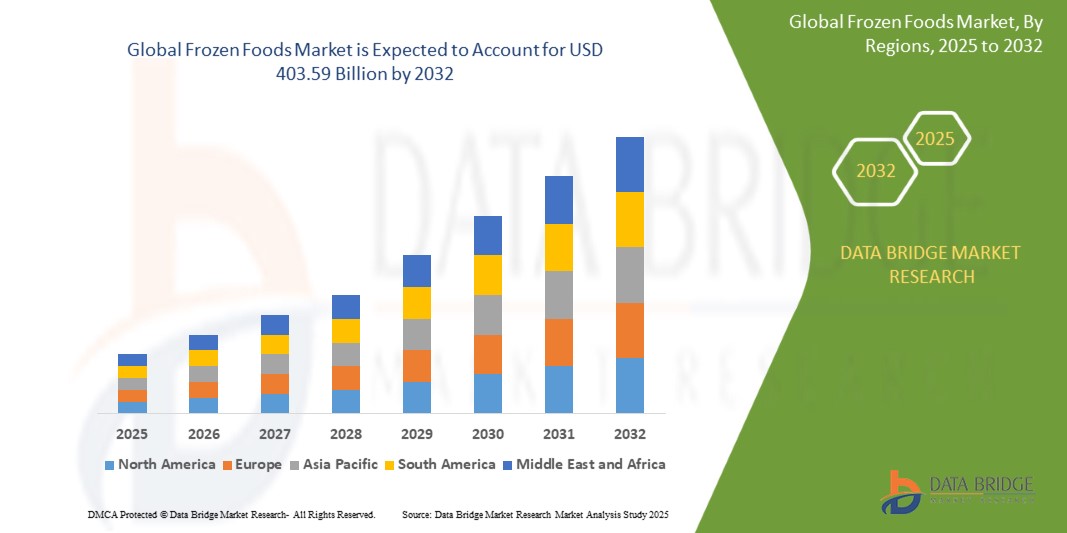
- The global frozen foods market was valued at USD 280.56 billion in 2024 and is expected to reach USD 403.59 billion by 2032
- During the forecast period of 2025 to 2032 the market is likely to grow at a CAGR of 4.65%, primarily driven by the rising demand for convenient and ready-to-eat meal options
- This growth is driven by factors such as the increasing consumer preference for time-saving, nutritious, and easily accessible frozen food products
Frozen Foods Market Analysis
- The market is divided into various product types including fruits, vegetables, bakery products, dairy products, meat and seafood, and convenience foods, catering to a wide range of consumer preferences
- With increasingly fast-paced lifestyles, consumers are opting for frozen foods that offer convenience, easy preparation, and longer shelf life, particularly in ready-to-eat and convenience meal segments
- Freezing techniques such as Individual Quick Freezing (IQF) and blast freezing are enhancing product quality, taste, and texture, leading to higher consumer acceptance of frozen food products
- For instance, major players such as McCain Foods and General Mills have expanded their frozen food offerings to include healthier and more convenient meal options, responding to the growing demand for nutritious and easy-to-prepare meals. This trend is particularly noticeable in supermarkets, where frozen food aisles are increasingly featuring a variety of ready-to-eat meals
Report Scope and Frozen Foods Market Segmentation
|
Attributes |
Frozen Foods Key Market Insights |
|
Segments Covered |
|
|
Countries Covered |
North America
Europe
Asia-Pacific
Middle East and Africa
South America
|
|
Key Market Players |
|
|
Market Opportunities |
|
|
Value Added Data Infosets |
In addition to the insights on market scenarios such as market value, growth rate, segmentation, geographical coverage, and major players, the market reports curated by the Data Bridge Market Research also include in-depth expert analysis, pricing analysis, brand share analysis, consumer survey, demography analysis, supply chain analysis, value chain analysis, raw material/consumables overview, vendor selection criteria, PESTLE Analysis, Porter Analysis, and regulatory framework. |
Frozen Foods Market Trends
“Growing Demand for Healthier and Convenient Frozen Food Options”
- Consumers are increasingly seeking healthier frozen food options, including those with organic ingredients, fewer additives, and lower sodium content. This shift aligns with a broader trend toward health and wellness, influencing purchasing decisions across various demographics
- The rise in vegetarianism, veganism, and flexitarian diets has led to a surge in demand for plant-based frozen foods. Offerings such as plant-based meat substitutes, dairy-free ice creams, and vegetable-based frozen meals cater to diverse dietary preferences, expanding the market's reach
- Busy lifestyles have heightened the appeal of convenient meal solutions. Frozen foods provide quick and easy options without compromising taste or nutrition. Single-serve frozen meals, microwaveable snacks, and pre-cut frozen produce are gaining popularity among consumers seeking hassle-free meal solutions
- Consumers are willing to pay more for higher-quality frozen food products. Brands are focusing on premium ingredients, innovative packaging, and gourmet flavors to differentiate themselves in the market. Premium frozen pizzas, artisanal ice creams, and specialty frozen appetizers are witnessing increased demand among discerning consumers
- There's a growing interest in ethnic and global cuisines, driving the demand for frozen foods featuring authentic flavors from around the world. Frozen ethnic meals, such as Indian curries, Asian stir-fries, and Mediterranean dishes, are becoming increasingly popular as consumers seek diverse culinary experiences at home
- For Instance, In France, the younger generation's preference for frozen French fries has led to a 25% increase in consumption. This shift has prompted local farmers to convert their fields to potato cultivation to meet the rising demand, illustrating the trend toward convenient and familiar frozen food options
Frozen Foods Market Dynamics
Driver
“Increasing Demand for Convenient and Ready-to-Eat Meals”
- In today's fast-paced world, consumers are seeking quick and easy meal solutions. Frozen foods offer the convenience of ready-to-eat options that require minimal preparation, aligning with the busy schedules of modern life
- Urban living and the rise of nuclear families have led to smaller household sizes, resulting in a higher demand for single-serve and easy-to-prepare frozen meals that cater to individual needs
- Contrary to perceptions of frozen foods being unhealthy, many consumers are now opting for frozen meals that offer balanced nutrition and portion control, supporting weight management and healthy eating habits
Opportunity
“Expansion into Emerging Markets”
- Developing regions such as Latin America, South Asia, and Africa present significant growth opportunities for frozen food companies due to increasing urbanization, rising disposable incomes, and changing dietary patterns
- Investments in cold chain logistics and retail infrastructure in these regions are improving the accessibility and availability of frozen foods, making it a viable market for expansion
- Tailoring frozen food offerings to suit local tastes and cultural preferences can enhance acceptance and demand in these emerging markets, fostering brand loyalty and market penetration
Restraint/Challenge
“Supply Chain and Storage Challenges”
- Maintaining the cold chain from production to retail is crucial for ensuring the safety and quality of frozen foods. Breaks in the cold chain can lead to spoilage, product recalls, and food safety issues, posing significant challenges for retailers and manufacturers
- Inadequate cold storage facilities, especially in developing countries, hinder the efficient distribution of frozen foods, limiting market reach and growth potential
- High energy consumption of freezing equipment leads to increased operational costs for retailers, challenging profitability and pricing strategies
- For Instance, In South Australia, family-run seafood businesses have faced challenges due to supply chain disruptions, including the impact of trade bans and climate change. For instance, Ferguson Australia diversified its market by supplying local supermarkets with frozen lobsters, demonstrating resilience and adaptability in addressing supply chain and storage challenges.
Frozen Foods Market Scope
The market is segmented on the basis product type, type, distribution channel, freezing technique, and consumption.
|
Segmentation |
Sub-Segmentation |
|
By Product Type |
|
|
By Type |
|
|
By Distribution channel |
|
|
By Freezing technique |
|
|
By Consumption |
|
Frozen Foods Market Regional Analysis
“North America is the Dominant Region in the Frozen Foods Market”
- North America, particularly the U.S., holds the largest share of the global frozen foods market. The region’s preference for convenient and ready-to-eat meal solutions drives this dominance. In 2023, the market size was valued at USD 268.10 billion, with North America leading the charge in both production and consumption of frozen foods
- North America benefits from a well-established cold chain infrastructure, ensuring the seamless distribution of frozen food products across regions. This infrastructure supports consumer access to a wide variety of frozen foods
- The fast-paced lifestyle and increasing preference for time-saving food solutions among North American consumers fuel the demand for frozen meals, snacks, and other frozen products. With a robust retail and food service industry, frozen food products have become a staple in the region’s everyday meals
“Asia-Pacific is Projected to Register the Highest Growth Rate”
- Asia-Pacific (APAC) is witnessing the fastest growth in the frozen foods market, driven by urbanization, rising disposable incomes, and changing consumer lifestyles. Countries such as China, India, and Japan are seeing an uptick in the demand for frozen foods, especially frozen vegetables, ready-to-eat meals, and snacks
- As urban populations in APAC continue to grow, there is a growing preference for convenient and nutritious food options. Frozen foods are increasingly being adopted due to their ease of preparation and long shelf life
- The expansion of supermarkets, hypermarkets, and online retail platforms is making frozen foods more accessible to the growing middle class in APAC. This is contributing to the region’s rapid market growth
Frozen Foods Market Share
The market competitive landscape provides details by competitor. Details included are company overview, company financials, revenue generated, market potential, investment in research and development, new market initiatives, global presence, production sites and facilities, production capacities, company strengths and weaknesses, product launch, product width and breadth, application dominance. The above data points provided are only related to the companies' focus related to market.
The Major Market Leaders Operating in the Market Are:
- The Hain Celestial Company (U.S.)
- AGRARFROST GMBH & CO. KG (Germany)
- Agristo (Belgium)
- Bart’s Potato Company bvba (Belgium)
- Royal Cosun (Netherlands)
- Farm Frites (Netherlands), Greenyard (Belgium)
- Himalaya Food International Ltd. (India)
- J.R. Simplot Company (U.S.)
- McCain Foods Ltd. (Canada)
- Lamb Weston Holdings, Inc. (U.S.)
- General Mills, Inc. (U.S.)
- Mondelez International, Inc. (U.S.)
- THE KRAFT HEINZ COMPANY (U.S.)
Latest Developments in Global Frozen Foods Market
- In April 2023, Nestlé and the private equity firm PAI Partners came to an agreement to establish a joint venture focused on Nestlé's frozen pizza business in Europe. This move aimed to create a specialized player in a highly competitive and constantly evolving market segment. In this joint venture, Nestlé would maintain a minority stake, ensuring equal voting rights in partnership with PAI Partners
- In March 2023, McCain Foods, the global leader in frozen potato products manufacturing, made a significant announcement of a substantial investment totaling USD 438.4 million. This investment is directed towards the expansion and doubling in size of its potato processing plant located in Coaldale, Alberta. This strategic move is expected to foster continued growth for the company, strengthening its ability to cater to key markets
- In 2021, Nomad Foods announced an agreement with Fortenova Grupa d. d. to acquire Fortenova's Frozen Food Business Group (FFBG) in cash for USD 724 million in order to expand its product portfolio, as FFBG offers a wide range of frozen meals and has a large distribution channel in Eastern Europe
- In June 2022, Conagra Brands Inc. launched its extensive summer line products in 2021 to provide manufacturers inside single-serve frozen meals and collect brands with new Banquet, Marie Callender's, Wholesome Alternative, and Hungry Man dishes. Conagra's mission is to please customers by providing nutritious frozen foods

- Interactive Data Analysis Dashboard
- Company Analysis Dashboard for high growth potential opportunities
- Research Analyst Access for customization & queries
- Competitor Analysis with Interactive dashboard
- Latest News, Updates & Trend analysis
- Harness the Power of Benchmark Analysis for Comprehensive Competitor Tracking
Global Frozen Food Market, Supply Chain Analysis and Ecosystem Framework
To support market growth and help clients navigate the impact of geopolitical shifts, DBMR has integrated in-depth supply chain analysis into its Global Frozen Food Market research reports. This addition empowers clients to respond effectively to global changes affecting their industries. The supply chain analysis section includes detailed insights such as Global Frozen Food Market consumption and production by country, price trend analysis, the impact of tariffs and geopolitical developments, and import and export trends by country and HSN code. It also highlights major suppliers with data on production capacity and company profiles, as well as key importers and exporters. In addition to research, DBMR offers specialized supply chain consulting services backed by over a decade of experience, providing solutions like supplier discovery, supplier risk assessment, price trend analysis, impact evaluation of inflation and trade route changes, and comprehensive market trend analysis.
Data collection and base year analysis are done using data collection modules with large sample sizes. The stage includes obtaining market information or related data through various sources and strategies. It includes examining and planning all the data acquired from the past in advance. It likewise envelops the examination of information inconsistencies seen across different information sources. The market data is analysed and estimated using market statistical and coherent models. Also, market share analysis and key trend analysis are the major success factors in the market report. To know more, please request an analyst call or drop down your inquiry.
The key research methodology used by DBMR research team is data triangulation which involves data mining, analysis of the impact of data variables on the market and primary (industry expert) validation. Data models include Vendor Positioning Grid, Market Time Line Analysis, Market Overview and Guide, Company Positioning Grid, Patent Analysis, Pricing Analysis, Company Market Share Analysis, Standards of Measurement, Global versus Regional and Vendor Share Analysis. To know more about the research methodology, drop in an inquiry to speak to our industry experts.
Data Bridge Market Research is a leader in advanced formative research. We take pride in servicing our existing and new customers with data and analysis that match and suits their goal. The report can be customized to include price trend analysis of target brands understanding the market for additional countries (ask for the list of countries), clinical trial results data, literature review, refurbished market and product base analysis. Market analysis of target competitors can be analyzed from technology-based analysis to market portfolio strategies. We can add as many competitors that you require data about in the format and data style you are looking for. Our team of analysts can also provide you data in crude raw excel files pivot tables (Fact book) or can assist you in creating presentations from the data sets available in the report.













