What is the Frozen Novelty Market Size and Growth Rate?
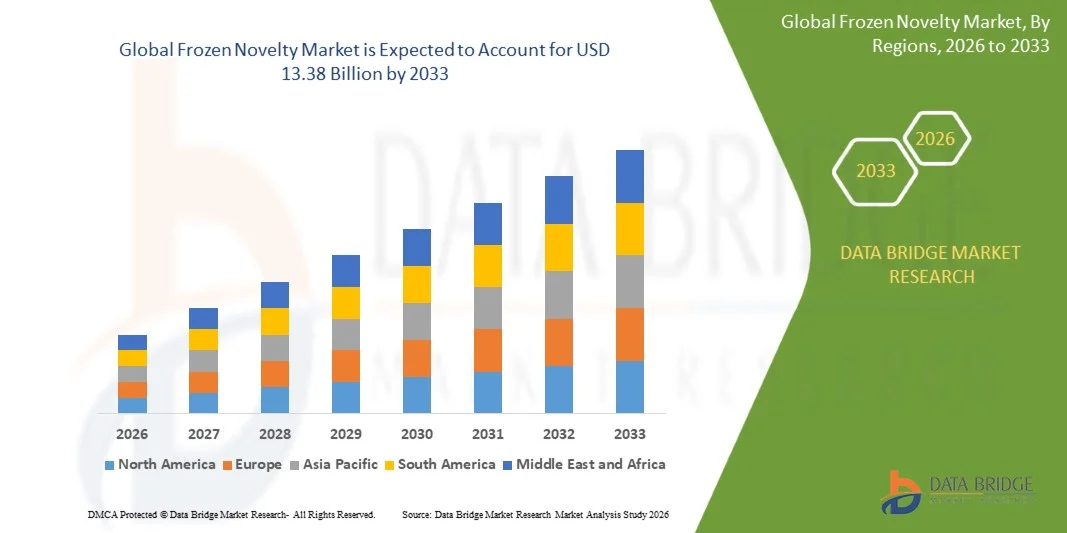
- As per Data Bridge Market Research analysis, the frozen novelty market was valued at USD 6.90 billion in 2025 and is projected to reach USD 13.38 billion by 2033, growing at a CAGR of 8.62% from 2026 to 2033.
- The market is experiencing consistent growth driven by increasing consumer demand for convenient and indulgent frozen desserts, rising preference for innovative and premium frozen novelty products, expansion of retail and foodservice channels, and growing availability of dairy-free, low-sugar, and plant-based alternatives.
- The increasing demand for convenient snack and dessert options, combined with changing consumer preferences toward novel flavors, healthier formulations, and portion-controlled products, is encouraging food manufacturers and retailers to expand their frozen novelty offerings. Product innovation across ice cream bars, frozen fruit bars, popsicles, frozen yogurt, sorbet, and ice cream sandwiches is further supporting market growth, while supermarkets, convenience stores, specialty retailers, and online channels are broadening product accessibility.
Market Size & Forecast
- Global Market Value (2025): USD 6.90 Billion
- Expected Market Value (2033): USD 13.38 Billion
- Forecast CAGR (2026–2033): 8.62%
- Leading Region in 2025: North America
- Fastest Growing Region: Asia Pacific
What are the Major Takeaways of the Frozen Novelty Market?
- North America dominated the frozen novelty market with the largest revenue share of 31.8% in 2025, supported by high consumption of frozen desserts, established cold-chain infrastructure, strong household freezer penetration, and extensive distribution through supermarkets, convenience stores, and foodservice outlets. This synthesized share is positioned between the regional shares reported by current market studies, which vary according to market definition.
- Asia-Pacific is expected to be the fastest-growing region at a CAGR of 6.5% from 2026 to 2033, fueled by rising disposable incomes, rapid urbanization, expanding organized retail and cold-chain infrastructure, and increasing consumer demand for innovative, premium, fruit-based, and dairy-free frozen novelty products across China, India, Japan, and other emerging markets.
- The ice cream bars segment led the product type category with a 43.2% share in 2025, driven by strong consumer preference for convenient single-serve formats, portability, portion control, premium coatings, filled varieties, and continued innovation in flavors and textures. Current market sources consistently identify ice cream bars as the leading product category, although reported shares differ across research methodologies.
- The ice pops segment is the fastest-growing product type, projected to register a CAGR of 6.4% from 2026 to 2033, reflecting rising demand for fruit-based, refreshing, affordable, and portion-controlled frozen treats, particularly in warmer climates and emerging markets.
- The residential segment accounted for 63.5% of the application category in 2025, supported by increasing at-home consumption, greater household freezer penetration, growing availability of multipacks, and consumer preference for convenient desserts that require no preparation. Available market research identifies residential or household consumption as the largest application category.
- Supermarkets and hypermarkets accounted for 44.8% of the distribution channel segment in 2025, supported by broad product assortments, dedicated freezer displays, promotional activity, established cold-chain networks, and high consumer traffic. Supermarkets are consistently identified as the leading distribution channel, although individual sources report different shares.
- The plant-based and better-for-you frozen novelty segment is the fastest-growing product-positioning category, with a CAGR of 9.1% from 2026 to 2033, driven by increasing demand for dairy-free, low-sugar, high-protein, and clean-label frozen treats among health-conscious consumers.
Report Scope and Frozen Novelty Market Segmentation
|
Attributes |
Frozen Novelty Key Market Insights |
|
Segments Covered |
|
|
Countries Covered |
North America
Europe
Asia-Pacific
Middle East and Africa
South America
|
|
Key Market Players |
|
|
Market Opportunities |
|
|
Value Added Data Infosets |
In addition to the insights on market scenarios such as market value, growth rate, segmentation, geographical coverage, and major players, the market reports curated by the Data Bridge Market Research also include in-depth expert analysis, pricing analysis, brand share analysis, consumer survey, demography analysis, supply chain analysis, value chain analysis, raw material/consumables overview, vendor selection criteria, PESTLE Analysis, Porter Analysis, and regulatory framework. |
What is the Key Trend in the Frozen Novelty Market?
- Frozen novelty manufacturers are increasingly expanding premium and indulgent product offerings through innovative flavors, branded collaborations, limited-edition launches, and convenient formats such as ice cream bars, sandwiches, and multi-packs, enabling brands to create differentiated consumer experiences.
- For instance, in March 2025, Froneri announced a strategic agreement with Mondelēz International and Lotus Bakeries to expand Lotus Biscoff ice cream offerings, including plans for Froneri to produce, market, and sell Biscoff ice cream in selected European markets from 2026.
- Product innovation is increasingly focused on combining familiar flavors, premium ingredients, and distinctive textures across frozen novelty formats to encourage trial and strengthen consumer engagement.
- For instance, in March 2025, Blue Bell Creameries introduced Banana Fudge Ice Cream, combining banana-flavored ice cream with milk chocolate ice cream and making the product available in both half-gallon and pint formats for a limited period.
- Frozen novelty companies are also introducing region-specific and seasonal flavors, limited-edition products, and premium stick bars to address changing consumer preferences and create additional consumption occasions.
- For instance, in April 2025, General Mills highlighted new Häagen-Dazs international offerings, including Belgian Chocolate Stickbars and additional seasonal ice cream products across international markets, demonstrating continued innovation in premium frozen formats and flavors.
- As manufacturers continue to combine premium positioning, innovative flavors, convenient formats, and brand collaborations, product innovation is expected to remain an important component of the global frozen novelty market.
What are the Key Drivers of the Frozen Novelty Market?
- The increasing consumer preference for convenient, indulgent, and differentiated desserts is supporting demand for frozen novelties across bars, pints, cups, sandwiches, and other portion-controlled formats.
- For instance, in March 2025, Froneri expanded its partnership with Mondelēz International and Lotus Bakeries to bring Lotus Biscoff into its branded ice cream portfolio, with plans for multiple formats and expanded distribution in selected European markets.
- Manufacturers are also expanding product portfolios with premium flavors, seasonal varieties, and novel combinations that provide consumers with new taste experiences while supporting at-home and on-the-go consumption.
- For instance, in September 2025, Blue Bell Creameries launched Classic Pecan Pie Ice Cream, combining brown sugar ice cream with roasted pecans, pie crust pieces, and pecan pie filling in pint and half-gallon formats.
- The expansion of plant-based and non-dairy frozen dessert options is also supporting product diversification as food manufacturers develop alternatives for consumers seeking dairy-free choices.
- For instance, Nestlé has developed a portfolio that includes non-dairy ice cream as part of its broader plant-based product offering, supported by dedicated research and development capabilities for developing new plant-based products.
- With manufacturers continuing to introduce premium flavors, convenient formats, plant-based alternatives, and limited-edition products, product diversification and consumer demand for differentiated frozen desserts are expected to support continued market growth.
Which Factors are Challenging the Growth of the Frozen Novelty Market?
- Frozen novelty manufacturers face challenges associated with refrigeration requirements, energy consumption, cold-chain distribution, and maintaining appropriate storage conditions throughout transportation and retail operations.
- For instance, in March 2025, Froneri highlighted its efforts to reduce the environmental impact of freezer operations and stated that it was investing in Energy Efficiency Class C freezers, with the objective of having all new freezer purchases meet this efficiency class by 2025.
- The need for specialized refrigerated infrastructure can increase operating and distribution requirements, particularly when manufacturers expand frozen novelty products across geographically dispersed markets.
- Frozen novelty companies also face challenges in maintaining product quality and consumer appeal while introducing new flavors, premium ingredients, and differentiated formulations across multiple markets and formats.
- For instance, in March 2025, Froneri described its Biscoff ice cream expansion as involving new routes to market and expanded distribution, highlighting the operational requirements associated with scaling branded ice cream products across selected European markets.
- In addition, manufacturers must balance indulgence, portion sizes, nutritional expectations, product innovation, and affordability, while managing refrigeration and distribution requirements, which can complicate product development and broader market expansion.
How is the Frozen Novelty Market Segmented?
The frozen novelty market is segmented on the basis of product type, formulation, packaging type, distribution channel, and end use.
- By Product Type
On the basis of product type, the frozen novelty market is segmented into ice cream bars, frozen fruit bars, frozen yogurt, sorbet, frozen custard, ice cream sandwiches, popsicles, and frozen cones. The ice cream bars segment dominated the market with a 40.82% share in 2025, supported by strong consumer preference for convenient, portion-controlled, and indulgent frozen desserts. Ice cream bars offer portability and ease of consumption and are widely distributed through supermarkets, convenience stores, foodservice outlets, and other retail channels. Chocolate coatings, premium inclusions, filled centers, nuts, caramel, and innovative flavor combinations are further supporting demand for ice cream bars. External market research places ice cream bars in the dominant position, with reported shares broadly ranging from the high-30% to low-40% range, supporting the positioning used in this analysis.
The frozen yogurt segment is projected to register the fastest growth at a 9.36% CAGR during the forecast period, supported by increasing consumer interest in lighter frozen desserts and products associated with yogurt-based nutritional attributes. Frozen yogurt is also increasingly used with toppings, fruits, nuts, and other dessert combinations, creating additional consumption occasions. External frozen novelty research similarly identifies frozen yogurt as one of the faster-growing product categories, supporting its growth positioning within the broader market.
- By Formulation
On the basis of formulation, the frozen novelty market is segmented into dairy-based, non-dairy, sugar-free, and low-calorie. The dairy-based segment dominated the market with a 72.18% share in 2025, supported by the established consumer preference for traditional dairy-based frozen desserts. Dairy-based formulations provide familiar taste, creaminess, and texture across ice cream bars, frozen yogurt, frozen custard, ice cream sandwiches, and frozen cones. Strong brand availability, established cold-chain infrastructure, and broad retail distribution continue to support the segment's leading position. External frozen novelty research also identifies dairy-based products as the dominant formulation category.
The non-dairy segment is projected to register the fastest growth at a 9.78% CAGR during the forecast period, driven by increasing demand for plant-based and dairy-free alternatives. Manufacturers are expanding the use of oat, coconut, almond, and other plant-based ingredients across frozen bars, sandwiches, cups, and other novelty formats. Product innovation and increasing availability through mainstream supermarkets, convenience stores, specialty stores, and online retail channels are supporting adoption. External market research similarly identifies non-dairy products as the fastest-growing formulation category.
- By Packaging Type
On the basis of packaging type, the frozen novelty market is segmented into pints, bars, cups, and multi-packs. The pints segment dominated the market with a 38.64% share in 2025, supported by the widespread use of pint packaging for frozen desserts and its suitability for household consumption. Pints provide convenient storage, multiple servings, and an established format for premium and mainstream frozen dessert products. Their broad availability across supermarkets, hypermarkets, convenience stores, specialty stores, and online grocery channels further supports segment demand. External frozen novelty research also identifies pints as the leading packaging format.
The bars segment is projected to register the fastest growth at a 9.52% CAGR during the forecast period, supported by the increasing demand for individually portioned and portable frozen desserts. Bar packaging is particularly suitable for impulse consumption and on-the-go occasions and enables manufacturers to introduce coatings, fillings, inclusions, and premium product architectures. The continued strength of ice cream bars as the leading product category is also supporting demand for bar-based packaging formats.
- By Distribution Channel
On the basis of distribution channel, the frozen novelty market is segmented into supermarkets and hypermarkets, convenience stores, online retail, specialty stores, and foodservice. The supermarkets and hypermarkets segment dominated the market with a 46.52% share in 2025, supported by broad product assortment, established refrigerated infrastructure, strong consumer traffic, and extensive availability of leading frozen novelty brands. These retail formats allow consumers to compare multiple brands, flavors, package sizes, and formulations in a single shopping location. Promotional campaigns, freezer displays, and private-label offerings further support frozen novelty sales through organized retail channels. External market research consistently identifies supermarkets and hypermarkets as the leading distribution channel.
The online retail segment is projected to register the fastest growth at a 11.26% CAGR during the forecast period, supported by increasing online grocery adoption, home-delivery services, quick-commerce platforms, and improvements in temperature-controlled distribution. Online channels provide consumers with convenient access to a broader range of frozen novelties while allowing manufacturers and retailers to expand their digital reach. External research also identifies online retail as the fastest-growing distribution channel for frozen novelties.
- By End Use
On the basis of end use, the frozen novelty market is segmented into household, foodservice, and institutional buyers. The household segment dominated the market with a 70.86% share in 2025, driven by strong at-home consumption of individually portioned frozen desserts, pints, cups, and multi-pack products. Increasing household freezer penetration, the availability of diverse frozen novelty products, and the expansion of premium, non-dairy, low-calorie, and fruit-based options are supporting household consumption. External market research also indicates that residential or household consumption represents the larger portion of frozen novelty demand.
The foodservice segment is projected to register the fastest growth at a 9.14% CAGR during the forecast period, supported by increasing use of frozen novelties across restaurants, cafés, quick-service establishments, hotels, entertainment venues, and other out-of-home consumption locations. Foodservice operators are increasingly incorporating branded and premium frozen desserts into menus to provide convenient dessert options and create additional consumption occasions. Expansion of foodservice establishments and increasing availability of frozen novelty products through out-of-home channels are expected to support segment growth.
Which Region Holds the Largest Share of the Frozen Novelty Market?
- North America dominated the frozen novelty market with the largest revenue share of 46.38% in 2025, supported by high consumer demand for premium and indulgent frozen desserts, strong penetration of established ice cream brands, and extensive availability of frozen novelty products across supermarkets, convenience stores, foodservice outlets, and specialty retailers.
- The region also benefits from well-developed cold-chain infrastructure, high household freezer penetration, and continuous product innovation across ice cream bars, frozen fruit bars, frozen yogurt, and other convenient frozen formats. Increasing consumer interest in premium, non-dairy, low-calorie, and reduced-sugar products is further encouraging manufacturers to expand their frozen novelty portfolios across the region.
U.S. Frozen Novelty Market Insight
The U.S. frozen novelty market is witnessing strong growth due to high consumption of ice cream and frozen desserts, extensive retail distribution, and increasing demand for convenient and premium frozen treats. The country's established cold-chain infrastructure and strong presence of major frozen dessert manufacturers support the availability of ice cream bars, pints, cups, sandwiches, popsicles, and multi-pack products across supermarkets, convenience stores, and online retail channels. In addition, growing consumer interest in non-dairy, low-calorie, sugar-free, and premium formulations is encouraging manufacturers to introduce differentiated frozen novelty products.
Asia-Pacific Frozen Novelty Market Insight
The Asia-Pacific frozen novelty market is expected to witness rapid growth, driven by rising disposable incomes, urbanization, changing dietary preferences, and increasing demand for convenient and indulgent desserts across countries such as China, India, and Japan. Expansion of modern retail, convenience stores, foodservice establishments, and online grocery platforms is improving consumer access to frozen novelty products. In addition, manufacturers are introducing localized flavors, fruit-based products, non-dairy formulations, and smaller portion sizes to address diverse consumer preferences across the region.
Japan Frozen Novelty Market Insight
The Japan frozen novelty market is witnessing consistent growth due to strong demand for premium desserts, innovative flavors, convenient single-serving products, and seasonal frozen treats. Consumers increasingly seek distinctive textures, flavors, and high-quality ingredients, encouraging manufacturers to develop premium ice cream bars, frozen yogurt, sorbet, and other specialty formats. Moreover, the country's developed convenience-store network and strong retail infrastructure provide extensive distribution opportunities for frozen novelty products, while product innovation and seasonal offerings continue to support market expansion.
China Frozen Novelty Market Insight
The China frozen novelty market is growing rapidly, driven by increasing urbanization, rising disposable incomes, expanding modern retail infrastructure, and growing consumer interest in premium and convenient desserts. Increasing penetration of supermarkets, convenience stores, e-commerce, and foodservice outlets is improving access to frozen novelty products across urban and emerging markets. In addition, manufacturers are expanding product portfolios with innovative flavors, fruit-based products, premium formulations, and smaller portion sizes to address evolving consumer preferences and increase consumption occasions.
U.K. Frozen Novelty Market Insight
The U.K. frozen novelty market is experiencing steady growth, supported by established frozen dessert consumption, extensive supermarket distribution, and increasing demand for premium and innovative frozen products. Consumers are showing growing interest in non-dairy, reduced-sugar, low-calorie, and fruit-based alternatives, encouraging manufacturers to diversify their product portfolios. Furthermore, the strong presence of convenience stores, supermarkets, foodservice outlets, and online grocery channels provides manufacturers with multiple distribution routes for frozen novelty products.
Germany Frozen Novelty Market Insight
The Germany frozen novelty market is expanding steadily due to established frozen dessert consumption, strong retail infrastructure, and increasing consumer interest in premium and innovative frozen products. Supermarkets, discount retailers, convenience outlets, and foodservice establishments provide broad distribution for ice cream bars, pints, cups, and other frozen novelty formats. Continuous introduction of non-dairy, low-calorie, reduced-sugar, and premium products is also supporting product diversification, while growing consumer demand for convenient portion-controlled desserts contributes to market expansion.
Which are the Top Companies in Frozen Novelty Market?
The Frozen Novelty industry is primarily led by well-established companies, including:
- Unilever PLC (U.K.)
- Nestlé S.A. (Switzerland)
- General Mills, Inc. (U.S.)
- The Häagen-Dazs Shoppe Company, Inc. (U.S.)
- Wells Enterprises, Inc. (U.S.)
- Froneri International Limited (U.K.)
- Mars, Incorporated (U.S.)
- Blue Bell Creameries, L.P. (U.S.)
- Dreyer's Grand Ice Cream, Inc. (U.S.)
- Turkey Hill Dairy (U.S.)
- Tillamook County Creamery Association (U.S.)
- Jeni's Splendid Ice Creams, LLC (U.S.)
- Ben & Jerry's Homemade Holdings Inc. (U.S.)
- Baskin-Robbins (U.S.)
- Dippin' Dots, LLC (U.S.)
- Amorino (France)
- Lotte Wellfood Co., Ltd. (South Korea)
- Meiji Holdings Co., Ltd. (Japan)
- GCMMF (Amul) (India)
- Kwality Wall's (India)
What are Latest Developments in Frozen Novelty Market?
- In September 2025, Blue Bell Creameries introduced Classic Pecan Pie Ice Cream, combining brown sugar ice cream with roasted pecans, pie crust pieces, and pecan pie filling. The launch demonstrates continued product innovation through familiar dessert-inspired flavors and premium inclusions in frozen novelty products.
- In April 2025, General Mills highlighted new Häagen-Dazs spring offerings, including Belgian Chocolate Stickbars and other seasonal frozen dessert products. The product expansion demonstrates continued innovation in premium stick-bar formats and seasonal flavor offerings within the frozen novelty category.
- In March 2025, Froneri announced an expanded strategic partnership with Mondelēz International and Lotus Bakeries to develop and distribute Lotus Biscoff ice cream products across selected European markets. The agreement includes plans to expand the Biscoff ice cream portfolio across multiple formats, strengthening the integration of recognized confectionery brands into frozen novelty products.
- In March 2025, Blue Bell Creameries launched Banana Fudge Ice Cream, combining banana-flavored ice cream with milk chocolate ice cream. The limited-time product launch reflects the continued use of distinctive flavor combinations and seasonal offerings to create consumer interest in the frozen dessert category.
- In February 2025, Unilever expanded its Magnum portfolio with new product innovations across markets, including new indulgent combinations and formats designed around premium chocolate and ice cream experiences. The development demonstrates the continued focus of major frozen dessert manufacturers on premiumization and product differentiation.

- Interactive Data Analysis Dashboard
- Company Analysis Dashboard for high growth potential opportunities
- Research Analyst Access for customization & queries
- Competitor Analysis with Interactive dashboard
- Latest News, Updates & Trend analysis
- Harness the Power of Benchmark Analysis for Comprehensive Competitor Tracking
Global Frozen Novelty Market, Supply Chain Analysis and Ecosystem Framework
To support market growth and help clients navigate the impact of geopolitical shifts, DBMR has integrated in-depth supply chain analysis into its Global Frozen Novelty Market research reports. This addition empowers clients to respond effectively to global changes affecting their industries. The supply chain analysis section includes detailed insights such as Global Frozen Novelty Market consumption and production by country, price trend analysis, the impact of tariffs and geopolitical developments, and import and export trends by country and HSN code. It also highlights major suppliers with data on production capacity and company profiles, as well as key importers and exporters. In addition to research, DBMR offers specialized supply chain consulting services backed by over a decade of experience, providing solutions like supplier discovery, supplier risk assessment, price trend analysis, impact evaluation of inflation and trade route changes, and comprehensive market trend analysis.
Data collection and base year analysis are done using data collection modules with large sample sizes. The stage includes obtaining market information or related data through various sources and strategies. It includes examining and planning all the data acquired from the past in advance. It likewise envelops the examination of information inconsistencies seen across different information sources. The market data is analysed and estimated using market statistical and coherent models. Also, market share analysis and key trend analysis are the major success factors in the market report. To know more, please request an analyst call or drop down your inquiry.
The key research methodology used by DBMR research team is data triangulation which involves data mining, analysis of the impact of data variables on the market and primary (industry expert) validation. Data models include Vendor Positioning Grid, Market Time Line Analysis, Market Overview and Guide, Company Positioning Grid, Patent Analysis, Pricing Analysis, Company Market Share Analysis, Standards of Measurement, Global versus Regional and Vendor Share Analysis. To know more about the research methodology, drop in an inquiry to speak to our industry experts.
Data Bridge Market Research is a leader in advanced formative research. We take pride in servicing our existing and new customers with data and analysis that match and suits their goal. The report can be customized to include price trend analysis of target brands understanding the market for additional countries (ask for the list of countries), clinical trial results data, literature review, refurbished market and product base analysis. Market analysis of target competitors can be analyzed from technology-based analysis to market portfolio strategies. We can add as many competitors that you require data about in the format and data style you are looking for. Our team of analysts can also provide you data in crude raw excel files pivot tables (Fact book) or can assist you in creating presentations from the data sets available in the report.