What is the Frozen Organic Snacks Market Size and Growth Rate?
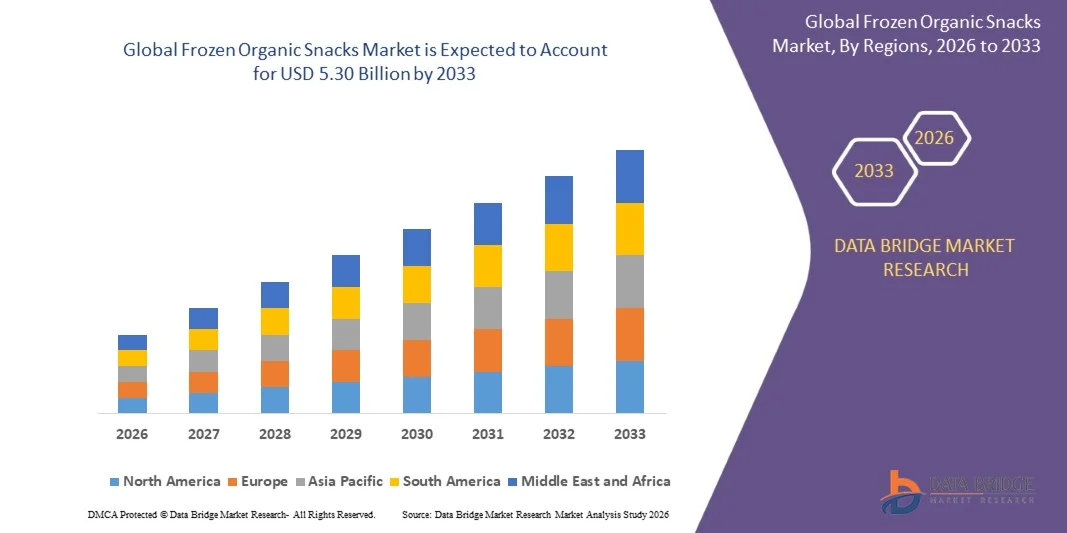
- As per Data Bridge Market Research analysis the frozen organic snacks market was valued at USD 2.44 billion in 2025 and is projected to reach USD 5.30 billion by 2033, growing at a CAGR of 10.20% from 2026 to 2033.
- The market is experiencing consistent growth driven by rising consumer demand for convenient, healthy, and clean-label snack options, increasing preference for organic food products, and expanding availability of frozen organic snacks through modern retail and online channels.
- The growing focus on healthier eating habits, coupled with increasing demand for minimally processed and preservative-free foods, is encouraging consumers, retailers, and food manufacturers to adopt and expand frozen organic snack offerings.
Market Size & Forecast
- Market Value (2025): USD 2.44 Billion
- Expected Market Value (2033): USD 5.30 Billion
- Forecast CAGR (2026–2033): 10.20%
- Leading Region in 2025: North America
- Fastest Growing Region: Asia-Pacific
What are the Major Takeaways of the Frozen Organic Snacks Market?
- North America dominated the frozen organic snacks market with the largest revenue share in 2025, supported by strong consumer demand for organic foods, convenient frozen products, and healthier snacking options.
- Asia-Pacific frozen organic snacks market is expected to witness the fastest growth rate from 2026 to 2033, supported by increasing urbanization, rising disposable incomes, and growing awareness of organic and healthier food products in countries such as China, Japan, and India.
- Frozen organic fruits segment held the largest market revenue share in 2025 driven by rising demand for convenient, nutrient-rich, and minimally processed frozen snack options. Frozen organic fruits are preferred due to their natural nutritional profile, convenience, longer shelf life, and increasing use in smoothies, desserts, and ready-to-eat snack applications.
- The organic frozen snack bars and bites segment is projected to register the fastest growth at a CAGR from 2026 to 2033, driven by increasing demand for convenient, portion-controlled, and clean-label snacking products. Rising consumer preference for organic ingredients and healthier alternatives to conventional packaged snacks is accelerating segment expansion.
- Pouches segment held the largest market revenue share in 2025 driven by their lightweight structure, portability, resealable features, and suitability for frozen fruits, vegetables, and smoothie packs. Pouches are preferred due to their convenience, efficient storage, and reduced packaging material requirements across household and retail applications.
- The cups and containers segment is projected to register the fastest growth at a CAGR from 2026 to 2033, driven by increasing demand for single-serving frozen snacks and convenient portion-controlled packaging. Rising consumption of frozen smoothie packs, fruit-based snacks, and ready-to-eat organic products is accelerating segment expansion.
Report Scope and Frozen Organic Snacks Market Segmentation
|
Attributes |
Frozen Organic Snacks Key Market Insights |
|
Segments Covered |
|
|
Countries Covered |
North America
Europe
Asia-Pacific
Middle East and Africa
South America
|
|
Key Market Players |
|
|
Market Opportunities |
|
|
Value Added Data Infosets |
In addition to the insights on market scenarios such as market value, growth rate, segmentation, geographical coverage, and major players, the market reports curated by the Data Bridge Market Research also include in-depth expert analysis, pricing analysis, brand share analysis, consumer survey, demography analysis, supply chain analysis, value chain analysis, raw material/consumables overview, vendor selection criteria, PESTLE Analysis, Porter Analysis, and regulatory framework. |
What is the Key Trend in the Frozen Organic Snacks Market?
- Consumers are increasingly seeking convenient frozen snacks made with organic, plant-based, and recognizable ingredients, as frozen formats provide longer shelf life while supporting quick and easy meal and snacking occasions.
- For instance, Daily Harvest offers frozen products made with certified organic fruits, vegetables, and whole-food ingredients, with its products frozen at peak ripeness to preserve nutrients and provide convenient preparation.
- The growing emphasis on whole-food ingredients, clean labels, and plant-based formulations is encouraging brands to expand organic frozen snack and meal portfolios to meet evolving consumer preferences.
- Retailers and food brands are increasingly combining organic positioning with functional nutrition, including higher-protein and nutrient-dense frozen products, to appeal to health-conscious consumers. For instance, Whole Foods Market identified “Protein Power-Up” as one of its top food trends for 2025 and highlighted protein-rich frozen and organic products within its trend selection.
- As consumers increasingly prioritize convenience, nutrition, and organic ingredients, manufacturers are expected to expand innovative frozen snack formats, strengthening the role of organic frozen products in everyday snacking and quick-meal occasions.
What are the Key Drivers of the Frozen Organic Snacks Market?
- Rising consumer demand for organic food products is a major driver of the frozen organic snacks market, supported by increasing awareness of clean-label ingredients, sustainable production, and healthier food choices.
- For instance, according to the Organic Trade Association, U.S. sales of certified organic products reached USD 76.6 billion in 2025, increasing 6.8% year-over-year and growing at twice the rate of the overall marketplace.
- The expansion of organic food sales across conventional grocery retailers is improving product accessibility and creating broader distribution opportunities for organic frozen snacks. USDA data shows that traditional grocery stores, club stores, and supercenters accounted for 56% of U.S. organic food sales to consumers in 2020.
- For instance, Daily Harvest provides frozen organic fruits and vegetable-based products directly to consumers, including certified organic smoothies and other frozen offerings, demonstrating the growing integration of organic products with convenient delivery models.
- With organic food sales continuing to expand and retailers and direct-to-consumer brands increasing access to convenient frozen offerings, demand for frozen organic snacks is expected to strengthen across household and on-the-go consumption occasions.
Which Factors are Challenging the Growth of the Frozen Organic Snacks Market?
- Higher production and retail prices for organic ingredients remain a major challenge for the frozen organic snacks market, as organic products generally carry price premiums compared with conventional alternatives.
- These price differences can limit adoption among price-sensitive consumers and create challenges for manufacturers seeking to balance organic certification, ingredient costs, cold-chain logistics, and competitive retail pricing.
- For instance, USDA reported that organic products continue to be priced higher than their conventional counterparts in many markets, while also noting that organic price premiums remain high as demand increases.
- The frozen organic snacks market also depends on reliable cold-chain infrastructure and specialized storage and transportation, which can increase operational costs and complicate distribution across distant or emerging markets. Daily Harvest, for instance, ships its frozen products on dry ice and requires customers to store them in freezers after delivery.
- These higher ingredient, certification, storage, and distribution costs continue to create pricing and accessibility barriers, particularly for smaller manufacturers and consumers in price-sensitive markets, potentially slowing wider adoption despite strong underlying demand for organic foods.
How is the Frozen Organic Snacks Market Segmented?
The market is segmented on the basis of product type, packaging type, consumer type, distribution channel, and end use.
- By Product Type
On the basis of product type, the frozen organic snacks market is segmented into frozen organic fruits, frozen organic vegetables, organic frozen smoothie packs, organic frozen appetizers, organic frozen snack bars and bites, and others. Frozen organic fruits segment held the largest market revenue share in 2025 driven by rising demand for convenient, nutrient-rich, and minimally processed frozen snack options. Frozen organic fruits are preferred due to their natural nutritional profile, convenience, longer shelf life, and increasing use in smoothies, desserts, and ready-to-eat snack applications.
The organic frozen snack bars and bites segment is projected to register the fastest growth at a CAGR from 2026 to 2033, driven by increasing demand for convenient, portion-controlled, and clean-label snacking products. Rising consumer preference for organic ingredients and healthier alternatives to conventional packaged snacks is accelerating segment expansion.
- By Packaging Type
On the basis of packaging type, the frozen organic snacks market is segmented into pouches, boxes and cartons, trays, cups and containers, and others. Pouches segment held the largest market revenue share in 2025 driven by their lightweight structure, portability, resealable features, and suitability for frozen fruits, vegetables, and smoothie packs. Pouches are preferred due to their convenience, efficient storage, and reduced packaging material requirements across household and retail applications.
The cups and containers segment is projected to register the fastest growth at a CAGR from 2026 to 2033, driven by increasing demand for single-serving frozen snacks and convenient portion-controlled packaging. Rising consumption of frozen smoothie packs, fruit-based snacks, and ready-to-eat organic products is accelerating segment expansion.
- By Consumer Type
On the basis of consumer type, the frozen organic snacks market is segmented into children, adults, families, health-conscious consumers, and others. Health-conscious consumers segment held the largest market revenue share in 2025 driven by increasing awareness of organic ingredients, clean-label products, and healthier snacking habits. Health-conscious consumers are increasingly preferring frozen organic snacks due to their nutritional value, convenience, and alignment with wellness-focused lifestyles.
The children segment is projected to register the fastest growth at a CAGR from 2026 to 2033, driven by increasing parental preference for healthier and convenient snack alternatives. Rising demand for organic ingredients, fruit-based snacks, and minimally processed products for children is accelerating segment expansion.
- By Distribution Channel
On the basis of distribution channel, the frozen organic snacks market is segmented into supermarkets and hypermarkets, convenience stores, specialty food stores, online retailers, and others. Supermarkets and hypermarkets segment held the largest market revenue share in 2025 driven by their extensive product availability, dedicated frozen food sections, promotional activities, and strong consumer footfall. Supermarkets and hypermarkets are preferred due to their wide assortment of organic frozen products and convenient one-stop shopping experience.
The online retailers segment is projected to register the fastest growth at a CAGR from 2026 to 2033, driven by increasing online grocery adoption, convenient home delivery, and expanding cold-chain fulfillment capabilities. Rising consumer preference for digital grocery shopping and increasing availability of premium organic frozen products online is accelerating segment expansion.
- By End Use
On the basis of end use, the frozen organic snacks market is segmented into household, foodservice, institutional, and others. Household segment held the largest market revenue share in 2025 driven by increasing demand for convenient meal solutions, ready-to-eat snacks, and longer shelf-life food products. Households are increasingly preferring frozen organic snacks due to their convenience, easy preparation, portion flexibility, and suitability for everyday consumption.
The foodservice segment is projected to register the fastest growth at a CAGR from 2026 to 2033, driven by increasing adoption of frozen organic ingredients and prepared snack products across restaurants, cafés, catering businesses, and institutional kitchens. Rising demand for consistent product quality, simplified food preparation, and efficient inventory management is accelerating segment expansion.
Which Region Holds the Largest Share of the Frozen Organic Snacks Market?
- North America dominated the frozen organic snacks market with the largest revenue share in 2025, supported by strong consumer demand for organic foods, convenient frozen products, and healthier snacking options.
- Consumers in the region increasingly value clean-label ingredients, nutritional benefits, and convenient preparation offered by frozen organic snacks. This widespread adoption is further supported by high disposable incomes, established organic food retailers, and strong availability of premium frozen products, establishing frozen organic snacks as a preferred choice across household and on-the-go consumption occasions.
U.S. Frozen Organic Snacks Market Insight
U.S. frozen organic snacks market captured the largest revenue share in 2025 within North America, fueled by the expanding organic food industry and increasing consumer preference for convenient and healthier snack alternatives. Consumers are increasingly prioritizing organic ingredients, minimally processed foods, and clean-label products. The growing preference for frozen fruits, vegetables, smoothie packs, and organic appetizers, combined with strong supermarket and online grocery distribution, further propels the frozen organic snacks industry. Moreover, the expansion of organic product portfolios by food manufacturers and retailers is significantly contributing to the market's expansion.
Europe Frozen Organic Snacks Market Insight
Europe frozen organic snacks market is expected to witness the fastest growth rate from 2026 to 2033, primarily driven by increasing consumer awareness of organic food, sustainability, and healthier eating habits. The increase in demand for convenient food products, coupled with stringent standards for organic production and labeling, is fostering the adoption of frozen organic snacks. European consumers are also drawn to clean-label, plant-based, and minimally processed products. The region is experiencing significant growth across household, retail, and foodservice applications, with frozen organic snacks gaining greater availability through supermarkets, specialty food stores, and online retailers.
U.K. Frozen Organic Snacks Market Insight
U.K. frozen organic snacks market is expected to witness the fastest growth rate from 2026 to 2033, driven by the escalating demand for organic and healthier food products and a growing preference for convenient snacking solutions. In addition, increasing consumer awareness of sustainable sourcing and clean-label ingredients is encouraging households to choose organic frozen snacks. The U.K.'s strong supermarket network, alongside its expanding online grocery infrastructure and growing availability of premium organic products, is expected to continue to stimulate market growth.
Germany Frozen Organic Snacks Market Insight
Germany frozen organic snacks market is expected to witness the fastest growth rate from 2026 to 2033, fueled by increasing awareness of organic food, sustainable consumption, and demand for convenient nutrition-focused products. Germany's well-developed retail infrastructure, combined with its strong organic food industry and emphasis on environmental sustainability, promotes the adoption of frozen organic snacks, particularly among health-conscious households. The availability of organic products through supermarkets, discount retailers, and specialty stores is also becoming increasingly prevalent, with a strong preference for high-quality, sustainably produced food aligning with local consumer expectations.
Asia-Pacific Frozen Organic Snacks Market Insight
The Asia-Pacific frozen organic snacks market is expected to witness the fastest growth rate from 2026 to 2033, supported by increasing urbanization, rising disposable incomes, and growing awareness of organic and healthier food products in countries such as China, Japan, and India. The region's growing inclination toward convenient and premium food products, supported by expanding modern retail and e-commerce channels, is driving the adoption of frozen organic snacks. Furthermore, increasing investments in cold-chain infrastructure and the expansion of international and domestic organic food brands are improving the affordability and accessibility of frozen organic snacks across the region.
Japan Frozen Organic Snacks Market Insight
Japan frozen organic snacks market is expected to witness the fastest growth rate from 2026 to 2033 due to the country's aging population, high demand for convenience, and increasing awareness of healthier food choices. The Japanese market places a significant emphasis on food quality and convenience, and the adoption of frozen organic snacks is driven by the increasing popularity of ready-to-eat and easy-to-prepare food products. The integration of organic ingredients with convenient frozen formats is fueling growth. Moreover, Japan's established frozen food culture and sophisticated retail infrastructure are likely to spur demand for convenient, nutritious, and premium organic snack solutions across residential and foodservice sectors.
China Frozen Organic Snacks Market Insight
The China frozen organic snacks market accounted for the largest market revenue share in Asia Pacific in 2025, attributed to the country's expanding middle class, rapid urbanization, and increasing consumer awareness of premium and healthier foods. China stands as one of the largest and fastest-growing markets for packaged and frozen food products, and organic frozen snacks are gaining popularity among urban households and younger consumers. The expansion of modern retail, e-commerce platforms, and cold-chain logistics, alongside increasing availability of organic food products, are key factors propelling the market in China.
Which are the Top Companies in Frozen Organic Snacks Market?
The frozen organic snacks industry is primarily led by well-established companies, including:
- Amy's Kitchen, Inc. (U.S.)
- Daily Harvest, Inc. (U.S.)
- Once Upon a Farm PBC (U.S.)
- Dr. Praeger's Sensible Foods, LLC (U.S.)
- General Mills, Inc. (U.S.)
- Conagra Brands, Inc. (U.S.)
- The Hain Celestial Group, Inc. (U.S.)
- Daiya Foods Inc. (Canada)
- Wawona Frozen Foods, Inc. (U.S.)
- Stahlbush Island Farms, Inc. (U.S.)
- Sno Pac Foods, Inc. (U.S.)
- Bonduelle SA (France)
- Ardo Group (Belgium)
- Nature's Path Foods, Inc. (Canada)
- Vegifresh Agro Exports Pvt. Ltd. (India)

- Interactive Data Analysis Dashboard
- Company Analysis Dashboard for high growth potential opportunities
- Research Analyst Access for customization & queries
- Competitor Analysis with Interactive dashboard
- Latest News, Updates & Trend analysis
- Harness the Power of Benchmark Analysis for Comprehensive Competitor Tracking
Data collection and base year analysis are done using data collection modules with large sample sizes. The stage includes obtaining market information or related data through various sources and strategies. It includes examining and planning all the data acquired from the past in advance. It likewise envelops the examination of information inconsistencies seen across different information sources. The market data is analysed and estimated using market statistical and coherent models. Also, market share analysis and key trend analysis are the major success factors in the market report. To know more, please request an analyst call or drop down your inquiry.
The key research methodology used by DBMR research team is data triangulation which involves data mining, analysis of the impact of data variables on the market and primary (industry expert) validation. Data models include Vendor Positioning Grid, Market Time Line Analysis, Market Overview and Guide, Company Positioning Grid, Patent Analysis, Pricing Analysis, Company Market Share Analysis, Standards of Measurement, Global versus Regional and Vendor Share Analysis. To know more about the research methodology, drop in an inquiry to speak to our industry experts.
Data Bridge Market Research is a leader in advanced formative research. We take pride in servicing our existing and new customers with data and analysis that match and suits their goal. The report can be customized to include price trend analysis of target brands understanding the market for additional countries (ask for the list of countries), clinical trial results data, literature review, refurbished market and product base analysis. Market analysis of target competitors can be analyzed from technology-based analysis to market portfolio strategies. We can add as many competitors that you require data about in the format and data style you are looking for. Our team of analysts can also provide you data in crude raw excel files pivot tables (Fact book) or can assist you in creating presentations from the data sets available in the report.