


Frozen Potato Market Overview
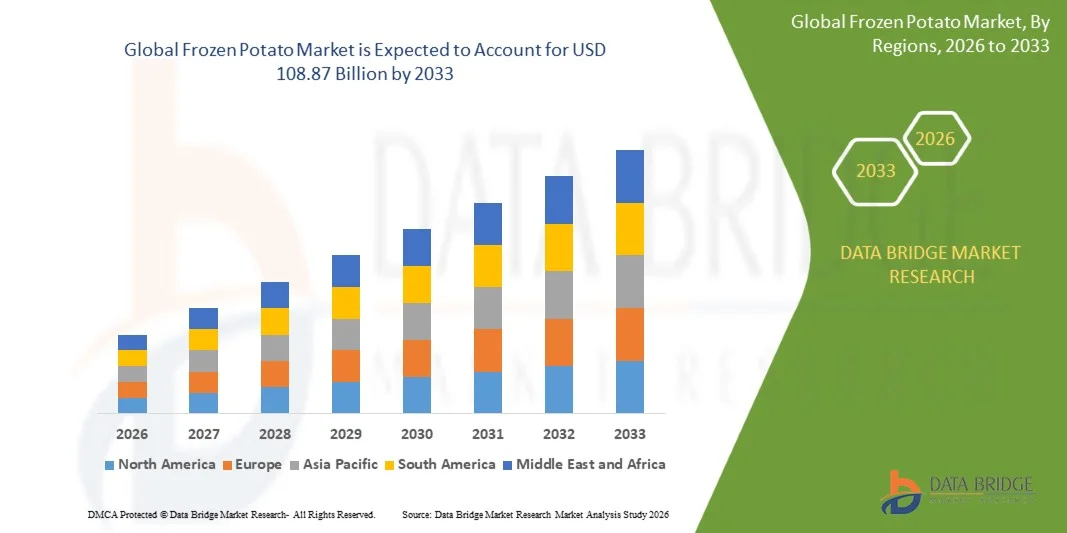
The Frozen Potato Market was valued at USD 75.40 Billion in 2025 and is projected to reach USD 108.87 Billion by 2033, growing at a CAGR of 4.70% from 2026 to 2033. The market is experiencing consistent growth driven by increasing demand for convenience foods, expanding quick-service restaurant networks, and rising consumption of ready-to-cook potato products across residential and commercial sectors. Growing urbanization, changing dietary habits, and improvements in cold chain infrastructure are further supporting market expansion across developed and emerging economies. Continuous product innovations and increasing penetration of organized retail channels are also contributing to sustained market growth.
The increasing preference for convenient meal solutions and frozen food products, combined with busy consumer lifestyles and rising disposable incomes, is encouraging greater adoption of frozen potato products worldwide. Frozen French fries, hash browns, and other potato specialties are increasingly being utilized by restaurants, hotels, and households due to their extended shelf life, ease of preparation, and consistent quality. Furthermore, expansion of foodservice industries and growing investments in advanced freezing and storage technologies are strengthening the long-term growth prospects of the Frozen Potato Market.
Key Market Trends & Insights
- Asia-Pacific dominated the Frozen Potato Market with the largest revenue share of 32% in 2025, supported by rising consumption of convenience foods, expanding quick-service restaurant chains, and increasing penetration of frozen food products across developing economies
- The french fries segment led the market with a 46.8% share in 2025, driven by strong consumer preference for convenient and ready-to-cook potato products across households and foodservice establishments
- North America is expected to be the fastest-growing region at a CAGR of 5.5% from 2026 to 2033, fueled by increasing demand for convenience foods, expansion of foodservice chains, and rising consumption of frozen snacks
- Hash brown is the fastest-growing product type, projected to register a CAGR of 7.8% from 2026 to 2033, supported by increasing demand for breakfast-oriented convenience foods and expanding menu offerings across cafés and restaurant chains
- Commercial accounted for 69.5% of the market in 2025, preferred by extensive consumption of frozen potato products across quick-service restaurants, hotels, cafés, institutional kitchens, and catering facilities
- The residential segment is the fastest-growing end user category, with a CAGR of 6.9% from 2026 to 2033, driven by rising demand for convenient and easy-to-prepare meal options among busy consumers
Market Size & Forecast
- Global Market Value (2025): USD 75.40 Billion
- Expected Market Value (2033): USD 108.87 Billion
- Forecast CAGR (2026–2033): 4.70%
- Leading Region in 2025: Asia-Pacific
- Fastest Growing Region: North America
Report Scope and Frozen Potato Market Segmentation
|
Attributes |
Frozen Potato Key Market Insights |
|
Segments Covered |
|
|
Countries Covered |
North America · U.S. · Canada · Mexico Europe · Germany · France · U.K. · Netherlands · Switzerland · Belgium · Russia · Italy · Spain · Turkey · Rest of Europe Asia-Pacific · China · Japan · India · South Korea · Singapore · Malaysia · Australia · Thailand · Indonesia · Philippines · Rest of Asia-Pacific Middle East and Africa · Saudi Arabia · U.A.E. · South Africa · Egypt · Israel · Rest of Middle East and Africa South America · Brazil · Argentina · Rest of South America |
|
Key Market Players |
· The Hain Celestial Company (U.S.) · AGRARFROST GMBH & CO. KG (Germany) · Agristo (Belgium) · Bart’s Potato Company bvba (Belgium) · Royal Cosun (Netherlands) · Farm Frites (Netherlands) · Greenyard (Belgium) · Himalaya Food International Ltd. (India) · J.R. Simplot Company (U.S.) · McCain Foods Ltd. (U.K.) · Lamb Weston Holdings, Inc. (U.K.) · General Mills, Inc. (U.S.) · Mondelez International, Inc. (U.S.) · THE KRAFT HEINZ COMPANY (U.S.) |
|
Market Opportunities |
· Growing Adoption of Air Fryer-Compatible and Health-Oriented Frozen Potato Products · Increasing Penetration of Frozen Foods in Emerging Markets · Expansion of E-Commerce and Online Grocery Distribution Channels for Frozen Products |
|
Value Added Data Infosets |
In addition to the insights on market scenarios such as market value, growth rate, segmentation, geographical coverage, and major players, the market reports curated by the Data Bridge Market Research also include in-depth expert analysis, pricing analysis, brand share analysis, consumer survey, demography analysis, supply chain analysis, value chain analysis, raw material/consumables overview, vendor selection criteria, PESTLE Analysis, Porter Analysis, and regulatory framework. |
Frozen Potato Market Trends
Trend: Rising Demand for Convenience and Ready-to-Cook Food Products
Consumers worldwide are increasingly shifting toward convenient meal solutions due to busy lifestyles, rising urbanization, and growing preference for time-saving food products. Frozen potato products such as French fries, hash browns, and potato specialties are witnessing strong demand across retail and foodservice channels owing to their long shelf life and ease of preparation. Expanding penetration of air fryers and home meal consumption trends are further supporting product adoption across developed and emerging economies. The increasing popularity of frozen food categories is also encouraging manufacturers to introduce value-added and premium offerings.
Companies such as McCain Foods and Lamb Weston continue to expand their product portfolios with innovative frozen potato offerings for both household and commercial consumers, while according to the U.S. Department of Agriculture, global frozen potato exports exceeded 8 million metric tons in 2024, reflecting strong worldwide demand.
Frozen Potato Market Dynamics
Key Market Driver: Expansion of Quick-Service Restaurants and Foodservice Chains
The rapid growth of quick-service restaurants, cafés, and institutional foodservice establishments is significantly driving demand for frozen potato products worldwide. Restaurants increasingly prefer frozen fries and potato specialties because they offer consistent quality, lower preparation time, and improved inventory management. Rising consumption of fast food and increasing spending on dining-out activities are further supporting market expansion across major economies. In addition, the expansion of international restaurant chains across Asia-Pacific and the Middle East is creating substantial opportunities for frozen potato suppliers.
Major companies such as McDonald's, Restaurant Brands International, and Yum! Brands rely extensively on suppliers including McCain Foods and J.R. Simplot Company to ensure a stable supply of frozen potato products, supporting continued growth of the commercial segment.
Key Restraint/Challenge: Fluctuations in Potato Prices and Raw Material Supply
A major challenge in the Frozen Potato market is the volatility in potato prices and disruptions in agricultural production caused by unfavorable weather conditions, water scarcity, and changing crop yields. Variations in raw material availability directly affect manufacturing costs and profit margins for frozen potato producers. Rising energy costs and increasing transportation expenses are further adding pressure on the overall supply chain. Supply shortages can also lead to reduced production volumes and inconsistent product availability across regions.
In 2024, Lamb Weston Holdings reported lower production volumes and higher manufacturing costs due to unfavorable potato harvest conditions in North America, highlighting the impact of raw material supply fluctuations on the frozen potato industry.
Key Market Opportunity: Increasing Penetration of Frozen Foods in Emerging Markets
The growing acceptance of frozen foods across emerging economies is creating substantial opportunities for frozen potato manufacturers. Rising disposable incomes, expanding modern retail networks, and improving cold chain infrastructure are increasing consumer access to frozen products in countries across Asia-Pacific, Latin America, and the Middle East. Growing urban populations and increasing demand for convenient food products are further accelerating market development. The rapid expansion of supermarkets, hypermarkets, and online grocery platforms is also enhancing product availability and supporting consumption growth.
Companies such as Farm Frites and McCain Foods are expanding their production capacities and strengthening their presence in India, China, and Southeast Asian countries to capitalize on rising demand for frozen food products and growing foodservice industries in these regions.
Frozen Potato Market Scope
The frozen potato market is segmented on the basis of product and end user.
- By Product
On the basis of product, the Frozen Potato Market is segmented into French Fries, Hash Brown, Shapes, Mashed, Sweet Potatoes/Yam, Battered/Cooked, Twice Baked, Topped/Stuff, and Others. The French Fries segment dominated the market with the largest share of 46.8% in 2025, driven by strong consumer preference for convenient and ready-to-cook potato products across households and foodservice establishments. Extensive utilization of frozen French fries by quick-service restaurants, fast-food chains, and institutional catering operations continues to support volume demand. The segment benefits from long shelf life, ease of preparation, and consistent taste and texture characteristics. Continuous expansion of international restaurant chains and rising consumption of Western-style snacks across emerging economies further strengthen segment leadership. Ongoing product innovations in seasoning and healthier cooking formats are also contributing to sustained market dominance.
The Hash Brown segment is projected to register the fastest growth at a CAGR of 7.8% from 2026 to 2033, driven by increasing demand for breakfast-oriented convenience foods and expanding menu offerings across cafés and restaurant chains. Rising consumer preference for quick meal solutions and ready-to-serve side dishes is accelerating product adoption. Manufacturers are introducing premium and flavored variants to cater to changing taste preferences and evolving consumption patterns. Growing penetration of frozen foods in developing countries and improvements in cold chain infrastructure are supporting market expansion. Increasing availability through supermarkets, hypermarkets, and online grocery platforms is further enhancing accessibility and fueling segment growth.
- By End User
On the basis of end user, the Frozen Potato Market is segmented into Residential and Commercial. The Commercial segment dominated the market with a share of 69.5% in 2025, supported by extensive consumption of frozen potato products across quick-service restaurants, hotels, cafés, institutional kitchens, and catering facilities. The segment benefits from increasing demand for standardized food quality, operational efficiency, and reduced preparation time in foodservice operations. Rising expansion of fast-food chains and growing popularity of takeaway and delivery services are creating substantial demand for frozen potato products. Bulk purchasing practices and the need for consistent supply throughout the year further reinforce segment dominance. Continuous menu diversification and increasing consumer spending on dining-out activities are strengthening the segment's leading position.
The Residential segment is projected to register the fastest growth at a CAGR of 6.9% from 2026 to 2033, driven by rising demand for convenient and easy-to-prepare meal options among busy consumers. Increasing adoption of frozen foods by working professionals and nuclear families is supporting market growth across developed and emerging economies. Improvements in household refrigeration capacity and greater product availability through retail channels are enhancing consumer access. Growing awareness regarding food preservation and reduced wastage is encouraging the use of frozen potato products for daily consumption. Expansion of e-commerce grocery platforms and increasing preference for home-based snacking and meal preparation are further accelerating segment growth.
Frozen Potato Market Regional Analysis
Asia-Pacific dominated the frozen potato market and accounted for the largest revenue share of 32% in 2025, supported by rising consumption of convenience foods, expanding quick-service restaurant chains, and increasing penetration of frozen food products across developing economies. The region benefits from a large consumer base, improving cold chain infrastructure, and growing demand for ready-to-cook products among urban populations. Increasing investments in food processing facilities and expansion of modern retail channels are further accelerating regional market growth. Rising disposable incomes and changing dietary preferences are also supporting long-term demand for frozen potato products.
China Frozen Potato Market Insight
China held the largest share in the Asia-Pacific Frozen Potato market in 2025, supported by strong growth of fast-food chains, increasing consumption of Western-style snacks, and expanding foodservice industries. The country benefits from a well-established food processing sector and rising investments in cold storage and distribution networks. Growing demand for convenient meal solutions among urban consumers is further supporting market expansion. In addition, increasing presence of international restaurant brands and rising online grocery sales are reinforcing China's leadership position in the regional market.
India Frozen Potato Market Insight
India is witnessing the fastest growth in the Asia-Pacific region, driven by rising urbanization, increasing adoption of frozen foods, and expanding quick-service restaurant networks. Growing demand for convenient and ready-to-cook food products among working professionals and younger consumers is significantly supporting market growth. Improvements in cold chain logistics and increasing penetration of supermarkets and hypermarkets are enhancing product accessibility. In addition, rising popularity of home delivery platforms and changing food consumption patterns are accelerating long-term market expansion.
Europe Frozen Potato Market Insight
The Europe Frozen Potato market is expanding steadily, supported by strong consumption of processed potato products and the presence of established foodservice and retail industries. Consumers across the region are increasingly preferring convenient meal solutions and premium frozen food products, which is strengthening market demand. High utilization of frozen potatoes in restaurants, hotels, and institutional catering facilities is further contributing to market expansion. In addition, continuous product innovation and increasing focus on sustainable food production practices are supporting regional market development.
Germany Frozen Potato Market Insight
Germany accounted for the largest share in the Europe Frozen Potato market in 2025, driven by strong demand from foodservice operators, growing retail sales of frozen foods, and extensive consumption of potato-based snacks. The country has a highly developed food processing industry that supports large-scale production and distribution of frozen potato products. Rising consumer preference for convenience foods and premium product offerings is further strengthening market growth. In addition, expansion of supermarket chains and increasing demand for ready-to-cook meals are reinforcing Germany's leading market position.
U.K. Frozen Potato Market Insight
The U.K. market is supported by increasing consumption of frozen convenience foods and strong demand from quick-service restaurants and takeaway outlets. Rising preference for easy-to-prepare meals and busy lifestyles are contributing to greater adoption of frozen potato products. The country is also witnessing growing demand for healthier and air-fryer-compatible frozen offerings among consumers. In addition, expansion of online grocery platforms and increasing availability of premium potato products are further supporting market growth.
North America Frozen Potato Market Insight
North America is projected to grow at the fastest CAGR of 5.5% from 2026 to 2033, driven by increasing demand for convenience foods, expansion of foodservice chains, and rising consumption of frozen snacks. Growing preference for ready-to-cook products and busy lifestyles are significantly supporting regional market growth. Strong adoption of advanced freezing technologies and extensive distribution networks are further accelerating product availability. In addition, increasing demand for premium and value-added potato products is boosting market expansion across the region.
U.S. Frozen Potato Market Insight
The U.S. accounted for the largest share in the North America Frozen Potato market in 2025, supported by strong consumption of French fries and other processed potato products across restaurants, retail outlets, and households. The country benefits from the presence of major frozen food manufacturers and an extensive cold storage infrastructure. Rising demand for convenient meal solutions and increasing popularity of home-based dining are further strengthening market growth. In addition, growing product innovation and expanding distribution through supermarkets and e-commerce channels are reinforcing the U.S. leadership position in the regional market.
Frozen Potato Market Share
The frozen potato industry is primarily led by well-established companies, including:
- The Hain Celestial Company (U.S.)
- AGRARFROST GMBH & CO. KG (Germany)
- Agristo (Belgium)
- Bart’s Potato Company bvba (Belgium)
- Royal Cosun (Netherlands)
- Farm Frites (Netherlands)
- Greenyard (Belgium)
- Himalaya Food International Ltd. (India)
- R. Simplot Company (U.S.)
- McCain Foods Ltd. (U.K.)
- Lamb Weston Holdings, Inc. (U.K.)
- General Mills, Inc. (U.S.)
- Mondelez International, Inc. (U.S.)
- THE KRAFT HEINZ COMPANY (U.S.)
Latest Developments in Frozen Potato Market
- In October 2025, J.R. Simplot Company, a leading agribusiness and food manufacturing company, acquired Belgium-based Clarebout Potatoes for an undisclosed amount. This strategic acquisition significantly strengthened Simplot’s frozen potato production and distribution capabilities across Europe while enhancing its ability to serve retail, foodservice, and private-label customers. The integration of Clarebout’s manufacturing expertise and established customer base is expected to improve supply chain efficiency and support increasing global demand for frozen potato products. The move also reinforces ongoing consolidation trends within the market and intensifies competition among major manufacturers.
- In September 2025, Lamb Weston introduced a new portfolio of frozen potato products tailored specifically for the foodservice industry after incorporating feedback from chefs and restaurant operators. This product expansion strengthened the company’s ability to address evolving menu requirements and demand for high-quality potato offerings. The initiative is expected to increase customer loyalty among restaurant chains and institutional buyers while supporting revenue growth in the commercial segment. The launch highlights the growing importance of customized product development in maintaining competitiveness within the frozen potato market.
- In August 2025, McCain Foods announced a partnership with a leading technology company to develop AI-driven solutions for optimizing supply chain operations. The collaboration is expected to improve inventory management, enhance forecasting capabilities, and reduce operational costs across production and distribution activities. By adopting advanced digital technologies, McCain Foods is strengthening its ability to respond efficiently to changing consumer demand and ensure reliable product availability. This development reflects the increasing role of automation and data analytics in improving competitiveness across the frozen potato industry.
- In July 2025, Aviko launched a sustainability initiative aimed at reducing water consumption in its manufacturing processes by 30% over the next five years. The program is expected to enhance resource efficiency and support the company’s long-term environmental goals while responding to growing consumer preference for sustainably produced food products. Improved sustainability performance may strengthen Aviko’s brand image and provide a competitive advantage among environmentally conscious customers. The initiative also highlights the industry's increasing focus on responsible production practices and resource conservation
- In May 2025, McCain Foods expanded investments in regenerative agriculture programs across North America and Europe to improve potato crop resilience and promote sustainable sourcing. The initiative is expected to strengthen raw material availability, enhance supply chain stability, and support the production of high-quality frozen potato products. Growing emphasis on sustainable agricultural practices is likely to improve long-term operational efficiency and meet increasing demand for environmentally responsible food products. This development underscores the importance of sustainable sourcing strategies in supporting future growth of the frozen potato market

- Interactive Data Analysis Dashboard
- Company Analysis Dashboard for high growth potential opportunities
- Research Analyst Access for customization & queries
- Competitor Analysis with Interactive dashboard
- Latest News, Updates & Trend analysis
- Harness the Power of Benchmark Analysis for Comprehensive Competitor Tracking
Global Frozen Potato Market, Supply Chain Analysis and Ecosystem Framework
To support market growth and help clients navigate the impact of geopolitical shifts, DBMR has integrated in-depth supply chain analysis into its Global Frozen Potato Market research reports. This addition empowers clients to respond effectively to global changes affecting their industries. The supply chain analysis section includes detailed insights such as Global Frozen Potato Market consumption and production by country, price trend analysis, the impact of tariffs and geopolitical developments, and import and export trends by country and HSN code. It also highlights major suppliers with data on production capacity and company profiles, as well as key importers and exporters. In addition to research, DBMR offers specialized supply chain consulting services backed by over a decade of experience, providing solutions like supplier discovery, supplier risk assessment, price trend analysis, impact evaluation of inflation and trade route changes, and comprehensive market trend analysis.
Data collection and base year analysis are done using data collection modules with large sample sizes. The stage includes obtaining market information or related data through various sources and strategies. It includes examining and planning all the data acquired from the past in advance. It likewise envelops the examination of information inconsistencies seen across different information sources. The market data is analysed and estimated using market statistical and coherent models. Also, market share analysis and key trend analysis are the major success factors in the market report. To know more, please request an analyst call or drop down your inquiry.
The key research methodology used by DBMR research team is data triangulation which involves data mining, analysis of the impact of data variables on the market and primary (industry expert) validation. Data models include Vendor Positioning Grid, Market Time Line Analysis, Market Overview and Guide, Company Positioning Grid, Patent Analysis, Pricing Analysis, Company Market Share Analysis, Standards of Measurement, Global versus Regional and Vendor Share Analysis. To know more about the research methodology, drop in an inquiry to speak to our industry experts.
Data Bridge Market Research is a leader in advanced formative research. We take pride in servicing our existing and new customers with data and analysis that match and suits their goal. The report can be customized to include price trend analysis of target brands understanding the market for additional countries (ask for the list of countries), clinical trial results data, literature review, refurbished market and product base analysis. Market analysis of target competitors can be analyzed from technology-based analysis to market portfolio strategies. We can add as many competitors that you require data about in the format and data style you are looking for. Our team of analysts can also provide you data in crude raw excel files pivot tables (Fact book) or can assist you in creating presentations from the data sets available in the report.













