


What is the Global Frozen Snack Food Market Size and Growth Rate?
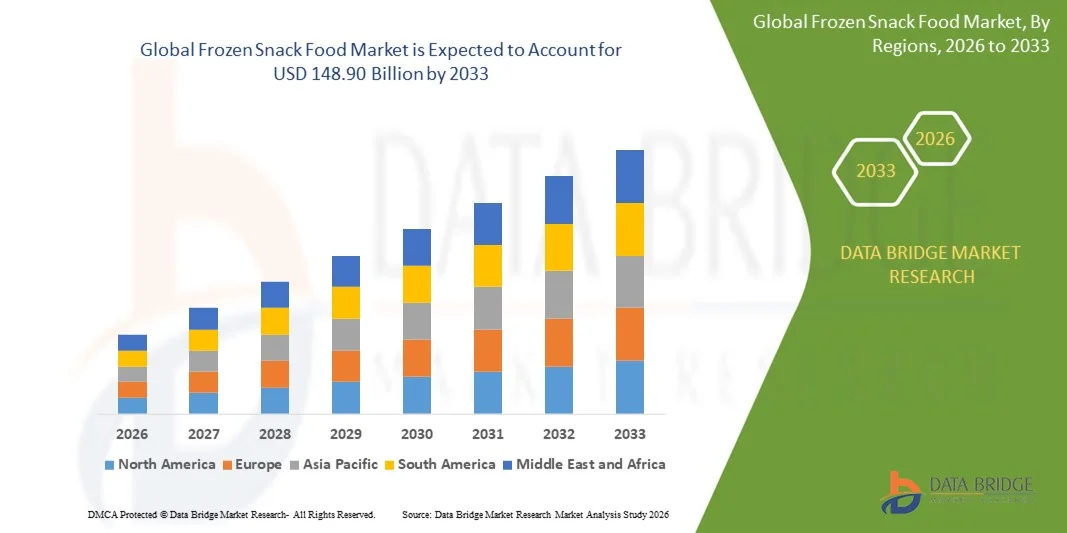
- As per Data Bridge Market Research analysis that the global frozen snack food market size was valued at USD 40.42 billion in 2025 and is expected to reach USD 148.90 billion by 2033, at a CAGR of17.70% during the forecast period
- The rise in the consumption of frozen snack food items because of their convenience acts as one of the major factors driving the growth of frozen snack food market
- The increase in consumer inclination towards Ready-to-Eat (RTE) food products because of rising trend of employment and less time to cook the food items and developments in the retail landscape accelerate the market growth
Market Size & Forecast
- Global Market Value (2025): USD 40.42 billion
- Expected Market Value (2033): USD 148.90 billion
- Forecast CAGR (2026–2033): 17.70%
What are the Major Takeaways of Frozen Snack Food Market?
- The rise in the preference for vegan sources of protein over animal protein containing high cholesterol level, fat, and calorie increasing the risk of cardiac diseases, high blood sugar level, and obesity among people encourages the manufacturers to offer plant-based/vegan frozen products which further influence the market
- In addition, digitalization of the retail industry, urbanization, growth in the awareness, surge in the disposable income, change in consumer lifestyle and rise in population globally positively affect the frozen snack food market. Furthermore, rise in trade of processed food and technological advancements in the cold chain market extend profitable opportunities to the market players
- Europe dominated the frozen snack food market with a 38.7% revenue share in 2025, driven by high consumption of ready-to-eat and convenience foods, well-established cold-chain infrastructure, and strong presence of leading frozen food manufacturers across Western and Northern Europe
- Asia-Pacific is projected to register the fastest CAGR of 11.2% from 2026 to 2033, driven by rapid urbanization, rising disposable incomes, changing dietary habits, and growing adoption of frozen foods across China, India, Japan, South Korea, and Southeast Asia
- The Bakery Products segment dominated the market with a 34.6% share in 2025, driven by high consumption of frozen pizzas, snacks, pastries, rolls, and ready-to-bake items
Report Scope and Frozen Snack Food Market Segmentation
|
Attributes |
Frozen Snack Food Key Market Insights |
|
Segments Covered |
|
|
Countries Covered |
North America
Europe
Asia-Pacific
Middle East and Africa
South America
|
|
Key Market Players |
|
|
Market Opportunities |
|
|
Value Added Data Infosets |
In addition to the insights on market scenarios such as market value, growth rate, segmentation, geographical coverage, and major players, the market reports curated by the Data Bridge Market Research also include in-depth expert analysis, pricing analysis, brand share analysis, consumer survey, demography analysis, supply chain analysis, value chain analysis, raw material/consumables overview, vendor selection criteria, PESTLE Analysis, Porter Analysis, and regulatory framework. |
What is the Key Trend in the Frozen Snack Food Market?
Increasing Shift Toward Convenient, Health-Oriented, and Premium Frozen Snack Foods
- The frozen snack foods market is witnessing strong demand for ready-to-eat, quick-preparation, and portion-controlled snacks, driven by busy lifestyles and rising urbanization
- Manufacturers are introducing baked, air-fried, plant-based, and high-protein frozen snacks with clean-label ingredients and reduced fat, sodium, and preservatives
- Growing preference for premium, ethnic, and gourmet frozen snacks is encouraging innovation in flavors, textures, and global cuisines
- For instance, companies such as Nestlé, Conagra Brands, McCain Foods, General Mills, and Ajinomoto have expanded their frozen snack portfolios with healthier formulations and value-added offerings
- Increasing adoption of smart freezers, modern cold-chain logistics, and e-commerce grocery platforms is improving product accessibility and shelf visibility
- As consumers prioritize convenience without compromising taste or nutrition, Frozen Snack Foods will remain essential for modern snacking habits and on-the-go consumption
What are the Key Drivers of Frozen Snack Food Market?
- Rising demand for convenient, time-saving, and long-shelf-life snack options among working professionals, students, and nuclear households
- For instance, in 2024–2025, leading players such as McCain Foods, Kraft Heinz, and Greenyard launched new frozen snacks targeting health-conscious and premium consumer segments
- Growing consumption of plant-based snacks, meat alternatives, and vegetarian frozen products is boosting market expansion across the U.S., Europe, and Asia-Pacific
- Advancements in freezing technologies, packaging solutions, and cold storage infrastructure have enhanced product quality, safety, and flavor retention
- Expansion of quick-service restaurants (QSRs), cafés, and foodservice chains is increasing demand for frozen appetizers and snack items
- Supported by rising disposable incomes and evolving dietary preferences, the Frozen Snack Foods market is expected to witness steady long-term growth
Which Factor is Challenging the Growth of the Frozen Snack Food Market?
- High dependency on cold-chain infrastructure and refrigerated transportation increases operational and distribution costs
- For instance, during 2024–2025, rising energy prices and logistics disruptions elevated storage and transportation expenses for frozen food manufacturers
- Consumer concerns related to perceived freshness, nutritional value, and use of additives can limit adoption in price-sensitive markets
- Limited cold storage availability in emerging economies restricts market penetration and product reach
- Intense competition from fresh snacks, ready-to-cook foods, and shelf-stable alternatives creates pricing pressure
- To address these challenges, companies are focusing on cost-efficient packaging, clean-label positioning, and cold-chain expansion to strengthen global adoption of Frozen Snack Foods
How is the Frozen Snack Food Market Segmented?
The market is segmented on the basis of product type and distribution channel.
- By Product Type
On the basis of product type, the frozen snack foods market is segmented into Vegetables and Fruits, Meat, Poultry and Seafood, Bakery Products, Meat Substitutes, Frozen Desserts and Confectionery, and Others. The Bakery Products segment dominated the market with a 34.6% share in 2025, driven by high consumption of frozen pizzas, snacks, pastries, rolls, and ready-to-bake items. These products benefit from wide consumer acceptance, ease of preparation, long shelf life, and strong presence across retail and foodservice channels. Rising demand from quick-service restaurants (QSRs), cafés, and institutional catering further supports segment dominance.
The Meat Substitutes segment is expected to grow at the fastest CAGR from 2026 to 2033, fueled by increasing adoption of plant-based diets, rising vegan and flexitarian populations, and growing awareness of sustainability and health benefits. Innovations in texture, taste, and protein enrichment are accelerating consumer acceptance, positioning meat substitutes as a high-growth product category within frozen snack foods.
- By Distribution Channel
On the basis of distribution channel, the frozen snack foods market is segmented into Store-Based and Non-Store-Based channels. The Store-Based segment dominated the market with a 72.1% share in 2025, supported by strong sales through supermarkets, hypermarkets, convenience stores, and specialty food retailers. Consumers prefer store-based channels due to product visibility, immediate availability, promotional offers, and trust in cold-chain handling. In-store freezer infrastructure and private-label expansion by retailers further strengthen this segment’s dominance.
The Non-Store-Based segment is projected to grow at the fastest CAGR from 2026 to 2033, driven by rapid expansion of e-commerce grocery platforms, direct-to-consumer (DTC) frozen food brands, and quick-commerce delivery services. Improved cold-chain logistics, digital payment adoption, and rising preference for doorstep delivery are accelerating online purchases, making non-store-based distribution a key growth avenue in the Frozen Snack Foods market.
Which Region Holds the Largest Share of the Frozen Snack Food Market?
- Europe dominated the frozen snack food market with a 38.7% revenue share in 2025, driven by high consumption of ready-to-eat and convenience foods, well-established cold-chain infrastructure, and strong presence of leading frozen food manufacturers across Western and Northern Europe. High demand for bakery snacks, frozen appetizers, and premium ethnic products across the U.K., Germany, France, Italy, and Nordic countries continues to support market leadership
- European manufacturers are actively introducing clean-label, organic, plant-based, and sustainably sourced frozen snacks, aligning with evolving consumer preferences for health, transparency, and environmental responsibility. Strong regulatory standards and advanced food processing technologies further enhance product quality and safety
- High urbanization, busy lifestyles, and strong penetration of supermarkets, hypermarkets, and private-label frozen food offerings reinforce Europe’s dominant position in the global Frozen Snack Food market
U.K. Frozen Snack Food Market Insight
The U.K. is a key contributor in Europe, supported by high consumption of frozen bakery snacks, appetizers, and ready meals. Strong retail penetration, widespread freezer ownership, and demand for premium and value-added frozen snacks drive steady market growth. Expansion of private-label offerings and innovation in healthier frozen snack alternatives further strengthen market adoption.
Germany Frozen Snack Food Market Insight
Germany demonstrates strong growth due to rising demand for convenient food solutions, increasing preference for frozen vegetarian and vegan snacks, and advanced cold storage infrastructure. Growing consumption through retail and foodservice channels supports long-term market expansion.
Asia-Pacific Frozen Snack Food Market
Asia-Pacific is projected to register the fastest CAGR of 11.2% from 2026 to 2033, driven by rapid urbanization, rising disposable incomes, changing dietary habits, and growing adoption of frozen foods across China, India, Japan, South Korea, and Southeast Asia. Expansion of modern retail formats, quick-commerce platforms, and cold-chain logistics is accelerating frozen snack food consumption across the region.
China Frozen Snack Food Market Insight
China is the largest contributor to Asia-Pacific growth, supported by expanding cold-chain networks, increasing demand for Western-style frozen snacks, and rapid growth of e-commerce grocery platforms. Rising consumption among young urban consumers and foodservice chains drives strong market expansion.
India Frozen Snack Food Market Insight
India is emerging as a high-growth market due to increasing adoption of frozen snacks in urban households, rising QSR penetration, and improving cold storage infrastructure. Growing demand for vegetarian and ethnic frozen snacks further accelerates market growth.
Japan Frozen Snack Food Market Insight
Japan shows steady growth driven by high demand for premium-quality frozen snacks, strong preference for portion-controlled products, and advanced freezing technologies. Convenience-oriented consumption patterns support sustained market development.
South Korea Frozen Snack Food Market Insight
South Korea contributes significantly through growing consumption of frozen ready-to-eat snacks, increasing westernization of diets, and strong presence of modern retail and foodservice chains. Innovation in flavors and packaging supports continuous market growth.
Which are the Top Companies in Which are the Top Companies in Frozen Snack Food Market?
The frozen snack Food industry is primarily led by well-established companies, including:
- Nestlé (Switzerland)
- General Mills, Inc. (U.S.)
- The Kraft Heinz Company (U.S.)
- Conagra Brands, Inc. (U.S.)
- JBS (Brazil)
- Ardo (Belgium)
- Aryzta AG (Switzerland)
- Amy’s Kitchen, Inc. (U.S.)
- Bellisio Foods, Inc. (U.S.)
- Bonduelle (France)
- FINDUS (U.K.)
- Goya Foods, Inc. (U.S.)
- Iceland Foods Ltd. (U.K.)
- Ajinomoto Foods North America (U.S.)
- Natures Peak (U.S.)
- McCain Foods Limited (Canada)
- Greenyard (Belgium)
- NICHIREI CORPORATION (Japan)
- Vinayak Foods Group (India)
- Northern Foods PLC (U.K.)
What are the Recent Developments in Global Frozen Snack Food Market?
- In April 2024, Newman’s Own, Inc., an American food and beverage company, expanded its frozen portfolio by launching thick-crust sourdough frozen pizzas made with premium ingredients, available in Uncured Pepperoni Ricotta, Meatball, and Five Cheese variants, strengthening its presence in the premium frozen snack segment
- In April 2024, Baskin Robbins, an American multinational ice cream manufacturer, introduced two new product formats in India, Doublet Bars and Ice Cream Funwich, with Doublet Bars offered in Choco Fudge and Raspberry Vanilla flavors, reinforcing brand innovation and expanding consumer choice in frozen desserts
- In April 2024, Havmor, a subsidiary of Lotte Wellfood Co Ltd, launched a new summer ice cream range in India featuring Indian dessert-inspired flavors such as Shahi Kesar and Rajwadi Kulfi, enhancing regional flavor appeal and driving seasonal demand
- In March 2024, BigBasket, an Indian online grocery retailer, launched a new frozen foods brand, Precia, offering frozen vegetables, frozen snacks, and frozen sweets nationwide, broadening its private-label portfolio and strengthening its frozen food ecosystem
- In December 2023, Genio Della Pizza, an American frozen pizza brand, introduced frozen pizzas in flavors including Margherita, The Bianca, Broccoli Rabe, and Marinara, expanding product variety and catering to evolving consumer taste preferences

- Interactive Data Analysis Dashboard
- Company Analysis Dashboard for high growth potential opportunities
- Research Analyst Access for customization & queries
- Competitor Analysis with Interactive dashboard
- Latest News, Updates & Trend analysis
- Harness the Power of Benchmark Analysis for Comprehensive Competitor Tracking
Global Frozen Snack Food Market, Supply Chain Analysis and Ecosystem Framework
To support market growth and help clients navigate the impact of geopolitical shifts, DBMR has integrated in-depth supply chain analysis into its Global Frozen Snack Food Market research reports. This addition empowers clients to respond effectively to global changes affecting their industries. The supply chain analysis section includes detailed insights such as Global Frozen Snack Food Market consumption and production by country, price trend analysis, the impact of tariffs and geopolitical developments, and import and export trends by country and HSN code. It also highlights major suppliers with data on production capacity and company profiles, as well as key importers and exporters. In addition to research, DBMR offers specialized supply chain consulting services backed by over a decade of experience, providing solutions like supplier discovery, supplier risk assessment, price trend analysis, impact evaluation of inflation and trade route changes, and comprehensive market trend analysis.
Data collection and base year analysis are done using data collection modules with large sample sizes. The stage includes obtaining market information or related data through various sources and strategies. It includes examining and planning all the data acquired from the past in advance. It likewise envelops the examination of information inconsistencies seen across different information sources. The market data is analysed and estimated using market statistical and coherent models. Also, market share analysis and key trend analysis are the major success factors in the market report. To know more, please request an analyst call or drop down your inquiry.
The key research methodology used by DBMR research team is data triangulation which involves data mining, analysis of the impact of data variables on the market and primary (industry expert) validation. Data models include Vendor Positioning Grid, Market Time Line Analysis, Market Overview and Guide, Company Positioning Grid, Patent Analysis, Pricing Analysis, Company Market Share Analysis, Standards of Measurement, Global versus Regional and Vendor Share Analysis. To know more about the research methodology, drop in an inquiry to speak to our industry experts.
Data Bridge Market Research is a leader in advanced formative research. We take pride in servicing our existing and new customers with data and analysis that match and suits their goal. The report can be customized to include price trend analysis of target brands understanding the market for additional countries (ask for the list of countries), clinical trial results data, literature review, refurbished market and product base analysis. Market analysis of target competitors can be analyzed from technology-based analysis to market portfolio strategies. We can add as many competitors that you require data about in the format and data style you are looking for. Our team of analysts can also provide you data in crude raw excel files pivot tables (Fact book) or can assist you in creating presentations from the data sets available in the report.













