


Fuel Additives and Lubricants Market Size
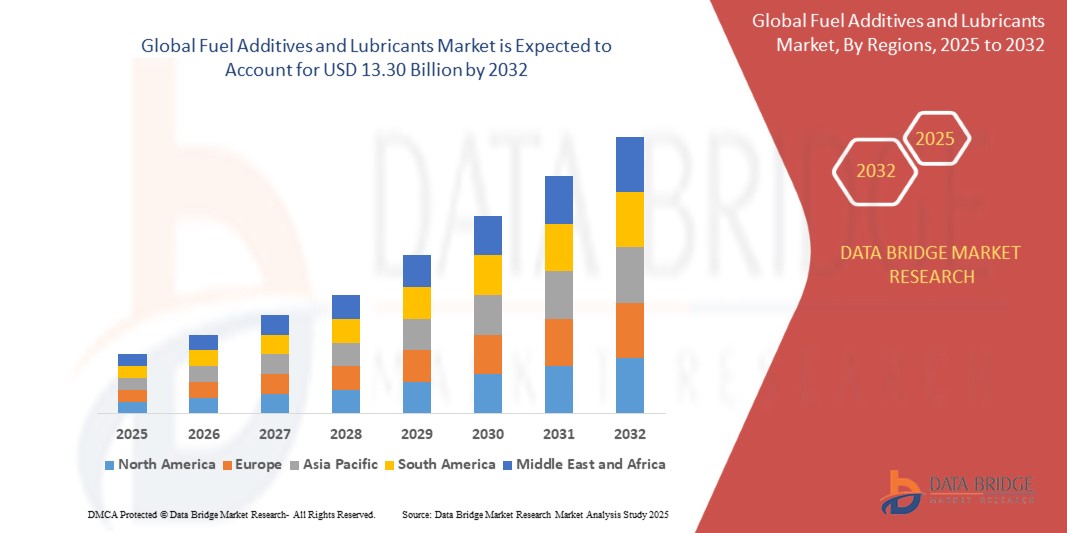
- The Global Fuel Additives and Lubricants Market size was valued at USD 9.71 Billion in 2024 and is expected to reach USD 13.30 Billion by 2032, at a CAGR of5.9% during the forecast period
- This growth is driven by factors such rising vehicle sales, stringent emission regulations, and demand for improved fuel efficiency
Fuel Additives and Lubricants Market Analysis
- Fuel Additives and Lubricants are essential components used to enhance fuel efficiency, engine performance, and longevity in automotive and industrial applications
- The demand for Fuel Additives and Lubricants is significantly driven by the growing automotive sector, stringent emission regulations, and the need for cleaner fuels
- North America is expected to dominate the Fuel Additives and Lubricants market due to advanced automotive infrastructure, regulatory mandates, and strong presence of key manufacturers
- Asia-Pacific is expected to be the fastest growing region in the Fuel Additives and Lubricants market during the forecast period due to rapid industrialization, rising vehicle ownership, and increasing energy demands
- The deposit control segment is expected to dominate the market with a 34.15% share due to their critical role in enhancing fuel combustion and maintaining engine cleanliness and efficiency.
Report Scope and Fuel Additives and Lubricants Market Segmentation
|
Attributes |
Fuel Additives and Lubricants Key Market Insights |
|
Segments Covered |
|
|
Countries Covered |
North America
Europe
Asia-Pacific
Middle East and Africa
South America
|
|
Key Market Players |
|
|
Market Opportunities |
|
|
Value Added Data Infosets |
In addition to the insights on market scenarios such as market value, growth rate, segmentation, geographical coverage, and major players, the market reports curated by the Data Bridge Market Research also include import export analysis, production capacity overview, production consumption analysis, price trend analysis, climate change scenario, supply chain analysis, value chain analysis, raw material/consumables overview, vendor selection criteria, PESTLE Analysis, Porter Analysis, and regulatory framework. |
Fuel Additives and Lubricants Market Trends
Sustainable Formulations and Performance Innovation in Fuel Additives and Lubricants
- One prominent trend in the Fuel Additives and Lubricants market is the growing emphasis on eco-friendly, low-emission formulations driven by stringent environmental regulations and consumer demand for sustainability
- Manufacturers are developing advanced additives and synthetic lubricants that enhance engine efficiency, reduce emissions, and extend equipment lifespan while minimizing environmental impact
- For instance, bio-based lubricants and low-sulfur fuel additives are gaining traction as they offer high performance with reduced ecological footprint.
- The increasing focus on electric and hybrid vehicles is also fueling demand for specialized lubricants and additives tailored for new-generation drivetrains, expanding innovation and market scope
Fuel Additives and Lubricants Market Dynamics
Driver
Rising Vehicle Ownership and Stringent Emission Regulations
- The growing global vehicle fleet, especially in emerging economies, is significantly contributing to the increased demand for Fuel Additives and Lubricants
- Economic growth, urbanization, and rising middle-class incomes have led to higher automobile ownership, which in turn drives the need for efficient fuel systems and engine protection
- Additives such as detergents, cetane improvers, and corrosion inhibitors are essential for improving fuel efficiency, reducing engine wear, and complying with evolving emission norms
For instance
- According to the International Energy Agency (IEA), global fuel consumption in road transport is expected to increase by over 25% by 2030, intensifying the need for performance-enhancing additives.
- As a result, the automotive industry’s reliance on fuel additives and high-performance lubricants is expected to grow rapidly, supporting long-term market expansion across region
Opportunity
Expansion of Bio-Based and Sustainable Lubricant Solutions
- The increasing focus on environmental sustainability and reduction of carbon emissions presents a significant opportunity for the Fuel Additives and Lubricants market
- Government incentives, green policies, and consumer awareness are driving demand for bio-based and biodegradable lubricants across industrial and automotive applications
- These lubricants, derived from renewable resources like vegetable oils, offer high performance with reduced environmental impact, appealing to eco-conscious end users
For instance
- According to the U.S. Department of Energy (2023), the bio-based lubricants market is expected to grow at over 6% annually due to rising adoption in government and commercial fleets.
- As a result, manufacturers investing in sustainable and innovative lubricant formulations stand to benefit from growing market share and enhanced brand value in a competitive landscape
Restraint/Challenge
Raw Material Price Volatility and Stringent Environmental Regulations
- The Fuel Additives and Lubricants market is vulnerable to fluctuations in crude oil, base stock, and specialty chemical prices, impacting production costs and margins
- Additionally, evolving environmental and safety regulations—such as REACH in Europe and EPA standards in the U.S.—raise compliance costs for additive formulations and lubricant production
- These factors create complexity for manufacturers aiming to maintain consistent pricing and regulatory adherence across multiple regions
For instance
- According to the International Energy Agency (2024), tightening sulfur and bio-content limits have forced several additive suppliers to reformulate products under aggressive timelines.
- Such regulatory burdens and input cost variability may increase operational expenses and hinder product innovation, particularly for small and mid‑sized companies
Fuel Additives and Lubricants Market Scope
The market is segmented on the basis of fuel additives type, lubricant base stock, lubricant type, fuel additives application, and end-user.
|
Segmentation |
Sub-Segmentation |
|
By Fuel Additives Type |
|
|
By Lubricant Base Stock |
|
|
By Lubricant Type |
|
|
By Fuel Additives Application |
|
|
By End User |
|
In 2025, the deposit control is projected to dominate the market with a largest share in fuel additives type segment
The deposit control additives segment is expected to dominate the Fuel Additives and Lubricants market with the largest share of 34.15% in 2025 due to its critical role in preventing deposit formation, maintaining fuel injector cleanliness, and ensuring optimal combustion. Deposit control additives inhibit carbon buildup on intake valves and fuel injectors, enhance fuel efficiency, and extend engine life by keeping critical components clean.
The Diesel Fuel Additives is expected to account for the largest share during the forecast period in application market
n 2025, the Diesel Fuel Additives segment is expected to dominate the market with the largest market share of 39.81% due to the rising demand for improved engine performance and fuel efficiency in diesel-powered vehicles and industrial machinery.
Fuel Additives and Lubricants Market Regional Analysis
North America Holds the Largest Share in the Fuel Additives and Lubricants Market
- North America dominates the Fuel Additives and Lubricants market with a share of 35.87%, driven by the region’s extensive industrial base, strong automotive sector, and high adoption of advanced fuel technologies
- The U.S. accounts for the largest share due to stringent environmental regulations promoting cleaner fuel additives and increasing demand for fuel-efficient engines in transportation and industrial applications
- Growing emphasis on reducing emissions and improving engine performance is accelerating the use of advanced lubricants and additives in the region
- Additionally, the presence of major global additive manufacturers and significant investments in R&D for sustainable and high-performance fuel solutions are key growth drivers
Asia-Pacific is Projected to Register the Highest CAGR in the Fuel Additives and Lubricants Market
- The Asia-Pacific region is expected to experience the fastest growth in the Fuel Additives and Lubricants market, fueled by rapid industrialization, urbanization, and rising vehicle ownership rates
- Countries such as China, India, and Indonesia are witnessing expanding automotive and manufacturing sectors, driving demand for fuel additives that enhance efficiency and reduce emissions
- Japan and South Korea are at the forefront of innovation in lubricant technologies, with increasing consumer and regulatory focus on eco-friendly and high-performance products
- Investments in infrastructure, growing awareness of environmental regulations, and rising adoption of synthetic lubricants and bio-based fuel additives are further boosting market growth across the region
Fuel Additives and Lubricants Market Share
The market competitive landscape provides details by competitor. Details included are company overview, company financials, revenue generated, market potential, investment in research and development, new market initiatives, global presence, production sites and facilities, production capacities, company strengths and weaknesses, product launch, product width and breadth, application dominance. The above data points provided are only related to the companies' focus related to market.
The Major Market Leaders Operating in the Market Are:
- Chevron Corporation (U.S.)
- Exxon Mobil Corporation (U.S.)
- The Lubrizol Corporation (U.S.)
- Afton Chemical Corporation (U.S.)
- Fuel Performance Solutions Ltd. (United Kingdom)
- Evonik Industries AG (Germany)
- BASF SE (Germany)
- LANXESS (Germany)
- TotalEnergies SE (France)
- Innospec Inc. (U.S.)
- Dorf Ketal Chemicals (India)
- Infineum International Limited (United Kingdom)
- Soham Chemicals (India)
- AMSOIL INC. (U.S.)
- Blaser Swisslube (Switzerland)
- DINOIL ITALIA (Italy)
- Croda International Plc (United Kingdom)
- ERC Emissions-Reduzierungs-Concepte GmbH (Germany)
- Xsnano International Co., Ltd. (China)
- NCH Corporation (U.S.)
Latest Developments in Global Fuel Additives and Lubricants Market
- In May 2024, Lubrizol introduced Lubrizol CV9660, a new low-SAPS heavy-duty lubricant technology designed to offer enhanced performance levels while providing a convenient solution for multiple viscosity grades
- In March 2024, Evonik entered into an agreement with Tongyi Petrochemical to advance green development within the lubricant industry. The partnership aims to develop low-carbon lubricant solutions in response to recent industry trends
- In October 2023, The Lubrizol Corporation announced a new distribution agreement with IMCD Group, a leading global distributor and formulator of specialty chemicals and ingredients. This partnership aims to strengthen Lubrizol’s presence and better serve the expanding fuel additives and lubricant market in Bangladesh
- In August 2022, BASF, a top producer of fuel additives, commenced production of fuel performance additives at its Pudong facility in Shanghai, China. The new plant was established to meet the increasing regional demand and to enhance supply flexibility and security for customers across Asia
- In December 2021, BASF introduced KEROPUR-D, a new high-performance multipurpose diesel additive, in South Korea. This additive effectively removes engine deposits and helps prevent the formation of new ones

- Interactive Data Analysis Dashboard
- Company Analysis Dashboard for high growth potential opportunities
- Research Analyst Access for customization & queries
- Competitor Analysis with Interactive dashboard
- Latest News, Updates & Trend analysis
- Harness the Power of Benchmark Analysis for Comprehensive Competitor Tracking
Global Fuel Additives And Lubricants Market, Supply Chain Analysis and Ecosystem Framework
To support market growth and help clients navigate the impact of geopolitical shifts, DBMR has integrated in-depth supply chain analysis into its Global Fuel Additives And Lubricants Market research reports. This addition empowers clients to respond effectively to global changes affecting their industries. The supply chain analysis section includes detailed insights such as Global Fuel Additives And Lubricants Market consumption and production by country, price trend analysis, the impact of tariffs and geopolitical developments, and import and export trends by country and HSN code. It also highlights major suppliers with data on production capacity and company profiles, as well as key importers and exporters. In addition to research, DBMR offers specialized supply chain consulting services backed by over a decade of experience, providing solutions like supplier discovery, supplier risk assessment, price trend analysis, impact evaluation of inflation and trade route changes, and comprehensive market trend analysis.
Data collection and base year analysis are done using data collection modules with large sample sizes. The stage includes obtaining market information or related data through various sources and strategies. It includes examining and planning all the data acquired from the past in advance. It likewise envelops the examination of information inconsistencies seen across different information sources. The market data is analysed and estimated using market statistical and coherent models. Also, market share analysis and key trend analysis are the major success factors in the market report. To know more, please request an analyst call or drop down your inquiry.
The key research methodology used by DBMR research team is data triangulation which involves data mining, analysis of the impact of data variables on the market and primary (industry expert) validation. Data models include Vendor Positioning Grid, Market Time Line Analysis, Market Overview and Guide, Company Positioning Grid, Patent Analysis, Pricing Analysis, Company Market Share Analysis, Standards of Measurement, Global versus Regional and Vendor Share Analysis. To know more about the research methodology, drop in an inquiry to speak to our industry experts.
Data Bridge Market Research is a leader in advanced formative research. We take pride in servicing our existing and new customers with data and analysis that match and suits their goal. The report can be customized to include price trend analysis of target brands understanding the market for additional countries (ask for the list of countries), clinical trial results data, literature review, refurbished market and product base analysis. Market analysis of target competitors can be analyzed from technology-based analysis to market portfolio strategies. We can add as many competitors that you require data about in the format and data style you are looking for. Our team of analysts can also provide you data in crude raw excel files pivot tables (Fact book) or can assist you in creating presentations from the data sets available in the report.













