


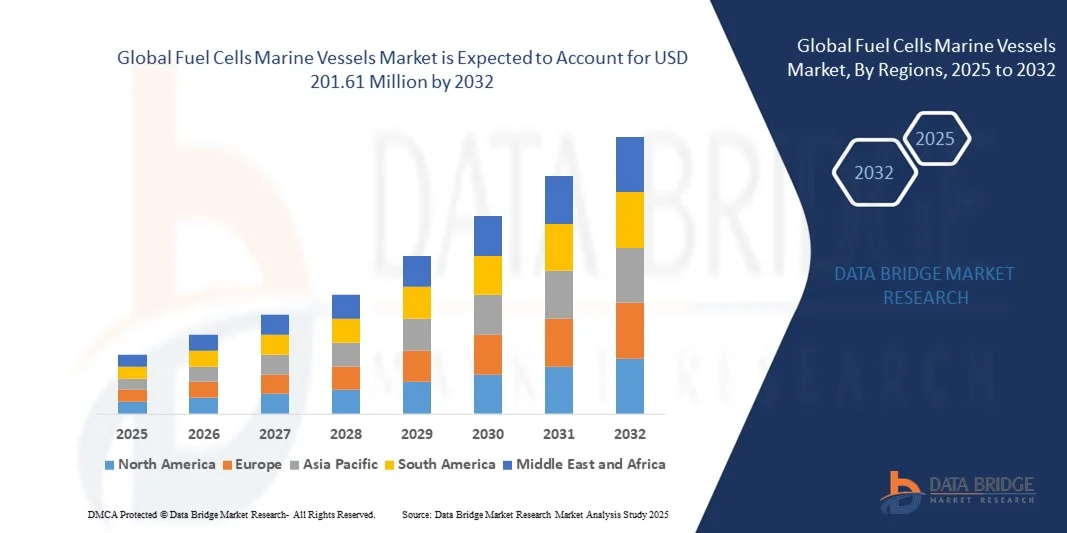
What is the Global Fuel Cells Marine Vessels Market Size and Growth Rate?
- The global fuel cells marine vessels market size was valued at USD 126.49 million in 2024 and is expected to reach USD 201.61 million by 2032, at a CAGR of 6.00% during the forecast period
- The factors such as demand for alternate propulsion systems and regulatory policies on emission control will foster the market growth. Moreover, increase in research and development activities in marine propulsion industry, low operating costs of fuel cells marine vessels and its focus on curbing environmental pollution will further carve the way for the growth of market. However, the dominance of other types of propulsion systems and competition from alternative technologies will hamper the market growth rate
What are the Major Takeaways of Fuel Cells Marine Vessels Market?
- The continuous innovation and advancements by manufacturers are expected to generate new opportunities for the market. The various issues in designs of propulsion systems will further restrict the scope of growth for the market
- North America dominated the fuel cells marine vessels market with the largest revenue share of 42.5% in 2024, driven by the strong adoption of clean energy solutions, growing emphasis on emission reduction in maritime operations, and the presence of major technology developers and shipbuilding firms
- The Asia-Pacific fuel cells marine vessels market is poised to grow at the fastest CAGR of 10.25% during the forecast period of 2025–2032, driven by increasing investments in hydrogen and fuel cell technologies in countries such as China, Japan, and South Korea
- The PEMFC segment dominated the market with the largest revenue share of 52% in 2024, driven by its high efficiency, rapid start-up capabilities, and suitability for marine applications such as ferries and passenger vessels
Report Scope and Fuel Cells Marine Vessels Market Segmentation
|
Attributes |
Fuel Cells Marine Vessels Key Market Insights |
|
Segments Covered |
|
|
Countries Covered |
North America
Europe
Asia-Pacific
Middle East and Africa
South America
|
|
Key Market Players |
|
|
Market Opportunities |
|
|
Value Added Data Infosets |
In addition to the insights on market scenarios such as market value, growth rate, segmentation, geographical coverage, and major players, the market reports curated by the Data Bridge Market Research also include in-depth expert analysis, pricing analysis, brand share analysis, consumer survey, demography analysis, supply chain analysis, value chain analysis, raw material/consumables overview, vendor selection criteria, PESTLE Analysis, Porter Analysis, and regulatory framework. |
What is the Key Trend in the Fuel Cells Marine Vessels Market?
Transition to Green and Efficient Marine Propulsion Systems
- A significant and accelerating trend in the global fuel cells marine vessels market is the adoption of hydrogen fuel cells and hybrid propulsion systems to replace conventional diesel engines, reducing greenhouse gas emissions and promoting sustainable shipping
- For instance, companies such as Siemens and Bloom Energy are developing fuel cell systems for marine vessels that provide zero-emission operation, longer endurance, and integration with energy storage solutions, enhancing overall vessel efficiency
- Integration of fuel cells with onboard energy management systems enables optimized power distribution, intelligent monitoring of fuel consumption, and predictive maintenance for improved operational reliability
- The seamless combination of fuel cells with hybrid electric systems facilitates centralized vessel energy control, enabling operators to manage propulsion, auxiliary power, and battery storage efficiently
- This shift toward cleaner, more efficient propulsion is reshaping expectations in maritime transport, with companies such as MEYER WERFT and PowerCell Sweden developing scalable solutions for ferries, cargo vessels, and yachts
- Growing demand for sustainable, emission-free marine vessels is encouraging investments in fuel cell technology, particularly in Europe and Asia, where environmental regulations are stringent
What are the Key Drivers of Fuel Cells Marine Vessels Market?
- Increasing regulatory pressure to reduce emissions from maritime transport and meet global environmental targets is a major driver for fuel cell adoption in marine vessels
- For instance, the International Maritime Organization (IMO) has mandated stricter emission controls, encouraging shipbuilders to explore alternative propulsion solutions such as hydrogen fuel cells
- The operational advantages of fuel cells, including quiet operation, low maintenance, and high energy efficiency, are driving their adoption over conventional engines
- The global push for decarbonization in shipping, combined with incentives for green technologies, makes fuel cells a vital choice for ship owners and operators
- The growing investment in renewable hydrogen production and fueling infrastructure enhances the feasibility and affordability of fuel cell-powered vessels
- The trend toward hybridization, integrating batteries and fuel cells, further expands the adoption across commercial ferries, cargo vessels, and naval ships, making fuel cells increasingly mainstream in the maritime industry
Which Factor is Challenging the Growth of the Fuel Cells Marine Vessels Market?
- High upfront costs of fuel cell systems compared to conventional diesel engines remain a significant barrier to widespread adoption
- Limited hydrogen infrastructure at ports and storage challenges for liquid or compressed hydrogen restrict market penetration, particularly in developing regions
- Technical challenges such as durability under marine conditions, integration with existing vessel systems, and safety concerns around hydrogen handling pose additional hurdles
- Despite falling costs, the perceived investment risk slows adoption among smaller ship operators and fleet owners, who may prefer conventional propulsion
- Overcoming these barriers requires government incentives, development of fueling networks, continuous R&D, and demonstration projects to build operator confidence and scale technology deployment effectively
How is the Fuel Cells Marine Vessels Market Segmented?
The fuel cells marine vessels market is segmented into three notable segments based on technology, power output, and application.
- By Technology
On the basis of technology, the fuel cells marine vessels market is segmented into PEMFC (Proton Exchange Membrane Fuel Cells), SOFC (Solid Oxide Fuel Cells), and other types. The PEMFC segment dominated the market with the largest revenue share of 52% in 2024, driven by its high efficiency, rapid start-up capabilities, and suitability for marine applications such as ferries and passenger vessels. PEMFCs are particularly favored due to their compact design, light weight, and ease of integration with hybrid propulsion systems.
The SOFC segment is anticipated to witness the fastest CAGR of 20% from 2025 to 2032, fueled by increasing adoption in larger vessels and commercial shipping applications. SOFC technology offers higher thermal efficiency and the ability to operate on a variety of fuels, making it ideal for high-power marine applications. The trend towards cleaner, more efficient propulsion systems is accelerating PEMFC adoption while opening new opportunities for SOFC growth.
- By Power Output
On the basis of power output, the fuel cells marine vessels market is segmented into <200 kW and >200 kW. The <200 kW segment held the largest market revenue share of 58% in 2024, driven by widespread use in small ferries, yachts, and service vessels. These lower-power fuel cells are highly favored for their cost-effectiveness, compact design, and ease of integration with auxiliary systems.
The >200 kW segment is expected to witness the fastest CAGR of 22% from 2025 to 2032, driven by the growing demand for medium- and large-sized commercial vessels, naval ships, and cargo vessels requiring high-power propulsion. Increasing investments in large-scale hydrogen fuel cell systems and hybrid solutions for efficient marine operations are fueling this growth. As shipping operators prioritize emission reduction and operational efficiency, high-power fuel cell installations are becoming a critical solution for sustainable maritime transport.
- By Application
On the basis of application, the fuel cells marine vessels market is segmented into commercial, military, and other applications. The commercial segment accounted for the largest market revenue share of 60% in 2024, supported by the rise of eco-friendly ferries, passenger ships, and short-haul transport vessels. Shipping companies are increasingly adopting fuel cell technology to comply with emissions regulations while reducing operational costs.
The military segment is expected to witness the fastest CAGR of 23% from 2025 to 2032, driven by the strategic need for stealthy, low-emission, and quiet naval vessels. Fuel cell technology provides military ships with operational advantages such as reduced thermal signature, low noise, and extended endurance. The adoption of fuel cells across both commercial and defense sectors underscores the increasing importance of sustainable propulsion technologies in the global maritime industry.
Which Region Holds the Largest Share of the Fuel Cells Marine Vessels Market?
- North America dominated the fuel cells marine vessels market with the largest revenue share of 42.5% in 2024, driven by the strong adoption of clean energy solutions, growing emphasis on emission reduction in maritime operations, and the presence of major technology developers and shipbuilding firms
- Stakeholders in the region highly value advanced propulsion systems, efficiency, and compliance with environmental regulations, which are boosting the adoption of fuel cell-powered vessels
- High R&D investments, government incentives for green shipping technologies, and a focus on decarbonization in commercial shipping and defense applications are further reinforcing North America’s leadership position
U.S. Fuel Cells Marine Vessels Market Insight
The U.S. market accounted for the largest revenue share within North America in 2024, propelled by significant investments in fuel cell technology for commercial and naval vessels. Rising demand for eco-friendly ferries, short-sea shipping solutions, and research-driven development programs are driving market growth. Furthermore, collaborations between technology providers and shipbuilders to integrate hydrogen fuel cells are expanding adoption. Government initiatives promoting zero-emission maritime transport and the increasing presence of advanced manufacturing infrastructure for fuel cell systems are further supporting growth.
Europe Fuel Cells Marine Vessels Market Insight
The Europe fuel cells marine vessels market is projected to grow steadily during the forecast period, driven by stringent maritime emission regulations and strong government backing for clean energy adoption. Countries such as Germany, Norway, and the Netherlands are increasingly integrating fuel cell systems in commercial ferries and passenger vessels. Urbanization, renewable energy initiatives, and investment in hybrid propulsion solutions are encouraging widespread adoption. In addition, collaborations between shipyards and technology providers for sustainable shipping solutions are fostering market expansion in both commercial and defense sectors.
U.K. Fuel Cells Marine Vessels Market Insight
The U.K. market is anticipated to expand at a significant CAGR during the forecast period, supported by the adoption of hydrogen-powered vessels in ports, rivers, and coastal transport. The country’s emphasis on decarbonizing shipping, along with strong maritime infrastructure and R&D initiatives, is facilitating market growth. Partnerships between fuel cell providers and shipbuilders, alongside government incentives for clean energy propulsion, are further driving adoption in commercial and defense marine applications.
Germany Fuel Cells Marine Vessels Market Insight
Germany’s market is expected to experience moderate growth, fueled by increasing focus on environmentally friendly propulsion systems and renewable energy integration. Germany’s advanced shipbuilding sector and its strategic emphasis on emission-free vessels promote the adoption of fuel cells, particularly in ferries and inland waterway vessels. In addition, public and private collaborations for sustainable marine transport and adherence to strict EU maritime emission regulations are supporting expansion in both commercial and government applications.
Which Region is the Fastest Growing Region in the Fuel Cells Marine Vessels Market?
The Asia-Pacific fuel cells marine vessels market is poised to grow at the fastest CAGR of 10.25% during the forecast period of 2025–2032, driven by increasing investments in hydrogen and fuel cell technologies in countries such as China, Japan, and South Korea. Rising urbanization, growing maritime trade, and government initiatives promoting zero-emission shipping are accelerating adoption. APAC is also emerging as a hub for fuel cell component manufacturing, improving affordability and accessibility of systems for both commercial and defense vessels.
Japan Fuel Cells Marine Vessels Market Insight
Japan’s market is witnessing robust growth due to a high-tech maritime culture, rapid urbanization, and government-backed projects for hydrogen-fueled ships. The integration of fuel cells with other advanced ship technologies and the increasing number of coastal ferries adopting eco-friendly propulsion are key growth drivers. In addition, the aging population is prompting investment in vessels with reduced noise, emissions, and enhanced safety, further boosting fuel cell adoption.
China Fuel Cells Marine Vessels Market Insight
China accounted for the largest revenue share within Asia-Pacific in 2024, supported by its rapidly expanding middle class, rising technological adoption, and the push for emission-free smart cities and ports. The government’s strategic initiatives for green shipping, along with the expansion of domestic fuel cell manufacturers, are fueling widespread adoption. In addition, growing demand for passenger ferries, commercial vessels, and rental fleets integrated with fuel cell technology is driving market growth.
Which are the Top Companies in Fuel Cells Marine Vessels Market?
The fuel cells marine vessels industry is primarily led by well-established companies, including:
- Fiskerstrand Verft AS (Norway)
- Siemens (Germany)
- MEYER WERFT GmbH & Co. KG (Germany)
- Bloom Energy (U.S.)
- Dynad International BV (Netherlands)
- PowerCellutio (Sweden)
- PowerCell Sweden AB (Sweden)
- Hyster-Yale Materials Handling, Inc. (U.S.)
- Panasonic Corporation (Japan)
- Proton Motor Fuel Cell GmbH (Germany)
- Hyundai Motor India (India)
- Advent Technologies (Greece)
- SFC Energy AG (Germany)
- TOSHIBA CORPORATION (Japan)
- Watt Fuel Cell Corporation (U.S.)
What are the Recent Developments in Global Fuel Cells Marine Vessels Market?
- In October 2025, Hyundai Heavy Industries, the world's largest shipbuilder, unveiled a 10,000-TEU container ship powered by fuel cells, designed in collaboration with Ballard Power Systems. This vessel is expected to reduce greenhouse gas emissions by up to 30% compared to conventional container ships, demonstrating the transformative potential of fuel cell technology in reducing maritime emissions
- In June 2024, MAN Energy Solutions, a German engine manufacturer, secured a contract to supply fuel cell systems for two new hydrogen-powered ferries in Denmark. Backed by the European Union's Innovation Fund, this project represents one of the largest fuel cell initiatives in the marine sector, highlighting growing investments in sustainable maritime solutions
- In March 2024, Rolls-Royce, a leading marine engineering company, formed a strategic partnership with Siemens Energy to develop and commercialize fuel cell solutions for the maritime industry. This collaboration aims to combine maritime expertise with advanced fuel cell technology, driving emission reductions and enhanced operational efficiency across marine vessels
- In February 2023, Ballard Power Systems announced the successful integration of their FCwave fuel cell system on a commercial ferry operated by BC Ferries in Canada. As the largest ferry operator in North America, BC Ferries’ adoption underscores the increasing commercial viability and effectiveness of fuel cells in marine transportation

- Interactive Data Analysis Dashboard
- Company Analysis Dashboard for high growth potential opportunities
- Research Analyst Access for customization & queries
- Competitor Analysis with Interactive dashboard
- Latest News, Updates & Trend analysis
- Harness the Power of Benchmark Analysis for Comprehensive Competitor Tracking
Data collection and base year analysis are done using data collection modules with large sample sizes. The stage includes obtaining market information or related data through various sources and strategies. It includes examining and planning all the data acquired from the past in advance. It likewise envelops the examination of information inconsistencies seen across different information sources. The market data is analysed and estimated using market statistical and coherent models. Also, market share analysis and key trend analysis are the major success factors in the market report. To know more, please request an analyst call or drop down your inquiry.
The key research methodology used by DBMR research team is data triangulation which involves data mining, analysis of the impact of data variables on the market and primary (industry expert) validation. Data models include Vendor Positioning Grid, Market Time Line Analysis, Market Overview and Guide, Company Positioning Grid, Patent Analysis, Pricing Analysis, Company Market Share Analysis, Standards of Measurement, Global versus Regional and Vendor Share Analysis. To know more about the research methodology, drop in an inquiry to speak to our industry experts.
Data Bridge Market Research is a leader in advanced formative research. We take pride in servicing our existing and new customers with data and analysis that match and suits their goal. The report can be customized to include price trend analysis of target brands understanding the market for additional countries (ask for the list of countries), clinical trial results data, literature review, refurbished market and product base analysis. Market analysis of target competitors can be analyzed from technology-based analysis to market portfolio strategies. We can add as many competitors that you require data about in the format and data style you are looking for. Our team of analysts can also provide you data in crude raw excel files pivot tables (Fact book) or can assist you in creating presentations from the data sets available in the report.













