


What is the Fuel Management System Market Size and Growth Rate ?
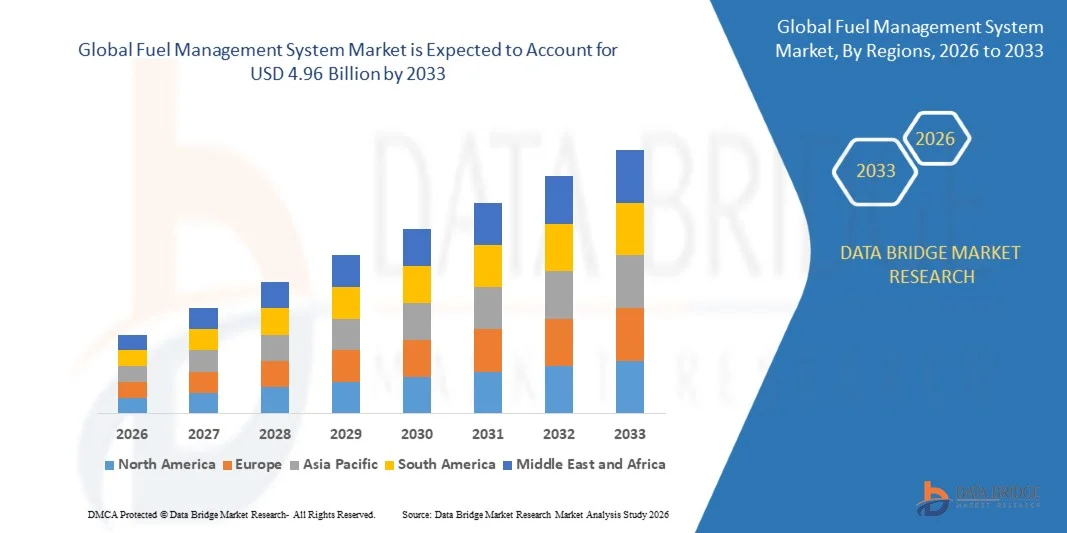
- As per Data Bridge Market Research Analysis the global fuel management system market size was valued at USD 2.06 billion in 2025 and is expected to reach USD 4.96 billion by 2033, at a CAGR of 11.6% during the forecast period
- The market growth is largely fueled by the increasing need for efficient fuel consumption monitoring and cost optimization across industries such as transportation, logistics, and mining, leading to the adoption of advanced fuel management technologies for operational control
- Furthermore, rising concerns regarding fuel theft, environmental compliance, and the demand for real-time data visibility are encouraging organizations to implement integrated fuel management solutions. These converging factors are accelerating the deployment of automated and digital fuel monitoring systems, thereby significantly boosting the market growth
Market Size & Forecast
- Global Market Value (2025): USD 2.06 billion
- Expected Market Value (2033): USD 4.96 billion
- Forecast CAGR (2026–2033): 11.6%
What are the Major Takeaways of Fuel Management System Market ?
- Fuel management systems are integrated solutions designed to monitor, control, and optimize fuel usage across fleets, storage facilities, and industrial operations. These systems utilize technologies such as sensors, telematics, and software platforms to provide real-time tracking, reporting, and analytics for improved efficiency and transparency
- The escalating demand for fuel management systems is primarily fueled by increasing fuel prices, the growing adoption of fleet management solutions, and the need for regulatory compliance and sustainability. Organizations are increasingly focusing on minimizing fuel losses and enhancing operational efficiency, which is driving the widespread adoption of advanced fuel management solutions
- North America dominated the fuel management system market with a share of 34.4% in 2025, due to the strong presence of advanced fleet management infrastructure and increasing demand for fuel efficiency and cost optimization across transportation and logistics sectors
- Asia-Pacific is expected to be the fastest growing region in the fuel management system market during the forecast period due to rapid industrialization, expanding transportation networks, and increasing fuel consumption across emerging economies such as China, India, and Japan
- Total fuel management segment dominated the market with a market share of 42.1% in 2025, due to its comprehensive capability to integrate fuel tracking, inventory management, and analytics into a single platform. Organizations prefer total fuel management solutions due to their ability to reduce fuel theft, optimize consumption, and improve operational transparency across large fleets and industrial operations
Report Scope and Fuel Management System Market Segmentation
|
Attributes |
Fuel Management System Key Market Insights |
|
Segments Covered |
|
|
Countries Covered |
North America
Europe
Asia-Pacific
Middle East and Africa
South America
|
|
Key Market Players |
|
|
Market Opportunities |
|
|
Value Added Data Infosets |
In addition to the market insights such as market value, growth rate, market segments, geographical coverage, market players, and market scenario, the market report curated by the Data Bridge Market Research team includes in-depth expert analysis, import/export analysis, pricing analysis, production consumption analysis, and pestle analysis. |
What is the Key Trend in the Fuel Management System Market ?
“Increasing Adoption of IoT-Enabled Fuel Monitoring Systems”
- A significant trend in the fuel management system market is the increasing adoption of IoT-enabled fuel monitoring solutions, driven by the need for real-time tracking, automation, and enhanced operational efficiency across industries. This trend is transforming traditional fuel management practices into data-driven systems that improve transparency and control over fuel usage
- For instance, Gilbarco Veeder-Root offers advanced IoT-based tank monitoring and fuel tracking solutions that provide real-time insights into fuel levels and system performance. These solutions enable operators to detect anomalies, reduce fuel losses, and enhance overall system reliability in complex fueling environments
- The integration of connected sensors and telematics is enabling continuous monitoring of fuel consumption across fleet operations and industrial sites. This capability supports better decision-making by providing accurate and timely data on fuel usage patterns and equipment performance
- Industries such as transportation and logistics are increasingly adopting IoT-enabled systems to improve route efficiency, reduce idle time, and ensure optimal fuel utilization. This is contributing to cost savings and improved operational productivity across large-scale fleet operations
- The adoption of cloud-connected fuel management platforms is further enhancing accessibility and scalability, allowing organizations to monitor multiple locations from centralized dashboards. This is strengthening operational coordination and improving resource management across geographically dispersed assets
- The market is witnessing a strong shift toward intelligent and automated fuel management ecosystems where IoT technologies play a central role. This ongoing transition is reinforcing the importance of connected solutions in achieving efficiency, compliance, and sustainability across global fuel operations
Fuel Management System Market Dynamics
Driver
“Rising Demand for Fuel Efficiency and Cost Optimization”
- The increasing need to optimize fuel consumption and reduce operational costs is a major driver for the fuel management system market, particularly in fuel-intensive industries such as transportation, mining, and construction. Organizations are prioritizing solutions that provide accurate fuel tracking and minimize wastage to enhance profitability
- For instance, Samsara provides fuel monitoring and telematics solutions that help fleet operators analyze fuel usage and identify inefficiencies in real time. These capabilities enable businesses to implement corrective measures and achieve significant cost savings across operations
- The rising volatility in fuel prices is compelling organizations to adopt systems that provide better control over fuel expenses and consumption patterns. This is increasing the demand for advanced monitoring and reporting tools that support financial planning and operational efficiency
- The integration of analytics and reporting features in fuel management systems allows organizations to identify trends, optimize routes, and reduce unnecessary fuel consumption. These insights are becoming essential for improving overall operational performance
- The growing emphasis on cost control and operational efficiency continues to strengthen this driver, positioning fuel management systems as essential tools for organizations aiming to enhance productivity and maintain competitive advantage
Restraint/Challenge
“High Initial Investment and Integration Complexity”
- The fuel management system market faces challenges due to the high initial investment required for deploying advanced hardware, software, and infrastructure components. These costs can be a significant barrier for small and medium-sized enterprises with limited budgets
- For instance, Dover Fueling Solutions offers integrated fuel management and automation systems that require substantial investment in equipment installation and system integration. The complexity of deploying such solutions across existing infrastructure can delay adoption and increase implementation costs
- The integration of fuel management systems with legacy equipment and enterprise platforms often requires customization and technical expertise. This complexity can lead to extended deployment timelines and increased operational disruption during implementation
- Organizations may face challenges in training personnel and managing system upgrades, particularly when transitioning from traditional fuel management methods to digital platforms. These factors can impact the overall efficiency and adoption rate of advanced systems
- The market continues to face constraints related to balancing advanced functionality with affordability and ease of integration. These challenges collectively influence adoption rates and require vendors to focus on cost-effective and user-friendly solutions to sustain growth
How is the Fuel Management System Market Segmented ?
The market is segmented on the basis of type, process, offering, deployment, application, and industry.
• By Type
On the basis of type, the fuel management system market is segmented into card-based, on-site, and total fuel management. The total fuel management segment dominated the largest market revenue share of 42.1% in 2025, driven by its comprehensive capability to integrate fuel tracking, inventory management, and analytics into a single platform. Organizations prefer total fuel management solutions due to their ability to reduce fuel theft, optimize consumption, and improve operational transparency across large fleets and industrial operations. The growing need for centralized control and real-time insights further strengthens the adoption of this segment across sectors such as logistics and oil and gas.
The card-based segment is anticipated to witness the fastest growth rate from 2026 to 2033, fueled by its cost-effectiveness and ease of implementation for small and medium-sized fleet operators. Card-based systems enable secure fuel transactions and tracking without requiring complex infrastructure, making them suitable for businesses seeking quick deployment and scalability. Increasing digitization of payment systems and rising awareness of fuel expense monitoring are also contributing to the rapid growth of this segment.
• By Process
On the basis of process, the fuel management system market is segmented into measuring, monitoring, reporting, and others. The monitoring segment held the largest market revenue share in 2025, driven by the increasing need for real-time visibility into fuel usage and storage conditions. Continuous monitoring helps organizations detect anomalies, prevent pilferage, and ensure compliance with regulatory standards, making it a critical component in fuel management operations. The integration of IoT-enabled sensors and advanced tracking technologies further enhances the effectiveness of monitoring systems across industries.
The reporting segment is expected to witness the fastest CAGR from 2026 to 2033, driven by the growing emphasis on data-driven decision-making and regulatory compliance. Advanced reporting tools provide detailed insights into fuel consumption patterns, operational efficiency, and cost optimization opportunities. Businesses are increasingly adopting reporting solutions to improve transparency, streamline audits, and support strategic planning initiatives.
• By Offering
On the basis of offering, the fuel management system market is segmented into hardware, software, and services. The hardware segment dominated the largest market revenue share in 2025, driven by the essential role of physical components such as sensors, fuel dispensers, and control units in enabling accurate fuel tracking and management. These components form the backbone of fuel management systems, ensuring reliable data collection and operational efficiency. The continuous advancement in sensor technology and automation further strengthens the demand for hardware solutions.
The software segment is anticipated to witness the fastest growth rate from 2026 to 2033, fueled by increasing demand for analytics platforms and cloud-based management systems. Software solutions enable real-time monitoring, predictive analytics, and seamless integration with enterprise systems, enhancing operational control and efficiency. The shift toward digital transformation and the need for scalable, user-friendly interfaces are key factors accelerating the adoption of software offerings.
• By Deployment
On the basis of deployment, the fuel management system market is segmented into cloud-based, on-premises, and hybrid. The on-premises segment held the largest market revenue share in 2025, driven by its ability to provide greater control over data security and system customization. Organizations operating in sensitive sectors such as defense and oil and gas prefer on-premises solutions to maintain strict data governance and ensure system reliability in remote locations. The demand for secure and internally managed infrastructure continues to support the dominance of this segment.
The cloud-based segment is expected to witness the fastest CAGR from 2026 to 2033, driven by its scalability, cost-efficiency, and remote accessibility. Cloud deployment allows organizations to manage fuel operations across multiple locations with real-time data synchronization and minimal infrastructure investment. The increasing adoption of digital platforms and the need for flexible, centralized management solutions are significantly boosting the growth of cloud-based systems.
• By Application
On the basis of application, the fuel management system market is segmented into fuel storage monitoring, access control, and fuel dispensing. The fuel dispensing segment dominated the largest market revenue share in 2025, driven by its critical role in ensuring accurate fuel distribution and preventing losses during dispensing operations. Advanced dispensing systems equipped with automation and authentication features help improve efficiency and reduce unauthorized usage. The increasing demand for precise fuel allocation in fleet and industrial operations further supports the dominance of this segment.
The access control segment is anticipated to witness the fastest growth rate from 2026 to 2033, fueled by rising concerns regarding fuel theft and unauthorized usage. Access control systems enable secure authentication of users and vehicles, ensuring that fuel is dispensed only to authorized entities. The growing adoption of RFID, biometric, and card-based authentication technologies is driving the expansion of this segment across multiple industries.
• By Industry
On the basis of industry, the fuel management system market is segmented into mining and construction, military and defense, oil and gas, transportation and logistics, and others. The transportation and logistics segment held the largest market revenue share in 2025, driven by the extensive use of fuel across large vehicle fleets and the need for efficient fuel consumption management. Companies in this sector rely heavily on fuel management systems to reduce operational costs, enhance route efficiency, and ensure accountability. The rapid expansion of e-commerce and global trade further increases the demand for fuel optimization solutions.
The mining and construction segment is expected to witness the fastest CAGR from 2026 to 2033, driven by the increasing use of heavy machinery and equipment requiring continuous fuel monitoring. Harsh operating environments and high fuel consumption levels necessitate advanced fuel management solutions to prevent losses and improve efficiency. The growing focus on cost control and operational transparency in large-scale infrastructure projects is significantly contributing to the growth of this segment.
Which Region Holds the Largest Share of the Fuel Management System Market ?
- North America dominated the fuel management system market with the largest revenue share of 34.4% in 2025, driven by the strong presence of advanced fleet management infrastructure and increasing demand for fuel efficiency and cost optimization across transportation and logistics sectors
- Organizations in the region highly prioritize real-time fuel monitoring, theft prevention, and integration of fuel systems with telematics and enterprise platforms to enhance operational control and transparency
- This widespread adoption is further supported by high digital adoption, stringent regulatory frameworks for fuel usage, and the growing need to reduce operational costs, establishing fuel management systems as a critical solution across commercial and industrial applications
U.S. Fuel Management System Market Insight
The U.S. fuel management system market captured the largest revenue share in 2025 within North America, fueled by the extensive use of large vehicle fleets and the increasing focus on fuel efficiency and emissions control. Companies are increasingly adopting advanced fuel monitoring and analytics solutions to optimize fuel consumption and reduce operational losses. The growing integration of IoT and cloud-based platforms, combined with strong investments in logistics and transportation infrastructure, further accelerates the adoption of fuel management systems across the country.
Europe Fuel Management System Market Insight
The Europe fuel management system market is projected to expand at a substantial CAGR throughout the forecast period, primarily driven by stringent environmental regulations and the increasing focus on reducing carbon emissions and fuel wastage. The rising adoption of advanced fleet management solutions and digital technologies is supporting the demand for fuel management systems across industries. The region is witnessing strong growth across transportation, oil and gas, and industrial sectors, with increasing investments in sustainable and efficient fuel usage practices.
U.K. Fuel Management System Market Insight
The U.K. fuel management system market is anticipated to grow at a noteworthy CAGR during the forecast period, driven by increasing fuel costs and the need for efficient fuel usage monitoring across commercial fleets. Organizations are focusing on adopting automated fuel tracking and reporting solutions to improve operational efficiency and reduce fuel-related expenses. The strong presence of logistics and e-commerce sectors, along with increasing digital transformation initiatives, is expected to support market growth.
Germany Fuel Management System Market Insight
The Germany fuel management system market is expected to expand at a considerable CAGR during the forecast period, fueled by the country’s strong industrial base and increasing emphasis on operational efficiency and sustainability. The demand for advanced fuel monitoring systems is rising across manufacturing, transportation, and construction sectors. The integration of digital technologies and automation in industrial operations is further contributing to the adoption of fuel management solutions in Germany.
Asia-Pacific Fuel Management System Market Insight
The Asia-Pacific fuel management system market is poised to grow at the fastest CAGR during the forecast period of 2026 to 2033, driven by rapid industrialization, expanding transportation networks, and increasing fuel consumption across emerging economies such as China, India, and Japan. The growing adoption of digital technologies and government initiatives promoting efficient fuel usage are accelerating market growth. The increasing demand for cost optimization and operational transparency is further boosting the adoption of fuel management systems across the region.
Japan Fuel Management System Market Insight
The Japan fuel management system market is gaining momentum due to the country’s advanced technological infrastructure and strong focus on efficiency and automation. Organizations are increasingly adopting fuel management solutions to optimize fuel usage and reduce operational costs across transportation and industrial sectors. The integration of IoT and smart monitoring systems is driving innovation, while the need for precise fuel tracking is supporting market expansion.
China Fuel Management System Market Insight
The China fuel management system market accounted for the largest market revenue share in Asia Pacific in 2025, attributed to rapid industrial growth, expanding logistics networks, and increasing demand for fuel efficiency. The country’s strong manufacturing base and growing adoption of digital solutions are driving the implementation of advanced fuel management systems. Government initiatives aimed at improving energy efficiency and reducing fuel wastage are further contributing to the growth of the market in China.
Which are the Top Companies in Fuel Management System Market ?
The fuel management system industry is primarily led by well-established companies, including:
- Gilbarco Inc. (U.S.)
- Dover Corporation (U.S.)
- Franklin Fueling Systems (U.S.)
- Piusi S.p.A. (Italy)
- HID Global Corporation (U.S.)
- Multiforce Systems Corporation (U.S.)
- Banlaw (Australia)
- Fluid Management Technology (Australia)
- Triscan Group Limited (U.K.)
- Guduza System Technologies (South Africa)
- ESI Total Fuel Management (Singapore)
- AssetWorks LLC (U.S.)
- SmartFlow Technologies (U.S.)
- World Fuel Services Corporation (U.S.)
- Technotrade LLC (U.S.)
- Romteck (Australia)
- Site Service Engineering (U.K.)
What are Latest Developments in Fuel Management System Market ?
- In January 2025, Veeder-Root introduced an advanced cloud-enabled tank monitoring and analytics platform aimed at improving real-time visibility and predictive maintenance for fuel storage systems. The solution was designed to integrate seamlessly with existing forecourt infrastructure while leveraging data analytics to detect anomalies and prevent fuel losses. This development is strengthening the market by accelerating the shift toward cloud-based fuel management solutions and enabling operators to enhance efficiency, compliance, and decision-making through centralized data insights
- In December 2024, Franklin Fueling Systems announced the release of an upgraded component for its EVO Series Electronic Line Leak Detection system, introducing a new 4-20mA pressure transducer with improved durability and installation efficiency. The compact design and enhanced wire connection were developed to withstand harsh fueling environments and extend product lifespan. This advancement is supporting the market by improving reliability in leak detection systems, reducing maintenance requirements, and enhancing safety standards across fuel station operations
- In October 2024, Dover Fueling Solutions launched the DX Rewards loyalty application integrated into its DFS Anthem UX dispenser platform, enabling customers to access personalized offers and redeem rewards directly at the fuel pump. The system created a connected digital experience without requiring external mobile devices, while allowing retailers to link existing loyalty programs with dispensing infrastructure. This innovation is contributing to market growth by enhancing customer engagement, increasing in-store sales opportunities, and promoting digital transformation at fueling stations
- In September 2024, Invenco by GVR entered into an agreement with Costco Wholesale Corporation to upgrade payment technologies across its Canadian fueling network through deployment of advanced terminals and microservices-based architecture. The rollout included FlexPay 6 modular outdoor payment systems and the iNFX platform to improve transaction speed and system uptime. This development is strengthening the market by advancing secure and efficient payment solutions, improving customer experience, and supporting high-volume fuel retail environments
- In August 2024, Titan Cloud announced a strategic partnership with a major U.S. supermarket operator to deploy its fuel management software across approximately 2,100 sites. The implementation of its Fuel Asset Optimization platform enabled end-to-end visibility of the fuel supply chain, from storage to dispensing. This initiative is driving market expansion by demonstrating large-scale adoption of advanced fuel management systems, reducing operational costs, and improving inventory control and compliance through real-time analytics

- Interactive Data Analysis Dashboard
- Company Analysis Dashboard for high growth potential opportunities
- Research Analyst Access for customization & queries
- Competitor Analysis with Interactive dashboard
- Latest News, Updates & Trend analysis
- Harness the Power of Benchmark Analysis for Comprehensive Competitor Tracking
Data collection and base year analysis are done using data collection modules with large sample sizes. The stage includes obtaining market information or related data through various sources and strategies. It includes examining and planning all the data acquired from the past in advance. It likewise envelops the examination of information inconsistencies seen across different information sources. The market data is analysed and estimated using market statistical and coherent models. Also, market share analysis and key trend analysis are the major success factors in the market report. To know more, please request an analyst call or drop down your inquiry.
The key research methodology used by DBMR research team is data triangulation which involves data mining, analysis of the impact of data variables on the market and primary (industry expert) validation. Data models include Vendor Positioning Grid, Market Time Line Analysis, Market Overview and Guide, Company Positioning Grid, Patent Analysis, Pricing Analysis, Company Market Share Analysis, Standards of Measurement, Global versus Regional and Vendor Share Analysis. To know more about the research methodology, drop in an inquiry to speak to our industry experts.
Data Bridge Market Research is a leader in advanced formative research. We take pride in servicing our existing and new customers with data and analysis that match and suits their goal. The report can be customized to include price trend analysis of target brands understanding the market for additional countries (ask for the list of countries), clinical trial results data, literature review, refurbished market and product base analysis. Market analysis of target competitors can be analyzed from technology-based analysis to market portfolio strategies. We can add as many competitors that you require data about in the format and data style you are looking for. Our team of analysts can also provide you data in crude raw excel files pivot tables (Fact book) or can assist you in creating presentations from the data sets available in the report.













