


What is the Fume Hood Market Size and Growth Rate?
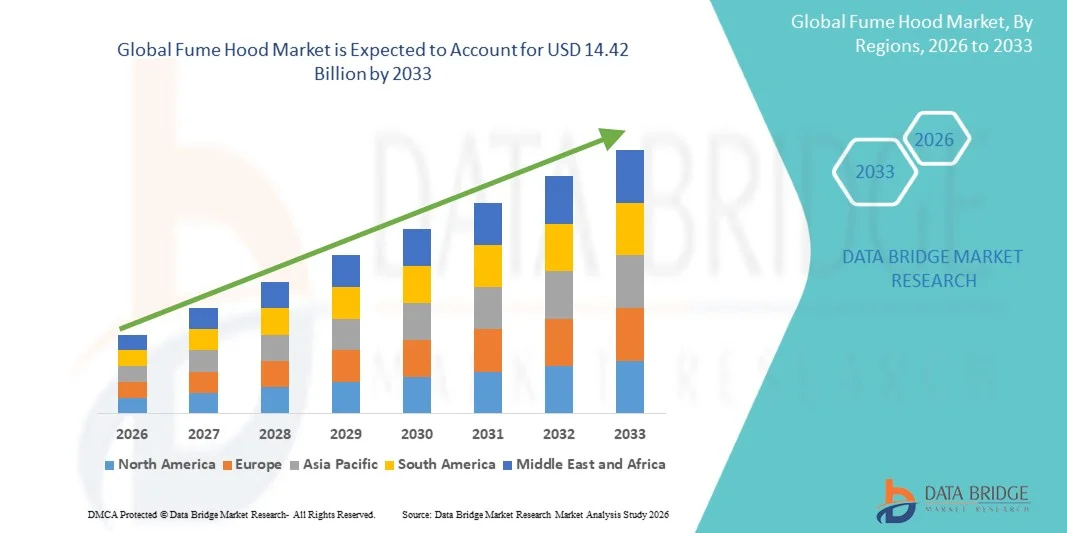
- As per Data Bridge Market Research analysis, the fume hood market was valued at USD 6.08 billion in 2025 and is projected to reach USD 14.42 billion by 2033, growing at a CAGR of 11.40% from 2026 to 2033.
- The market is experiencing consistent growth driven by rising demand for laboratory safety equipment, increasing research and development activities, stringent workplace safety regulations, and expanding applications across pharmaceutical, biotechnology, chemical, academic, and healthcare laboratories.
- The increasing focus on protecting laboratory personnel from hazardous chemicals, toxic fumes, and airborne contaminants, combined with stricter occupational health and laboratory safety standards, is compelling research institutions, pharmaceutical companies, and industrial laboratories to adopt advanced fume hood systems. Ducted, ductless, and smart fume hoods are increasingly being adopted to provide controlled, efficient, and safer working environments for chemical handling and laboratory procedures.
Market Size & Forecast
- Global Market Value (2025): USD 6.08 Billion
- Expected Market Value (2033): USD 14.42 Billion
- Forecast CAGR (2026–2033): 11.40%
What are the Major Takeaways of the Fume Hood Market?
- North America dominated the fume hood market with a 42.34% revenue share in 2025, supported by stringent laboratory safety regulations, advanced research infrastructure, and strong pharmaceutical and biotechnology industries.
- Asia-Pacific is expected to be the fastest-growing region at a CAGR of 5.43% from 2026 to 2033, fueled by expanding pharmaceutical and chemical manufacturing, increasing research and development investments, and growing laboratory infrastructure across China, India, Japan, and South Korea
- The ducted fume hoods segment led the market with a 62.45% share in 2025, driven by their strong containment performance and ability to continuously exhaust hazardous fumes outside the laboratory.
- Ductless fume hoods are the fastest-growing product type, projected to register a CAGR of 6.65%, reflecting the surge in demand for flexible laboratory infrastructure and easier installation.
- The stainless steel segment dominated the material type category with a 41.34% revenue share in 2025, led by its durability, corrosion resistance, cleanability, and suitability for demanding laboratory environments
- Constant air volume accounted for 41.51% of the market share in 2025, preferred by its established technology, predictable exhaust performance, and relatively straightforward operation.
- The variable air volume segment is the fastest-growing airflow category, with a CAGR of 7.50%, driven by increasing emphasis on laboratory energy efficiency and dynamic airflow management.
Report Scope and Fume Hood Market Segmentation
|
Attributes |
Fume Hood Key Market Insights |
|
Segments Covered |
|
|
Countries Covered |
North America
Europe
Asia-Pacific
Middle East and Africa
South America
|
|
Key Market Players |
|
|
Market Opportunities |
|
|
Value Added Data Infosets |
In addition to the insights on market scenarios such as market value, growth rate, segmentation, geographical coverage, and major players, the market reports curated by the Data Bridge Market Research also include in-depth expert analysis, patient epidemiology, pipeline analysis, pricing analysis, and regulatory framework. |
What is the Key Trend in the Fume Hood Market?
- Laboratories are increasingly adopting energy-efficient and smart fume hood systems to reduce ventilation-related energy consumption while maintaining effective containment, particularly as research facilities focus on sustainability and operational efficiency.
- For instance, in March 2025, the University of Iowa reported that its “Shut the Sash” program had installed more than 120 reminder stickers across teaching and research laboratories, noting that a single fume hood can consume energy equivalent to approximately three U.S. homes. The initiative demonstrates growing emphasis on sash management to reduce airflow, energy consumption, and greenhouse-gas emissions.
- Variable-air-volume systems, sash-position monitoring, airflow controls, and automated alarms are increasingly being integrated into modern fume hoods to optimize exhaust airflow according to laboratory activity.
- Laboratory operators are also increasingly emphasizing proper sash management and continuous performance monitoring to improve containment while lowering unnecessary exhaust and HVAC demand.
- For instance, in November 2025, the U.S. Department of Energy reported that UC Santa Barbara’s building-management-system monitoring of fume hood sash positions verified an average reduction of 185 CFM per hood, equivalent to approximately USD 1,300 in annual savings per fume hood. The case demonstrates the growing use of real-time monitoring and optimized sash management to improve fume hood energy efficiency.
- As laboratories continue prioritizing energy efficiency, worker protection, and intelligent ventilation management, the adoption of advanced fume hood technologies is expected to accelerate, reinforcing smart and energy-efficient systems as a core direction of the market.
What are the Key Drivers of the Fume Hood Market?
- The increasing need to protect laboratory personnel from toxic, corrosive, carcinogenic, and volatile chemicals is significantly increasing demand for fume hoods as an essential engineering control for hazardous laboratory operations.
- For instance, in March 2026, the National Institute of General Medical Sciences (NIGMS) highlighted chemical fume hood safety as part of its laboratory safety training resources, reinforcing the continued need for engineering controls that protect laboratory personnel from hazardous chemical exposures. The NIH identifies chemical fume hoods as an important component of laboratory safety for controlling harmful vapors, fumes, and particulates.
- Pharmaceutical, biotechnology, chemical, academic, and healthcare laboratories are expanding research activities, increasing the volume of chemical handling and creating greater requirements for reliable local exhaust ventilation and laboratory containment equipment.
- For instance, in September 2022, OSHA cited Phoenix Environmental Laboratories after an inspection found employee exposure to hazardous chemicals and required the company to ensure its chemical fume hoods functioned properly and did not leak onto employees. The enforcement action demonstrates how workplace chemical-exposure risks and regulatory requirements reinforce demand for properly functioning fume hood systems.
- With laboratory research and chemical handling continuing to expand alongside increasingly rigorous occupational safety requirements, fume hoods will remain indispensable for controlling airborne contaminants and protecting personnel across research-intensive environments.
Which Factors are Challenging the Growth of the Fume Hood Market?
- Advanced fume hood systems require significant installation and operating expenditure because ducted configurations require exhaust fans, ductwork, make-up air, HVAC integration, monitoring systems, and regular testing and maintenance.
- For instance, in August 2021, MIT reported that 58 of its 69 fume hoods in the Undergraduate Teaching Laboratory were regularly unused during off-hours, while operating the hoods and conditioning replacement air created substantial energy costs
- These high infrastructure and energy costs can limit adoption among smaller laboratories, educational institutions, and organizations operating in cost-sensitive markets where laboratory budgets are constrained.
- Ducted systems can also require substantial building modifications because laboratory exhaust must be appropriately designed and integrated with HVAC systems, making installation more complex during laboratory construction or renovation projects.
- For instance, in January 2022, a study published in the Journal of Cleaner Production found that fume-hood-intensive laboratories in hot and humid climates can consume substantial energy because exhausted air must be cooled and dehumidified.
- The high capital requirements, ongoing energy consumption, and technical complexity associated with advanced fume hood installations therefore continue to restrict adoption, particularly among smaller institutions and laboratories with limited infrastructure and operating budgets.
How is the Fume Hood Market Segmented?
The fume hood market is segmented on the basis of product type, material, airflow, and end user.
- By Product Type
On the basis of product type, the fume hood market is segmented into ducted fume hoods, ductless fume hoods, walk-in fume hoods, and others. The ducted fume hoods segment dominated the market with 62.45% share in 2025, owing to their strong containment performance and ability to continuously exhaust hazardous fumes outside the laboratory. These systems are extensively used in pharmaceutical, chemical, biotechnology, academic, and research laboratories where hazardous substances are routinely handled. Ducted configurations are particularly preferred for high-volume chemical applications because they do not depend on filter capacity in the same way as ductless systems. Their compatibility with established laboratory exhaust infrastructure also supports widespread adoption. Stringent occupational safety requirements and the need for reliable contaminant removal further reinforce their use.
The ductless fume hoods segment is projected to register the fastest growth at a CAGR of 6.65% during forecast period, driven by increasing demand for flexible laboratory infrastructure and easier installation. These systems use filtration technologies to capture contaminants rather than exhausting laboratory air through permanent ductwork. Their flexibility makes them suitable for laboratory renovations, temporary research spaces, and facilities where conventional ducting is difficult or expensive to install. Advances in multi-stage filtration are expanding their use for specific chemical applications. Ductless systems can also reduce the building modifications required during laboratory expansion or relocation. Increasing adoption of modular and adaptable laboratory designs is further supporting demand.
- By Material
On the basis of material, the fume hood market is segmented into stainless steel, polypropylene, mild steel, epoxy-coated materials, and others. The stainless steel segment dominated the market with 41.34% share in 2025, supported by its durability, corrosion resistance, cleanability, and suitability for demanding laboratory environments. Stainless steel is widely incorporated into pharmaceutical, chemical, healthcare, and research laboratory equipment where frequent exposure to chemicals and cleaning agents occurs. Its smooth surface facilitates cleaning and supports contamination-control requirements. The material also provides strong mechanical durability for laboratories operating equipment continuously. Established manufacturing capabilities and familiarity among laboratory designers further support its adoption.
The polypropylene segment is projected to register the fastest growth at a CAGR of 6.32% during forecast period, driven by increasing demand for highly corrosion-resistant laboratory equipment. Polypropylene is particularly suitable for laboratories handling aggressive acids and corrosive chemicals that may damage conventional metal construction. Its chemical resistance can extend equipment service life and reduce maintenance requirements in demanding applications. Growing chemical research and pharmaceutical laboratory activities are creating additional opportunities for polypropylene-based systems. The material is also relatively lightweight, supporting flexible installation and laboratory reconfiguration. Increasing awareness of chemical compatibility is encouraging laboratories to select construction materials according to the substances handled.
- By Airflow
On the basis of airflow, the fume hood market is segmented into constant air volume, variable air volume, low-airflow systems, high-airflow systems, and smart/IoT-enabled systems. The constant air volume segment dominated the market with 41.51% share in 2025, owing to its established technology, predictable exhaust performance, and relatively straightforward operation. Constant-air-volume systems maintain a consistent exhaust airflow during operation, providing stable containment conditions for laboratory personnel. Their established installation base makes them widely used across academic, research, pharmaceutical, and chemical laboratories. They are also relatively simple for facility teams to operate and maintain compared with sophisticated automated airflow systems. Existing laboratories frequently continue to use this configuration because replacement with advanced systems can require additional investment
The variable air volume segment is projected to register the fastest growth at a CAGR of 7.50% during forecast period, driven by increasing emphasis on laboratory energy efficiency and dynamic airflow management. VAV systems automatically adjust exhaust airflow according to sash position and operating requirements, reducing unnecessary ventilation when the hood is not fully open. This can lower HVAC and exhaust-fan energy requirements while maintaining appropriate containment. Growing sustainability targets among universities, pharmaceutical companies, and research institutions are encouraging investment in energy-efficient laboratory infrastructure. Integration with sensors and building-management systems is further improving automated airflow control. Modern laboratory construction increasingly incorporates VAV technology as part of high-performance ventilation strategies.
- By End User
On the basis of end user, the fume hood market is segmented into laboratory, pharmaceutical, chemical, healthcare, industrial, and others. The pharmaceutical and biotechnology segment dominated the market with 48.54% share in 2025, supported by extensive laboratory requirements across drug discovery, analytical testing, quality control, and biotechnology research. Pharmaceutical laboratories routinely handle solvents, reagents, active pharmaceutical ingredients, and other substances requiring controlled containment. Increasing pharmaceutical R&D expenditure and expansion of laboratory infrastructure are supporting demand for advanced fume hood systems. Regulatory requirements for worker protection and controlled laboratory environments further strengthen adoption. Fume hoods are also important in quality-control and analytical laboratories where chemical preparation and testing activities are performed.
The academic and research institutions segment is projected to register the fastest growth at a CAGR of 7.65% during forecast period, driven by laboratory modernization, scientific research expansion, and replacement of aging containment infrastructure. Universities and research institutes use fume hoods across chemistry, materials science, environmental research, biotechnology, and other scientific disciplines. Increasing investment in new research facilities is creating opportunities for installation of modern containment and ventilation systems. Institutions are also increasingly seeking energy-efficient equipment to reduce laboratory operating expenses and meet sustainability objectives. Replacement of older constant-air-volume systems with more efficient and automated alternatives is creating additional demand.
Which Region Holds the Largest Share of the Fume Hood Market?
- North America dominated the fume hood market with a 42.34% revenue share in 2025, supported by stringent laboratory safety regulations, advanced research infrastructure, and strong pharmaceutical and biotechnology industries.
- The region also benefits from substantial pharmaceutical and life-science research activity, established laboratory safety standards, and continued investment in laboratory construction and modernization. Strong demand for compliant containment equipment across universities, research institutions, pharmaceutical facilities, and chemical laboratories continues to strengthen North America’s leadership position in the global market
U.S. Fume Hood Market Insight
The U.S. fume hood market is witnessing strong growth due to rising investments in pharmaceutical and biotechnology research, laboratory modernization, and stringent workplace safety requirements. The country’s mature research ecosystem, along with increasing adoption of energy-efficient, variable-air-volume, and smart fume hood systems, is driving demand across academic, healthcare, chemical, and industrial applications. In addition, growing emphasis on protecting laboratory personnel from hazardous chemical exposure and improving laboratory ventilation efficiency is accelerating fume hood adoption across research institutions and commercial laboratories.
Asia-Pacific Fume Hood Market Insight
The Asia-Pacific fume hood market is expected to witness rapid growth, driven by expanding pharmaceutical manufacturing, increasing chemical production, and rising investments in laboratory infrastructure across countries such as China, India, and Japan. Growing awareness regarding laboratory safety, increasing research and development activities, and rising demand for modern containment equipment are supporting regional market expansion. In addition, the growing presence of biotechnology companies, academic research facilities, and advanced testing laboratories is accelerating fume hood adoption across pharmaceutical, chemical, and industrial sectors.
Japan Fume Hood Market Insight
The Japan fume hood market is witnessing consistent growth due to rising investments in advanced laboratory infrastructure, pharmaceutical research, and chemical safety technologies. Pharmaceutical manufacturers, universities, research institutes, and chemical laboratories are increasingly adopting high-performance fume hoods for hazardous chemical handling, analytical testing, and research activities. Moreover, increasing integration of energy-efficient airflow controls and smart monitoring technologies, along with Japan’s focus on laboratory safety and operational efficiency, is further contributing to market growth.
China Fume Hood Market Insight
The China fume hood market is growing rapidly, driven by expanding pharmaceutical and chemical manufacturing, increasing research infrastructure, and rising government emphasis on workplace and laboratory safety. Growing adoption of energy-efficient and advanced containment systems across pharmaceutical, academic, industrial, and chemical laboratories is significantly boosting market demand. In addition, rising investments in biotechnology research, increasing construction of modern laboratories, and rapid development of domestic pharmaceutical and life-science industries are positioning China as one of the fastest-growing markets for fume hoods globally.
U.K. Fume Hood Market Insight
The U.K. fume hood market is experiencing steady growth, supported by rising adoption of advanced laboratory safety equipment in pharmaceutical research, academic institutions, healthcare facilities, and chemical laboratories. Increasing investments in laboratory modernization and growing demand for energy-efficient, reliable containment systems are contributing to market growth. Furthermore, integration of variable-air-volume controls, automated sash monitoring, and smart airflow technologies is improving laboratory ventilation efficiency and safety, positioning the U.K. as an important market for advanced fume hood systems.
Germany Fume Hood Market Insight
The Germany fume hood market is expanding steadily due to the country’s strong pharmaceutical and chemical industries, advanced research capabilities, and increasing adoption of energy-efficient laboratory technologies. Pharmaceutical companies, universities, chemical manufacturers, and research institutes are increasingly utilizing fume hoods for hazardous substance handling, analytical testing, and research activities. Continuous advancements in airflow management, filtration, and intelligent monitoring technologies, along with strong emphasis on occupational safety and energy efficiency, are further driving market growth in Germany.
Which are the Top Companies in Fume Hood Market?
The fume hood industry is primarily led by well-established companies, including:
- Labconco (U.S.)
- KEWAUNEE SCIENTIFIC CORPORATION (U.S.)
- Air Science USA LLC (U.S.)
- HEMCO Corporation (U.S.)
- Mott Manufacturing Ltd. (Canada)
- Terra Universal. Inc. (U.S.)
- Erlab (France)
- WALDNER Holding SE & Co. KG (Germany)
- CRUMA (Spain)
- Yamato Scientific Co.,Ltd (Japan)
- Jeio Tech Co., Ltd. (South Korea)
- Flow Sciences, Inc. (U.S.)
- Air Master Systems Corporation (U.S.)
- Bedcolab Ltd. (Canada)
- Baker Company, Inc. (U.S.)
- TopAir Systems (U.S.)
- Cleatech LLC (U.S.)
- Monmouth Scientific Ltd (U.K.)
- CIF Lab Solutions L.P. (Canada)
- Thermo Fisher Scientific Inc. (U.S.)
What are Latest Developments in Fume Hood Market?
- In August 2025, Esco Lifesciences announced that Esco Bangladesh had installed seven Frontier Duo B Series ducted fume hoods at a leading pharmaceutical company in Bangladesh. Five of the seven units had already been installed and commissioned by Esco’s certified service engineers, with the project focused on improving airflow containment, chemical safety, and laboratory protection. The installation demonstrates continued investment by pharmaceutical laboratories in advanced ducted fume hood infrastructure to strengthen workplace safety and comply with laboratory safety requirements.
- In August 2024, Labconco highlighted the completion of Eurofins’ Food Integrity & Innovation Facility in Madison, Wisconsin, which incorporated 72 fume hoods. The facility included specialized hoods for solvent extraction, heated samples, steam-bath applications, and chemical analysis, including 16-foot-wide units with independently operating sashes and floor-mounted hoods capable of accommodating large containers. The project demonstrates increasing demand for customized and energy-efficient fume hood infrastructure in advanced analytical and food-science laboratories.
- In November 2023, Esco Lifesciences reported the use of its Frontier Acela fume hood at the University of Venda in South Africa for advanced environmental and scientific research. The Acela fume hood provided a controlled environment for handling hazardous and volatile materials, supporting researchers conducting specialized laboratory work. The installation illustrates the increasing adoption of high-performance fume hoods within university research facilities and the broader expansion of laboratory safety infrastructure in emerging markets.
- In February 2022, Illinois State University’s Board of Trustees authorized a USD 4.264 million project to repair and upgrade laboratory classroom fume hoods in the Science Laboratory Building. The project included replacement of fume hood exhaust air valves and related components. The investment demonstrates the significant ongoing replacement and modernization demand for laboratory fume hood and exhaust infrastructure in educational institutions.
- In August 2021, MIT reported that its Chemistry Undergraduate Teaching Laboratory had placed 58 of its 69 fume hoods into an automated “hibernation” mode during periods of non-use. The initiative reduced unnecessary fan operation and the energy required to heat and cool air exhausted through the hoods, demonstrating how laboratories are increasingly adopting energy-management strategies alongside conventional fume hood systems. The project subsequently became an example of sustainable laboratory ventilation management and received recognition from the International Institute for Sustainable Laboratories.

- Interactive Data Analysis Dashboard
- Company Analysis Dashboard for high growth potential opportunities
- Research Analyst Access for customization & queries
- Competitor Analysis with Interactive dashboard
- Latest News, Updates & Trend analysis
- Harness the Power of Benchmark Analysis for Comprehensive Competitor Tracking
Data collection and base year analysis are done using data collection modules with large sample sizes. The stage includes obtaining market information or related data through various sources and strategies. It includes examining and planning all the data acquired from the past in advance. It likewise envelops the examination of information inconsistencies seen across different information sources. The market data is analysed and estimated using market statistical and coherent models. Also, market share analysis and key trend analysis are the major success factors in the market report. To know more, please request an analyst call or drop down your inquiry.
The key research methodology used by DBMR research team is data triangulation which involves data mining, analysis of the impact of data variables on the market and primary (industry expert) validation. Data models include Vendor Positioning Grid, Market Time Line Analysis, Market Overview and Guide, Company Positioning Grid, Patent Analysis, Pricing Analysis, Company Market Share Analysis, Standards of Measurement, Global versus Regional and Vendor Share Analysis. To know more about the research methodology, drop in an inquiry to speak to our industry experts.
Data Bridge Market Research is a leader in advanced formative research. We take pride in servicing our existing and new customers with data and analysis that match and suits their goal. The report can be customized to include price trend analysis of target brands understanding the market for additional countries (ask for the list of countries), clinical trial results data, literature review, refurbished market and product base analysis. Market analysis of target competitors can be analyzed from technology-based analysis to market portfolio strategies. We can add as many competitors that you require data about in the format and data style you are looking for. Our team of analysts can also provide you data in crude raw excel files pivot tables (Fact book) or can assist you in creating presentations from the data sets available in the report.













