


Global Function Driven Metagenomics Market
Market Size in USD Million
CAGR :
% 
 USD
228.27 Million
USD
389.00 Million
2025
2033
USD
228.27 Million
USD
389.00 Million
2025
2033
 Forecast Period Forecast Period |
2026 –2033 |
 Market Size (Base Year) Market Size (Base Year) |
USD 228.27 Million |
 Market Size (Forecast Year) Market Size (Forecast Year) |
USD 389.00 Million |
 CAGR CAGR |
% |
| Major Markets Players |
|
Function Driven Metagenomics Market Size
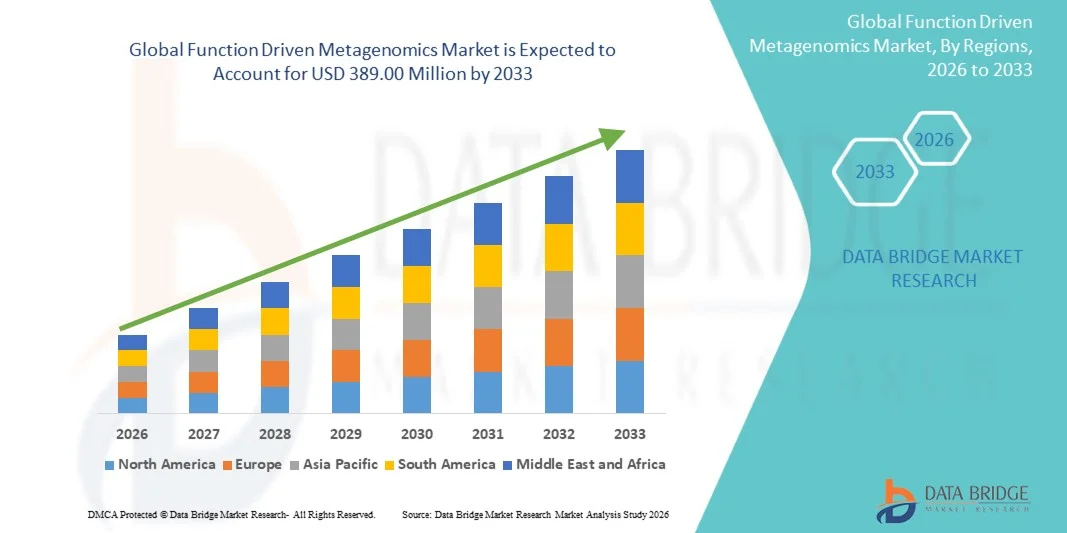
- The global function driven metagenomics market size was valued at USD 228.27 million in 2025 and is expected to reach USD 389.00 million by 2033, at a CAGR of 6.89% during the forecast period
- The growth is largely fueled by expanding adoption of high-throughput sequencing and bioinformatics technologies, declining sequencing costs, and rising use of metagenomics across sectors such as agriculture environmental monitoring, clinical diagnostics, drug discovery, and industrial biotechnology
- Furthermore, growing demand for precise microbial community analysis, microbiome-based diagnostics & therapeutics, environmental sustainability efforts and microbiome-informed agricultural practices is establishing function-driven metagenomics as the preferred analytic approach across sectors
Function Driven Metagenomics Market Analysis
- Function-driven metagenomics, which enables direct screening of genes from environmental samples to identify functional traits, enzymes, and metabolic activities, is becoming a critical tool across biotechnology, healthcare, and environmental science due to its ability to uncover novel biological functions that traditional culture-based or sequence-only methods cannot detect
- The accelerating adoption of function-driven metagenomics is primarily fueled by rapid advancements in sequencing platforms, rising interest in microbiome-based solutions, increasing demand for novel enzymes in industrial processes, and expanding applications across human health, environmental monitoring, agriculture, and biofuel development
- North America dominated the function-driven metagenomics market in 2025 with a market share of 40.2%, driven by strong genomic research capabilities, substantial investments by biotechnology and pharmaceutical companies, and the presence of advanced academic and research institutes actively applying functional screening technologies
- Asia-Pacific is expected to be the fastest-growing region during the forecast period due to expanding genomic infrastructure, increased government funding toward microbiome and environmental research, and growing utilization of metagenomic tools across biotechnology companies and academic laboratories
- The Kits and Reagents segment dominated the market with the largest share of 62.8% in 2025, supported by their extensive use in sample preparation, library construction, and functional screening workflows, making them essential consumables for research laboratories, biotechnology companies, and academic institutions conducting function-based metagenomic studies
Report Scope and Function Driven Metagenomics Market Segmentation
|
Attributes |
Function Driven Metagenomics Key Market Insights |
|
Segments Covered |
|
|
Countries Covered |
North America
Europe
Asia-Pacific
Middle East and Africa
South America
|
|
Key Market Players |
|
|
Market Opportunities |
|
|
Value Added Data Infosets |
In addition to the insights on market scenarios such as market value, growth rate, segmentation, geographical coverage, and major players, the market reports curated by the Data Bridge Market Research also include in-depth expert analysis, patient epidemiology, pipeline analysis, pricing analysis, and regulatory framework |
Function Driven Metagenomics Market Trends
“Accelerated Discovery Through AI-Enhanced Functional Screening”
- A significant and accelerating trend in the global function-driven metagenomics market is the deepening integration of artificial intelligence (AI) and advanced computational tools into functional screening workflows, enabling faster identification of genes, enzymes, and metabolic activities from complex microbiomes
- For instance, several AI-powered pipelines now assist in predicting enzyme functions from metagenomic libraries, allowing researchers to prioritize high-value gene clusters and accelerate downstream validation in industrial biotechnology and pharmaceutical research
- AI integration in functional metagenomics enables capabilities such as improved annotation accuracy, automated hit-selection, and intelligent pattern recognition in microbial gene expression datasets. For instance, AI-driven enzyme discovery platforms can rapidly identify catalytic variants with enhanced activity or stability, improving screening efficiency
- The seamless integration of AI with high-throughput sequencing, automation, and computational biology allows scientists to manage functional screening, gene expression analysis, and metabolic modeling through unified digital platforms, strengthening research workflows across multiple application areas
- This trend toward more intelligent, automated, and predictive metagenomic tools is fundamentally reshaping expectations for gene and enzyme discovery. Consequently, companies and research groups are developing AI-enhanced metagenomic platforms that support rapid identification of biocatalysts for bioremediation, human health, agriculture, and industrial processing
- The demand for function-driven metagenomic solutions with AI-enabled decision-making is growing rapidly across pharmaceutical, biotechnology, environmental, and agricultural sectors, as organizations increasingly prioritize high-throughput discovery and precision-based microbial function analysis
Function Driven Metagenomics Market Dynamics
Driver
“Growing Need Due to Advancements in Microbiome Research and Biotechnology Innovation”
- The increasing prevalence of microbiome research across human health, agriculture, and environmental science, coupled with rapid improvements in sequencing technologies, is a significant driver for the heightened demand for function-driven metagenomics
- For instance, in 2025, several biotech companies announced expansions of metagenomic screening programs aimed at discovering new enzymes for bioprocessing and therapeutics, highlighting strong R&D momentum supporting market growth
- As researchers seek deeper insights into microbial communities and their biochemical functions, function-driven metagenomics offers advanced capabilities such as activity-based screening, enzyme discovery, and functional gene profiling providing major advantages over traditional sequencing approaches
- Furthermore, the growing popularity of microbiome-based therapeutics, sustainable agriculture solutions, and environmental remediation technologies is making functional metagenomics an integral analytical method supporting innovation across diverse industries
- The ability to identify functional traits directly from uncultured microorganisms, accelerate biocatalyst discovery, and support precision biotechnology applications are key factors propelling the adoption of function-driven metagenomics across academic, industrial, and clinical sectors. The increasing availability of user-friendly sequencing kits, reagents, and functional assay platforms further contributes to market growth
Restraint/Challenge
“Data Complexity Issues and Regulatory Compliance Hurdles”
- Concerns surrounding the complexity of functional screening data, combined with regulatory challenges associated with environmental and clinical metagenomic applications, pose a significant limitation to broader market penetration
- For instance, reports highlighting the difficulty of standardizing functional assays across diverse microbial ecosystems have made some research organizations hesitant to adopt advanced function-driven metagenomic approaches
- Addressing these challenges through improved computational pipelines, harmonized assay validation, and stronger data-quality frameworks is crucial for building industry confidence. Companies and research groups are increasingly emphasizing robust workflow standardization and secure data handling to support compliance with evolving regulations. In addition, the relatively high cost of functional screening instrumentation, high-throughput sequencing systems, and AI-enabled analysis platforms can be a barrier for smaller laboratories or institutions with limited budgets
- While technological costs are gradually decreasing, the perceived premium associated with advanced functional screening and enzyme discovery platforms can still hinder widespread adoption, particularly in developing regions or early-stage research settings
- Overcoming these challenges through enhanced workflow standardization, researcher training, cost-optimized platforms, and clearer regulatory guidelines will be vital for sustained market growth and broader adoption of function-driven metagenomic tools
Function Driven Metagenomics Market Scope
The market is segmented on the basis of product, application, and end users.
- By Product
On the basis of product, the global function-driven metagenomics market is segmented into kits and reagents, sequencing and data analytics services, instruments, consumables, and others. Kits and Reagents segment dominated the market with the largest market revenue share of 62.8% in 2025, driven by their crucial role in sample preparation, DNA/RNA extraction, library construction, and functional screening workflows. Researchers across pharmaceutical, biotechnology, and academic sectors prefer kits and reagents for their standardized protocols, reproducibility, and reliability in identifying novel enzymes and microbial pathways. The recurring consumption of reagents ensures steady revenue generation. Continuous innovation in enzyme-based assays and high-sensitivity reagents further strengthens market demand. Kits and reagents are integral to both small-scale and large-scale functional metagenomics projects, providing essential support for high-throughput screening platforms. Their compatibility with automated laboratory workflows and integration into industrial applications also reinforces their market dominance.
The Sequencing and Data Analytics Services segment is anticipated to witness the fastest growth rate of 22.3% from 2026 to 2033, fueled by increasing outsourcing of sequencing, annotation, and computational analysis. Organizations without in-house sequencing infrastructure heavily rely on specialized service providers to reduce operational costs and accelerate functional gene discovery. Cloud-based bioinformatics platforms, AI-driven analytics, and long-read sequencing advancements are driving adoption. Integrated services combining wet-lab processing and computational analysis are becoming more prevalent, enhancing efficiency and scalability. Growth is further supported by rising demand for microbiome-based therapeutics and industrial enzyme discovery. As functional metagenomics projects increase in scale and complexity, demand for expert sequencing and data analytics services is expected to surge.
- By Application
On the basis of application, the global function-driven metagenomics market is segmented into environmental, human health, agriculture, biotechnology, biofuel, and others. Environmental segment dominated the market with the largest market revenue share of 38.7% in 2025, driven by widespread adoption in soil, water, wastewater, and extreme ecosystem studies. Environmental agencies and research institutes rely on function-driven metagenomics to monitor pollution, study biodegradation pathways, and assess ecosystem resilience. Government-backed sustainability programs and funding for environmental research further boost adoption. Functional metagenomics enables the discovery of enzymes for bioremediation and industrial applications. Large-scale environmental sequencing projects maintain consistent demand. Its dominance is reinforced by continuous investments in ecological and applied microbiology research.
The Human Health segment is anticipated to witness the fastest growth rate of 23.1% from 2026 to 2033, driven by increasing interest in microbiome-based diagnostics, therapeutics, and personalized medicine. Functional metagenomics enables detailed profiling of microbial metabolic activities in the gut, skin, oral cavity, and respiratory systems. Pharmaceutical and biotech companies leverage this approach for the discovery of novel bioactive compounds and antibiotics. Rising prevalence of chronic and infectious diseases drives clinical adoption and research funding. Startups developing microbiome-based therapeutics heavily rely on functional metagenomics workflows. Expansion in clinical, pharmaceutical, and research applications ensures rapid segment growth.
- By End Users
On the basis of end users, the global function-driven metagenomics market is segmented into pharmaceutical industries, biotechnology companies, research laboratories, pathology laboratories, academic and research institutes, and others. Pharmaceutical Industries segment dominated the market with the largest market revenue share of 40.2% in 2025, driven by heavy investment in antibiotic discovery, therapeutic enzyme screening, and microbiome-based product development. Functional metagenomics accelerates identification of novel bioactive molecules and metabolic pathways. Increasing antimicrobial resistance (AMR) challenges further boost adoption. Collaborations with academic and sequencing service providers expand capabilities. High-volume R&D spending ensures consistent demand. Its dominance is reinforced by strategic integration of functional metagenomics into drug discovery pipelines.
The Biotechnology Companies segment is anticipated to witness the fastest growth rate of 21.9% from 2026 to 2033, driven by industrial enzyme development and bio-based product innovation. Biotech firms and startups rely on functional metagenomics for high-throughput enzyme screening. Advances in protein engineering, AI, and synthetic biology further accelerate adoption. Demand for sustainable industrial processes supports market expansion. Venture capital investment and partnerships with research institutions drive growth. Commercialization of novel functional enzymes reinforces the segment’s rapid growth trajectory.
Function Driven Metagenomics Market Regional Analysis
- North America dominated the function-driven metagenomics market in 2025 with a market share of 40.2%, driven by strong genomic research capabilities, substantial investments by biotechnology and pharmaceutical companies, and the presence of advanced academic and research institutes actively applying functional screening technologies
- Research institutions, academic laboratories, and biotech startups in the region are rapidly integrating function-driven metagenomics to discover novel enzymes, therapeutic compounds, and microbiome-based solutions
- The widespread adoption is further supported by government funding initiatives, high R&D expenditure, and the presence of key industry players offering advanced kits, sequencing services, and analytics platforms
U.S. Function Driven Metagenomics Market Insight
The U.S. function-driven metagenomics market captured the largest revenue share of 82% in 2025 within North America, driven by strong investments in pharmaceutical and biotechnology R&D and the presence of advanced sequencing infrastructure. Researchers and biotech companies are rapidly adopting functional metagenomics to discover novel enzymes, bioactive compounds, and microbiome-based therapeutics. The growing emphasis on high-throughput screening, AI-driven bioinformatics, and integrated sequencing services further propels the market. In addition, government-backed initiatives and extensive research funding contribute to market expansion. The country’s technologically advanced ecosystem, combined with a focus on precision medicine and industrial enzyme development, reinforces its leadership in the global market.
Europe Function-Driven Metagenomics Market Insight
The Europe market is projected to expand at a substantial CAGR throughout the forecast period, primarily driven by regulatory support for microbiome-based therapeutics, industrial enzyme discovery, and environmental monitoring applications. Countries such as Germany, France, and the UK are investing in functional genomics infrastructure and bioinformatics platforms. Rising adoption of advanced sequencing technologies, strong collaborations between academia and industry, and growing interest in sustainable biotechnology foster market growth. Functional metagenomics applications are witnessing significant adoption across clinical research, agriculture, and industrial biotech. Government-backed R&D funding and awareness of microbiome therapeutics further strengthen the region’s market position.
U.K. Function-Driven Metagenomics Market Insight
The U.K. market is anticipated to grow at a noteworthy CAGR during the forecast period, fueled by increasing investments in pharmaceutical R&D, enzyme discovery, and microbiome research. The growing focus on personalized medicine, precision microbiome diagnostics, and functional genomics in agriculture and industry drives adoption. Collaborative initiatives between research institutes and biotech companies enhance access to sequencing services and analytics platforms. Government support, coupled with strong academic research output and a robust biotech ecosystem, continues to stimulate market growth. Awareness of microbial therapeutics and sustainable biotechnology solutions is encouraging adoption across clinical, industrial, and academic segments.
Germany Function-Driven Metagenomics Market Insight
The Germany market is expected to expand at a considerable CAGR during the forecast period, driven by increasing awareness of biotechnology innovations and the demand for advanced sequencing and functional genomics solutions. Germany’s well-established research infrastructure, combined with strong emphasis on industrial biotechnology and sustainable applications, promotes the adoption of functional metagenomics in pharmaceutical, environmental, and agricultural sectors. Integration of high-throughput screening, bioinformatics, and AI-based analysis in research labs further supports growth. The country’s focus on eco-conscious and secure solutions in industrial and clinical applications aligns with rising market demand.
Asia-Pacific Function-Driven Metagenomics Market Insight
The Asia-Pacific market is poised to grow at the fastest CAGR of 25% during the forecast period of 2026 to 2033, driven by rising R&D investments, expanding biotechnology infrastructure, and increasing adoption of sequencing technologies in countries such as China, Japan, and India. Government initiatives promoting biotech research, digital health, and industrial enzyme development are accelerating adoption. The region benefits from a growing talent pool in genomics, bioinformatics, and synthetic biology. Rapid urbanization, increasing disposable incomes, and rising awareness of functional metagenomics in human health, agriculture, and biofuel sectors further propel growth. APAC is emerging as both a consumer and manufacturing hub for functional genomics technologies, improving affordability and accessibility.
Japan Function-Driven Metagenomics Market Insight
The Japan market is gaining momentum due to high technological adoption, a strong focus on precision medicine, and increasing investment in microbiome and industrial enzyme research. Researchers are leveraging functional metagenomics for discovery of novel bioactive compounds and functional genes. Integration of sequencing platforms with AI-driven bioinformatics accelerates high-throughput analysis. The country’s aging population and emphasis on healthcare innovation drive demand for microbiome-based diagnostics and therapeutics. In addition, Japan’s robust industrial biotechnology sector fosters applications in biofuels, food processing, and enzyme development.
India Function-Driven Metagenomics Market Insight
The India market accounted for the largest market revenue share in Asia-Pacific in 2025, attributed to rapid urbanization, growing pharmaceutical and biotech R&D, and increasing adoption of sequencing technologies. India is becoming a hub for functional metagenomics research in microbiome therapeutics, industrial enzymes, agriculture, and biofuel development. Government initiatives supporting smart cities, digital healthcare, and biotech innovation are boosting adoption. The availability of cost-effective sequencing platforms and domestic service providers enhances accessibility. Strong collaborations between academia, industry, and startups further drive market expansion across clinical, industrial, and agricultural applications.
Function Driven Metagenomics Market Share
The Function Driven Metagenomics industry is primarily led by well-established companies, including:
- llumina, Inc. (U.S.)
- Thermo Fisher Scientific, Inc. (U.S.)
- Oxford Nanopore Technologies plc. (U.K.)
- QIAGEN (Germany)
- Biospringer (France)
- PacBio (U.S.)
- MGI Technology Co., Ltd. (China)
- BIOMÉRIEUX (France)
- CosmosID (U.S.)
- Zymo Research Corporation (U.S.)
- Fios Genomics (U.K.)
- Biolog (U.S.)
- Microbiome Insights (Canada)
- DNA Genotek Inc. (Canada)
- Labcorp (U.S.)
- BASF (Germany)
- Agilent Technologies, Inc. (U.S.)
- Synbio Technologies, Inc. (U.S.)
- Novogene Co., Ltd. (China)
- Macrogen, Inc. (South Korea)
What are the Recent Developments in Global Function Driven Metagenomics Market?
- In April 2025, Metabolon, Inc. announced the launch of a new microbiome research solution integrating metagenomics sequencing, a microbiome metabolite panel, and bioinformatics tools to offer an “all‑in‑one” toolkit for researchers studying microbial function and metabolite output. This aims to bridge genetic potential and phenotypic outcome enabling deeper functional insight into microbiomes
- In November 2023, Phase Genomics was awarded “Metagenomics Innovation of the Year 2023” by BioTech Breakthrough Awards for its proprietary metagenomics platform (ProxiMeta). This recognition reflects Phase Genomics’ advances in proximity‑ligation sequencing–based metagenomics, enabling researchers to map phage–bacteria interactions across complex microbial communities at an unprecedented scale, which is vital for antimicrobial resistance monitoring, environmental microbiology, and large‑scale functional microbiome investigations
- In August 2024, MGI Tech launched a Human Microbiome Metagenomics Sequencing Package, covering the full workflow from sample collection and extraction to sequencing and analysis. The package is designed to simplify and automate human‑microbiome studies and supports large‑scale stool‑sample sequencing, thereby boosting throughput and accessibility for researchers globally
- In June 2024, a new bioinformatics system called MegIS was proposed, enabling in‑storage processing of metagenomic data significantly reducing data‑movement overhead in large metagenomic pipelines, achieving major speedups compared to state‑of‑the‑art tools while retaining accuracy. This advances scalability and cost‑effectiveness of metagenomics analysis
- In May 2023, MGI’s long‑term initiative, Million Microbiome of Humans Project (MMHP), reached a milestone in its mission to sequence microbial DNA from one million human samples reinforcing large‑scale, population‑level functional metagenomics efforts. This project aims to build a comprehensive global human‑microbiome map for health and disease research
SKU-
Get online access to the report on the World's First Market Intelligence Cloud

- Interactive Data Analysis Dashboard
- Company Analysis Dashboard for high growth potential opportunities
- Research Analyst Access for customization & queries
- Competitor Analysis with Interactive dashboard
- Latest News, Updates & Trend analysis
- Harness the Power of Benchmark Analysis for Comprehensive Competitor Tracking
Research Methodology
Data collection and base year analysis are done using data collection modules with large sample sizes. The stage includes obtaining market information or related data through various sources and strategies. It includes examining and planning all the data acquired from the past in advance. It likewise envelops the examination of information inconsistencies seen across different information sources. The market data is analysed and estimated using market statistical and coherent models. Also, market share analysis and key trend analysis are the major success factors in the market report. To know more, please request an analyst call or drop down your inquiry.
The key research methodology used by DBMR research team is data triangulation which involves data mining, analysis of the impact of data variables on the market and primary (industry expert) validation. Data models include Vendor Positioning Grid, Market Time Line Analysis, Market Overview and Guide, Company Positioning Grid, Patent Analysis, Pricing Analysis, Company Market Share Analysis, Standards of Measurement, Global versus Regional and Vendor Share Analysis. To know more about the research methodology, drop in an inquiry to speak to our industry experts.
Customization Available
Data Bridge Market Research is a leader in advanced formative research. We take pride in servicing our existing and new customers with data and analysis that match and suits their goal. The report can be customized to include price trend analysis of target brands understanding the market for additional countries (ask for the list of countries), clinical trial results data, literature review, refurbished market and product base analysis. Market analysis of target competitors can be analyzed from technology-based analysis to market portfolio strategies. We can add as many competitors that you require data about in the format and data style you are looking for. Our team of analysts can also provide you data in crude raw excel files pivot tables (Fact book) or can assist you in creating presentations from the data sets available in the report.












