


Functional FMCG Products Market Overview
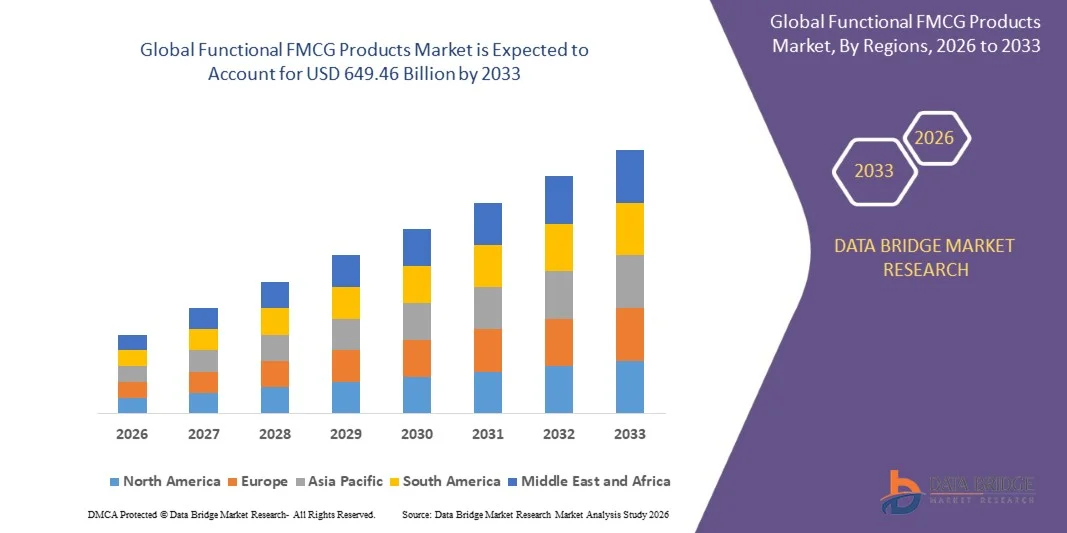
The Functional FMCG Products Market was valued at USD 321.20 billion in 2025 and is projected to reach USD 649.46 billion by 2033, growing at a CAGR of 9.20% from 2026 to 2033. The market is experiencing strong growth driven by rising consumer awareness regarding health and wellness, increasing demand for nutrient-enriched and fortified food and beverage products, and growing preference for preventive healthcare solutions over traditional reactive treatments.
The increasing prevalence of lifestyle-related disorders such as obesity, diabetes, and cardiovascular diseases is significantly driving the adoption of functional FMCG products that offer added health benefits beyond basic nutrition. Consumers are increasingly shifting toward products containing probiotics, vitamins, minerals, and plant-based ingredients that support immunity, digestion, and overall well-being. In addition, rapid urbanization, rising disposable incomes, and the expansion of organized retail and e-commerce channels are further accelerating market penetration across both developed and emerging economies.
Key Market Trends & Insights
- North America dominated the functional FMCG products market with the largest revenue share in 2025, supported by high consumer awareness regarding nutrition, strong purchasing power, well-established retail infrastructure, and widespread availability of functional food, beverage, and supplement products across mainstream distribution channels.
- Asia-Pacific is expected to be the fastest-growing region, recording a strong CAGR from 2026 to 2033. Growth is driven by rising disposable incomes, rapid urbanization, increasing health awareness, expanding middle-class population, and growing penetration of fortified and functional food products across emerging economies.
- The Functional Beverages segment held the largest market revenue share of approximately 31.4% in 2025 driven by rising demand for immunity-boosting drinks, energy beverages, and probiotic-infused hydration products across global urban populations. Increasing consumption of ready-to-drink fortified beverages in North America and Asia-Pacific is further supporting segment dominance, particularly among working professionals and fitness-conscious consumers.
- The Dietary Supplements segment is projected to register the fastest growth at a CAGR of 10.6% from 2026 to 2033, driven by increasing focus on preventive healthcare, aging populations, and rising adoption of vitamin and mineral supplementation for immunity, bone health, and overall wellness.
- The Vitamins segment accounted for the largest market revenue share of approximately 28.9% in 2025, supported by widespread use in fortified foods, beverages, and dietary supplements aimed at addressing micronutrient deficiencies and supporting immune health.
- The Probiotics segment is expected to register the fastest growth at a CAGR of 11.2% from 2026 to 2033, driven by increasing awareness of gut health, rising demand for functional dairy products, and growing scientific validation of microbiome benefits in digestive and immune system support.
- The Supermarkets & Hypermarkets segment held the largest market revenue share of approximately 38.7% in 2025, driven by strong product visibility, wide SKU availability, and high consumer preference for physical product comparison in developed economies.
- The Online Retail segment is projected to register the fastest growth at a CAGR of 13.8% from 2026 to 2033, driven by rapid expansion of e-commerce platforms, increasing adoption of subscription-based nutrition services, and rising demand for personalized functional nutrition products delivered directly to consumers.
- The Adults segment held the largest market revenue share of approximately 44.6% in 2025, driven by high consumption of functional foods and beverages among working-age populations seeking energy, immunity, and stress management benefits.
- The Geriatric Population segment is projected to register the fastest growth at a CAGR of 9.9% from 2026 to 2033, driven by increasing aging populations globally and rising demand for products supporting bone health, cardiovascular health, and cognitive function.
- The Immunity Boosting segment accounted for the largest market revenue share of approximately 29.8% in 2025, driven by heightened consumer awareness of preventive healthcare and increased demand for fortified products containing vitamins, minerals, and herbal extracts.
- The Digestive Health segment is expected to register the fastest growth at a CAGR of 11.5% from 2026 to 2033, driven by rising consumption of probiotic-based foods and beverages and increasing awareness of gut microbiome health benefits across global consumer markets.
Market Size & Forecast
- Global Market Value (2025): USD 321.20 Billion
- Expected Market Value (2033): USD 649.46 Billion
- Forecast CAGR (2026–2033): 9.20%
- Leading Region in 2025: North America
- Fastest Growing Region: Asia-Pacific
Report Scope and Functional FMCG Products Market Segmentation
|
Attributes |
Functional FMCG Products Key Market Insights |
|
Segments Covered |
|
|
Countries Covered |
North America
Europe
Asia-Pacific
Middle East and Africa
South America
|
|
Key Market Players |
• Nestlé (Switzerland) |
|
Market Opportunities |
• Expansion Of Plant Based Functional FMCG Products |
|
Value Added Data Infosets |
In addition to the insights on market scenarios such as market value, growth rate, segmentation, geographical coverage, and major players, the market reports curated by the Data Bridge Market Research also include in-depth expert analysis, pricing analysis, brand share analysis, consumer survey, demography analysis, supply chain analysis, value chain analysis, raw material/consumables overview, vendor selection criteria, PESTLE Analysis, Porter Analysis, and regulatory framework. |
Functional FMCG Products Market Trends
Trend: Growth In Functional Nutrition And Clean Label FMCG Products
Increasing consumer preference for health-focused, natural, and nutrient-enriched FMCG products is reshaping the global food and beverage industry. Rising awareness of preventive healthcare, coupled with growing concerns over obesity, diabetes, and lifestyle-related disorders, is driving demand for functional foods, beverages, and dietary supplements enriched with probiotics, vitamins, minerals, and plant-based ingredients. Conventional FMCG products with high sugar, artificial additives, and preservatives are increasingly being replaced by clean label alternatives with transparent ingredient sourcing and added health benefits.
In modern retail ecosystems, global FMCG manufacturers are expanding functional product portfolios to meet rising demand for immunity-boosting and wellness-oriented consumption. For instance, probiotic yogurt consumption in Europe has increased significantly, with Danone reporting strong double-digit growth in its functional dairy segment across key markets such as France and Germany. Similarly, fortified beverage adoption in Asia-Pacific, particularly in Japan and South Korea, is rising due to increasing consumer focus on digestive health and energy enhancement, with functional drink penetration exceeding 35–40% in urban retail channels.
The rapid expansion of e-commerce and direct-to-consumer nutrition platforms is also accelerating accessibility of functional FMCG products, enabling personalized nutrition solutions based on AI-driven dietary recommendations. In addition, rising demand for plant-based protein products, such as pea protein snacks and fortified dairy alternatives, is gaining traction globally due to sustainability concerns and lactose intolerance prevalence. Clinical studies conducted in 2025 indicate that regular consumption of probiotic and fortified foods can improve gut health indicators by nearly 20–25% in adult populations over a 12-week period.
Functional FMCG Products Market Dynamics
Key Market Driver: Rising Health Consciousness And Preventive Healthcare Adoption
Consumers globally are increasingly shifting toward preventive healthcare practices, prioritizing nutrition-based wellness over reactive medical treatment. Rising prevalence of chronic diseases and nutritional deficiencies is encouraging the adoption of fortified foods, functional beverages, and dietary supplements designed to support immunity, digestion, and overall well-being.
FMCG companies are actively reformulating products to include functional ingredients such as probiotics, omega-3 fatty acids, vitamins, and botanical extracts. For instance, global sales of fortified dairy and functional beverages have seen consistent growth in North America and Europe, driven by increasing demand for immunity-boosting products post-pandemic. Rising fitness culture and awareness of nutritional balance are also contributing to sustained market expansion across urban populations.
In addition, increasing penetration of wellness-focused retail formats and subscription-based nutrition services is enabling wider accessibility of functional FMCG products across both developed and emerging economies.
Key Restraint/Challenge: High Product Cost And Regulatory Compliance Complexity
Despite strong growth potential, premium pricing of functional FMCG products remains a key barrier, particularly in price-sensitive markets across Asia, Africa, and Latin America. The incorporation of specialized ingredients such as probiotics, plant extracts, and fortified micronutrients increases production costs, limiting affordability for mass-market consumers.
In addition, strict regulatory frameworks governing health claims and functional labeling vary across regions, creating compliance challenges for global manufacturers. Companies must meet complex food safety standards and clinical validation requirements before marketing functional benefits, increasing time-to-market and operational costs.
Market analyses indicate that functional FMCG products can be priced 15–40% higher than conventional alternatives, limiting penetration in lower-income consumer segments despite rising health awareness.
Key Market Opportunity: Expansion Of Personalized Nutrition And Plant Based Functional Products
The growing shift toward personalized nutrition and plant-based diets is creating significant opportunities in the functional FMCG market. Consumers are increasingly seeking tailored dietary solutions based on lifestyle, age, and health conditions, supported by advancements in AI-driven nutrition platforms and digital health ecosystems.
Companies are launching personalized supplement packs, fortified beverages, and plant-based protein products designed to address specific health needs such as immunity, gut health, and weight management. For instance, demand for plant-based dairy alternatives such as almond and oat milk has surged globally, with retail sales in the U.S. and Europe growing at double-digit rates in recent years.
In addition, innovations in biotechnology and food science are enabling the development of next-generation functional ingredients with enhanced bioavailability and targeted health benefits. Pilot nutrition programs conducted in 2025 across urban populations in Japan and the U.S. reported improved dietary compliance and a 15–20% improvement in key wellness indicators among consumers using personalized functional nutrition solutions.
Functional FMCG Products Market Scope
The market is segmented on the basis of product type, ingredient type, distribution channel, end user, and functionality.
• By Product Type
On the basis of product type, the Functional FMCG Products Market is segmented into Functional Beverages, Functional Foods, Dietary Supplements, Fortified Dairy Products, Nutritional Snacks, Personal Care Products, and Others. The Functional Beverages segment held the largest market revenue share of approximately 31.4% in 2025 driven by rising demand for immunity-boosting drinks, energy beverages, and probiotic-infused hydration products across global urban populations. Increasing consumption of ready-to-drink fortified beverages in North America and Asia-Pacific is further supporting segment dominance, particularly among working professionals and fitness-conscious consumers.
The Dietary Supplements segment is projected to register the fastest growth at a CAGR of 10.6% from 2026 to 2033, driven by increasing focus on preventive healthcare, aging populations, and rising adoption of vitamin and mineral supplementation for immunity, bone health, and overall wellness.
• By Ingredient Type
On the basis of ingredient type, the market is segmented into Probiotics, Vitamins, Minerals, Proteins & Amino Acids, Botanicals & Herbal Extracts, Omega Fatty Acids, and Others. The Vitamins segment accounted for the largest market revenue share of approximately 28.9% in 2025, supported by widespread use in fortified foods, beverages, and dietary supplements aimed at addressing micronutrient deficiencies and supporting immune health.
The Probiotics segment is expected to register the fastest growth at a CAGR of 11.2% from 2026 to 2033, driven by increasing awareness of gut health, rising demand for functional dairy products, and growing scientific validation of microbiome benefits in digestive and immune system support.
• By Distribution Channel
On the basis of distribution channel, the market is segmented into Supermarkets & Hypermarkets, Convenience Stores, Online Retail, Pharmacies & Drug Stores, Specialty Stores, and Others. The Supermarkets & Hypermarkets segment held the largest market revenue share of approximately 38.7% in 2025, driven by strong product visibility, wide SKU availability, and high consumer preference for physical product comparison in developed economies.
The Online Retail segment is projected to register the fastest growth at a CAGR of 13.8% from 2026 to 2033, driven by rapid expansion of e-commerce platforms, increasing adoption of subscription-based nutrition services, and rising demand for personalized functional nutrition products delivered directly to consumers.
• By End User
On the basis of end user, the market is segmented into Adults, Geriatric Population, Children, Athletes & Fitness Enthusiasts, and General Wellness Consumers. The Adults segment held the largest market revenue share of approximately 44.6% in 2025, driven by high consumption of functional foods and beverages among working-age populations seeking energy, immunity, and stress management benefits.
The Geriatric Population segment is projected to register the fastest growth at a CAGR of 9.9% from 2026 to 2033, driven by increasing aging populations globally and rising demand for products supporting bone health, cardiovascular health, and cognitive function.
• By Functionality
On the basis of functionality, the market is segmented into Energy & Stamina Enhancement, Immunity Boosting, Digestive Health, Weight Management, Skin & Hair Health, and Bone & Joint Health. The Immunity Boosting segment accounted for the largest market revenue share of approximately 29.8% in 2025, driven by heightened consumer awareness of preventive healthcare and increased demand for fortified products containing vitamins, minerals, and herbal extracts.
The Digestive Health segment is expected to register the fastest growth at a CAGR of 11.5% from 2026 to 2033, driven by rising consumption of probiotic-based foods and beverages and increasing awareness of gut microbiome health benefits across global consumer markets.
Functional FMCG Products Market Regional Analysis
North America Functional FMCG Products Market Insight
North America dominated the functional FMCG products market with the largest revenue share of 37.8% in 2025, supported by high consumer awareness regarding health and wellness, strong purchasing power, and widespread adoption of fortified foods and beverages. Consumers in the region highly value immunity-boosting products, clean label formulations, and protein-enriched nutrition solutions integrated into daily diets. This widespread adoption is further supported by advanced retail infrastructure, high penetration of e-commerce nutrition platforms, and strong presence of leading functional food and beverage manufacturers, establishing functional FMCG products as a key part of preventive healthcare consumption.
U.S. Functional FMCG Products Market Insight
The U.S. functional FMCG products market captured the largest revenue share in 2025 within North America, fueled by strong demand for dietary supplements, functional beverages, and plant-based nutrition products. Consumers are increasingly prioritizing preventive healthcare, fitness-oriented diets, and personalized nutrition solutions supported by digital health platforms. The growing preference for clean label, organic, and non-GMO fortified products further propels market growth. Moreover, increasing integration of functional ingredients such as probiotics, omega-3 fatty acids, and vitamins into mainstream FMCG products is significantly contributing to market expansion.
Europe Functional FMCG Products Market Insight
The Europe functional FMCG products market is expected to witness the fastest growth rate from 2026 to 2033, primarily driven by rising health consciousness, strong regulatory support for food fortification, and increasing demand for natural and organic functional foods. The region is experiencing strong adoption of probiotic dairy products, fortified beverages, and plant-based nutrition solutions across residential consumers. European consumers are also highly focused on sustainability and clean label transparency, which is accelerating innovation in functional product formulations. The market is expanding across supermarkets, pharmacies, and specialty health stores, with increasing penetration of premium wellness brands.
U.K. Functional FMCG Products Market Insight
The U.K. functional FMCG products market is expected to witness strong growth from 2026 to 2033, driven by rising consumer focus on immunity, digestive health, and weight management products. Increasing demand for functional beverages, protein-rich snacks, and dietary supplements is being supported by busy urban lifestyles and growing fitness culture. In addition, the expansion of online nutrition platforms and subscription-based health product delivery services is enhancing market accessibility. Concerns regarding lifestyle diseases are further encouraging consumers to shift toward fortified and health-enhancing FMCG products.
Germany Functional FMCG Products Market Insight
The Germany functional FMCG products market is expected to witness steady growth from 2026 to 2033, fueled by increasing awareness of preventive healthcare and strong preference for natural, organic, and scientifically validated functional ingredients. German consumers highly prioritize product quality, safety, and sustainability, which is driving demand for clean label fortified foods and beverages. The integration of probiotics, vitamins, and plant-based proteins into daily nutrition is expanding across both urban and semi-urban populations. In addition, strong retail infrastructure and pharmacy-based distribution are supporting market penetration.
Asia-Pacific Functional FMCG Products Market Insight
The Asia-Pacific functional FMCG products market is expected to witness the fastest growth rate from 2026 to 2033, supported by rising disposable incomes, rapid urbanization, and increasing awareness of nutritional health benefits in countries such as China, Japan, and India. The region is experiencing strong demand for functional beverages, fortified dairy products, and dietary supplements due to shifting dietary habits and growing health concerns. Government initiatives promoting nutrition awareness and food fortification are further accelerating adoption. In addition, APAC’s strong manufacturing base for FMCG products is enhancing affordability and accessibility across mass consumer markets.
Japan Functional FMCG Products Market Insight
The Japan functional FMCG products market is expected to witness steady growth from 2026 to 2033 due to the country’s aging population, high health consciousness, and strong demand for scientifically backed functional foods. Japanese consumers place significant emphasis on digestive health, bone strength, and longevity-focused nutrition products. The integration of probiotics, collagen-based supplements, and fortified beverages is widely observed in daily consumption patterns. Moreover, innovation in functional food technology and strong retail availability across convenience stores is supporting market expansion.
China Functional FMCG Products Market Insight
The China functional FMCG products market accounted for the largest market revenue share in Asia Pacific in 2025, attributed to rapid urbanization, rising middle-class population, and increasing health awareness among consumers. China stands as one of the largest markets for functional beverages, dietary supplements, and fortified foods, driven by strong demand for immunity enhancement and nutritional balance. The push toward healthy lifestyles, combined with expansion of e-commerce platforms and domestic FMCG innovation, is further propelling market growth. In addition, government support for nutrition improvement programs is strengthening long-term adoption across urban and rural populations.
Functional FMCG Products Market Share
The Functional FMCG Products industry is primarily led by well-established companies, including:
• Nestlé (Switzerland)
• PepsiCo (U.S.)
• Danone (France)
• Unilever (U.K.)
• The Coca-Cola Company (U.S.)
• Abbott Laboratories (U.S.)
• Herbalife Nutrition (U.S.)
• Amway Corporation (U.S.)
• General Mills (U.S.)
• Kellogg Company (U.S.)
• Yakult Honsha (Japan)
• DSM-Firmenich (Switzerland)
• Arla Foods (Denmark)
• Glanbia plc (Ireland)
• Mondelez International (U.S.)

- Interactive Data Analysis Dashboard
- Company Analysis Dashboard for high growth potential opportunities
- Research Analyst Access for customization & queries
- Competitor Analysis with Interactive dashboard
- Latest News, Updates & Trend analysis
- Harness the Power of Benchmark Analysis for Comprehensive Competitor Tracking
Data collection and base year analysis are done using data collection modules with large sample sizes. The stage includes obtaining market information or related data through various sources and strategies. It includes examining and planning all the data acquired from the past in advance. It likewise envelops the examination of information inconsistencies seen across different information sources. The market data is analysed and estimated using market statistical and coherent models. Also, market share analysis and key trend analysis are the major success factors in the market report. To know more, please request an analyst call or drop down your inquiry.
The key research methodology used by DBMR research team is data triangulation which involves data mining, analysis of the impact of data variables on the market and primary (industry expert) validation. Data models include Vendor Positioning Grid, Market Time Line Analysis, Market Overview and Guide, Company Positioning Grid, Patent Analysis, Pricing Analysis, Company Market Share Analysis, Standards of Measurement, Global versus Regional and Vendor Share Analysis. To know more about the research methodology, drop in an inquiry to speak to our industry experts.
Data Bridge Market Research is a leader in advanced formative research. We take pride in servicing our existing and new customers with data and analysis that match and suits their goal. The report can be customized to include price trend analysis of target brands understanding the market for additional countries (ask for the list of countries), clinical trial results data, literature review, refurbished market and product base analysis. Market analysis of target competitors can be analyzed from technology-based analysis to market portfolio strategies. We can add as many competitors that you require data about in the format and data style you are looking for. Our team of analysts can also provide you data in crude raw excel files pivot tables (Fact book) or can assist you in creating presentations from the data sets available in the report.













