


What is the Functional Tonic Water Market Size and Growth Rate?
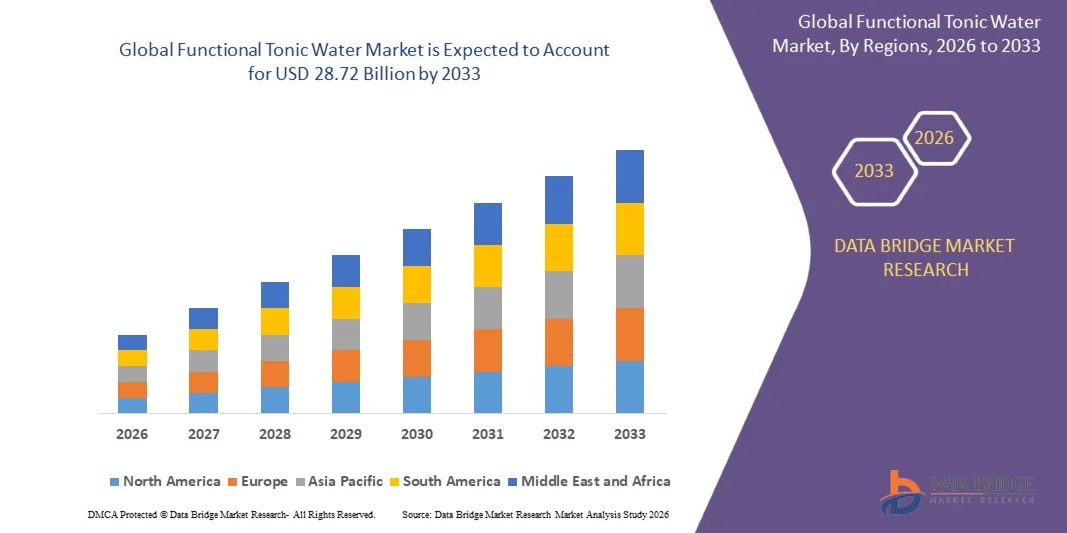
- As per Data Bridge Market Research analysis, the global functional tonic water market was valued at USD 18.21 billion in 2025 and is projected to reach USD 28.72 billion by 2033, growing at a CAGR of 5.86% from 2026 to 2033.
- The market is experiencing steady growth driven by rising global cocktail culture, premiumization of at-home mixology, and expanding demand for functional, better-for-you beverage formulations across both alcoholic and non-alcoholic occasions.
- The growing popularity of gin & tonic and other spirit-mixer cocktails, combined with rising consumer interest in low-sugar, naturally sweetened, and fortified beverages, is compelling established mixer brands and FMCG companies to expand their functional tonic water portfolios. Flavored and botanical variants are increasingly replacing plain carbonated mixers in many markets, offering differentiated taste experiences alongside functional benefits such as added vitamins, probiotics, and adaptogens.
Market Size & Forecast
- Global Market Value (2025): USD 18.21 Billion
- Expected Market Value (2033): USD 28.72 Billion
- Forecast CAGR (2026–2033): 5.86%
- Leading Region in 2025: Europe
- Fastest Growing Region: Asia-Pacific
What are the Major Takeaways of the Functional Tonic Water Market?
- Europe dominated the global functional tonic water market with the largest revenue share of 36.85% in 2025, supported by strong gin & tonic culture, established premium mixer brands, and extensive on-trade distribution.
- Asia-Pacific is expected to be the fastest-growing region at a CAGR of 7.85% from 2026 to 2033, fueled by rising urbanization, expanding cocktail culture, and growing modern retail and e-commerce infrastructure in China, India, and Japan.
- The classic/original tonic water segment led the market with a 42.30% share in 2025, driven by its widespread use as a cocktail mixer and long-standing consumer familiarity.
- Flavored tonic water is the fastest-growing product type, projected to register a CAGR of 7.40%, reflecting rising demand for citrus, fruit, and botanical variants.
- The alcoholic mixers segment dominated the category type with a 55.60% revenue share in 2025, led by sustained global demand for gin & tonic and other spirit-based cocktail occasions.
- Glass bottles accounted for 46.75% of the market share in 2025, preferred for their premium positioning and strong association with craft and on-trade mixer brands.
- The probiotic & prebiotic infused segment is the fastest-growing functional ingredient category, with a CAGR of 8.20%, driven by rising consumer focus on gut-health and wellness-oriented beverages.
Report Scope and Functional Tonic Water Market Segmentation
Attributes |
Functional Tonic Water Key Market Insights |
|
Segments Covered |
|
|
Countries Covered |
North America
Europe
Asia-Pacific
Middle East and Africa
South America
|
|
Key Market Players |
|
|
Market Opportunities |
|
|
Value Added Data Infosets |
The primary challenges include the high cost of premium and ethically sourced ingredients, rising input costs, and supply chain disruptions. These factors can increase product prices, create margin pressures for manufacturers, and limit affordability among price-sensitive consumers, particularly in emerging markets |
What is the Key Trend in the Functional Tonic Water Market?
- Established mixer producers are diversifying beyond classic quinine tonic into functional and better-for-you formats, reformulating recipes with natural sweeteners, added vitamins, and lower sugar content to meet evolving consumer preferences.
- For instance, in January 2025, Molson Coors took an 8.5% equity stake in Fever-Tree as part of a new North American production, distribution, and sales partnership intended to accelerate the brand's growth beyond its core tonic portfolio.
- Rising interest in low- and no-alcohol social occasions is prompting mixer brands to expand ready-to-drink and mocktail-friendly tonic water lines aimed at moderation-focused consumers.
- For instance, during 2025, Fever-Tree's UK non-alcoholic ready-to-drink range, including a Mediterranean-style G&T multipack and a non-alcoholic mojito mix, became the brand's fastest-selling innovation to date.
- Premium mixer brands continue to invest in flavor innovation to widen tonic water's appeal beyond the traditional gin & tonic occasion and into daytime and standalone refreshment consumption.
- For instance, in April 2025, Thomas Henry introduced Vivid Watermelon, its first new mixer flavor in four years, rolling it out across roughly 15 European markets to tap into daytime and low-and-no drinking trends.
As functional beverage brands and hospitality operators continue to prioritize premiumization, flavor diversification, and wellness positioning, the adoption of functional tonic water is expected to accelerate, reinforcing its role as a core component of modern cocktail culture and everyday refreshment.
What are the Key Drivers of the Global Functional Tonic Water Market?
- The rising global popularity of cocktail culture and at-home mixology has significantly increased demand for premium, high-quality tonic water mixers that elevate both professional and home-bar drink experiences.
- For instance, premium mixer producers such as Fever-Tree have reported that non-tonic and diversified premium products now account for approximately 45% of global brand revenue, reflecting broadening consumer demand for expanded, premium mixer portfolios.
- Growing consumer preference for low-sugar, naturally sweetened, and functional beverages is prompting manufacturers to reformulate classic tonic recipes with natural sweeteners, botanical extracts, and added vitamins or probiotics.
- For instance, In 2023, Zevia Tonic Water has positioned itself as a stevia-sweetened, zero-sugar, and zero-artificial-sweetener alternative to conventional tonic water, reflecting the broader industry shift toward cleaner-label, functional mixer formulations
- The expansion of organized retail, e-commerce, and HoReCa channels across emerging markets is improving accessibility and distribution of premium and functional tonic water brands, supporting broader category adoption.
- For instance, following in February 2025 strategic partnership with Molson Coors, Fever-Tree gained access to an expanded U.S. distribution network spanning retail, e-commerce activation, and on-trade channels, supporting broader accessibility and category penetration for its premium mixer portfolio.
With cocktail culture, premiumization, and wellness-oriented consumption continuing to converge, functional tonic water is expected to remain a key growth category within the broader mixer and functional beverage landscape.
Which Factors are Challenging the Growth of the Functional Tonic Water Market?
- Premium tonic water formulations require higher-cost inputs, including natural sweeteners, quinine extract, and glass packaging, which keep retail prices above those of mainstream carbonated soft drinks.
- These higher costs limit adoption among price-sensitive consumers and smaller retail and hospitality operators in emerging economies.
- For instance, Fever-Tree experienced notable gross margin compression during 2022 and 2023 due to rising glass, freight, and energy costs, with margins only beginning to recover through 2024 and 2025 as input costs normalized, underscoring the cost sensitivity inherent to premium mixer production.
- Regulatory scrutiny and labeling requirements around quinine content in certain countries add compliance complexity for manufacturers seeking to enter or expand within new markets.
- The high input costs and regulatory complexity associated with premium and functional tonic water formulations continue to restrict adoption among smaller organizations and cost-sensitive markets, slowing category penetration despite growing consumer demand.
How is the Global Functional Tonic Water Market Segmented?
The global functional tonic water market is segmented on the basis of product type, functional ingredient, packaging type, distribution channel, end user, category, sweetener type, price tier, and flavor profile.
- By Product Type
On the basis of product type, the global functional tonic water market is segmented into classic/original tonic water, flavored tonic water, low-calorie/sugar-free tonic water, and herbal & botanical tonic water. The classic/original tonic water segment dominated the market with a 42.30% share in 2025, owing to its versatility as a cocktail mixer, wide bartender adoption, and long-standing consumer familiarity across both on-trade and retail channels. These products remain the default choice for gin & tonic occasions and continue to anchor most mixer portfolios worldwide.
The flavored tonic water segment is projected to register the fastest growth at a CAGR of 7.40% from 2026 to 2033, driven by rising consumer interest in citrus, botanical, and fruit-forward variants that broaden tonic water's use beyond traditional cocktail mixing into standalone refreshment occasions.
- By Functional Ingredient
On the basis of functional ingredient, the global functional tonic water market is segmented into quinine-based, vitamin & mineral fortified, probiotic & prebiotic infused, adaptogen-infused, and electrolyte-enhanced. The quinine-based segment led the market with a 39.85% share in 2025, supported by its role as the defining ingredient of traditional tonic water and its continued preference among premium and craft mixer brands for authentic bitterness profiles.
The probiotic & prebiotic infused segment is expected to witness the fastest CAGR of 8.20% from 2026 to 2033, driven by rising consumer focus on gut-health and functional wellness attributes in everyday beverages.
- By Packaging Type
On the basis of packaging type, the global functional tonic water market is segmented into glass bottles, PET/plastic bottles, aluminum cans, and multipack cartons. The glass bottles segment dominated the market with a 46.75% share in 2025, owing to its association with premium positioning, superior product preservation, and strong preference among craft and on-trade mixer brands.
The aluminum cans segment is anticipated to witness the fastest CAGR of 7.65% from 2026 to 2033, supported by growing demand for portable, recyclable, and single-serve formats across retail and e-commerce channels.
- By Distribution Channel
On the basis of distribution channel, the global functional tonic water market is segmented into supermarkets & hypermarkets, convenience stores, online retail/e-commerce, on-trade (bars, pubs & restaurants), and specialty & health food stores. The on-trade segment dominated the market with a 37.90% share in 2025, driven by strong demand from bars, pubs, and restaurants where tonic water is served as a core cocktail mixer alongside gin and other spirits.
The online retail/e-commerce segment is expected to witness the fastest CAGR of 8.55% from 2026 to 2033, driven by the growth of direct-to-consumer subscription models and expanding digital availability of premium and craft mixer brands.
- By End User
On the basis of end user, the global functional tonic water market is segmented into household/retail consumers, HoReCa (hotels, restaurants & cafés), and bars & nightclubs. The HoReCa segment dominated the market with a 44.60% share in 2025, supported by widespread use of tonic water as a core mixer in professional bar programs and hospitality beverage menus globally.
The household/retail consumers segment is projected to witness the fastest CAGR of 7.30% from 2026 to 2033, driven by the growing popularity of home mixology and moderation-led drinking occasions.
- By Category
On the basis of category, the global functional tonic water market is segmented into alcoholic mixers and non-alcoholic functional beverages. The alcoholic mixers segment dominated the market with a 55.60% share in 2025, owing to sustained global demand for gin & tonic and other cocktail occasions across bars, restaurants, and home settings.
The non-alcoholic functional beverages segment is expected to witness the fastest CAGR of 8.10% from 2026 to 2033, driven by the broader moderation trend and rising demand for low- and no-alcohol social occasions.
- By Sweetener Type
On the basis of sweetener type, the global functional tonic water market is segmented into sugar-sweetened, naturally sweetened, artificially sweetened, and sugar-free. The sugar-sweetened segment dominated the market with a 41.20% share in 2025, supported by strong consumer familiarity with traditional tonic water taste profiles and its continued preference among classic cocktail formulations.
The naturally sweetened segment is projected to witness the fastest CAGR of 7.95% from 2026 to 2033, driven by increasing consumer preference for clean-label formulations using stevia and monk fruit extract in place of refined sugar.
- By Price Tier
On the basis of price tier, the global functional tonic water market is segmented into mass/economy, premium, and super-premium/craft. The premium segment dominated the market with a 45.35% share in 2025, supported by rising consumer willingness to pay for higher-quality mixers that elevate cocktail experiences in both on-trade and at-home settings.
The super-premium/craft segment is expected to witness the fastest CAGR of 7.75% from 2026 to 2033, driven by growing demand for artisanal, small-batch mixer brands among discerning consumers and specialty bars.
- By Flavor Profile
On the basis of flavor profile, the global functional tonic water market is segmented into classic bitter/original, citrus-infused, fruit-infused, and herbal & spiced. The classic bitter/original segment dominated the market with a 40.10% share in 2025, owing to its established role as the standard tonic water profile preferred across mainstream cocktail and retail applications.
The fruit-infused segment is anticipated to witness the fastest CAGR of 7.55% from 2026 to 2033, driven by growing consumer interest in novel flavor experiences and expanding use in spritz-style and highball serves.
Which Region Holds the Largest Share of the Global Functional Tonic Water Market?
- Europe dominated the global functional tonic water market and accounted for the largest revenue share of 36.85% in 2025, supported by deep-rooted gin & tonic culture, established premium mixer brands, and extensive on-trade distribution networks.
- The region also benefits from strong bartender-led innovation, high adoption of premium and craft mixer brands, and growing use of functional tonic water across both cocktail and standalone refreshment occasions. Continued flavor and formulation innovation is expected to strengthen Europe's leadership position in the global market.
U.K. Functional Tonic Water Market Insight
The U.K. functional tonic water market remains a global innovation hub, anchored by home-grown premium mixer brands and a deeply established gin & tonic drinking culture. Rising demand for non-alcoholic and low-ABV mixer formats, alongside continued flavor innovation from leading producers, is supporting sustained market growth. Expanding distribution through both on-trade and e-commerce channels continues to reinforce the U.K.'s position as a key market for premium and functional tonic water.
Germany Functional Tonic Water Market Insight
The Germany functional tonic water market is expanding steadily, supported by a strong domestic premium mixer industry, an active craft cocktail bar scene, and continuous flavor innovation from Berlin-based and other regional producers. Growing consumer interest in botanical and lower-sugar tonic variants, combined with strong export activity across European markets, continues to drive category growth in Germany.
Asia-Pacific Functional Tonic Water Market Insight
The Asia-Pacific functional tonic water market is expected to witness rapid growth, driven by rising urbanization, expanding cocktail and hospitality culture, and growing modern retail and e-commerce penetration across countries such as China, India, and Japan. Increasing consumer awareness of premium and functional beverage options, along with the expansion of international mixer brands into regional markets, is supporting strong category growth across the region.
Japan Functional Tonic Water Market Insight
The Japan functional tonic water market is witnessing consistent growth, supported by a well-established premium beverage culture, rising interest in highball and cocktail-style drinking occasions, and growing demand for functional and low-sugar beverage formats. Increasing collaboration between international mixer brands and local distributors is further supporting market expansion in Japan.
China Functional Tonic Water Market Insight
The China functional tonic water market is growing rapidly, driven by expanding urban hospitality and bar culture, rising disposable incomes, and increasing consumer interest in premium imported beverage brands. Growing adoption of functional and better-for-you beverage formats, along with rapid expansion of e-commerce and modern retail infrastructure, is positioning China as one of the fastest-growing markets for functional tonic water globally.
Which are the Top Companies in the Global Functional Tonic Water Market?
The global functional tonic water industry is primarily led by well-established companies, including:
- Fever-Tree Drinks plc (U.K.)
- Thomas Henry GmbH & Co. KG (Germany)
- Fentimans Ltd. (U.K.)
- Suntory Beverage & Food Limited (Japan)
- Britvic plc (U.K.)
- The Coca-Cola Company (U.S.)
- Mixer Brands, Inc. (Q Mixers) (U.S.)
- East Imperial Ltd. (New Zealand)
- Franklin & Sons Ltd. (U.K.)
- 1724 Tonic Water S.L. (Spain)
- Merchant's Heart Beverage Co. (U.S.)
- Double Dutch Drinks Ltd. (U.K.)
- Three Cents S.A. (Greece)
- Boylan Bottling Co. (U.S.)
- Aromhuset AB (Sweden)
- Indi & Cold (Spain)
- Bickford's Australia Pty Ltd. (Australia)
- Top Note Tonic (U.S.)
- Powell & Mahoney Ltd. (U.S.)
- Owen's Craft Mixers, Inc. (U.S.)
- Aqua Monaco GmbH (Germany)
- London Essence Company (U.K.)
- Betsy's Botanicals (U.S.)
- Nordic Mist (Coca-Cola FEMSA) (Spain)
What are the Latest Developments in the Functional Tonic Water Market?
- In January 2025, Molson Coors acquired an 8.5% equity stake in Fever-Tree as part of a new North American production, distribution, and sales partnership, aimed at accelerating the brand's growth beyond its core tonic water portfolio. The agreement shifted Fever-Tree's U.S. distribution model and positioned Molson Coors to support broader category expansion for the premium mixer brand.
- In fiscal year 2025, Fever-Tree reported that non-tonic products, including ginger beer, premium sodas, and non-alcoholic ready-to-drink lines, accounted for approximately 45% of global brand revenue, with its U.K. non-alcoholic ready-to-drink range becoming the company's fastest-selling innovation to date. This reflects the broader industry shift toward diversified, functional mixer portfolios.
- In April 2025, Thomas Henry launched Vivid Watermelon, its first new mixer flavor in four years, rolling the limited-edition product out across approximately 15 European markets to tap into daytime and low-and-no drinking occasions. The launch marked the brand's 15th anniversary and formed part of its broader flavor innovation strategy.
- During 2025, U.S. mixer brand Q Mixers expanded its core lineup with the launch of "Q Refreshers," reflecting intensifying competitive pressure and innovation activity within the premium mixer category.
- Through the second half of 2025, Fever-Tree reported U.S. net sales growth of approximately 6% year-over-year, crediting its new distribution partnership with Molson Coors for supporting continued market share gains in the North American mixer category.

- Interactive Data Analysis Dashboard
- Company Analysis Dashboard for high growth potential opportunities
- Research Analyst Access for customization & queries
- Competitor Analysis with Interactive dashboard
- Latest News, Updates & Trend analysis
- Harness the Power of Benchmark Analysis for Comprehensive Competitor Tracking
Data collection and base year analysis are done using data collection modules with large sample sizes. The stage includes obtaining market information or related data through various sources and strategies. It includes examining and planning all the data acquired from the past in advance. It likewise envelops the examination of information inconsistencies seen across different information sources. The market data is analysed and estimated using market statistical and coherent models. Also, market share analysis and key trend analysis are the major success factors in the market report. To know more, please request an analyst call or drop down your inquiry.
The key research methodology used by DBMR research team is data triangulation which involves data mining, analysis of the impact of data variables on the market and primary (industry expert) validation. Data models include Vendor Positioning Grid, Market Time Line Analysis, Market Overview and Guide, Company Positioning Grid, Patent Analysis, Pricing Analysis, Company Market Share Analysis, Standards of Measurement, Global versus Regional and Vendor Share Analysis. To know more about the research methodology, drop in an inquiry to speak to our industry experts.
Data Bridge Market Research is a leader in advanced formative research. We take pride in servicing our existing and new customers with data and analysis that match and suits their goal. The report can be customized to include price trend analysis of target brands understanding the market for additional countries (ask for the list of countries), clinical trial results data, literature review, refurbished market and product base analysis. Market analysis of target competitors can be analyzed from technology-based analysis to market portfolio strategies. We can add as many competitors that you require data about in the format and data style you are looking for. Our team of analysts can also provide you data in crude raw excel files pivot tables (Fact book) or can assist you in creating presentations from the data sets available in the report.













