


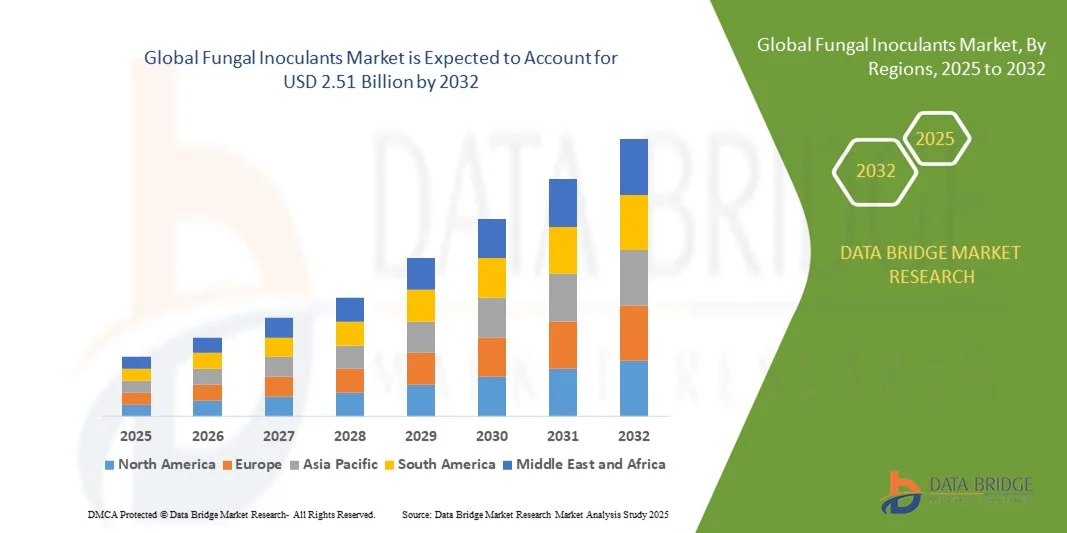
Fungal Inoculants Market Size
- The global fungal inoculants market size was valued at USD 1.7 billion in 2024 and is expected to reach USD 2.51 billion by 2032, at a CAGR of 5.0% during the forecast period
- The market growth is largely fueled by the increasing adoption of sustainable and organic farming practices, coupled with rising awareness among farmers regarding soil health, crop productivity, and the environmental benefits of bio-based inputs
- Furthermore, the growing demand for high-yield and nutrient-efficient crops is driving farmers to integrate fungal inoculants into their cultivation practices. These factors, along with supportive government policies promoting biofertilizers and reduced chemical fertilizer usage, are accelerating the uptake of fungal inoculants, thereby significantly boosting the industry’s growth
Fungal Inoculants Market Analysis
- Fungal inoculants, comprising beneficial fungi such as mycorrhiza and Trichoderma spp., are increasingly recognized as vital agricultural inputs due to their ability to enhance nutrient uptake, improve soil structure, and increase crop yield in both conventional and organic farming systems
- The escalating demand for fungal inoculants is primarily fueled by the global shift towards sustainable agriculture, the need for enhanced soil fertility and plant resilience, and growing awareness of environmentally friendly farming practices that reduce dependency on synthetic fertilizers
- North America dominated the fungal inoculants market with a share of 39.43% in 2024, due to increasing adoption of sustainable agriculture practices and rising awareness about soil health and crop productivity
- Asia-Pacific is expected to be the fastest growing region in the fungal inoculants market during the forecast period due to rapid urbanization, increasing food demand, and rising adoption of sustainable agriculture in countries such as China, India, and Japan
- Agricultural inoculants segment dominated the market with a market share of 62% in 2024, due to their widespread adoption in crop production to enhance soil fertility, nutrient uptake, and plant growth. Farmers increasingly prefer agricultural inoculants due to their proven effectiveness in boosting crop yields and improving resistance against pathogens. The segment benefits from ongoing research and development that has led to improved formulations with higher shelf-life and efficacy. Integration with modern agricultural practices, including precision farming, further fuels demand. Agricultural inoculants also find strong application across diverse crops and soil types, supporting consistent performance. The segment’s established distribution networks and availability in packaged forms make it highly accessible to farmers globally
Report Scope and Fungal Inoculants Market Segmentation
|
Attributes |
Fungal Inoculants Key Market Insights |
|
Segments Covered |
|
|
Countries Covered |
North America
Europe
Asia-Pacific
Middle East and Africa
South America
|
|
Key Market Players |
|
|
Market Opportunities |
|
|
Value Added Data Infosets |
In addition to the insights on market scenarios such as market value, growth rate, segmentation, geographical coverage, and major players, the market reports curated by the Data Bridge Market Research also include in-depth expert analysis, pricing analysis, brand share analysis, consumer survey, demography analysis, supply chain analysis, value chain analysis, raw material/consumables overview, vendor selection criteria, PESTLE Analysis, Porter Analysis, and regulatory framework. |
Fungal Inoculants Market Trends
Adoption of Sustainable Farming Boosts Fungal Inoculants
- A major trend influencing the fungal inoculants market is the widespread adoption of sustainable and eco-friendly farming practices aimed at reducing chemical dependency and improving soil health. Fungal inoculants, particularly mycorrhizal and endophytic fungal strains, are gaining importance for their ability to enhance nutrient uptake, enrich soil fertility, and improve plant resilience against abiotic stress
- For instance, companies such as Novozymes A/S and Symborg have introduced advanced biofertilizer solutions based on mycorrhizal associations to help farmers enhance phosphorus uptake and overall root development. These microbial technologies are being integrated into regenerative agriculture programs across regions such as North America and Europe to promote long-term sustainability in crop production
- Fungal inoculants play a central role in restoring soil microbial balance by forming symbiotic relationships with plant roots. This natural bioenhancement process enables efficient nutrient cycling, boosts water retention, and promotes healthier root architecture, leading to improved yield quality and consistency
- In addition, government agricultural schemes and private sector initiatives promoting organic and regenerative farming are creating favorable conditions for fungal inoculant commercialization. Policies encouraging reduced fertilizer application and promoting biological soil amendments have accelerated adoption among small and large-scale farmers
- The integration of fungal inoculants into seed treatments, soil conditioners, and biofertilizer blends has also expanded their usage across diverse crops such as cereals, pulses, vegetables, and fruit plantations. This versatility supports improved productivity under varying soil and climatic conditions
- Overall, the movement toward sustainable farming backed by increased investments in biological inputs reflects a long-term transition from synthetic fertilizers to microbial-enhanced agronomy. The trend underlines fungal inoculants’ growing importance in achieving nutrient efficiency, environmental balance, and resilient agricultural productivity
Fungal Inoculants Market Dynamics
Driver
Growing Global Demand for High-Yield and Nutrient-Efficient Crops
- The rising global demand for high-yield and nutrient-efficient crops is a significant driver for the fungal inoculants market. Farmers are under increasing pressure to produce more on limited arable land while maintaining soil fertility and reducing dependence on conventional agrochemicals
- For instance, in 2024, Bayer AG and Novozymes expanded their biological crop solution portfolios by incorporating advanced mycorrhizal strains aimed at improving phosphorus and micronutrient uptake in cereals and oilseeds. Such strategic collaborations highlight growing corporate investments in microbial-based technologies to enhance crop performance sustainably
- Fungal inoculants improve plant nutrient absorption by forming mutualistic relationships with roots, which enables efficient mineral and water uptake even in nutrient-depleted soils. This natural inoculation process reduces fertilizer consumption while maintaining consistent crop productivity
- In addition, the increasing preference for environment-friendly agricultural practices among both producers and consumers is driving the adoption of biofertilizers as viable substitutes for chemical fertilizers, contributing to long-term soil restoration and improved farm economics
- The expanding role of fungal inoculants in promoting root health, yield enhancement, and nutrient-use efficiency positions them as a key enabler of high-output, sustainable agriculture. Their integration into modern agronomic programs is contributing to global food security goals and reinforcing the shift toward biologically enhanced crop systems
Restraint/Challenge
Limited Awareness and Quality Issues
- A major challenge hindering the fungal inoculants market is the limited awareness among farmers regarding product application, benefits, and storage conditions. Despite proven efficacy, knowledge gaps persist in rural and developing agricultural regions, leading to inconsistent adoption and suboptimal results
- For instance, small farmers in countries such as India and Kenya often lack technical training and guidance on proper inoculant use. Companies such as Symborg and T. Stanes & Company are conducting field demonstrations and training programs to educate growers on dosage management and storage requirements, yet penetration remains low in some areas
- Fungal inoculants are sensitive to environmental conditions such as temperature and humidity, which can affect the viability of spores during transportation and shelf storage. Poor handling practices and limited cold-chain infrastructure contribute to quality deterioration, reducing product effectiveness in the field
- In addition, the market faces challenges from unstandardized formulations and inconsistent microbial counts across manufacturers, which create reliability concerns and affect farmer confidence in biological inputs
- Overcoming these limitations through wider educational outreach, improved formulation stability, and stricter quality control regulations will be essential for expanding fungal inoculant adoption. A coordinated approach among producers, agricultural extension services, and policymakers will ensure consistent quality and greater acceptance of fungal inoculants in global farming systems
Fungal Inoculants Market Scope
The market is segmented on the basis of type, crop type, mode of application, and source.
- By Type
On the basis of type, the fungal inoculants market is segmented into agricultural inoculants and silage inoculants. The agricultural inoculants segment dominated the market with the largest market revenue share of 62% in 2024, driven by their widespread adoption in crop production to enhance soil fertility, nutrient uptake, and plant growth. Farmers increasingly prefer agricultural inoculants due to their proven effectiveness in boosting crop yields and improving resistance against pathogens. The segment benefits from ongoing research and development that has led to improved formulations with higher shelf-life and efficacy. Integration with modern agricultural practices, including precision farming, further fuels demand. Agricultural inoculants also find strong application across diverse crops and soil types, supporting consistent performance. The segment’s established distribution networks and availability in packaged forms make it highly accessible to farmers globally.
The silage inoculants segment is anticipated to witness the fastest growth rate from 2025 to 2032, driven by increasing demand in the livestock and dairy sectors for higher-quality silage and improved feed efficiency. Silage inoculants enhance fermentation, reduce nutrient losses, and prevent spoilage, making them crucial for modern animal husbandry. The rising focus on sustainable livestock practices and the need to maintain consistent feed quality are propelling adoption. Technological advancements have led to more targeted inoculant strains for different forage crops, further encouraging usage. Growth is also supported by the expansion of commercial dairy farms and feed production facilities in emerging regions. In addition, regulatory approvals and incentives in several countries for feed safety and quality are accelerating market penetration of silage inoculants.
- By Crop Type
On the basis of crop type, the market is segmented into cereals and grains, oilseeds and pulses, fruits and vegetables, forage, and others. The cereals and grains segment dominated the market in 2024, owing to the widespread cultivation of staple crops such as wheat, rice, and maize, which benefit significantly from fungal inoculants. These inoculants improve nutrient absorption, particularly nitrogen fixation and phosphorus solubilization, enhancing plant growth and productivity. The segment sees consistent adoption due to government programs promoting sustainable agriculture and soil health. Cereals and grains are grown in large acreages worldwide, creating a stable demand base. Farmers increasingly integrate inoculants into standard agronomic practices to reduce chemical fertilizer usage. Moreover, the cost-effectiveness and proven yield improvements of fungal inoculants in cereals and grains reinforce the segment’s dominance.
The oilseeds and pulses segment is expected to witness the fastest growth from 2025 to 2032, driven by rising demand for protein-rich crops and healthy edible oils. Inoculants enhance soil fertility and nutrient availability, supporting higher yields in crops such as soybeans, chickpeas, and lentils. For instance, adoption in soybean cultivation by companies such as Novozymes has demonstrated notable improvements in nitrogen fixation and overall productivity. The growth is further accelerated by increasing awareness of sustainable farming and organic practices in both developing and developed regions. Expansion of oilseed and pulse cultivation in Asia-Pacific and Latin America is also fueling demand. Farmers prefer inoculants to reduce dependency on chemical fertilizers, improving soil health in the long term. In addition, crop rotation practices with pulses further encourage inoculant adoption, ensuring soil enrichment and disease resistance.
- By Mode of Application
On the basis of mode of application, the fungal inoculants market is segmented into seed inoculation, soil inoculation, and others. The seed inoculation segment dominated the market in 2024 due to its simplicity, efficiency, and direct impact on crop germination and early growth stages. Farmers increasingly favor seed inoculation as it ensures uniform distribution of beneficial fungi and maximizes nutrient uptake from the start. This method minimizes wastage of inoculants and reduces labor costs, making it economically attractive for large-scale farming. Technological improvements in coating techniques have enhanced the survivability and effectiveness of fungal strains. Seed inoculation also enables precise application in modern mechanized farming, supporting scalable adoption. Regulatory support for biofertilizers and inoculants further strengthens this segment’s position.
Soil inoculation is anticipated to witness the fastest growth rate from 2025 to 2032, driven by the growing emphasis on improving soil health and sustainable farming practices. For instance, companies such as BASF have developed soil-applied fungal formulations that enhance nutrient cycling, suppress soil-borne diseases, and improve crop resilience. Adoption is increasing in orchards, vegetable farms, and large-field cereal cultivation where direct soil application ensures broader coverage. Government initiatives promoting soil rejuvenation and organic farming are further boosting demand. Soil inoculation also supports long-term productivity improvements, attracting large commercial farms. The segment benefits from innovations in granular and liquid formulations, offering easier handling and better shelf-life. Rising awareness of soil microbiome importance in overall crop health reinforces adoption trends in this segment.
- By Source
On the basis of source, the fungal inoculants market is segmented into mycorrhiza, Trichoderma spp., and other fungal sources. The mycorrhiza segment dominated the market in 2024, attributed to its proven symbiotic relationship with plants that enhances nutrient absorption, particularly phosphorus, and improves drought tolerance. Mycorrhizal inoculants are increasingly preferred in high-value crops and organic farming systems. The segment benefits from extensive research validating its positive impact on soil microbiome, crop yield, and plant resistance against pathogens. Farmers also favor mycorrhiza for its long-term soil improvement properties and compatibility with various crops. Commercial availability of easy-to-use formulations has strengthened market penetration. In addition, collaborations between biotech firms and agricultural cooperatives have facilitated adoption globally.
Trichoderma spp. is expected to witness the fastest growth from 2025 to 2032, driven by its effectiveness as a biocontrol agent against soil-borne pathogens and its role in promoting plant growth. For instance, Trichoderma-based inoculants by companies such as Koppert have demonstrated enhanced disease suppression and nutrient mobilization in various crops. Rising concerns over chemical fungicide usage and increasing demand for sustainable agriculture are major growth drivers. The segment also benefits from formulation innovations that improve spore viability and shelf-life. Trichoderma inoculants are gaining traction in fruits, vegetables, and high-value horticultural crops, particularly in regions emphasizing organic practices. Government incentives for biopesticides and biofertilizers further support segment expansion. Moreover, their dual functionality in pathogen control and growth promotion makes Trichoderma a preferred choice for modern farming systems.
Fungal Inoculants Market Regional Analysis
- North America dominated the fungal inoculants market with the largest revenue share of 39.43% in 2024, driven by increasing adoption of sustainable agriculture practices and rising awareness about soil health and crop productivity
- Farmers in the region highly value the ability of fungal inoculants to enhance nutrient uptake, improve yield, and reduce dependency on chemical fertilizers
- This widespread adoption is further supported by strong government support for biofertilizers, well-established distribution networks, and high investment in agricultural R&D, establishing fungal inoculants as a preferred solution across both large-scale and smallholder farms
U.S. Fungal Inoculants Market Insight
The U.S. fungal inoculants market captured the largest revenue share in North America in 2024, fueled by increasing demand for sustainable farming inputs and precision agriculture solutions. Farmers are increasingly integrating fungal inoculants to improve crop yields, soil fertility, and resilience against plant pathogens. The growing trend of organic farming, coupled with rising awareness of biofertilizer benefits and adoption of advanced farming technologies, further propels the market, while strong presence of leading biofertilizer manufacturers and supportive policies for environmentally friendly agriculture are significantly contributing to market growth.
Europe Fungal Inoculants Market Insight
The Europe fungal inoculants market is projected to expand at a substantial CAGR throughout the forecast period, primarily driven by stringent regulations on chemical fertilizers and a strong push for sustainable agriculture. The rise in organic farming and adoption of soil health improvement practices is fostering fungal inoculant demand, as European farmers value their ability to increase nutrient efficiency and reduce environmental impact. Significant growth is observed across cereals, oilseeds, and horticulture applications, with fungal inoculants being increasingly used in both conventional and organic cultivation systems.
U.K. Fungal Inoculants Market Insight
The U.K. fungal inoculants market is anticipated to grow at a noteworthy CAGR during the forecast period, driven by increasing focus on sustainable farming practices and crop productivity. Concerns regarding soil degradation and environmental sustainability are encouraging farmers to adopt biofertilizers, while the U.K.’s modern agricultural infrastructure and government initiatives promoting eco-friendly farming continue supporting market growth. High awareness of organic and precision agriculture is further stimulating demand for fungal inoculants in cereals, vegetables, and horticulture.
Germany Fungal Inoculants Market Insight
The Germany fungal inoculants market is expected to expand at a considerable CAGR during the forecast period, fueled by the country’s emphasis on environmental sustainability and technologically advanced agriculture. German farmers increasingly adopt fungal inoculants to enhance crop yield, nutrient uptake, and resistance to soil-borne diseases, while government incentives, research programs, and adoption of modern farming techniques promote their use. Integration of fungal inoculants into both large-scale and specialty crop cultivation is becoming increasingly prevalent, aligning with local sustainability and productivity goals.
Asia-Pacific Fungal Inoculants Market Insight
The Asia-Pacific fungal inoculants market is poised to grow at the fastest CAGR during the forecast period of 2025 to 2032, driven by rapid urbanization, increasing food demand, and rising adoption of sustainable agriculture in countries such as China, India, and Japan. Farmers in the region are embracing fungal inoculants to improve soil fertility, crop yield, and resilience against pests and diseases, while government initiatives promoting organic and eco-friendly farming and rising awareness about soil health are driving adoption. Expanding agricultural research, growing presence of domestic biofertilizer manufacturers, and cost-effective solutions are boosting market penetration across both smallholder and commercial farms.
Japan Fungal Inoculants Market Insight
The Japan fungal inoculants market is gaining momentum due to high focus on sustainable agriculture, soil health, and precision farming technologies. Farmers increasingly utilize fungal inoculants to improve nutrient absorption, crop yield, and resilience against plant stress, while integration with advanced cultivation techniques and strong government support for eco-friendly inputs is fueling growth in both cereal and horticulture sectors. The aging farming population further drives demand for efficient, low-maintenance biofertilizer solutions.
China Fungal Inoculants Market Insight
The China fungal inoculants market accounted for the largest revenue share in Asia-Pacific in 2024, attributed to the country’s rapid urbanization, large-scale agricultural production, and increasing adoption of sustainable farming practices. Fungal inoculants are becoming increasingly popular among cereal, oilseed, and vegetable farmers due to their role in enhancing soil fertility, crop yield, and nutrient efficiency, while government initiatives promoting biofertilizers and the presence of leading domestic manufacturers are driving market expansion. The push towards eco-friendly agriculture and high demand for food security are further propelling the market across both commercial and smallholder farms.
Fungal Inoculants Market Share
The fungal inoculants industry is primarily led by well-established companies, including:
- BASF SE (Germany)
- Bayer AG (Germany)
- Novozymes (Denmark)
- Verdesian Life Sciences (U.S.)
- ABM Advanced Biological Marketing (U.S.)
- BrettYoung (Canada)
- Precision Laboratories, LLC (U.S.)
- Queensland Agricultural Seeds (Australia)
- TerraMax, Inc. (U.S.)
- XiteBio Technologies Inc. (U.S.)
- Chr. Hansen Holding A/S (Denmark)
- Lallemand Inc. (Canada)
- Kemin Industries, Inc. (U.S.)
- Provita Supplements GmbH (Germany)
- Corteva (U.S.)
- MBFi (U.S.)
- Cargill, Incorporated (U.S.)
- BIOMIN Holding GmbH (Austria)
- ADM (U.S.)
Latest Developments in Global Fungal Inoculants Market
- In June 2025, ProGro BIO announced its plan to seek regulatory approval for a new line of organic biocontrol products targeting fungal pathogens, nematodes, and foliar pests, building on its inoculant platform. Expanding into biocontrol products broadens the scope of fungal technologies from nutrient enhancement to integrated pest and soil health solutions. This development creates additional revenue streams, attracts farmers seeking multifunctional bio-inputs, and strengthens the overall market position of fungal inoculants in sustainable agriculture
- In April 2025, a collaborative research project demonstrated that fungal endophyte inoculants improve soil carbon sequestration, enhance soil structure, and increase crop yields. This scientific advancement emphasizes the dual agronomic and environmental benefits of fungal inoculants, highlighting their role in productivity and also in sustainability initiatives. As environmental compliance and carbon-conscious farming become priorities globally, this research reinforces the strategic value of fungal inoculants and drives market expansion
- In February 2025, ProGro BIO announced the results of its 2024 in-field trials for its Rhizol soil inoculant line, showing significant yield increases, improved soil health, and pathogen suppression across multiple states. The successful demonstration of large-scale effectiveness strengthens market credibility and builds grower confidence in fungal inoculants. This validation encourages broader adoption among commercial farmers, accelerating demand for microbial soil inputs and reinforcing the market’s growth trajectory
- In February 2025, Groundwork BioAg launched its Rootella Forte mycorrhizal inoculant, enabling farmers to treat twice the acreage per unit while participating in a carbon-credit program. This product launch significantly strengthens the scale-economics of mycorrhizal technologies, making fungal inoculants more cost-effective for large-scale farmers. By linking crop productivity with carbon credits, it adds a new revenue stream for growers and accelerates the adoption of bio-based soil health solutions across both conventional and regenerative agriculture systems, thereby expanding the overall market
- In January 2025, Groundwork BioAg entered into an exclusive commercial partnership to distribute its Rootella mycorrhizal inoculants in China’s cropland. This strategic alliance taps into one of the world’s largest agricultural markets, substantially increasing the geographic reach of fungal inoculants. By providing easier access to biofertilizers in emerging markets, it enhances market penetration, supports awareness about soil health solutions, and positions fungal inoculants as a mainstream input in Asia-Pacific agriculture

- Interactive Data Analysis Dashboard
- Company Analysis Dashboard for high growth potential opportunities
- Research Analyst Access for customization & queries
- Competitor Analysis with Interactive dashboard
- Latest News, Updates & Trend analysis
- Harness the Power of Benchmark Analysis for Comprehensive Competitor Tracking
Global Fungal Inoculants Market, Supply Chain Analysis and Ecosystem Framework
To support market growth and help clients navigate the impact of geopolitical shifts, DBMR has integrated in-depth supply chain analysis into its Global Fungal Inoculants Market research reports. This addition empowers clients to respond effectively to global changes affecting their industries. The supply chain analysis section includes detailed insights such as Global Fungal Inoculants Market consumption and production by country, price trend analysis, the impact of tariffs and geopolitical developments, and import and export trends by country and HSN code. It also highlights major suppliers with data on production capacity and company profiles, as well as key importers and exporters. In addition to research, DBMR offers specialized supply chain consulting services backed by over a decade of experience, providing solutions like supplier discovery, supplier risk assessment, price trend analysis, impact evaluation of inflation and trade route changes, and comprehensive market trend analysis.
Data collection and base year analysis are done using data collection modules with large sample sizes. The stage includes obtaining market information or related data through various sources and strategies. It includes examining and planning all the data acquired from the past in advance. It likewise envelops the examination of information inconsistencies seen across different information sources. The market data is analysed and estimated using market statistical and coherent models. Also, market share analysis and key trend analysis are the major success factors in the market report. To know more, please request an analyst call or drop down your inquiry.
The key research methodology used by DBMR research team is data triangulation which involves data mining, analysis of the impact of data variables on the market and primary (industry expert) validation. Data models include Vendor Positioning Grid, Market Time Line Analysis, Market Overview and Guide, Company Positioning Grid, Patent Analysis, Pricing Analysis, Company Market Share Analysis, Standards of Measurement, Global versus Regional and Vendor Share Analysis. To know more about the research methodology, drop in an inquiry to speak to our industry experts.
Data Bridge Market Research is a leader in advanced formative research. We take pride in servicing our existing and new customers with data and analysis that match and suits their goal. The report can be customized to include price trend analysis of target brands understanding the market for additional countries (ask for the list of countries), clinical trial results data, literature review, refurbished market and product base analysis. Market analysis of target competitors can be analyzed from technology-based analysis to market portfolio strategies. We can add as many competitors that you require data about in the format and data style you are looking for. Our team of analysts can also provide you data in crude raw excel files pivot tables (Fact book) or can assist you in creating presentations from the data sets available in the report.













