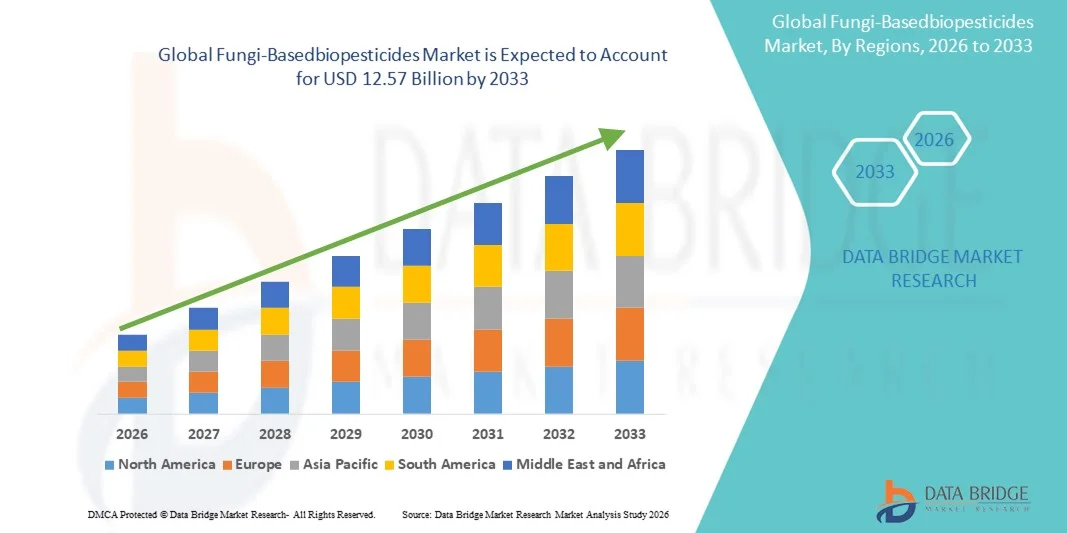
What is the Global Fungi-Basedbiopesticides Market Size and Growth Rate?
- The global fungi-basedbiopesticides market size was valued at USD 4.20 billion in 2025 and is expected to reach USD 12.57 billion by 2033, at a CAGR of15.20% during the forecast period
- The rise in the acceptance of organic food among consumers across the globe acts as one of the major factors driving the growth of fungi-basedbiopesticides market
- The use of synthetic chemicals can lead to pollution and contamination of the soil along with their harmful effects on the food chain and rise in awareness of residue-free food due to huge importance for biological products, accelerate the market growth
What are the Major Takeaways of Fungi-Basedbiopesticides Market?
- The high costs associated with the development of synthetic crop protection products and rise in adoption of fungi-basedbiopesticides by farmers to meet the standards prescribed by international exports, further influence the market
- In addition, increase in organic cultivation for fruits & vegetables and initiatives taken by government for emphasizing the use of integrated pest management and strategic developments such as expansions, new product launches, collaborations, and agreements positively affect the fungi-basedbiopesticides market. Furthermore, pest developing resistance to crop protection chemicals and advancements in microbial research by key players
- North America dominated the fungi-based biopesticides market with an estimated 43.65% revenue share in 2025, driven by strong adoption of sustainable agricultural practices, early acceptance of biological crop protection solutions, and stringent regulations limiting chemical pesticide usage across the U.S. and Canada
- Asia-Pacific is projected to register the fastest CAGR of 8.9% from 2026 to 2033, driven by expanding agricultural activity, rising awareness of soil health, and increasing restrictions on chemical pesticide residues across China, India, Japan, South Korea, and Southeast Asia
- The Trichoderma spp. segment dominated the market with an estimated 46.7% share in 2025, owing to its widespread use in disease control, soil health improvement, and plant growth promotion
Report Scope and Fungi-Basedbiopesticides Market Segmentation
|
Attributes |
Fungi-Basedbiopesticides Key Market Insights |
|
Segments Covered |
|
|
Countries Covered |
North America
Europe
Asia-Pacific
Middle East and Africa
South America
|
|
Key Market Players |
|
|
Market Opportunities |
|
|
Value Added Data Infosets |
In addition to the insights on market scenarios such as market value, growth rate, segmentation, geographical coverage, and major players, the market reports curated by the Data Bridge Market Research also include in-depth expert analysis, pricing analysis, brand share analysis, consumer survey, demography analysis, supply chain analysis, value chain analysis, raw material/consumables overview, vendor selection criteria, PESTLE Analysis, Porter Analysis, and regulatory framework. |
What is the Key Trend in the Fungi-Basedbiopesticides Market?
Increasing Shift Toward Sustainable, Residue-Free, and Target-Specific Crop Protection Solutions
- The fungi-based biopesticides market is witnessing a strong shift toward eco-friendly, biological pest control products that reduce chemical residues and environmental impact
- Manufacturers are developing strain-specific, high-efficacy fungal formulations such as Beauveria bassiana, Trichoderma, and Metarhizium to improve pest targeting and crop compatibility
- Growing demand for integrated pest management (IPM) and organic farming practices is accelerating adoption across fruits, vegetables, cereals, and horticultural crops
- For instance, companies such as BASF, Bayer, Koppert Biological Systems, and Novozymes are expanding fungal biopesticide portfolios with enhanced shelf life and field stability
- Rising focus on soil health improvement, resistance management, and biodiversity preservation is further strengthening market penetration
- As agriculture moves toward sustainability and reduced chemical dependence, fungi-based biopesticides are becoming essential tools for modern crop protection
What are the Key Drivers of Fungi-Basedbiopesticides Market?
- Increasing global demand for organic food, residue-free produce, and sustainable agricultural inputs
- For instance, during 2024–2025, leading agro-biological companies such as UPL, Valent BioSciences, and Marrone Bio Innovations expanded production capacity and registrations for fungal biopesticides
- Stringent regulations on chemical pesticide usage across the U.S., Europe, and Asia-Pacific are driving adoption of biological alternatives
- Advancements in fermentation technology, formulation science, and spore stabilization have improved product efficacy and shelf life
- Rising awareness among farmers regarding pest resistance management and long-term soil fertility supports market growth
- Backed by government support, sustainable farming initiatives, and growing biologicals investment, the fungi-based biopesticides market is expected to witness strong long-term expansion
Which Factor is Challenging the Growth of the Fungi-Basedbiopesticides Market?
- Higher production costs and shorter shelf life compared to synthetic pesticides limit large-scale adoption in cost-sensitive regions
- For instance, during 2024–2025, challenges related to temperature sensitivity, storage conditions, and transportation affected fungal biopesticide distribution
- Variability in field performance due to climatic conditions, humidity, and application methods creates adoption barriers
- Limited farmer awareness and lack of technical knowledge regarding proper usage and application timing slow market penetration
- Competition from low-cost chemical pesticides continues to exert pricing pressure
- To overcome these challenges, companies are investing in improved formulations, farmer education programs, cold-chain logistics, and regulatory approvals to accelerate global adoption of fungi-based biopesticides
How is the Fungi-Basedbiopesticides Market Segmented?
The market is segmented on the basis of type, mode of application, formulation, and crop type.
- By Type
On the basis of type, the fungi-based biopesticides market is segmented into Trichoderma spp., Mycorrhiza, and Others. The Trichoderma spp. segment dominated the market with an estimated 46.7% share in 2025, owing to its widespread use in disease control, soil health improvement, and plant growth promotion. Trichoderma-based biopesticides are highly effective against soil-borne pathogens, improve nutrient uptake, and are extensively adopted across cereals, fruits, vegetables, and horticultural crops. Their compatibility with integrated pest management (IPM) systems and organic farming further supports dominance.
The Mycorrhiza segment is expected to grow at the fastest CAGR from 2026 to 2033, driven by increasing focus on sustainable agriculture and enhanced crop productivity. Rising awareness of symbiotic fungi that improve root development, drought resistance, and nutrient absorption is accelerating adoption, particularly in high-value crops and regenerative farming practices.
- By Mode of Application
On the basis of mode of application, the market is segmented into Soil Treatment, Foliar Spray, and Seed Treatment. The Soil Treatment segment dominated the market with a 41.3% share in 2025, as fungi-based biopesticides are primarily used to control soil-borne pathogens and improve microbial balance. Soil application enhances root-zone protection, promotes long-term crop health, and delivers sustained pest control, making it highly preferred in cereals, vegetables, and plantation crops.
The Seed Treatment segment is projected to grow at the fastest CAGR from 2026 to 2033, supported by rising adoption of preventive crop protection strategies. Treating seeds with fungal biopesticides ensures early-stage disease protection, improves germination rates, and reduces chemical pesticide dependency. Growing demand for cost-effective and environmentally safe seed enhancement solutions is fueling rapid growth.
- By Formulation
On the basis of formulation, the fungi-based biopesticides market is segmented into Dry Formulation and Liquid Formulation. The Dry Formulation segment held the largest market share of 53.9% in 2025, driven by its longer shelf life, ease of storage, and lower transportation costs. Powder and granule-based fungal products are widely used by farmers due to their stability under varying climatic conditions and suitability for large-scale agricultural applications.
The Liquid Formulation segment is expected to witness the fastest CAGR from 2026 to 2033, owing to its ease of application, faster microbial activation, and better coverage during foliar and soil treatments. Increasing adoption of precision agriculture, mechanized spraying, and ready-to-use formulations is accelerating demand for liquid fungal biopesticides, especially in commercial farming and high-value crops.
- By Crop Type
On the basis of crop type, the market is segmented into Cereals and Grains, Oilseeds and Pulses, Fruits and Vegetables, and Others. The Cereals and Grains segment dominated the market with a 38.6% share in 2025, supported by large cultivation areas, high pest pressure, and increasing adoption of sustainable farming practices. Fungi-based biopesticides are widely used to protect staple crops such as rice, wheat, and maize from fungal and insect pests.
The Fruits and Vegetables segment is anticipated to grow at the fastest CAGR from 2026 to 2033, driven by rising demand for organic produce, export-quality crops, and residue-free food. High economic value, strict residue regulations, and increasing greenhouse cultivation are accelerating fungal biopesticide adoption in this segment.
Which Region Holds the Largest Share of the Fungi-Basedbiopesticides Market?
- North America dominated the fungi-based biopesticides market with an estimated 43.65% revenue share in 2025, driven by strong adoption of sustainable agricultural practices, early acceptance of biological crop protection solutions, and stringent regulations limiting chemical pesticide usage across the U.S. and Canada. High penetration of organic farming, large-scale commercial agriculture, and advanced agri-biotech infrastructure continues to support market leadership
- Leading companies in North America are investing in advanced fungal strain development, improved formulations, and large-scale fermentation technologies, strengthening product efficacy and shelf life. Continuous R&D investment in eco-friendly crop protection solutions supports long-term market expansion
- Strong regulatory support for bio-inputs, high farmer awareness, and well-established distribution networks further reinforce regional market dominance
U.S. Fungi-Based Biopesticides Market Insight
The U.S. is the largest contributor in North America, supported by widespread adoption of integrated pest management (IPM), strong demand for organic food, and extensive use of biological solutions across fruits, vegetables, cereals, and row crops. Presence of major biopesticide manufacturers, robust R&D ecosystems, and favorable EPA registrations continue to drive market growth.
Canada Fungi-Based Biopesticides Market Insight
Canada contributes significantly due to increasing adoption of sustainable farming practices, rising organic acreage, and government initiatives promoting reduced chemical pesticide use. Growing demand from cereal, pulse, and horticulture farming supports steady market expansion.
Asia-Pacific Fungi-Based Biopesticides Market
Asia-Pacific is projected to register the fastest CAGR of 8.9% from 2026 to 2033, driven by expanding agricultural activity, rising awareness of soil health, and increasing restrictions on chemical pesticide residues across China, India, Japan, South Korea, and Southeast Asia. Rapid growth in organic farming, government-led sustainable agriculture programs, and rising food safety concerns are accelerating adoption of fungi-based biopesticides across staple and high-value crops. Expanding local production, improving distribution networks, and cost-effective formulations are further supporting rapid market penetration
China Fungi-Based Biopesticides Market Insight
China is the largest contributor in Asia-Pacific, supported by strong government initiatives promoting green agriculture, reduction of chemical inputs, and large-scale crop cultivation. Rising demand for residue-free produce and expanding domestic biopesticide manufacturing drive market growth.
Japan Fungi-Based Biopesticides Market Insight
Japan shows steady growth due to strong focus on food safety, high-quality agricultural inputs, and adoption of biological solutions in horticulture and protected cultivation. Advanced farming practices support premium biopesticide demand.
India Fungi-Based Biopesticides Market Insight
India is emerging as a high-growth market, driven by increasing organic farming, government subsidies for bio-inputs, and rising awareness among farmers. Expanding horticulture and cereal production further boost adoption.
South Korea Fungi-Based Biopesticides Market Insight
South Korea contributes through growing demand for sustainable crop protection in high-value crops, supported by advanced agricultural technology adoption and rising emphasis on environmental safety.
Which are the Top Companies in Fungi-Basedbiopesticides Market?
The fungi-basedbiopesticides industry is primarily led by well-established companies, including:
- BASF SE (Germany)
- Bayer AG (Germany)
- Certis USA L.L.C. (U.S.)
- Novozymes (Denmark)
- Marrone Bio Innovations (U.S.)
- Som Phytopharma India Ltd. (India)
- Valent BioSciences LLC (U.S.)
- BioWorks Inc. (U.S.)
- Bionema (U.K.)
- Vegalab S.A. (France)
- FMC Corporation (U.S.)
- Koppert Biological Systems (Netherlands)
- UPL (India)
What are the Recent Developments in Global Fungi-Basedbiopesticides Market?
- In May 2024, Bioceres Crop Solutions Corp announced that Brazil’s Ministry of Agriculture and Livestock (MAPA, Ministério da Agricultura e Pecuária) approved three new bio-insecticidal and bio-nematicidal solutions derived from inactivated cells of the company’s proprietary Burkholderia platform, significantly expanding its biological crop protection portfolio and strengthening its presence in the Latin American market
- In May 2024, FMC Corporation and Optibrium signed a strategic agreement to accelerate the discovery of next-generation crop protection technologies, including biopesticides, by leveraging machine learning and artificial intelligence, reinforcing FMC’s innovation-driven approach to sustainable agriculture solutions
- In April 2024, Bayer entered into an agreement with U.K.-based AlphaBio Control to develop a new biological insecticide for arable crops such as oilseed rape and cereals, enhancing Bayer’s sustainable crop protection offerings and strengthening its biological product pipeline
- In March 2024, BASF announced an investment to build a new fermentation plant at its Ludwigshafen site for biological and biotechnology-based crop protection products, expected to be operational in the second half of 2025, supporting large-scale production of biological fungicides and seed treatments
- In December 2023, Syngenta launched CERTANO, its first biological product for sugarcane cultivation, a microbiological bionematicide with biofungicidal properties that delivers both immediate and long-lasting protection, reinforcing Syngenta’s expansion into biological crop protection solutions

- Interactive Data Analysis Dashboard
- Company Analysis Dashboard for high growth potential opportunities
- Research Analyst Access for customization & queries
- Competitor Analysis with Interactive dashboard
- Latest News, Updates & Trend analysis
- Harness the Power of Benchmark Analysis for Comprehensive Competitor Tracking
Data collection and base year analysis are done using data collection modules with large sample sizes. The stage includes obtaining market information or related data through various sources and strategies. It includes examining and planning all the data acquired from the past in advance. It likewise envelops the examination of information inconsistencies seen across different information sources. The market data is analysed and estimated using market statistical and coherent models. Also, market share analysis and key trend analysis are the major success factors in the market report. To know more, please request an analyst call or drop down your inquiry.
The key research methodology used by DBMR research team is data triangulation which involves data mining, analysis of the impact of data variables on the market and primary (industry expert) validation. Data models include Vendor Positioning Grid, Market Time Line Analysis, Market Overview and Guide, Company Positioning Grid, Patent Analysis, Pricing Analysis, Company Market Share Analysis, Standards of Measurement, Global versus Regional and Vendor Share Analysis. To know more about the research methodology, drop in an inquiry to speak to our industry experts.
Data Bridge Market Research is a leader in advanced formative research. We take pride in servicing our existing and new customers with data and analysis that match and suits their goal. The report can be customized to include price trend analysis of target brands understanding the market for additional countries (ask for the list of countries), clinical trial results data, literature review, refurbished market and product base analysis. Market analysis of target competitors can be analyzed from technology-based analysis to market portfolio strategies. We can add as many competitors that you require data about in the format and data style you are looking for. Our team of analysts can also provide you data in crude raw excel files pivot tables (Fact book) or can assist you in creating presentations from the data sets available in the report.