


Funisitis Market Size
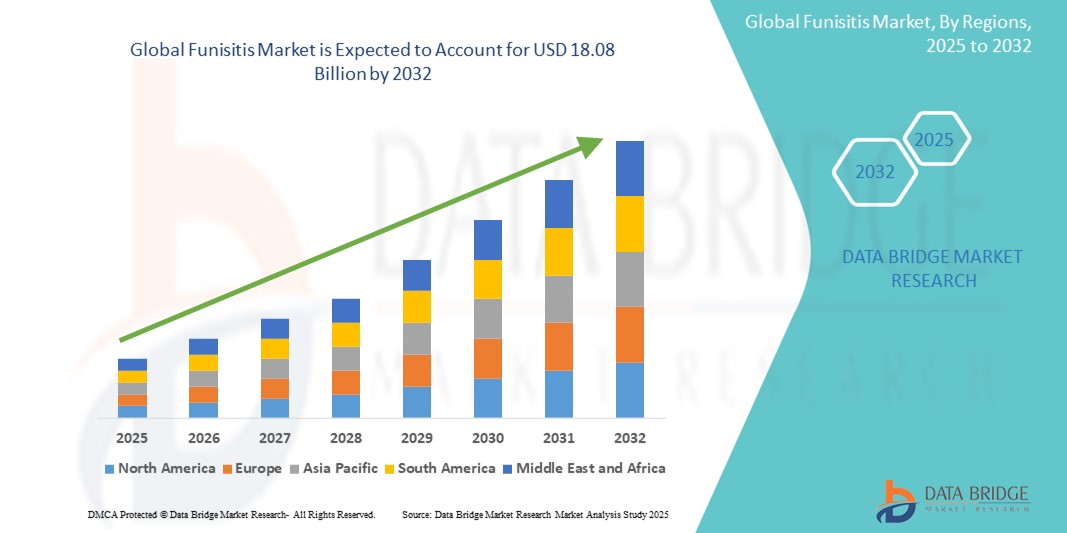
- The global funisitis market size was valued at USD 13.73 billion in 2024 and is expected to reach USD 18.08 billion by 2032, at a CAGR of 3.50% during the forecast period
- The market growth is largely fueled by the rising prevalence of intrauterine infections and increasing awareness regarding prenatal and neonatal care, driving demand for early diagnosis and targeted treatment of funisitis across healthcare systems globally
- Furthermore, growing research initiatives and technological advancements in diagnostic tools such as histopathological examination and biomarker-based testing are enhancing the accuracy and timeliness of funisitis detection, supporting improved clinical outcomes
Funisitis Market Analysis
- Funisitis, a condition characterized by inflammation of the connective tissue of the umbilical cord typically associated with intra-amniotic infection, is gaining attention due to its link to adverse neonatal outcomes including preterm birth and neonatal sepsis. As a result, it is becoming a key focus area in maternal-fetal health diagnostics and therapeutics across both developed and developing regions
- The escalating demand for effective diagnostic and therapeutic solutions for funisitis is primarily fueled by increasing awareness of prenatal care, advancements in infection detection technologies, and the growing burden of preterm complications globally
- North America dominated the funisitis market with the largest revenue share of 36.4% in 2024, supported by well-established healthcare infrastructure, higher healthcare spending, and early adoption of advanced diagnostic techniques. The U.S. remains the key contributor, driven by rising investments in perinatal care and strong clinical research support for early intervention strategies
- Asia-Pacific is expected to be the fastest-growing region in the funisitis market during the forecast period, propelled by improving access to maternal care services, increasing birth rates, rising government healthcare investments, and a growing focus on reducing neonatal mortality and morbidity
- The Antibiotics segment dominated the funisitis market with a revenue share of 62.3% in 2024, as they are the primary line of treatment to manage maternal and fetal infections. Broad-spectrum antibiotics are often administered prophylactically or therapeutically to reduce the risk of neonatal complications
Report Scope and Funisitis Market Segmentation
|
Attributes |
Funisitis Key Market Insights |
|
Segments Covered |
|
|
Countries Covered |
North America
Europe
Asia-Pacific
Middle East and Africa
South America
|
|
Key Market Players |
|
|
Market Opportunities |
|
|
Value Added Data Infosets |
In addition to the insights on market scenarios such as market value, growth rate, segmentation, geographical coverage, and major players, the market reports curated by the Data Bridge Market Research also include in-depth expert analysis, pricing analysis, brand share analysis, consumer survey, demography analysis, supply chain analysis, value chain analysis, raw material/consumables overview, vendor selection criteria, PESTLE Analysis, Porter Analysis, and regulatory framework. |
Funisitis Market Trends
“Improved Diagnosis and Monitoring Through Technological Advancements”
- A significant and accelerating trend in the global funisitis market is the growing integration of advanced diagnostic technologies, including digital pathology, biomarker analysis, and real-time fetal monitoring. These innovations are greatly enhancing clinicians' ability to detect, manage, and prevent complications associated with funisitis
- For instance, novel imaging-supported histological tools allow for more accurate detection of inflammatory changes in the umbilical cord, facilitating timely intervention in high-risk pregnancies. In addition, developments in non-invasive prenatal testing are helping identify intrauterine infections earlier than traditional methods
- Digital diagnostic platforms are now capable of analyzing histopathological data with improved precision, supporting better classification of inflammation severity. Some platforms are also equipped with machine learning algorithms that aid in pattern recognition for early signs of intra-amniotic infection
- The integration of maternal health monitoring with fetal surveillance systems enables healthcare providers to track fetal well-being and maternal biomarkers in real time, contributing to proactive and individualized care approaches
- This seamless advancement in diagnostic and monitoring capabilities fosters comprehensive oversight of maternal-fetal health, enabling early detection of complications such as funisitis and reducing the risk of preterm delivery and neonatal morbidity
- As healthcare systems increasingly adopt these intelligent and data-driven tools across both developed and emerging markets, the demand for accurate, scalable, and efficient funisitis diagnostic solutions is rising significantly in both hospital and research settings
Funisitis Market Dynamics
Driver
“Growing Need Due to Rising Neonatal Complications and Prenatal Infections”
- The increasing prevalence of prenatal infections and inflammation-related complications during pregnancy is a significant driver for the heightened demand for early detection and treatment of funisitis
- For instance, in April 2024, researchers at a leading maternal-fetal medicine institute announced advancements in biomarker-based diagnostics for intrauterine infections, enabling faster detection of funisitis and improved neonatal outcomes. Such innovations by key players are expected to drive the funisitis industry growth during the forecast period
- As healthcare providers become more aware of the critical role of timely diagnosis in reducing preterm birth complications and stillbirth risks, funisitis screening is becoming an essential component of maternal care protocols
- Furthermore, increasing integration of advanced diagnostics in prenatal care settings, especially in urban hospitals and specialized maternity clinics, is making funisitis detection more accessible and efficient
- The availability of targeted antibiotic therapies, combined with rapid test kits and improved histopathological tools, is also propelling adoption in both public and private healthcare facilities. The growing demand for maternal health solutions in developing economies, supported by government and NGO-backed health programs, further contributes to market growth
Restraint/Challenge
“Limited Awareness and High Cost of Advanced Diagnostic Tools”
- Limited awareness among healthcare professionals and expectant mothers, especially in rural or low-resource settings, remains a major barrier to the early diagnosis and treatment of funisitis
- For instance, lack of routine screening protocols in certain regions leads to underdiagnosis or misdiagnosis of funisitis, contributing to preventable neonatal complications
- Addressing these gaps through enhanced training of obstetricians, midwives, and healthcare workers is crucial for improving diagnosis rates. Public health education campaigns can also raise awareness about the importance of prenatal infection management
- In addition, the relatively high cost of advanced diagnostic modalities such as immunohistochemistry or PCR-based testing can be a constraint in developing regions
- While point-of-care diagnostic tools are emerging, the perceived premium associated with newer technologies can deter widespread adoption, particularly in cost-sensitive healthcare systems
- Overcoming these challenges through policy support, subsidized screening programs, and investments in affordable diagnostic alternatives will be key to ensuring broader market penetration and sustained growth
Funisitis Market Scope
The market is segmented on the basis of type, treatment, dosage, route of administration, end users, and distribution channel.
- By Type
On the basis of type, the funisitis market is segmented into acute funisitis, chronic funisitis, sclerosing funisitis, and necrotizing funisitis. Acute Funisitis accounted for the largest market revenue share of 48.6% in 2024, primarily driven by its high prevalence in intrauterine infections and its frequent diagnosis during histopathological examination of the umbilical cord in preterm births. It is often linked with chorioamnionitis and is a critical marker for early intervention.
Sclerosing Funisitis is expected to witness the fastest CAGR of 7.9% from 2025 to 2032, due to increasing awareness and improved diagnostic capabilities. Though rare, it presents significant clinical complications, warranting attention in high-risk pregnancies.
- By Treatment
On the basis of treatment, the market is segmented into antibiotics and others. The antibiotics segment dominated the market with a revenue share of 62.3% in 2024, as they are the primary line of treatment to manage maternal and fetal infections. Broad-spectrum antibiotics are often administered prophylactically or therapeutically to reduce the risk of neonatal complications.
The others segment includes supportive therapies, such as corticosteroids and immunomodulators, and is gaining traction in severe or resistant cases.
- By Dosage
On the basis of dosage, the market is segmented into tablet, injection, and others. Injection held the largest market share of 54.1% in 2024, owing to its rapid onset of action, which is crucial in emergency prenatal care settings. Injectable antibiotics and corticosteroids are widely used in hospital setups for immediate management.
The Tablet segment is expected to witness the fastest CAGR from 2025 to 2032, due to its convenience in outpatient follow-up and maternal infection management during early gestation.
- By Route of Administration
On the basis of route of administration, the market is segmented into oral, intravenous, and others. The intravenous segment dominated in 2024, accounting for 59.4% of the market, due to the need for rapid drug delivery in acute funisitis and labor-related infections.
The oral segment is expected to witness the fastest CAGR from 2025 to 2032, especially in mild to moderate maternal infections managed in ambulatory settings.
- By End Users
On the basis of end users, the market is segmented into clinics, hospitals, and others. Hospitals held the largest market revenue share of 68.7% in 2024, driven by the availability of specialized care, access to diagnostic tools, and the need for emergency treatment in cases of high-risk pregnancies.
Clinics are expected to witness the fastest growth rate due to expanding access to prenatal care in semi-urban and rural areas, supported by government and private health initiatives.
- By Distribution Channel
On the basis of distribution channel, the market is segmented into hospital pharmacy, retail pharmacy, and online pharmacy. Hospital pharmacies dominated the segment in 2024 with a share of 61.8%, supported by direct treatment workflows and immediate drug availability in inpatient settings.
The online pharmacy segment is expected to register the highest CAGR from 2025 to 2032, owing to growing digital healthcare adoption and ease of access to prescribed medications.
Funisitis Market Regional Analysis
- North America dominated the funisitis market with the largest revenue share of 36.4% in 2024, driven by advanced neonatal care infrastructure, high healthcare spending, and strong clinical awareness around intrauterine infections
- The region benefits from well-established perinatal care protocols and increasing adoption of early diagnostic tools across hospitals and clinics
- The market is projected to grow at a CAGR of 7.8% from 2025 to 2032, supported by rising investments in maternal-fetal medicine research
U.S. Funisitis Market Insight
The U.S. funisitis market accounted for a substantial 81.05% of North America’s market share in 2024, due to widespread access to prenatal diagnostics and comprehensive health insurance coverage. The market is further driven by the presence of key healthcare players, ongoing clinical trials, and high public awareness of prenatal infections.
Europe Funisitis Market Insight
The Europe funisitis market held a significant market share of 28.2% in 2024, with increasing emphasis on maternal health safety and compliance with EU perinatal guidelines. Countries such as Germany, the U.K., France, and the Netherlands are leading in the adoption of funisitis screening in routine prenatal care.
U.K. Funisitis Market Insight
The U.K. funisitis market accounted for 19.3% of Europe’s market share in 2024, benefiting from national initiatives such as the NHS’s perinatal care programs. The market is projected to grow at a notable CAGR, supported by growing awareness, public healthcare funding, and high adoption of non-invasive diagnostics.
Germany Funisitis Market Insight
The Germany funisitis market captured 22.8% of the European market share in 2024, owing to its strong neonatal infrastructure and clinical research activities. The market is expected to expand at a considerable CAGR, underpinned by the country’s leadership in diagnostic technology and early-stage prenatal interventions.
Asia-Pacific Funisitis Market Insight
The Asia-Pacific funisitis market is projected to grow at the fastest CAGR of 6.2% from 2025 to 2032, driven by rising healthcare investments, urbanization, and government-supported maternal health initiatives. The region accounted for a market share of 22.1% in 2024, with growing accessibility to prenatal care services in China, India, and Southeast Asia. Local manufacturing, growing hospital births, and adoption of cost-effective diagnostic kits are major contributors to the regional expansion.
Japan Funisitis Market Insight
The Japan funisitis market held a market share of 18.6% in the Asia-Pacific region in 2024, attributed to its high-tech healthcare system and strong focus on elderly and maternal care. With increasing urban birth rates and preference for integrated perinatal monitoring, the market is expected to grow with a considerable CAGR, during the forecast period.
China Funisitis Market Insight
The China funisitis market captured the largest share in the Asia-Pacific region at 41.5% in 2024, driven by rapid technological adoption, public health reforms, and urban population growth. Supportive policies under initiatives such as “Healthy China 2030” and widespread implementation of smart hospital systems are accelerating growth.
Funisitis Market Share
The Funisitis industry is primarily led by well-established companies, including:
- Amgen Inc. (U.S.)
- Bristol-Myers Squibb Company (U.S.)
- Erytech Pharma (France)
- Novartis AG (Switzerland)
- Pfizer Inc. (U.S.)
- Rare Disease Therapeutics, Inc. (U.S.)
- Sanofi (France)
- Takeda Pharmaceutical Company Limited (Japan)
- Genmab A/S (Denmark)
- Baxter (U.S.)
- Gilead Sciences, Inc. (U.S.)
- Eisai Co., Ltd. (Japan)
- SymBio Pharmaceuticals Limited (Japan)
- Kiadis Pharma (Netherlands)
- OBI Pharma (Taiwan)
- Astellas Pharma Inc. (Japan)
- Medexus Pharmaceuticals, Inc. (Canada)
Latest Developments in Global Funisitis Market
- In September 2023, Pfizer and BioNTech gained FDA approval for their supplemental Biologics License Application, allowing use of their COMIRNATY 2023-2024 Formulation for ages 12 and up, with emergency authorization for children aged 6 months to 11 years against the Omicron XBB.1.5 variant. The current recommendation suggests a single dose for most individuals aged 5 and above, with potential for additional doses for under 5s lacking a complete three-dose series with earlier COVID-19 vaccines
- In February 2025, a study published in the American Journal of Obstetrics & Gynecology found that funisitis significantly increases the risk of death or cerebral palsy in extremely preterm infants born before 27 weeks of gestation. Among survivors, exposure to funisitis was associated with a 23% higher risk of cerebral palsy, with approximately 60% of this risk attributed directly to funisitis itself and 40% mediated through preterm birth. The findings underscore the importance of early detection and intervention strategies for intrauterine inflammation to improve neonatal outcomes

- Interactive Data Analysis Dashboard
- Company Analysis Dashboard for high growth potential opportunities
- Research Analyst Access for customization & queries
- Competitor Analysis with Interactive dashboard
- Latest News, Updates & Trend analysis
- Harness the Power of Benchmark Analysis for Comprehensive Competitor Tracking
Data collection and base year analysis are done using data collection modules with large sample sizes. The stage includes obtaining market information or related data through various sources and strategies. It includes examining and planning all the data acquired from the past in advance. It likewise envelops the examination of information inconsistencies seen across different information sources. The market data is analysed and estimated using market statistical and coherent models. Also, market share analysis and key trend analysis are the major success factors in the market report. To know more, please request an analyst call or drop down your inquiry.
The key research methodology used by DBMR research team is data triangulation which involves data mining, analysis of the impact of data variables on the market and primary (industry expert) validation. Data models include Vendor Positioning Grid, Market Time Line Analysis, Market Overview and Guide, Company Positioning Grid, Patent Analysis, Pricing Analysis, Company Market Share Analysis, Standards of Measurement, Global versus Regional and Vendor Share Analysis. To know more about the research methodology, drop in an inquiry to speak to our industry experts.
Data Bridge Market Research is a leader in advanced formative research. We take pride in servicing our existing and new customers with data and analysis that match and suits their goal. The report can be customized to include price trend analysis of target brands understanding the market for additional countries (ask for the list of countries), clinical trial results data, literature review, refurbished market and product base analysis. Market analysis of target competitors can be analyzed from technology-based analysis to market portfolio strategies. We can add as many competitors that you require data about in the format and data style you are looking for. Our team of analysts can also provide you data in crude raw excel files pivot tables (Fact book) or can assist you in creating presentations from the data sets available in the report.












