


What is the Gait & Motion Monitoring Wearables Market Size and Growth Rate?
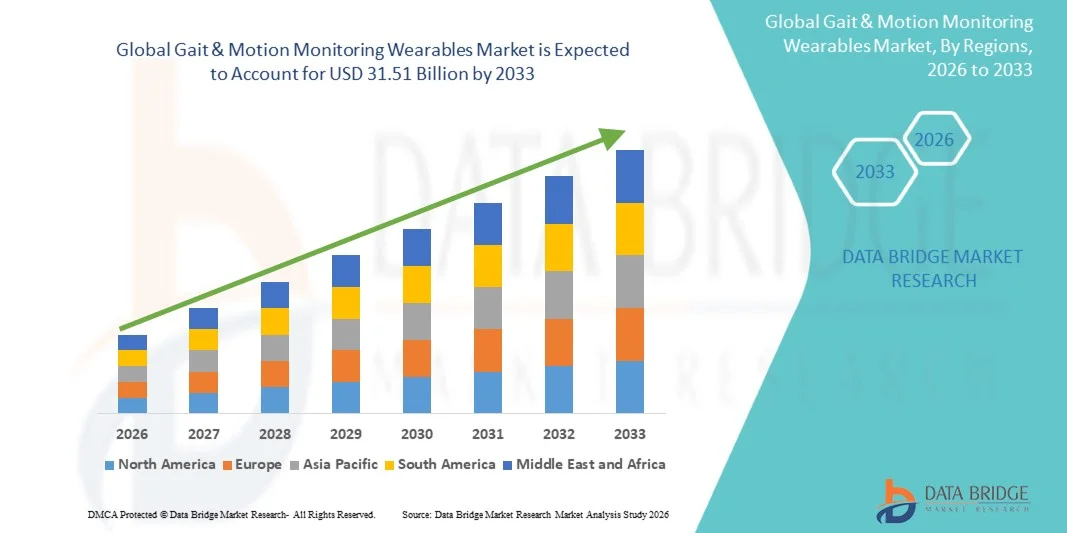
- The global gait & motion monitoring wearables market size was valued at USD 10.3 billion in 2025and is expected to reach USD 31.51 billion by 2033, at a CAGR of 15% during the forecast period
- Market expansion is driven by rising demand for real-time movement tracking, increasing prevalence of neurological and musculoskeletal disorders, and growing adoption of wearable health monitoring technologies in clinical and non-clinical settings
- In addition, advancements in sensor miniaturization, AI-based motion analytics, and remote patient monitoring systems are significantly enhancing the accuracy and utility of gait analysis devices across healthcare, sports, and industrial applications
What are the Major Takeaways of Gait & Motion Monitoring Wearables Market?
- Gait and motion monitoring wearables play a critical role in analyzing human movement patterns, posture, balance, and mobility using integrated sensors and intelligent software platforms.
- These systems are increasingly used for early diagnosis of conditions such as Parkinson’s disease, stroke rehabilitation monitoring, orthopedic recovery assessment, and fall-risk prediction in elderly populations.
- Growing adoption of remote patient monitoring and tele-rehabilitation programs is significantly increasing demand for wearable motion tracking solutions in home healthcare environments.
- North America holds a dominant position due to advanced healthcare infrastructure, strong digital health adoption, and high penetration of wearable fitness and medical devices, accounting for 40% market share in 2025
- Asia-Pacific is expected to be the fastest-growing region, driven by expanding healthcare access, rising elderly population, and increasing awareness of preventive healthcare technologies, registering a CAGR of 16% during 2026–2033
- Wrist-worn and body-worn sensors dominate due to ease of use, continuous monitoring capability, and compatibility with AI-powered analytics platforms.
Report Scope and Gait & Motion Monitoring Wearables Market Segmentation
|
Attributes |
Gait & Motion Monitoring Wearables Key Market Insights |
|
Segments Covered |
|
|
Countries Covered |
North America
Europe
Asia-Pacific
Middle East and Africa
South America
|
|
Key Market Players |
|
|
Market Opportunities |
|
|
Value Added Data Infosets |
In addition to the insights on market scenarios such as market value, growth rate, segmentation, geographical coverage, and major players, the market reports curated by the Data Bridge Market Research also include in-depth expert analysis, patient epidemiology, pipeline analysis, pricing analysis, and regulatory framework |
What is the Key Trend in the Gait & Motion Monitoring Wearables Market?
“AI-Driven Motion Intelligence and Remote Mobility Monitoring”
- A major trend shaping the market is the integration of AI and machine learning algorithms with wearable motion sensors to deliver real-time gait analysis and predictive mobility insights.
- For example, advanced wearable platforms now provide clinicians with continuous movement data, enabling early detection of mobility decline in neurological and orthopedic patients.
- Smart textiles and embedded sensor clothing are emerging as next-generation solutions for unobtrusive and continuous motion tracking.
- Increasing use of cloud-based analytics allows remote rehabilitation monitoring, reducing hospital dependency and improving patient adherence to therapy programs.
- Demand for multi-sensor fusion systems combining IMU, pressure sensors, and vision-based tracking is rising to improve accuracy in complex motion environments.
- Growth of sports performance analytics is further expanding adoption among professional athletes and training organizations.
Driver What are the Key Drivers of Gait & Motion Monitoring Wearables Market?
“Rising Demand for Remote Monitoring and Rehabilitation Solutions”
- Increasing prevalence of neurological disorders, musculoskeletal injuries, and age-related mobility issues is driving demand for continuous gait monitoring solutions
- Healthcare providers are increasingly adopting wearable motion tracking systems to improve rehabilitation outcomes and reduce in-person clinical visits
- Expansion of telehealth and home-based care models is accelerating deployment of wearable devices for long-term mobility tracking
- Growing emphasis on preventive healthcare and early diagnosis of movement disorders is boosting adoption across hospitals and homecare users
- Integration of wearable data into electronic health records is improving clinical decision-making and personalized treatment planning
Restraint/Challenge
“Data Accuracy, Standardization, and High Device Costs”
- Variability in motion data accuracy across different environments and user behaviors remains a key challenge for large-scale clinical adoption
- Lack of standardized protocols for gait analysis interpretation can limit consistency in diagnostic outcomes
- High costs associated with advanced multi-sensor systems and AI-enabled platforms can restrict adoption in cost-sensitive regions
- Privacy concerns related to continuous motion and behavioral tracking may hinder acceptance among some user groups
- Limited awareness and training among healthcare professionals regarding advanced wearable analytics tools also impacts adoption rates
How is the Gait & Motion Monitoring Wearables Market Segmented?
The market is segmented on the basis of product, technology, application, and end user.
- By Product
On the basis of product, the global gait & motion monitoring wearables market is segmented into wrist-worn devices, foot-worn devices, body-worn sensors, smart clothing (e-textiles), and assistive wearables. The body-worn sensors segment dominated the market with the largest revenue share of 35% in 2025, driven by their high accuracy in capturing full-body motion data, strong adoption in clinical gait analysis, and increasing use in rehabilitation and neurological disorder monitoring. These sensors are widely preferred due to their ability to provide real-time biomechanical insights, portability, and compatibility with AI-driven analytics platforms.
The smart clothing (e-textiles) segment is expected to witness the fastest growth during the forecast period, fueled by rising demand for non-intrusive, continuous monitoring solutions. Advancements in flexible electronics, sensor integration into fabrics, and increasing use in sports performance tracking and elderly care are accelerating adoption globally.
- By Technology
On the basis of technology, the market is segmented into inertial measurement units (IMU), pressure & force sensors, optical / camera-based systems, radar-based motion sensing, and sensor fusion + AI/ML analytics platforms. The IMU-based systems segment dominated the market in 2025 due to cost-effectiveness, portability, and wide usage in wearable motion tracking applications across healthcare and sports.
The sensor fusion + AI/ML analytics platforms segment is expected to register the fastest growth, driven by increasing demand for predictive mobility insights, real-time gait analysis, and integration with digital health ecosystems.
- By Application
On the basis of application, the market is segmented into healthcare & rehabilitation, sports & fitness, clinical & biomechanics research, elderly care & fall detection, security & biometrics, and industrial safety. The healthcare & rehabilitation segment dominated the market in 2025 due to rising prevalence of neurological and musculoskeletal disorders and increasing use of wearables in post-surgical recovery and physiotherapy monitoring.
The elderly care & fall detection segment is expected to witness the fastest growth during the forecast period, driven by the rapidly aging global population and increasing demand for continuous mobility monitoring and fall prevention systems.
- By End User
On the basis of end user, the market is segmented into hospitals & clinics, rehabilitation centers, sports organizations & athletes, home healthcare users, defense & security agencies, research institutes & universities, and industrial workforce monitoring. Hospitals & clinics dominated the market in 2025 due to high adoption of clinical gait analysis systems and integration of wearable motion tracking in rehabilitation programs.
Home healthcare users are expected to register the fastest growth during the forecast period, driven by rising demand for remote patient monitoring, tele-rehabilitation, and home-based mobility assessment solutions.
Which Region Holds the Largest Share of the Gait & Motion Monitoring Wearables Market?
- North America holds a dominant position due to advanced healthcare infrastructure, strong digital health adoption, and high penetration of wearable fitness and medical devices, accounting for 40% market share in 2025
- High prevalence of neurological disorders, musculoskeletal conditions, and age-related mobility issues is driving strong demand for gait and motion monitoring wearables across clinical and homecare settings
- Strong presence of leading wearable technology companies, AI analytics providers, and research institutions is accelerating innovation and early adoption of advanced motion tracking solutions
U.S. Gait & Motion Monitoring Wearables Market Insight
The U.S. gait & motion monitoring wearables market holds a dominant position in North America, driven by high adoption of digital health technologies, strong presence of leading wearable and medical device companies, and advanced rehabilitation infrastructure. Increasing prevalence of neurological disorders, sports injuries, and age-related mobility conditions is significantly boosting demand for motion tracking solutions. The growing integration of AI-powered gait analysis in clinical decision-making and widespread use of remote patient monitoring platforms are further supporting market expansion.
U.K. Gait & Motion Monitoring Wearables Market Insight
The Europe gait & motion monitoring wearables market is witnessing steady growth, supported by strong healthcare systems, rising aging population, and increasing focus on preventive healthcare and rehabilitation services. Countries across the region are increasingly adopting wearable motion tracking technologies for early diagnosis of mobility disorders and post-operative recovery monitoring. Favorable healthcare policies, research funding in biomechanics, and growing use of digital health solutions are further strengthening market adoption.
Germany Gait & Motion Monitoring Wearables Market Insight
The U.K. gait & motion monitoring wearables market is growing steadily, driven by strong national healthcare initiatives focused on digital transformation and remote patient monitoring. Increasing cases of stroke, Parkinson’s disease, and orthopedic conditions are boosting demand for gait analysis and rehabilitation wearables. The presence of advanced clinical research institutions and rising adoption of tele-rehabilitation programs are further accelerating market penetration across hospitals and homecare settings.
Asia-Pacific Gait & Motion Monitoring Wearables Market Insight
The Asia-Pacific gait & motion monitoring wearables market is expected to grow at the fastest pace globally, driven by rapid urbanization, rising healthcare expenditure, and increasing awareness of preventive healthcare. Expanding elderly population and growing burden of neurological and musculoskeletal disorders are fueling demand for mobility monitoring solutions. Increasing adoption of digital health technologies, particularly in China, India, and Japan, is further accelerating market expansion.
Japan Gait & Motion Monitoring Wearables Market Insight
The Japan gait & motion monitoring wearables market is strongly driven by its rapidly aging population and high prevalence of mobility-related disorders. The country’s advanced healthcare system and strong focus on robotics and precision healthcare are supporting adoption of wearable motion tracking technologies. Increasing use of gait analysis in elderly care, rehabilitation robotics, and home-based monitoring solutions is further strengthening market growth.
India Gait & Motion Monitoring Wearables Market Insight
The India gait & motion monitoring wearables market is witnessing strong growth due to rising healthcare awareness, expanding elderly population, and increasing burden of neurological and orthopedic conditions. Rapid digitalization of healthcare, growing adoption of telemedicine, and improving access to rehabilitation services are driving demand for wearable motion monitoring solutions. Expanding domestic medtech innovation and cost-effective wearable devices are further accelerating market penetration across urban and semi-urban regions.
Which are the Top Companies in Gait & Motion Monitoring Wearables Market?
The Gait & motion monitoring wearables industry is primarily led by well-established companies, including:
- Xsens Technologies B.V. (Netherlands)
- Vicon Motion Systems Ltd. (U.K.)
- Noraxon USA Inc. (U.S.)
- Qualisys AB (Sweden)
- APDM Wearable Technologies (Clario) (U.S.)
- Gait Up SA (Switzerland)
- BioSensics LLC (U.S.)
- Delsys Inc. (U.S.)
- KINEXON GmbH (Germany)
- Motek Medical (DIH Group) (Netherlands)
- BTS Bioengineering S.p.A (Italy)
- Tekscan Inc. (U.S.)
- Motion Analysis Corporation (U.S.)
- Shimmer Research (Ireland)
- Cometa Srl (Italy)
- Zebris Medical GmbH (Germany)
- Kistler Group (Switzerland)
- Simi Reality Motion Systems GmbH (Germany)
- ProtoKinetics (U.S.)
- Movella Inc. (U.S.)
What are the Recent Developments in Global Gait & Motion Monitoring Wearables Market?
- In November 2025, Xsens Technologies B.V. launched its next-generation Xsens Link motion capture system, enhancing wearable biomechanics tracking for healthcare, sports, and robotics applications with improved sensor accuracy and real-time motion analytics
- In November 2025, KINEXON GmbH expanded its real-time motion tracking platform to strengthen athlete performance monitoring and industrial workforce safety through advanced wearable sensor integration and AI-based analytics systems
- In May 2025, Movella Inc. (Xsens ecosystem) introduced upgraded motion analysis software with improved biomechanical modeling for gait, posture, and rehabilitation tracking, enabling more precise clinical and research applications
- In April 2025, research highlighted new smart insole wearable systems capable of real-time gait monitoring using pressure sensor networks, enabling early detection of mobility disorders such as Parkinson’s disease and plantar fasciitis
- In 2025, wearable IMU-based gait recognition systems such as wrist-worn solutions demonstrated advancement in real-time, on-device motion tracking for injury prevention and sports performance optimization without relying on cloud computing

- Interactive Data Analysis Dashboard
- Company Analysis Dashboard for high growth potential opportunities
- Research Analyst Access for customization & queries
- Competitor Analysis with Interactive dashboard
- Latest News, Updates & Trend analysis
- Harness the Power of Benchmark Analysis for Comprehensive Competitor Tracking
Data collection and base year analysis are done using data collection modules with large sample sizes. The stage includes obtaining market information or related data through various sources and strategies. It includes examining and planning all the data acquired from the past in advance. It likewise envelops the examination of information inconsistencies seen across different information sources. The market data is analysed and estimated using market statistical and coherent models. Also, market share analysis and key trend analysis are the major success factors in the market report. To know more, please request an analyst call or drop down your inquiry.
The key research methodology used by DBMR research team is data triangulation which involves data mining, analysis of the impact of data variables on the market and primary (industry expert) validation. Data models include Vendor Positioning Grid, Market Time Line Analysis, Market Overview and Guide, Company Positioning Grid, Patent Analysis, Pricing Analysis, Company Market Share Analysis, Standards of Measurement, Global versus Regional and Vendor Share Analysis. To know more about the research methodology, drop in an inquiry to speak to our industry experts.
Data Bridge Market Research is a leader in advanced formative research. We take pride in servicing our existing and new customers with data and analysis that match and suits their goal. The report can be customized to include price trend analysis of target brands understanding the market for additional countries (ask for the list of countries), clinical trial results data, literature review, refurbished market and product base analysis. Market analysis of target competitors can be analyzed from technology-based analysis to market portfolio strategies. We can add as many competitors that you require data about in the format and data style you are looking for. Our team of analysts can also provide you data in crude raw excel files pivot tables (Fact book) or can assist you in creating presentations from the data sets available in the report.













