


What is the Gallium Oxide Materials Market Size and Growth Rate?
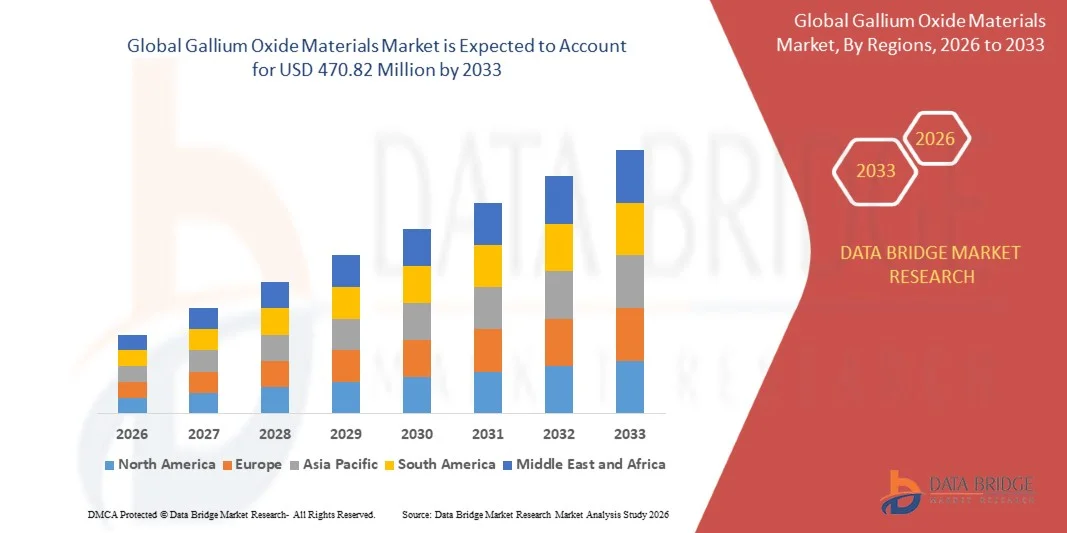
- As per Data Bridge Market Research analysis, the gallium oxide materials market was valued at USD 182.46 million in 2025 and is projected to reach USD 470.82 million by 2033, growing at a CAGR of 12.58% from 2026 to 2033.
- The market is experiencing robust growth driven by the increasing demand for ultra-wide bandgap semiconductor materials, rapid advancements in power electronics and deep-ultraviolet optoelectronic devices, and expanding adoption across electric vehicles, renewable energy systems, aerospace, and next-generation communication infrastructure.
- The growing need for high-voltage, high-temperature, and high-frequency semiconductor devices, combined with continuous investments in gallium oxide crystal growth, epitaxial technologies, and advanced wafer manufacturing, is accelerating commercial adoption of gallium oxide materials. β-Ga₂O₃ is increasingly being explored as a replacement for conventional semiconductor materials owing to its ultra-wide bandgap and high critical breakdown electric field, making it highly suitable for next-generation power devices and solar-blind ultraviolet detectors
Market Size & Forecast
- Global Market Value (2025): USD 182.46 Million
- Expected Market Value (2033): USD 470.82 Million
- Forecast CAGR (2026–2033): 12.58%
- Leading Region in 2025: North America
- Fastest Growing Region: Asia-Pacific
What are the Major Takeaways of the Gallium Oxide Materials Market?
- North America dominated the gallium oxide materials market with the largest revenue share of 38.2% in 2025, supported by advanced semiconductor manufacturing capabilities, and increasing demand for high-performance power electronics across automotive, defense, and data center applications.
- Asia-Pacific is expected to be the fastest-growing region at a CAGR of 16.8% from 2026 to 2033, fueled by expanding semiconductor manufacturing, technological leadership, and substantial government investments in advanced materials and renewable energy infrastructure.
- The beta gallium oxide (β-Ga₂O₃) segment led the market with a 63.4% share in 2025, driven by its ultra-wide bandgap (~4.8 eV), exceptionally high critical breakdown electric field, and superior thermal and chemical stability.
- Epsilon gallium oxide (ε-Ga₂O₃) are the fastest-growing product type, projected to register a CAGR of 16.9%, reflecting the surge in intrinsic polarization properties and growing potential for high-electron-mobility transistors (HEMTs) and RF devices.
- The molecular beam epitaxy (MBE) segment dominated the technology category with a 42.8% revenue share in 2025, led by its ability to produce high-quality epitaxial gallium oxide layers with precise thickness and composition control.
- Power and high voltage devices accounted for 56.7% of the market share in 2025, preferred by increasing demand for semiconductor materials capable of operating at high voltages, high temperatures, and high switching frequencies.
- The gas sensors segment is the fastest-growing application category, with a CAGR of 16.2%, driven by rising demand for real-time environmental monitoring and industrial safety solutions.
Report Scope and Gallium Oxide Materials Market Segmentation
|
Attributes |
Gallium Oxide Materials Key Market Insights |
|
Segments Covered |
|
|
Countries Covered |
North America
Europe
Asia-Pacific
Middle East and Africa
South America
|
|
Key Market Players |
|
|
Market Opportunities |
|
|
Value Added Data Infosets |
In addition to the insights on market scenarios such as market value, growth rate, segmentation, geographical coverage, and major players, the market reports curated by the Data Bridge Market Research also include import export analysis, production capacity overview, production consumption analysis, price trend analysis, climate change scenario, supply chain analysis, value chain analysis, raw material/consumables overview, vendor selection criteria, PESTLE Analysis, Porter Analysis, and regulatory framework. |
What is the Key Trend in the Gallium Oxide Materials Market?
- Commercialization of ultra-wide-bandgap gallium oxide semiconductor materials is accelerating to enable higher-voltage, lower-loss, and higher-temperature power devices for electric vehicles, renewable energy systems, aerospace, and industrial electronics.
- For instance, in August 2025, Kyma Technologies and Novel Crystal Technology announced a strategic collaboration to develop 150 mm gallium oxide epitaxial wafers for multi-kV power electronics, supporting commercialization of next-generation Ga₂O₃ devices.
- Continuous advancements in bulk crystal growth, epitaxial wafer fabrication, and defect reduction are improving material quality and accelerating the transition from laboratory-scale research to commercial semiconductor manufacturing.
- Semiconductor manufacturers are increasingly investing in native gallium oxide substrates and epitaxial technologies to enhance device efficiency, breakdown voltage, and reliability for ultra-wide-bandgap power electronics.
- For instance, In August 2024, a study published in Advanced Materials Interfaces demonstrated controlled fabrication of ultrathin gallium oxide heterostructures for low-power ReRAM devices, highlighting the expanding application potential of gallium oxide beyond conventional high-power electronics.
- As demand for next-generation high-voltage semiconductor materials continues to increase across automotive, renewable energy, aerospace, and defense industries, commercialization of gallium oxide materials is expected to accelerate significantly.
What are the Key Drivers of the Gallium Oxide Materials Market?
- The rising demand for ultra-wide-bandgap semiconductor materials for high-voltage, high-frequency, and high-temperature power electronics is significantly increasing investment in gallium oxide material development and device commercialization.
- For instance, in February 2025, researchers published a study in Nature Communications demonstrating a low-temperature pressure-assisted liquid-metal printing process for β-Ga₂O₃ thin-film transistors, enabling cost-effective fabrication of high-performance gallium oxide devices for power electronics, deep-ultraviolet optoelectronics, wearable electronics, and harsh-environment applications, further accelerating commercial adoption of gallium oxide materials.
- Electric vehicle manufacturers, renewable energy developers, and industrial power equipment suppliers are increasingly evaluating gallium oxide devices to improve switching efficiency, reduce energy losses, and support higher operating voltages.
- For instance, in October 2024, researchers reported β-Ga₂O₃ MIS Schottky Barrier Diodes with an AlN interfacial layer in IEEE Transactions on Electron Devices, demonstrating technology suitable for high-breakdown-voltage power applications, reinforcing the commercial potential of gallium oxide in next-
- With industries prioritizing higher efficiency, compact power conversion, and reliable high-voltage semiconductor technologies, gallium oxide materials are expected to become a critical platform for next-generation power electronic devices.
Which Factors are Challenging the Growth of the Gallium Oxide Materials Market?
- Gallium oxide materials face commercialization challenges due to limited availability of defect-free bulk substrates, complex epitaxial growth processes, and the high cost of producing device-grade semiconductor wafers.
- These manufacturing limitations restrict large-scale production capacity and delay wider adoption across commercial power electronics and semiconductor applications.
- For instance, a September 2024 an article in Applied Physics Express reported that although β-Ga₂O₃ wafer sizes have expanded to 4–6 inches, high epi-wafer costs, killer defects, and epitaxial layer purity issues remain significant obstacles to practical commercialization and large-scale industrial adoption.
- The high capital requirements associated with crystal growth, wafer processing, and advanced epitaxial deposition continue to limit market entry for emerging manufacturers and research organizations.
- For instance, In October 2025 an article published in Materials Today Advances identified high fabrication costs, low thermal conductivity, expensive iridium crucibles for bulk crystal growth, and limited availability of high-purity gallium as major barriers preventing large-scale commercialization of gallium oxide power devices.
- High production costs and constrained substrate availability continue to slow commercialization, limiting widespread deployment of gallium oxide materials despite rapidly growing demand for ultra-wide-bandgap semiconductor technologies.
How is the Gallium Oxide Materials Market Segmented?
The gallium oxide materials market is segmented on the basis of product type, technology, application, and end user.
- By Product Type
On the basis of product type, the gallium oxide materials market is segmented into alpha gallium oxide (α-Ga₂O₃), beta gallium oxide (β-Ga₂O₃), gamma gallium oxide (γ-Ga₂O₃), delta gallium oxide (δ-Ga₂O₃), and epsilon gallium oxide (ε-Ga₂O₃). The beta gallium oxide (β-Ga₂O₃) segment dominated the market with an estimated share of 63.4% in 2025, owing to its ultra-wide bandgap (~4.8 eV), exceptionally high critical breakdown electric field, and superior thermal and chemical stability. It is the most mature and commercially available gallium oxide polymorph, making it the preferred material for high-voltage power electronics and deep-ultraviolet optoelectronic devices. β-Ga₂O₃ substrates can be produced using cost-effective melt-growth techniques, supporting scalable manufacturing. The material is widely adopted for Schottky barrier diodes, MOSFETs, and UV photodetectors. Strong investments from semiconductor manufacturers and research institutes continue to reinforce its market leadership. Its combination of performance and commercial readiness makes β-Ga₂O₃ the dominant product segment.
The epsilon gallium oxide (ε-Ga₂O₃) segment is projected to register the fastest growth at an estimated CAGR of 16.9% from 2026 to 2033, driven by its intrinsic polarization properties and growing potential for high-electron-mobility transistors (HEMTs) and RF devices. Researchers are increasingly exploring ε-Ga₂O₃ for advanced electronic and optoelectronic applications requiring high carrier mobility. Progress in epitaxial growth techniques is improving crystal quality and enabling broader adoption. Increasing demand for next-generation communication systems is creating new opportunities. Government-funded semiconductor research programs are accelerating innovation. As commercialization advances, the segment is expected to gain significant momentum.
- By Technology
On the basis of technology, the gallium oxide materials market is segmented into molecular beam epitaxy (mbe), chemical vapor deposition (cvd), chemical synthesis, thermal vaporization and sublimation, and others. The molecular beam epitaxy (MBE) segment dominated the market with an estimated share of 42.8% in 2025, owing to its ability to produce high-quality epitaxial gallium oxide layers with precise thickness and composition control. MBE enables fabrication of low-defect semiconductor structures required for advanced power devices and deep-UV optoelectronics. The technology is extensively utilized in research laboratories and semiconductor development programs due to its exceptional material purity. It also supports precise doping control essential for next-generation electronic devices. Continuous investments in semiconductor fabrication are strengthening adoption. Its precision and material quality continue to make it the leading deposition technology.
The chemical vapor deposition (CVD) segment is expected to witness the fastest growth at an estimated CAGR of 15.8% from 2026 to 2033, driven by increasing demand for scalable and cost-effective wafer manufacturing. CVD enables uniform deposition across large-area substrates suitable for commercial semiconductor production. Improvements in precursor chemistry and reactor design are enhancing film quality and process efficiency. The technology is increasingly adopted for commercial power electronics manufacturing. Rising investments in advanced semiconductor fabs further support growth. Its scalability is expected to accelerate market expansion.
- By Application
On the basis of application, the gallium oxide materials market is segmented into power and high voltage devices, electroluminescent devices, gas sensors, and others. The power and high voltage devices segment dominated the market with an estimated share of 56.7% in 2025, driven by increasing demand for semiconductor materials capable of operating at high voltages, high temperatures, and high switching frequencies. Gallium oxide enables smaller and more energy-efficient power devices than many conventional materials. The material is increasingly used in electric vehicles, renewable energy systems, industrial power supplies, and smart grid infrastructure. Growing investments in energy-efficient power conversion technologies are accelerating commercial adoption. Continuous innovation in power semiconductor design strengthens this segment's leadership. Its superior electrical performance makes it the largest application segment.
The gas sensors segment is projected to register the fastest growth at an estimated CAGR of 16.2% from 2026 to 2033, supported by rising demand for real-time environmental monitoring and industrial safety solutions. Gallium oxide exhibits excellent sensitivity toward combustible and toxic gases, making it suitable for advanced sensing applications. Increasing implementation of emission monitoring regulations is driving adoption across manufacturing and energy industries. Research on nanostructured gallium oxide sensors is improving detection accuracy and response time. Growing investments in smart cities and industrial automation are creating additional opportunities. These factors are expected to drive rapid expansion.
- By End User
On the basis of end user, the gallium oxide materials market is segmented into consumer electronics, telecommunications, automotive electronics, industrial electronics, aerospace & defense, and research institutes. The industrial electronics segment dominated the market with an estimated share of 34.9% in 2025, owing to increasing deployment of high-voltage power devices in industrial automation, power distribution systems, renewable energy infrastructure, and heavy electrical equipment. Industrial users require semiconductor materials capable of delivering high efficiency and reliable operation under extreme conditions. Gallium oxide meets these requirements through superior breakdown voltage and thermal stability. Rising investments in industrial electrification continue to support demand. Modernization of power infrastructure is strengthening adoption. These factors make industrial electronics the leading end-user segment.
The automotive electronics segment is expected to witness the fastest growth at an estimated CAGR of 17.1% from 2026 to 2033, driven by increasing electrification of vehicles and expanding adoption of high-efficiency power semiconductor devices. Electric vehicles require compact, high-voltage components capable of improving battery efficiency and reducing energy losses. Gallium oxide is gaining attention for traction inverters, onboard chargers, and power management systems. Continuous investments by automotive manufacturers are accelerating research and commercialization. Government initiatives supporting electric mobility are further boosting demand. These trends are expected to position automotive electronics as the fastest-growing end-user segment.
Which Region Holds the Largest Share of the Gallium Oxide Materials Market?
- North America dominated the gallium oxide materials market with the largest revenue share of 38.2% in 2025, supported by advanced semiconductor manufacturing capabilities, , and increasing demand for high-performance power electronics across automotive, defense, and data center applications.
- The region also benefits from strong government funding for domestic semiconductor manufacturing, increasing demand for high-voltage power electronics, and expanding adoption of gallium oxide materials across electric vehicles, aerospace & defense, renewable energy, and industrial electronics applications. Continuous investments in next-generation semiconductor technologies and commercialization initiatives continue to strengthen North America's leadership position in the global market.
U.S. Gallium Oxide Materials Market Insight
The U.S. gallium oxide materials market is witnessing strong growth due to rising investments in ultra-wide-bandgap semiconductor research, domestic semiconductor manufacturing, and next-generation power electronics. The country's robust semiconductor ecosystem, together with increasing adoption of gallium oxide for electric vehicles, aerospace, defense, and renewable energy applications, is driving commercial interest. In addition, federal initiatives under the CHIPS and Science Act are accelerating advanced materials research and semiconductor supply chain localization. In August 2025, Kyma Technologies partnered with Japan's Novel Crystal Technology to commercialize 150 mm gallium oxide epiwafers for next-generation power devices, further strengthening the U.S. market position.
Asia-Pacific Gallium Oxide Materials Market Insight
The Asia-Pacific gallium oxide materials market is expected to witness rapid growth, driven by expanding semiconductor manufacturing capacity, increasing electric vehicle production, and significant investments in advanced electronic materials across China, Japan, South Korea, and Taiwan. Growing government support for semiconductor self-sufficiency, together with increasing demand for high-efficiency power devices, is supporting regional market expansion. In addition, the region hosts several leading gallium oxide crystal and substrate developers, accelerating commercialization activities. Japan's Novel Crystal Technology remains one of the global pioneers in commercial β-Ga₂O₃ substrate production, supporting regional technological leadership.
Japan Gallium Oxide Materials Market Insight
The Japan gallium oxide materials market is witnessing consistent growth due to continuous investments in ultra-wide-bandgap semiconductor technologies, advanced crystal growth, and power electronics research. Japanese companies and research institutes are global leaders in β-Ga₂O₃ substrate development, epitaxial wafer manufacturing, and next-generation semiconductor commercialization. Moreover, government-backed semiconductor initiatives and strong collaboration between academia and industry continue to accelerate innovation. Novel Crystal Technology is recognized globally for commercial gallium oxide substrate manufacturing and continues expanding production capabilities for power semiconductor applications.
China Gallium Oxide Materials Market Insight
The China gallium oxide materials market is growing rapidly, driven by expanding domestic semiconductor manufacturing, increasing investments in power semiconductor technologies, and strong government support for semiconductor localization. Rising production of electric vehicles, renewable energy equipment, and industrial power electronics is significantly increasing demand for ultra-wide-bandgap materials. In addition, China's dominance in global gallium production provides a stable raw material supply for gallium oxide manufacturing. According to the U.S. Geological Survey (USGS), China remains the world's largest producer of primary gallium, reinforcing its strategic position in the gallium oxide value chain.
U.K. Gallium Oxide Materials Market Insight
The U.K. gallium oxide materials market is experiencing steady growth, supported by increasing investments in compound semiconductor research, advanced materials innovation, and power electronics development. Universities and research organizations are actively investigating gallium oxide for next-generation electronic and optoelectronic devices. Furthermore, government support through the UK National Semiconductor Strategy is strengthening semiconductor R&D capabilities and encouraging collaboration between academia and industry. These initiatives are positioning the U.K. as an emerging innovation hub for advanced semiconductor materials.
Germany Gallium Oxide Materials Market Insight
The Germany gallium oxide materials market is expanding steadily due to the country's strong power electronics industry, advanced semiconductor research infrastructure, and increasing focus on energy-efficient industrial technologies. German research institutes and semiconductor companies are actively developing ultra-wide-bandgap semiconductor devices for electric mobility and renewable energy systems. Continuous investments under the European Chips Act and collaborative research programs are further accelerating gallium oxide innovation. Fraunhofer Institute for Applied Solid State Physics (IAF) continues to advance research on next-generation wide-bandgap semiconductor materials, supporting Germany's leadership in semiconductor innovation.
Which are the Top Companies in Gallium Oxide Materials Market?
The gallium oxide materials industry is primarily led by well-established companies, including:
- Novel Crystal Technology, Inc. (Japan)
- ROHM Co., Ltd. (Japan)
- Taiyo Nippon Sanso Corporation (Japan)
- JX Advanced Metals Corporation (Japan)
- Torex Semiconductor Ltd. (Japan)
- YASKAWA ELECTRIC CORPORATION (Japan)
- Kyma Technologies (U.S.)
- SHINDENGEN ELECTRIC MANUFACTURING CO., LTD. (Japan)
- Sojitz Machinery Corporation (Japan)
- FLOSFIA, Inc. (Japan)
- CBC Co., Ltd. (Japan)
- Iwatani Corporation (Japan)
- AIXTRON SE (Germany)
- AGC Inc. (Japan)
- Veeco Instruments Inc. (U.S.)
- Oxford Instruments plc (U.K.)
- Mitsubishi Electric Corporation (Japan)
- CreaTec Fischer & Co. GmbH (Germany)
- Ferrotec Holdings Corporation (Japan)
What are Latest Developments in Gallium Oxide Materials Market?
- In August 2025, Kyma Technologies and Novel Crystal Technology announced a strategic collaboration to develop commercial 150 mm gallium oxide (Ga₂O₃) epitaxial wafers for next-generation power electronics. The partnership combines Novel Crystal Technology's bulk β-Ga₂O₃ substrate expertise with Kyma's epitaxial growth capabilities to accelerate commercialization of high-quality epiwafers for electric vehicles, renewable energy systems, aerospace, and industrial power applications while strengthening the global gallium oxide supply chain
- In April 2025, Novel Crystal Technology announced the development of the world's highest-performance gallium oxide transistor, achieving significant improvements in device performance for ultra-high-voltage power applications. The advancement enhances the commercial viability of β-Ga₂O₃ semiconductors and supports their adoption in electric vehicles, industrial power systems, renewable energy infrastructure, and next-generation power conversion technologies.
- In March 2024, Novel Crystal Technology announced a breakthrough in β-Ga₂O₃ crystal growth technology, enabling the production of larger, higher-quality gallium oxide substrates with improved crystal uniformity. The development is expected to enhance wafer yield, improve device reliability, and support large-scale manufacturing of gallium oxide power semiconductors for commercial applications.
- In March 2022, Novel Crystal Technology, in collaboration with Taiyo Nippon Sanso, Tokyo University of Agriculture and Technology, and NEDO, successfully demonstrated the world's first epitaxial deposition of β-Ga₂O₃ on a 6-inch wafer using the HVPE method. The breakthrough enables large-diameter, lower-cost gallium oxide wafer production and represents a significant milestone toward commercialization of high-voltage power devices for electric vehicles and industrial energy systems.
- In December 2021, Novel Crystal Technology announced the world's first ampere-class 1200 V breakdown-voltage gallium oxide Schottky barrier diode, demonstrating stable high-current operation with ultra-wide-bandgap β-Ga₂O₃ technology. The achievement marked a major step toward practical commercialization of gallium oxide power devices for high-efficiency power conversion, electric vehicles, renewable energy systems, and industrial electronics.

- Interactive Data Analysis Dashboard
- Company Analysis Dashboard for high growth potential opportunities
- Research Analyst Access for customization & queries
- Competitor Analysis with Interactive dashboard
- Latest News, Updates & Trend analysis
- Harness the Power of Benchmark Analysis for Comprehensive Competitor Tracking
Global Gallium Oxide Materials Market, Supply Chain Analysis and Ecosystem Framework
To support market growth and help clients navigate the impact of geopolitical shifts, DBMR has integrated in-depth supply chain analysis into its Global Gallium Oxide Materials Market research reports. This addition empowers clients to respond effectively to global changes affecting their industries. The supply chain analysis section includes detailed insights such as Global Gallium Oxide Materials Market consumption and production by country, price trend analysis, the impact of tariffs and geopolitical developments, and import and export trends by country and HSN code. It also highlights major suppliers with data on production capacity and company profiles, as well as key importers and exporters. In addition to research, DBMR offers specialized supply chain consulting services backed by over a decade of experience, providing solutions like supplier discovery, supplier risk assessment, price trend analysis, impact evaluation of inflation and trade route changes, and comprehensive market trend analysis.
Data collection and base year analysis are done using data collection modules with large sample sizes. The stage includes obtaining market information or related data through various sources and strategies. It includes examining and planning all the data acquired from the past in advance. It likewise envelops the examination of information inconsistencies seen across different information sources. The market data is analysed and estimated using market statistical and coherent models. Also, market share analysis and key trend analysis are the major success factors in the market report. To know more, please request an analyst call or drop down your inquiry.
The key research methodology used by DBMR research team is data triangulation which involves data mining, analysis of the impact of data variables on the market and primary (industry expert) validation. Data models include Vendor Positioning Grid, Market Time Line Analysis, Market Overview and Guide, Company Positioning Grid, Patent Analysis, Pricing Analysis, Company Market Share Analysis, Standards of Measurement, Global versus Regional and Vendor Share Analysis. To know more about the research methodology, drop in an inquiry to speak to our industry experts.
Data Bridge Market Research is a leader in advanced formative research. We take pride in servicing our existing and new customers with data and analysis that match and suits their goal. The report can be customized to include price trend analysis of target brands understanding the market for additional countries (ask for the list of countries), clinical trial results data, literature review, refurbished market and product base analysis. Market analysis of target competitors can be analyzed from technology-based analysis to market portfolio strategies. We can add as many competitors that you require data about in the format and data style you are looking for. Our team of analysts can also provide you data in crude raw excel files pivot tables (Fact book) or can assist you in creating presentations from the data sets available in the report.













