


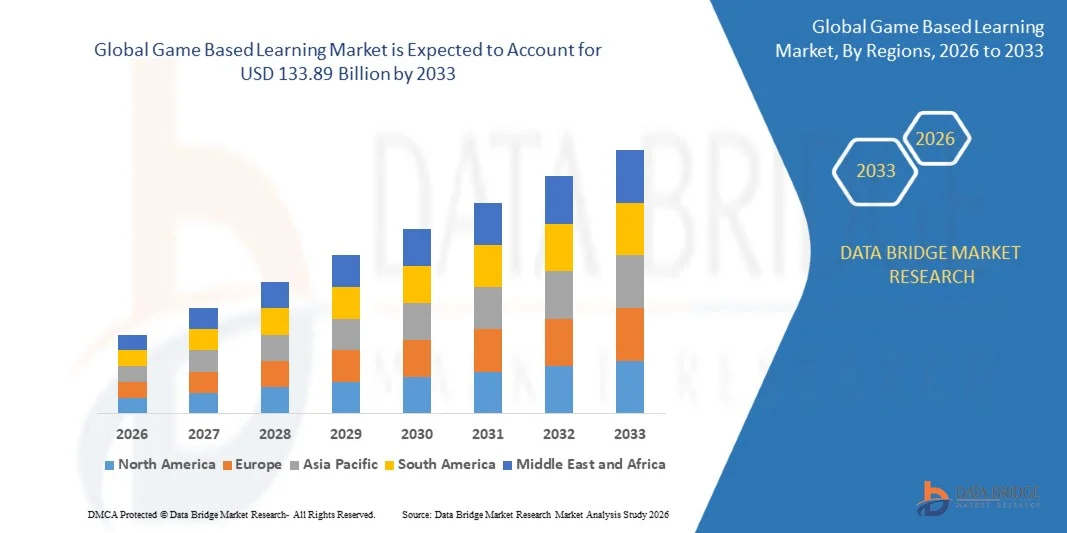
Game Based Learning Market Size
- The global Game-Based Learning Market size was valued at USD 26.59 billion in 2025 and is expected to reach USD 133.89 billion by 2033, at a CAGR of 22.39% during the forecast period.
- The market growth is largely driven by increasing adoption of digital learning platforms and technological advancements in educational software, fostering interactive and immersive learning experiences across schools, universities, and corporate training programs.
- Furthermore, rising demand for personalized, engaging, and outcome-focused learning solutions is encouraging institutions and organizations to integrate game-based learning into their curricula. These factors are collectively accelerating the adoption of game-based learning tools, thereby significantly boosting the industry’s growth.
Game Based Learning Market Analysis
- Game-based learning, offering interactive and gamified educational experiences, is increasingly becoming a vital component of modern education and corporate training programs due to its ability to enhance engagement, improve knowledge retention, and facilitate personalized learning pathways.
- The escalating demand for game-based learning is primarily fueled by the widespread adoption of digital learning platforms, growing emphasis on skill-based and competency-driven education, and a rising preference for immersive, interactive, and outcome-focused learning experiences.
- North America dominated the Global Game-Based Learning Market with the largest revenue share of 32.7% in 2025, characterized by early adoption of e-learning technologies, high investment in educational infrastructure, and a strong presence of key industry players, with the U.S. experiencing substantial growth in corporate training and K-12 implementations, driven by innovations from both established EdTech companies and startups focusing on AI, VR, and adaptive learning features.
- Asia-Pacific is expected to be the fastest-growing region in the Global Game-Based Learning Market during the forecast period due to increasing digitalization in education, rising smartphone and tablet penetration, and growing investments in skill development programs.
- The solutions segment dominated the market with the largest revenue share of 62.5% in 2025, driven by the rising deployment of gamified learning platforms in K-12, higher education, and corporate training programs.
Report Scope and Game Based Learning Market Segmentation
|
Attributes |
Game Based Learning Key Market Insights |
|
Segments Covered |
|
|
Countries Covered |
North America
Europe
Asia-Pacific
Middle East and Africa
South America
|
|
Key Market Players |
|
|
Market Opportunities |
|
|
Value Added Data Infosets |
In addition to the market insights such as market value, growth rate, market segments, geographical coverage, market players, and market scenario, the market report curated by the Data Bridge Market Research team includes in-depth expert analysis, import/export analysis, pricing analysis, production consumption analysis, and pestle analysis. |
Game Based Learning Market Trends
“Enhanced Learning Through AI and Immersive Technologies”
- A significant and accelerating trend in the global Game-Based Learning Market is the deepening integration with artificial intelligence (AI), virtual reality (VR), and adaptive learning platforms. This fusion of technologies is significantly enhancing learner engagement, personalization, and outcomes across educational institutions and corporate training programs.
- For instance, platforms such as Kahoot! and Duolingo use AI-driven analytics to personalize quizzes and learning paths, ensuring learners receive content tailored to their proficiency level. Similarly, Classcraft integrates gamification with real-time feedback and adaptive challenges, keeping learners motivated and on track.
- AI integration in game-based learning enables features such as tracking learner progress, predicting skill gaps, and providing intelligent recommendations for targeted improvement. For example, platforms like Smart Sparrow leverage AI to adapt scenarios based on student performance, while VR-based simulations offer immersive experiential learning in safe, controlled environments.
- The seamless integration of game-based learning platforms with cloud-based educational ecosystems allows centralized management of multiple courses, learner data, and performance analytics. Educators and trainers can monitor progress, adjust difficulty levels, and provide instant feedback through a single interface, creating a holistic and adaptive learning experience.
- This trend towards more intelligent, interactive, and immersive learning solutions is fundamentally reshaping expectations for educational and corporate training programs. Consequently, companies such as Byju’s and BrainPOP are developing AI-enabled and VR-integrated learning modules that offer personalized learning paths, real-time feedback, and gamified interactions.
- The demand for game-based learning solutions that leverage AI, VR, and adaptive technologies is growing rapidly across both K-12, higher education, and corporate sectors, as learners and organizations increasingly prioritize engagement, skill development, and measurable learning outcomes.
Game Based Learning Market Dynamics
Driver
“Growing Need Due to Demand for Engaging and Personalized Learning”
- The increasing focus on skill development, learner engagement, and personalized education, coupled with the accelerating adoption of digital learning platforms, is a significant driver for the heightened demand for game-based learning solutions.
- For instance, in 2025, Byju’s expanded its AI-driven personalized learning modules for K-12 students, integrating gamified assessments and interactive content to enhance engagement and retention. Strategies by key companies such as this are expected to drive the global game-based learning market growth during the forecast period.
- As educators and organizations become more aware of the limitations of traditional teaching methods and seek solutions that improve motivation and outcomes, game-based learning platforms offer features such as real-time feedback, adaptive challenges, and progress tracking, providing a compelling upgrade over conventional learning methods.
- Furthermore, the growing prevalence of digital classrooms, e-learning initiatives, and corporate training programs is making game-based learning an integral part of educational ecosystems, offering seamless integration with Learning Management Systems (LMS), online portals, and collaboration tools.
- The ability to deliver engaging content, personalize learning paths, and provide performance analytics to teachers and managers are key factors propelling the adoption of game-based learning in schools, higher education, and corporate settings. The trend toward interactive and mobile-friendly learning platforms, along with increasing access to affordable digital devices, further contributes to market growth.
Restraint/Challenge
“Concerns Regarding Content Quality, Technical Accessibility, and Cost”
- Concerns surrounding the quality and alignment of game-based learning content with curriculum standards, as well as technical accessibility issues such as internet connectivity and device compatibility, pose significant challenges to broader market adoption.
- For instance, reports of poorly designed or non-standardized educational games have made some educators and organizations hesitant to adopt game-based learning solutions.
- Addressing these concerns through high-quality, curriculum-aligned content, intuitive platform design, and cross-device compatibility is crucial for building user trust. Companies such as Kahoot! and BrainPOP emphasize research-based design, adaptive learning features, and robust platform performance in their offerings to reassure educators and corporate trainers.
- Additionally, the relatively high cost of premium game-based learning platforms, especially those incorporating VR/AR, AI, or extensive analytics, can be a barrier to adoption for budget-conscious schools or small businesses. While more affordable solutions exist, advanced features often come at a premium price.
- Overcoming these challenges through better content curation, enhanced platform accessibility, teacher training, and the development of cost-effective solutions will be vital for sustained growth in the global game-based learning market.
Game Based Learning Market Scope
The market is segmented on the basis of Component, game type, end user.
• By Component
On the basis of component, the Global Game-Based Learning Market is segmented into solutions and services. The solutions segment dominated the market with the largest revenue share of 62.5% in 2025, driven by the rising deployment of gamified learning platforms in K-12, higher education, and corporate training programs. Learning solutions include game-based software, learning management systems (LMS), and mobile applications that facilitate interactive, personalized, and adaptive learning experiences. These solutions are widely adopted due to their ability to increase learner engagement, track progress, and provide instant feedback.
The services segment, encompassing consulting, training, content development, and maintenance, is expected to witness the fastest CAGR of 22.3% from 2026 to 2033. This growth is fueled by increasing demand for tailored content, instructor support, and integration services to ensure smooth implementation of game-based learning systems, especially in institutions and organizations adopting digital-first learning strategies.
• By Game Type
On the basis of game type, the Global Game-Based Learning Market is segmented into AR/VR games, location-based games, AI-based games, assessment and evaluation games, training, knowledge and skill-based games, language learning games, and others. The training, knowledge, and skill-based games segment dominated the market with a revenue share of 45.8% in 2025, owing to their widespread adoption in corporate training, skill development programs, and educational institutions focused on competency-based learning. These games enhance practical knowledge, problem-solving skills, and workplace readiness.
The AR/VR games segment is anticipated to witness the fastest CAGR of 24.1% from 2026 to 2033, driven by technological advancements, increasing affordability of immersive devices, and growing interest in experiential learning solutions. AR/VR games offer high engagement and hands-on experience, making them increasingly popular in both educational and corporate environments seeking interactive, simulation-based learning experiences.
• By End User
On the basis of end user, the Global Game-Based Learning Market is segmented into education, governments, consumers, and enterprises. The education segment dominated the market with the largest revenue share of 50.6% in 2025, fueled by the adoption of game-based learning in K-12 schools, higher education institutions, and online learning platforms. Educational institutions leverage these platforms to improve student engagement, retention, and performance through interactive and gamified content.
The enterprise segment is expected to witness the fastest CAGR of 23.7% from 2026 to 2033, driven by increasing corporate investment in employee training, onboarding, and skill development programs. Enterprises are adopting gamified solutions to enhance learning efficiency, track employee performance, and improve knowledge retention, particularly in sectors requiring continuous upskilling and compliance training. The growing focus on workforce productivity and engagement is expected to accelerate the uptake of game-based learning solutions in corporate environments.
Game Based Learning Market Regional Analysis
- North America dominated the Global Game-Based Learning Market with the largest revenue share of 32.7% in 2025, driven by a growing demand for digital learning solutions, technological adoption in education, and the presence of major EdTech companies.
- Learners and institutions in the region highly value the interactive, engaging, and personalized experiences offered by game-based learning platforms, which enhance knowledge retention, skill development, and learner motivation across K-12, higher education, and corporate training sectors.
- This widespread adoption is further supported by high investments in educational technology, strong internet and device penetration, and a tech-savvy population that embraces innovative teaching and learning methods, establishing game-based learning as a preferred solution for both academic institutions and enterprises seeking effective, outcome-driven learning experiences.
U.S. Game-Based Learning Market Insight
The U.S. game-based learning market captured the largest revenue share of 81% in 2025 within North America, fueled by the rapid adoption of digital learning platforms and increasing integration of technology in K-12 and higher education institutions. Schools and enterprises are prioritizing interactive, personalized, and skill-based learning solutions to enhance engagement and knowledge retention. The growing preference for AI-powered learning tools, mobile app accessibility, and cloud-based platforms further propels market growth. Moreover, the adoption of gamified corporate training and professional development programs is significantly contributing to the expansion of game-based learning in the U.S., supported by strong technological infrastructure and high investment in educational innovation.
Europe Game-Based Learning Market Insight
The Europe game-based learning market is projected to expand at a substantial CAGR during the forecast period, primarily driven by government initiatives promoting digital education, technological adoption in schools, and the growing need for workforce upskilling. Urbanization and digital literacy are fostering the adoption of interactive learning solutions across residential, educational, and corporate sectors. European institutions are increasingly implementing gamified platforms to enhance student motivation and improve learning outcomes, while companies are leveraging these solutions for employee training and performance evaluation.
U.K. Game-Based Learning Market Insight
The U.K. game-based learning market is anticipated to grow at a noteworthy CAGR during the forecast period, driven by the increasing emphasis on digital learning, skill development, and interactive educational methods. Rising concerns about student engagement and knowledge retention are encouraging schools, universities, and businesses to adopt gamified learning platforms. Additionally, the U.K.’s strong EdTech ecosystem, robust internet penetration, and supportive e-learning infrastructure are expected to continue stimulating market growth, with both educational institutions and enterprises embracing innovative digital training solutions.
Germany Game-Based Learning Market Insight
The Germany game-based learning market is expected to expand at a considerable CAGR during the forecast period, fueled by a strong focus on educational innovation, digital literacy, and corporate skill development. German institutions are increasingly adopting AI-driven, interactive learning solutions to enhance student engagement and improve workforce productivity. The integration of gamified learning with digital classrooms and corporate LMS platforms is gaining traction, while local emphasis on data privacy and high-quality content ensures the adoption of reliable, secure solutions across educational and enterprise sectors.
Asia-Pacific Game-Based Learning Market Insight
The Asia-Pacific game-based learning market is poised to grow at the fastest CAGR of 24% during 2026–2033, driven by rapid digitalization, rising disposable incomes, and the increasing adoption of mobile and cloud-based learning platforms in countries such as China, Japan, and India. Government initiatives promoting smart education and digital classrooms, combined with the growing corporate training sector, are accelerating market growth. Furthermore, the region’s emerging EdTech ecosystem and availability of affordable, localized gamified learning solutions are expanding access to a wider learner base.
Japan Game-Based Learning Market Insight
The Japan game-based learning market is gaining momentum due to high technological adoption, the emphasis on personalized and interactive education, and corporate upskilling programs. Educational institutions and enterprises are increasingly implementing gamified solutions to improve engagement and knowledge retention. The integration of AI, VR/AR, and mobile learning platforms is fueling growth, while Japan’s aging population and demand for intuitive, accessible learning tools are encouraging adoption in both residential and professional sectors.
China Game-Based Learning Market Insight
The China game-based learning market accounted for the largest market revenue share in Asia-Pacific in 2025, attributed to rapid urbanization, a tech-savvy student population, and strong governmental support for digital education. Educational institutions, private EdTech companies, and corporate organizations are increasingly adopting gamified learning platforms to enhance engagement, personalize learning, and track performance. The availability of cost-effective, scalable, and AI-enabled game-based learning solutions, alongside a growing domestic EdTech ecosystem, is a key factor driving the market in China.
Game Based Learning Market Share
The Game Based Learning industry is primarily led by well-established companies, including:
- Kahoot! ASA (Norway)
- BYJU’S (India)
- Duolingo, Inc. (U.S.)
- BrainPOP, Inc. (U.S.)
- Quizlet, Inc. (U.S.)
- Age of Learning, Inc. (U.S.)
- Rosetta Stone, Ltd. (U.S.)
- Edmentum, Inc. (U.S.)
- Classcraft Studios (Canada)
- Smart Sparrow (Australia)
- Labster (Denmark)
- Cengage Learning (U.S.)
- Pearson Education (U.K.)
- Prodigy Education (Canada)
- ABCmouse.com (U.S.)
- Top Hat (Canada)
- 2U, Inc. (U.S.)
- iCivics, Inc. (U.S.)
- DreamBox Learning (U.S.)
- Socrative (U.S.)
What are the Recent Developments in Game Based Learning Market?
- In April 2024, Kahoot! ASA, a global leader in game-based learning solutions, launched a strategic initiative in South Africa aimed at enhancing interactive learning in schools and enterprises through its advanced gamified platforms. This initiative underscores the company's dedication to delivering engaging, scalable, and effective learning solutions tailored to the unique educational needs of the local market. By leveraging its global expertise and innovative product offerings, Kahoot! is not only addressing regional learning challenges but also reinforcing its position in the rapidly growing global game-based learning market.
- In March 2024, Duolingo, Inc., a leading language-learning platform, introduced a new AI-powered gamified curriculum specifically designed for K-12 schools and corporate language programs. The innovative system integrates adaptive learning, interactive quizzes, and real-time performance tracking to enhance learner engagement and retention. This advancement highlights Duolingo’s commitment to developing cutting-edge educational technologies that make learning more effective, personalized, and motivating for diverse learner groups.
- In March 2024, BYJU’S, an Indian EdTech giant, successfully deployed the Smart Classroom Initiative in Bengaluru, aimed at transforming urban schools and educational institutions through immersive game-based learning platforms and interactive digital content. This initiative leverages AI, AR/VR, and adaptive learning technologies to create more engaging and effective learning environments, underscoring BYJU’S dedication to fostering innovative and scalable education solutions in India.
- In February 2024, Quizlet, Inc., a leading provider of digital learning and revision tools, announced a strategic partnership with the National Tutoring Association to create a gamified learning platform for students and educators. The collaboration is designed to enhance engagement, knowledge retention, and accessibility for learners, facilitating more effective and interactive study experiences. The initiative underscores Quizlet’s commitment to driving innovation and improving learning outcomes across diverse educational settings.
- In January 2024, BrainPOP, Inc., a pioneer in animated educational content and game-based learning, unveiled its Interactive Learning Suite 2.0 at the EdTech Europe Conference 2024. The new platform, equipped with gamified assessments, adaptive quizzes, and AI-driven recommendations, enables learners to personalize their learning journey and track progress in real-time. The launch highlights BrainPOP’s commitment to integrating advanced technology into educational solutions, offering students and educators enhanced engagement, learning efficiency, and measurable outcomes.

- Interactive Data Analysis Dashboard
- Company Analysis Dashboard for high growth potential opportunities
- Research Analyst Access for customization & queries
- Competitor Analysis with Interactive dashboard
- Latest News, Updates & Trend analysis
- Harness the Power of Benchmark Analysis for Comprehensive Competitor Tracking
Data collection and base year analysis are done using data collection modules with large sample sizes. The stage includes obtaining market information or related data through various sources and strategies. It includes examining and planning all the data acquired from the past in advance. It likewise envelops the examination of information inconsistencies seen across different information sources. The market data is analysed and estimated using market statistical and coherent models. Also, market share analysis and key trend analysis are the major success factors in the market report. To know more, please request an analyst call or drop down your inquiry.
The key research methodology used by DBMR research team is data triangulation which involves data mining, analysis of the impact of data variables on the market and primary (industry expert) validation. Data models include Vendor Positioning Grid, Market Time Line Analysis, Market Overview and Guide, Company Positioning Grid, Patent Analysis, Pricing Analysis, Company Market Share Analysis, Standards of Measurement, Global versus Regional and Vendor Share Analysis. To know more about the research methodology, drop in an inquiry to speak to our industry experts.
Data Bridge Market Research is a leader in advanced formative research. We take pride in servicing our existing and new customers with data and analysis that match and suits their goal. The report can be customized to include price trend analysis of target brands understanding the market for additional countries (ask for the list of countries), clinical trial results data, literature review, refurbished market and product base analysis. Market analysis of target competitors can be analyzed from technology-based analysis to market portfolio strategies. We can add as many competitors that you require data about in the format and data style you are looking for. Our team of analysts can also provide you data in crude raw excel files pivot tables (Fact book) or can assist you in creating presentations from the data sets available in the report.













