


Gas Detection Equipment Market Overview
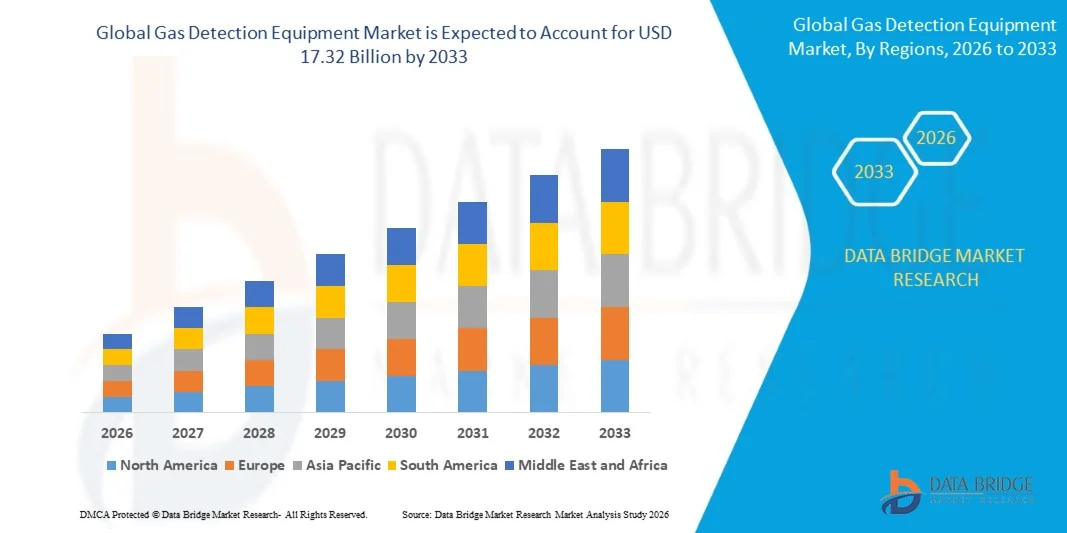
The Gas Detection Equipment Market was valued at USD 6.47 Billion in 2025 and is projected to reach USD 17.32 Billion by 2033, growing at a CAGR of 13.10% from 2026 to 2033. The market is experiencing consistent growth driven by increasing industrial safety regulations, rising demand for real-time hazard monitoring systems, and growing adoption of advanced sensor-based detection technologies across oil & gas, chemical, manufacturing, and environmental monitoring industries. Rapid industrialization, expanding infrastructure development, and rising awareness regarding occupational safety are further supporting market growth across both developed and emerging economies.
The increasing global focus on workplace safety compliance and environmental protection is driving widespread adoption of gas detection systems across high-risk industries. Growing deployment of fixed and portable detection devices, supported by advancements in infrared, semiconductor, and laser-based sensing technologies, is improving accuracy and response times in hazardous environments. In addition, rising integration of IoT-enabled monitoring systems and cloud-based safety platforms is enhancing real-time visibility and predictive maintenance capabilities, further strengthening market expansion.
Key Market Trends & Insights
- Asia-Pacific dominated the Gas Detection Equipment Market with the largest revenue share of 34.4% in 2025, supported by rapid industrialization, expanding oil and gas infrastructure, and strong growth in manufacturing and chemical processing industries
- The fixed gas detector segment led the market with a 58.2% share in 2025, driven by extensive deployment across oil and gas facilities, chemical plants, and manufacturing units requiring continuous and real-time gas monitoring
- North America is expected to be the fastest-growing region at a CAGR of 9.9% from 2026 to 2033, fueled by strong adoption of advanced safety monitoring technologies, stringent occupational safety regulations, and expanding oil and gas exploration activities
- Photoionization Detector (PID) is the fastest-growing technology type, projected to register a CAGR of 12.8% from 2026 to 2033, supported by increasing demand for volatile organic compound detection across environmental monitoring and industrial hygiene applications
- The Infrared (IR) segment dominated the technology category with a 34.6% revenue share in 2025, led by its high accuracy, stability, and suitability for hydrocarbon gas detection in oil and gas and petrochemical environments
- Industrial accounted for 40.7% of the market in 2025, preferred by widespread deployment across manufacturing facilities, refineries, and heavy processing plants requiring continuous hazard monitoring
- The portable gas detector segment is the fastest-growing product category, with a CAGR of 11.4% from 2026 to 2033, driven by increasing demand for mobility-based safety solutions across confined spaces and field operations
Market Size & Forecast
- Global Market Value (2025): USD 6.47 Billion
- Expected Market Value (2033): USD 17.32 Billion
- Forecast CAGR (2026–2033): 13.10%
- Leading Region in 2025: Asia-Pacific
- Fastest Growing Region: North America
Report Scope and Gas Detection Equipment Market Segmentation
|
Attributes |
Gas Detection Equipment Key Market Insights |
|
Segments Covered |
|
|
Countries Covered |
North America · U.S. · Canada · Mexico Europe · Germany · France · U.K. · Netherlands · Switzerland · Belgium · Russia · Italy · Spain · Turkey · Rest of Europe Asia-Pacific · China · Japan · India · South Korea · Singapore · Malaysia · Australia · Thailand · Indonesia · Philippines · Rest of Asia-Pacific Middle East and Africa · Saudi Arabia · U.A.E. · South Africa · Egypt · Israel · Rest of Middle East and Africa South America · Brazil · Argentina · Rest of South America |
|
Key Market Players |
· Emerson Electric Co. (U.S.) · Honeywell (U.S.) · Yokogawa Electric Corporation (Japan) · Drägerwerk AG (Germany) · Fluke Corporation (U.S.) · MSA Safety (U.S.) · ABB Ltd. (Switzerland) · Industrial Scientific (U.S.) · GfG Instrumentation (Germany) · RKI Instruments (U.S.) · Teledyne Technologies (U.S.) · Crowcon Detection Instruments (U.K.) · Siemens AG (Germany) · Xgard (U.K.) · Det-Tronics (U.S.) · Bacharach Inc. (U.S.) · General Monitors (U.S.) |
|
Market Opportunities |
· Expansion of Industrial Automation and Smart Factories · Growing Demand for Portable Gas Detection Devices · Rising Deployment in Hydrogen and Renewable Energy Infrastructure |
|
Value Added Data Infosets |
In addition to the insights on market scenarios such as market value, growth rate, segmentation, geographical coverage, and major players, the market reports curated by the Data Bridge Market Research also include in-depth expert analysis, geographically represented company-wise production and capacity, network layouts of distributors and partners, detailed and updated price trend analysis and deficit analysis of supply chain and demand. |
Gas Detection Equipment Market Trends
Trend: Increasing Adoption of IoT-Enabled and Cloud-Based Gas Monitoring Systems
Gas detection systems are increasingly evolving toward IoT-enabled, wireless, and cloud-connected platforms to enable real-time monitoring, predictive alerts, and centralized safety management across industrial sites. Integration of smart sensors with industrial control systems is improving hazard detection speed and reducing response times in high-risk environments such as oil & gas, chemical plants, and mining operations. The shift toward digital safety ecosystems is also supporting remote monitoring of multiple facilities, enhancing operational efficiency and compliance with safety standards.
Companies such as Honeywell International Inc. have advanced connected safety ecosystems through platforms such as Honeywell Forge and gas detection solutions that integrate real-time monitoring and analytics for industrial safety optimization.
Gas Detection Equipment Market Dynamics
Key Market Driver: Stringent Workplace Safety Regulations
Increasing enforcement of occupational safety and health regulations is significantly driving demand for gas detection equipment across industrial sectors. Regulatory bodies such as OSHA in the U.S. and the European Agency for Safety and Health at Work (EU-OSHA) mandate continuous monitoring of toxic and flammable gases in hazardous workplaces, particularly in oil & gas, petrochemical, and manufacturing industries. This is compelling industries to deploy both fixed and portable gas detection systems to ensure compliance and prevent accidents.
Companies such as Drägerwerk AG and MSA Safety are widely supplying certified gas detection solutions used across refineries, confined space operations, and industrial facilities to meet stringent global safety compliance requirements.
Key Restraint/Challenge: High Cost of Advanced Multi-Sensor Gas Detection Systems
The high cost of advanced multi-gas and infrared-based detection systems remains a major challenge, particularly for small and medium-sized enterprises operating with limited safety budgets. High initial installation costs, calibration requirements, and periodic maintenance expenses increase the total cost of ownership for advanced gas detection networks. In addition, integration of IoT-enabled and AI-based monitoring systems further adds to deployment complexity and cost barriers.
The adoption gap is particularly evident in cost-sensitive industrial segments in developing economies, where reliance on basic single-gas detectors remains more common despite rising safety risks.
Key Market Opportunity: Growing Demand for Portable Gas Detection Devices
Rising demand for portable gas detection devices is creating strong growth opportunities due to increasing field-based operations, confined space entry requirements, and emergency response applications. These devices provide mobility, real-time alerts, and multi-gas detection capabilities, making them essential for industries such as construction, mining, utilities, and oilfield services. Continuous improvements in battery life, sensor miniaturization, and wireless connectivity are further enhancing usability and adoption.
Companies such as Industrial Scientific Corporation and RKI Instruments are actively expanding their portable gas detection portfolios, offering rugged and connected devices designed for high-risk field environments and emergency safety applications.
Gas Detection Equipment Market Scope
The gas detection equipment market is segmented on the basis of product, technology, and end use,
- By Product
On the basis of product, the Gas Detection Equipment Market is segmented into fixed gas detector and portable gas detector. The Fixed Gas Detector segment dominated the market with the largest share of 58.2% in 2025, driven by extensive deployment across oil and gas facilities, chemical plants, and manufacturing units requiring continuous and real-time gas monitoring. These systems are permanently installed, ensuring uninterrupted safety surveillance in high-risk zones. Strong regulatory compliance requirements for industrial safety standards further strengthen adoption. Large-scale integration in industrial infrastructure continues to reinforce its leading position across developed and emerging economies.
The Portable Gas Detector segment is projected to register the fastest growth at a CAGR of 11.4% from 2026 to 2033, driven by increasing demand for mobility-based safety solutions across confined spaces and field operations. Rising awareness regarding worker safety in mining, utilities, and construction activities is supporting rapid adoption. Technological advancements in compact sensors and battery efficiency are improving usability and operational reliability. Expanding industrial workforce safety regulations are further accelerating deployment across multiple end-use industries.
- By Technology
On the basis of technology, the Gas Detection Equipment Market is segmented into semiconductor, infrared (IR), laser-based detection, catalytic, photoionization detector (PID), and others. The Infrared (IR) segment dominated the market with a share of 34.6% in 2025, supported by its high accuracy, stability, and suitability for hydrocarbon gas detection in oil and gas and petrochemical environments. IR sensors offer low maintenance requirements and long operational life, making them ideal for fixed installations. Their resistance to sensor poisoning enhances reliability in harsh industrial conditions. Strong adoption across process industries continues to reinforce segment leadership.
The Photoionization Detector (PID) segment is projected to register the fastest growth at a CAGR of 12.8% from 2026 to 2033, driven by increasing demand for volatile organic compound detection across environmental monitoring and industrial hygiene applications. Growing regulatory focus on air quality monitoring is accelerating adoption of PID-based systems. Enhanced sensitivity to low ppm-level gas concentrations improves detection efficiency in hazardous environments. Continuous advancements in miniaturization and real-time monitoring capabilities are further supporting rapid market expansion.
- By End Use
On the basis of end use, the Gas Detection Equipment Market is segmented into medical, building automation & domestic appliances, environmental, petrochemical, automotive, industrial, and others. The Industrial segment dominated the market with the largest share of 40.7% in 2025, driven by widespread deployment across manufacturing facilities, refineries, and heavy processing plants requiring continuous hazard monitoring. Strict occupational safety regulations and compliance mandates are major adoption drivers. High-risk working environments necessitate integrated gas detection systems for operational safety assurance. Strong penetration across global industrial infrastructure continues to sustain its leading position.
The Environmental segment is projected to register the fastest growth at a CAGR of 11.9% from 2026 to 2033, driven by increasing focus on air quality monitoring and emission control initiatives across urban and industrial regions. Rising governmental regulations aimed at reducing pollution levels are boosting deployment of advanced gas detection systems. Expanding use in smart city projects and environmental surveillance networks is further supporting growth. Increasing public health concerns related to air contamination are accelerating long-term adoption across developed and emerging markets.
Gas Detection Equipment Market Regional Analysis
Asia-Pacific dominated the gas detection equipment market and accounted for the largest revenue share of 34.4% in 2025, driven by rapid industrialization, expanding oil and gas infrastructure, and strong growth in manufacturing and chemical processing industries. The region benefits from increasing enforcement of workplace safety regulations, rising investments in industrial automation, and growing awareness regarding occupational hazard prevention. Expanding construction activities, mining operations, and energy projects are further accelerating demand for advanced fixed and portable gas detection systems. In addition, increasing adoption of smart safety monitoring solutions across large-scale industrial facilities is reinforcing regional market dominance.
China Gas Detection Equipment Market Insight
China held the largest share in the Asia-Pacific Gas Detection Equipment market in 2025, supported by its massive industrial base, extensive petrochemical sector, and large-scale manufacturing ecosystem. The country has strong deployment of gas detection systems across refineries, chemical plants, and energy facilities to comply with tightening safety regulations. Rapid urbanization and infrastructure development are further driving adoption in building automation and environmental monitoring applications. In addition, increasing investments in industrial IoT-enabled safety systems and domestic sensor manufacturing capabilities are strengthening China’s leadership position in the global market.
India Gas Detection Equipment Market Insight
India is witnessing the fastest growth in the Asia-Pacific region at a CAGR of 12.7% from 2026 to 2033, driven by rapid expansion of the industrial sector, increasing focus on workplace safety, and rising investments in oil and gas, mining, and manufacturing industries. Growing awareness regarding occupational health hazards and stricter enforcement of safety compliance standards are significantly boosting adoption of portable and fixed gas detectors. Expansion of chemical processing, pharmaceuticals, and construction activities is further supporting market penetration. In addition, increasing government initiatives toward industrial modernization and smart city development are accelerating long-term demand for gas detection technologies.
Europe Gas Detection Equipment Market Insight
The Europe Gas Detection Equipment market is expanding steadily, supported by strict occupational safety regulations, strong environmental monitoring policies, and high adoption of advanced industrial automation systems. Increasing demand from petrochemical, automotive, and industrial manufacturing sectors is driving deployment of high-precision gas detection solutions. The region’s focus on reducing industrial emissions and improving air quality standards is further strengthening adoption across environmental and building automation applications. In addition, growing investments in hydrogen infrastructure and renewable energy projects are creating new opportunities for advanced gas detection systems.
Germany Gas Detection Equipment Market Insight
Germany accounted for the largest share in the Europe Gas Detection Equipment market in 2025, driven by its strong industrial manufacturing base, advanced chemical sector, and high emphasis on workplace safety compliance. The country has extensive deployment of fixed gas detection systems across automotive, engineering, and chemical production facilities. Strong adoption of Industry 4.0 technologies is further enhancing integration of smart gas monitoring solutions. In addition, rising focus on emission control and industrial sustainability is reinforcing Germany’s leadership in the regional market.
U.K. Gas Detection Equipment Market Insight
The U.K. market is supported by increasing demand for gas detection systems across oil and gas operations, construction sites, and commercial building safety applications. Strong regulatory frameworks focused on worker safety and environmental protection are driving widespread adoption of portable and fixed gas detectors. Rising investments in offshore energy projects and infrastructure modernization are further supporting market expansion. In addition, growing awareness of indoor air quality monitoring in residential and commercial buildings is contributing to steady growth.
North America Gas Detection Equipment Market Insight
North America is projected to grow at the fastest CAGR of 9.9% from 2026 to 2033, driven by strong adoption of advanced safety monitoring technologies, stringent occupational safety regulations, and expanding oil and gas exploration activities. Increasing deployment of IoT-enabled gas detection systems across industrial facilities is enhancing real-time monitoring capabilities and operational efficiency. Rising investments in shale gas production, chemical manufacturing, and infrastructure safety systems are further accelerating regional demand. In addition, growing focus on reducing industrial accidents and improving environmental compliance is boosting adoption of advanced gas detection solutions.
U.S. Gas Detection Equipment Market Insight
The U.S. accounted for the largest share in the North America Gas Detection Equipment market in 2025, supported by strong demand from oil and gas, petrochemical, manufacturing, and industrial safety applications. The country benefits from stringent OSHA regulations mandating the use of gas detection systems across high-risk industries. High adoption of advanced sensor technologies and integrated safety automation systems is further strengthening market growth. In addition, increasing focus on workplace safety modernization and smart industrial monitoring solutions is reinforcing the U.S. leadership position in the regional market.
Gas Detection Equipment Market Share
The gas detection equipment industry is primarily led by well-established companies, including:
- Emerson Electric Co. (U.S.)
- Honeywell (U.S.)
- Yokogawa Electric Corporation (Japan)
- Drägerwerk AG (Germany)
- Fluke Corporation (U.S.)
- MSA Safety (U.S.)
- ABB Ltd. (Switzerland)
- Industrial Scientific (U.S.)
- GfG Instrumentation (Germany)
- RKI Instruments (U.S.)
- Teledyne Technologies (U.S.)
- Crowcon Detection Instruments (U.K.)
- Siemens AG (Germany)
- Xgard (U.K.)
- Det-Tronics (U.S.)
- Bacharach Inc. (U.S.)
- General Monitors (U.S.)
Latest Developments in Gas Detection Equipment Market
- In April 2026, Siemens AG introduced an AI-enabled gas detection analytics enhancement within its industrial safety portfolio, strengthening real-time leak detection and predictive monitoring capabilities across large-scale process industries. The upgrade integrates advanced machine learning models with fixed gas detection networks to improve anomaly identification and reduce response time in high-risk environments. It enhances operational visibility for oil & gas, chemical, and manufacturing facilities by enabling continuous monitoring through centralized dashboards. The development is expected to improve compliance efficiency while reducing unplanned downtime and improving overall plant safety performance
- In March 2026, ABB Ltd. introduced EmissionVision, a cloud-based platform designed to automate and optimize advanced gas leak detection and repair workflows across industrial facilities. The solution integrates leak detection data, field inspection tasks, and analytics into a unified digital ecosystem, enabling faster identification and resolution of gas leaks. It significantly reduces manual inspection dependency by digitizing reporting and compliance tracking processes. The platform is expected to enhance regulatory compliance, improve emissions control efficiency, and support sustainability goals by accelerating response times and operational coordination
- In March 2026, Honeywell International Inc. launched a next-generation NDIR (Non-Dispersive Infrared) gas sensor aimed at improving detection accuracy for flammable gases such as methane in industrial environments. The sensor is designed for seamless integration into both fixed and portable gas detection systems, enhancing reliability across diverse operating conditions. It reduces false alarms and improves performance in harsh industrial settings such as oil & gas and petrochemical plants. The innovation is expected to strengthen workplace safety standards while supporting wider adoption of advanced infrared sensing technologies in gas detection systems
- In November 2025, Drägerwerk AG introduced an upgraded portable gas detection solution featuring enhanced multi-gas sensing capability and improved battery efficiency for extended field operations. The system is designed to support workers in confined space entry, emergency response, and industrial maintenance activities where mobility and accuracy are critical. It improves real-time hazard detection while offering higher durability in extreme environmental conditions. The advancement is expected to drive increased adoption of portable safety devices across construction, mining, and industrial service sectors
- In February 2025, Teledyne Gas & Flame Detection (Teledyne GFD) introduced the Spyglass Xtend triple-infrared flame detector capable of detecting both hydrogen and hydrocarbon fires simultaneously. This advancement enhances industrial safety by providing broader fire detection coverage in complex industrial environments where multiple fuel sources may be present. It reduces the risk of undetected hydrogen-related or hydrocarbon-based fire incidents, improving emergency response efficiency. The development is expected to strengthen demand for advanced infrared-based detection systems across oil & gas and high-risk industrial applications

- Interactive Data Analysis Dashboard
- Company Analysis Dashboard for high growth potential opportunities
- Research Analyst Access for customization & queries
- Competitor Analysis with Interactive dashboard
- Latest News, Updates & Trend analysis
- Harness the Power of Benchmark Analysis for Comprehensive Competitor Tracking
Global Gas Detection Equipment Market, Supply Chain Analysis and Ecosystem Framework
To support market growth and help clients navigate the impact of geopolitical shifts, DBMR has integrated in-depth supply chain analysis into its Global Gas Detection Equipment Market research reports. This addition empowers clients to respond effectively to global changes affecting their industries. The supply chain analysis section includes detailed insights such as Global Gas Detection Equipment Market consumption and production by country, price trend analysis, the impact of tariffs and geopolitical developments, and import and export trends by country and HSN code. It also highlights major suppliers with data on production capacity and company profiles, as well as key importers and exporters. In addition to research, DBMR offers specialized supply chain consulting services backed by over a decade of experience, providing solutions like supplier discovery, supplier risk assessment, price trend analysis, impact evaluation of inflation and trade route changes, and comprehensive market trend analysis.
Data collection and base year analysis are done using data collection modules with large sample sizes. The stage includes obtaining market information or related data through various sources and strategies. It includes examining and planning all the data acquired from the past in advance. It likewise envelops the examination of information inconsistencies seen across different information sources. The market data is analysed and estimated using market statistical and coherent models. Also, market share analysis and key trend analysis are the major success factors in the market report. To know more, please request an analyst call or drop down your inquiry.
The key research methodology used by DBMR research team is data triangulation which involves data mining, analysis of the impact of data variables on the market and primary (industry expert) validation. Data models include Vendor Positioning Grid, Market Time Line Analysis, Market Overview and Guide, Company Positioning Grid, Patent Analysis, Pricing Analysis, Company Market Share Analysis, Standards of Measurement, Global versus Regional and Vendor Share Analysis. To know more about the research methodology, drop in an inquiry to speak to our industry experts.
Data Bridge Market Research is a leader in advanced formative research. We take pride in servicing our existing and new customers with data and analysis that match and suits their goal. The report can be customized to include price trend analysis of target brands understanding the market for additional countries (ask for the list of countries), clinical trial results data, literature review, refurbished market and product base analysis. Market analysis of target competitors can be analyzed from technology-based analysis to market portfolio strategies. We can add as many competitors that you require data about in the format and data style you are looking for. Our team of analysts can also provide you data in crude raw excel files pivot tables (Fact book) or can assist you in creating presentations from the data sets available in the report.













