


Gas Mixture Market Overview
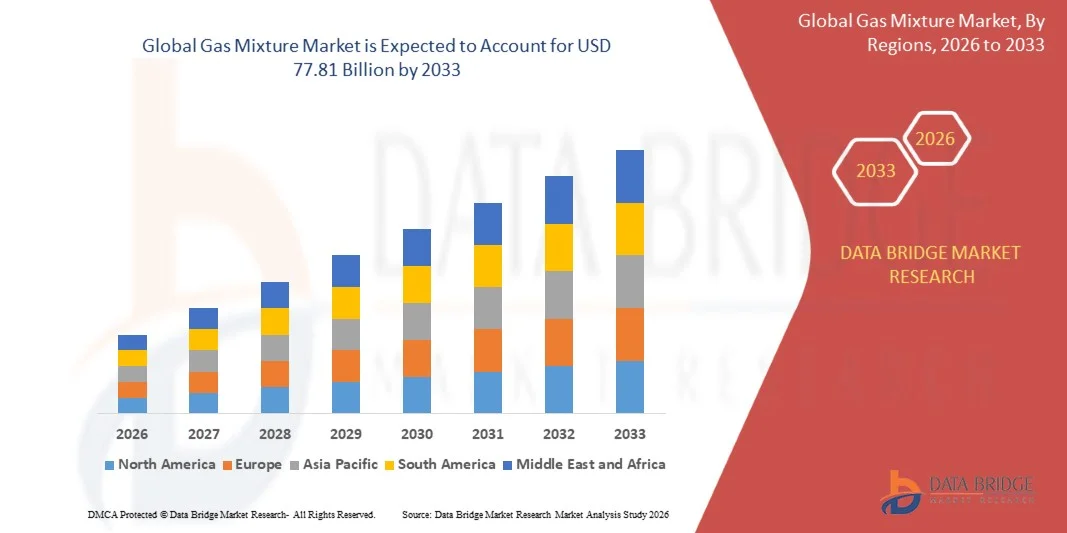
The Gas Mixture Market was valued at USD 49.05 billion in 2025 and is projected to reach USD 77.81 billion by 2033, growing at a CAGR of 5.94% from 2026 to 2033. The market is experiencing consistent growth driven by rising demand for specialty and calibration gases, expanding industrial manufacturing activities, and increasing applications across healthcare, electronics, chemicals, food and beverages, and environmental monitoring.
The growing need for precise gas compositions in industrial processes, laboratory testing, medical diagnostics, and emission monitoring is compelling manufacturers and end users to adopt customized gas mixtures. Increasing investments in semiconductor fabrication, pharmaceutical production, welding, metal processing, and renewable energy infrastructure are further supporting market growth. In addition, stringent regulations related to workplace safety, product quality, and air-emission monitoring are accelerating the use of certified gas mixtures for calibration, quality control, and analytical applications.
Key Market Trends & Insights
- North America dominated the gas mixture market with the largest revenue share of 36.8% in 2025, supported by well-established industrial gas infrastructure, strong demand for specialty and calibration gases, advanced laboratory networks, and increasing requirements for emissions monitoring and industrial safety applications.
- Asia-Pacific is expected to be the fastest-growing region, recording a CAGR of 7.1% from 2026 to 2033. Growth is driven by rapid industrialization, expanding semiconductor and electronics manufacturing, rising healthcare investments, and increasing demand for specialty gases across China, Japan, and India.
- The Nitrogen Mixtures segment held the largest market revenue share of approximately 28.6% in 2025 driven by its widespread use in chemical processing, food packaging, metal fabrication, electronics manufacturing, and analytical calibration applications. Nitrogen mixtures are preferred due to their inert properties, broad industrial compatibility, and ability to support controlled atmospheres across manufacturing and laboratory environments.
- The Specialty Gas Mixtures segment is projected to register the fastest growth at a CAGR of 7.2% from 2026 to 2033, driven by increasing demand for customized calibration gases in semiconductor manufacturing, environmental monitoring, medical diagnostics, and advanced analytical testing. Rising adoption in high-precision instrument calibration and emissions measurement applications is accelerating segment expansion.
- The Cylinder and Packaged Distribution segment held the largest market revenue share of approximately 47.3% in 2025 driven by its widespread use in laboratories, healthcare facilities, small and medium-sized industrial units, food and beverage processing, and field-based gas monitoring applications. Cylinder and packaged distribution is preferred due to its flexibility, ease of handling, and suitability for delivering customized gas mixtures in smaller volumes.
- The Merchant Liquid Distribution segment is projected to register the fastest growth at a CAGR of 6.5% from 2026 to 2033, driven by increasing demand for bulk gas supply across chemical manufacturing, metal fabrication, electronics production, and large-scale industrial processing facilities. Rising industrial production capacity and growing need for reliable bulk gas delivery are accelerating segment expansion.
- The Air Separation Technology segment held the largest market revenue share of approximately 61.4% in 2025 driven by its widespread use in the production of oxygen, nitrogen, argon, and other atmospheric gases for industrial, medical, and chemical applications. Air separation technology is preferred due to its ability to provide high-purity gases at large volumes and support continuous supply requirements across manufacturing facilities.
- The Hydrogen Production Technology segment is projected to register the fastest growth at a CAGR of 7.8% from 2026 to 2033, driven by increasing adoption of hydrogen-based gas mixtures in refining, chemicals, metal processing, electronics, and clean-energy applications. Rising investments in hydrogen production infrastructure and low-carbon industrial processes are accelerating segment expansion.
- The Chemicals segment held the largest market revenue share of approximately 29.8% in 2025 driven by its widespread use in chemical synthesis, process control, emissions monitoring, laboratory analysis, and industrial safety applications. Gas mixtures are preferred in chemical facilities due to their ability to support accurate process conditions, improve product quality, and enable reliable monitoring of hazardous gases.
- The Electronics segment is projected to register the fastest growth at a CAGR of 7.5% from 2026 to 2033, driven by increasing demand for ultra-high-purity and specialty gas mixtures in semiconductor fabrication, display manufacturing, electronic component production, and analytical testing. Rising investments in advanced semiconductor manufacturing and electronics production capacity are accelerating segment expansion.
Market Size & Forecast
- Global Market Value (2025): USD 49.05 Billion
- Expected Market Value (2033): USD 77.81 Billion
- Forecast CAGR (2026–2033): 5.94%
- Leading Region in 2025: North America
- Fastest Growing Region: Asia-Pacific
Report Scope and Gas Mixture Market Segmentation
|
Attributes |
Gas Mixture Key Market Insights |
|
Segments Covered |
· By Mixture: Oxygen Mixtures, Nitrogen Mixtures, Carbon Dioxide Mixtures, Argon Mixtures, Hydrogen Mixtures, Specialty Gas Mixtures, and Others · By Transportation: Cylinder and Packaged Distribution, Merchant Liquid Distribution, and Tonnage Distribution · By Manufacturing Process: Air Separation Technology, Hydrogen Production Technology, and Others · By End User: Metal Manufacturing and Fabrication, Chemicals, Medical and Healthcare, Electronics, Food and Beverages, and Others |
|
Countries Covered |
North America · U.S. · Canada · Mexico Europe · Germany · France · U.K. · Netherlands · Switzerland · Belgium · Russia · Italy · Spain · Turkey · Rest of Europe Asia-Pacific · China · Japan · India · South Korea · Singapore · Malaysia · Australia · Thailand · Indonesia · Philippines · Rest of Asia-Pacific Middle East and Africa · Saudi Arabia · U.A.E. · South Africa · Egypt · Israel · Rest of Middle East and Africa South America · Brazil · Argentina · Rest of South America |
|
Key Market Players |
• Advanced Specialty Gases (U.S.) |
|
Market Opportunities |
• Expansion Of Gas Mixtures In Semiconductor Manufacturing And Electronics Testing • Growing Demand For Customized Medical And Environmental Monitoring Gas Mixtures |
|
Value Added Data Infosets |
In addition to the insights on market scenarios such as market value, growth rate, segmentation, geographical coverage, and major players, the market reports curated by the Data Bridge Market Research also include import export analysis, production capacity overview, production consumption analysis, price trend analysis, climate change scenario, supply chain analysis, value chain analysis, raw material/consumables overview, vendor selection criteria, PESTLE Analysis, Porter Analysis, and regulatory framework. |
Gas Mixture Market Trends
Trend: Growing Adoption Of High-Purity And Multi-Component Gas Mixtures For Precision Applications
Increasing demand for highly accurate, stable, and customized gas compositions across semiconductor manufacturing, environmental monitoring, healthcare, energy, and analytical laboratories is supporting the adoption of specialty gas mixtures. Conventional single-gas supplies are often insufficient for advanced calibration, process control, and testing requirements, encouraging end users to adopt multi-component and ultra-high-purity gas mixtures that can replicate real operating conditions and support reliable instrument performance.
In semiconductor and display manufacturing, gas mixtures are increasingly used for process control, chamber cleaning, etching, deposition, and emissions measurement. For instance, CF₄ and NF₃ are widely used in industrial applications and require accurate concentration monitoring due to their high global warming potential. A 2025 study developed a five-point calibration approach combining residual gas analyzer and Fourier-transform infrared spectroscopy data to estimate process-gas concentrations in semiconductor and display operations.
The growing deployment of multi-parameter gas detection systems is also accelerating demand for certified multi-component mixtures. These mixtures can simultaneously calibrate sensors for gases such as oxygen, carbon monoxide, hydrogen sulfide, and methane, reducing calibration time and cylinder-management requirements. Multi-component gas mixtures accounted for 51.74% of the specialty calibration gases market in 2025, compared with 32.16% for binary gas mixtures, reflecting increased use across industrial safety, environmental monitoring, and analytical applications.
Gas Mixture Market Dynamics
Key Market Driver: Rising Demand For Accurate Calibration And Emission Monitoring Systems
Industries worldwide are facing increasing regulatory and operational pressure to improve workplace safety, control emissions, maintain product quality, and ensure accuracy in gas detection and analytical equipment. Gas mixtures are widely used as certified reference materials for calibrating gas analyzers, detectors, chromatographs, and environmental monitoring systems, creating sustained demand across oil and gas, chemicals, power generation, healthcare, and manufacturing sectors.
Industries such as oil and gas, chemicals, mining, and wastewater treatment are increasingly using gas mixtures to calibrate portable and fixed gas detection systems for hazardous environments. For instance, portable four-gas detectors require mixtures containing oxygen, carbon monoxide, hydrogen sulfide, and combustible gases to validate multiple sensor channels during one calibration process. Gas detectors represented approximately 43.8% of calibration gas mixture market revenue in 2025, supported by the large installed base of portable and fixed safety-monitoring instruments.
Similarly, environmental monitoring agencies and industrial facilities are expanding the use of calibration gas mixtures in continuous emission monitoring systems, stack-gas analyzers, and ambient-air-quality instruments. Calibration gas mixtures are essential for validating measurements of pollutants and greenhouse gases, including methane, ozone, carbon dioxide, and nitrogen oxides. Laboratories typically recalibrate analytical instruments every three to six months using certified reference mixtures, with high-purity mixtures supporting measurement accuracy within approximately ±0.5%.
Key Restraint/Challenge: Complex Mixture Stability And High Handling Costs
Gas mixtures require precise formulation, certification, packaging, and storage to maintain stable concentrations throughout their usable life. Reactive, corrosive, and low-concentration gas components can interact with cylinder walls, valves, and regulators, affecting mixture stability and creating challenges for applications requiring trace-level accuracy. These technical requirements increase production complexity and can limit the availability of specialized gas mixtures in cost-sensitive and remote markets.
In addition, compressed gas cylinders require specialized transport, handling, storage, and periodic testing procedures, increasing logistics costs for suppliers and end users. Industrial users must also ensure compatibility between gas mixtures, cylinder materials, pressure regulators, and analytical instruments to prevent contamination and measurement errors. Multi-component gas mixtures can command a price premium of approximately 20% to 45% over comparable single-gas cylinders due to additional formulation, certification, and stability-verification requirements.
Limited shelf life can further affect procurement planning for highly reactive or ultra-low-concentration mixtures. Calibration mixtures containing reactive gases may require more frequent replacement, particularly when used in high-precision environmental, medical, and semiconductor applications. The need for traceability to recognized standards and documented quality assurance also increases compliance costs for manufacturers and laboratories.
Key Market Opportunity: Expansion In Semiconductor Manufacturing And Medical Diagnostics
Rapid expansion of semiconductor fabrication, advanced electronics manufacturing, and medical diagnostics is creating new opportunities for customized and ultra-high-purity gas mixtures. Semiconductor facilities require tightly controlled gas compositions for wafer processing, etching, deposition, chamber cleaning, and process monitoring, while medical laboratories require certified gas mixtures for respiratory analysis, anesthesia monitoring, blood-gas testing, and diagnostic instrument calibration.
Electronics and semiconductor applications accounted for approximately 10.89% of the specialty calibration gases market in 2025, supported by demand for high-purity and precisely blended gases in fabrication and testing environments. Gas mixing and blending is projected to grow at approximately 9.3% across the specialty gas industry, driven by demand for precision-blended gases used in analytical calibration, environmental monitoring, semiconductor processes, medical diagnostics, and laser applications.
Healthcare and laboratory applications are also increasing the use of certified gas mixtures to support accurate medical testing and instrument validation. Healthcare and laboratory applications represented approximately 20.15% of the specialty calibration gases market in 2025, while the medical segment accounted for approximately 12.6% of calibration gas mixture market revenue. Growing adoption of respiratory-care equipment, clinical analyzers, and laboratory automation is expected to support further demand for medical-grade and customized gas mixtures.
Gas Mixture Market Scope
The market is segmented on the basis of mixture, transportation, manufacturing process, and end user.
- By Mixture
On the basis of mixture, the gas mixture market is segmented into Oxygen Mixtures, Nitrogen Mixtures, Carbon Dioxide Mixtures, Argon Mixtures, Hydrogen Mixtures, Specialty Gas Mixtures, and Others. The Nitrogen Mixtures segment held the largest market revenue share of approximately 28.6% in 2025 driven by its widespread use in chemical processing, food packaging, metal fabrication, electronics manufacturing, and analytical calibration applications. Nitrogen mixtures are preferred due to their inert properties, broad industrial compatibility, and ability to support controlled atmospheres across manufacturing and laboratory environments.
The Specialty Gas Mixtures segment is projected to register the fastest growth at a CAGR of 7.2% from 2026 to 2033, driven by increasing demand for customized calibration gases in semiconductor manufacturing, environmental monitoring, medical diagnostics, and advanced analytical testing. Rising adoption in high-precision instrument calibration and emissions measurement applications is accelerating segment expansion.
- By Transportation
On the basis of transportation, the gas mixture market is segmented into Cylinder and Packaged Distribution, Merchant Liquid Distribution, and Tonnage Distribution. The Cylinder and Packaged Distribution segment held the largest market revenue share of approximately 47.3% in 2025 driven by its widespread use in laboratories, healthcare facilities, small and medium-sized industrial units, food and beverage processing, and field-based gas monitoring applications. Cylinder and packaged distribution is preferred due to its flexibility, ease of handling, and suitability for delivering customized gas mixtures in smaller volumes.
The Merchant Liquid Distribution segment is projected to register the fastest growth at a CAGR of 6.5% from 2026 to 2033, driven by increasing demand for bulk gas supply across chemical manufacturing, metal fabrication, electronics production, and large-scale industrial processing facilities. Rising industrial production capacity and growing need for reliable bulk gas delivery are accelerating segment expansion.
- By Manufacturing Process
On the basis of manufacturing process, the gas mixture market is segmented into Air Separation Technology, Hydrogen Production Technology, and Others. The Air Separation Technology segment held the largest market revenue share of approximately 61.4% in 2025 driven by its widespread use in the production of oxygen, nitrogen, argon, and other atmospheric gases for industrial, medical, and chemical applications. Air separation technology is preferred due to its ability to provide high-purity gases at large volumes and support continuous supply requirements across manufacturing facilities.
The Hydrogen Production Technology segment is projected to register the fastest growth at a CAGR of 7.8% from 2026 to 2033, driven by increasing adoption of hydrogen-based gas mixtures in refining, chemicals, metal processing, electronics, and clean-energy applications. Rising investments in hydrogen production infrastructure and low-carbon industrial processes are accelerating segment expansion.
- By End User
On the basis of end user, the gas mixture market is segmented into Metal Manufacturing and Fabrication, Chemicals, Medical and Healthcare, Electronics, Food and Beverages, and Others. The Chemicals segment held the largest market revenue share of approximately 29.8% in 2025 driven by its widespread use in chemical synthesis, process control, emissions monitoring, laboratory analysis, and industrial safety applications. Gas mixtures are preferred in chemical facilities due to their ability to support accurate process conditions, improve product quality, and enable reliable monitoring of hazardous gases.
The Electronics segment is projected to register the fastest growth at a CAGR of 7.5% from 2026 to 2033, driven by increasing demand for ultra-high-purity and specialty gas mixtures in semiconductor fabrication, display manufacturing, electronic component production, and analytical testing. Rising investments in advanced semiconductor manufacturing and electronics production capacity are accelerating segment expansion.
Gas Mixture Market Regional Analysis
North America Gas Mixture Market Insight
North America dominated the gas mixture market with the largest revenue share of 36.8% in 2025, supported by strong demand for specialty gases across healthcare, chemicals, electronics, metal fabrication, food processing, and environmental monitoring applications. The region benefits from a well-established industrial gas infrastructure, advanced laboratory networks, and increasing requirements for accurate calibration and emissions monitoring. Growing adoption of high-purity and customized gas mixtures across industrial safety, analytical testing, and medical applications is further supporting market expansion.
U.S. Gas Mixture Market Insight
The U.S. gas mixture market captured the largest revenue share in 2025 within North America, fueled by increasing use of calibration gases, medical gases, specialty gas mixtures, and industrial process gases across manufacturing and laboratory facilities. End users are increasingly prioritizing accurate gas analysis, workplace safety, product quality, and emissions compliance through certified gas mixtures. Moreover, rising investments in semiconductor manufacturing, chemical processing, oil and gas operations, and healthcare infrastructure are significantly contributing to the market’s expansion.
Europe Gas Mixture Market Insight
The Europe gas mixture market is expected to witness the fastest growth rate from 2026 to 2033, primarily driven by stringent environmental regulations and the escalating need for accurate emission monitoring across industrial facilities. The increase in industrial automation, coupled with demand for high-purity gases in chemicals, electronics, healthcare, and food processing, is fostering the adoption of gas mixtures. European manufacturers are also increasingly using certified gas mixtures for calibration, quality control, laboratory testing, and process optimization applications.
U.K. Gas Mixture Market Insight
The U.K. gas mixture market is expected to witness the fastest growth rate from 2026 to 2033, driven by increasing demand for specialty gases across pharmaceutical production, healthcare, research laboratories, food processing, and environmental monitoring applications. In addition, stringent requirements related to workplace safety, air-quality monitoring, and industrial emissions are encouraging end users to adopt certified calibration and specialty gas mixtures. The U.K.’s established research infrastructure, combined with growing investment in advanced manufacturing and laboratory testing, is expected to continue to stimulate market growth.
Germany Gas Mixture Market Insight
The Germany gas mixture market is expected to witness the fastest growth rate from 2026 to 2033, fueled by increasing demand for high-purity gases across automotive manufacturing, chemicals, metal fabrication, electronics, and industrial testing applications. Germany’s well-developed industrial infrastructure, combined with its emphasis on precision manufacturing and environmental compliance, promotes the adoption of gas mixtures for welding, heat treatment, calibration, process control, and emissions monitoring. The integration of advanced gas analysis systems with automated manufacturing processes is also becoming increasingly prevalent, with a strong preference for reliable and certified gas mixtures aligning with local industrial requirements.
Asia-Pacific Gas Mixture Market Insight
The Asia-Pacific gas mixture market is expected to witness the fastest growth rate from 2026 to 2033, supported by rapid industrialization, expanding electronics manufacturing, rising healthcare investments, and increasing demand for specialty gases in countries such as China, Japan, and India. The region’s growing focus on semiconductor production, chemical processing, metal manufacturing, and food and beverage processing is driving adoption of gas mixtures. Furthermore, as Asia-Pacific emerges as a major manufacturing hub for electronics, automotive components, and industrial equipment, the demand for high-purity and customized gas mixtures is expanding across a wider industrial base.
Japan Gas Mixture Market Insight
The Japan gas mixture market is expected to witness the fastest growth rate from 2026 to 2033 due to the country’s advanced electronics industry, strong manufacturing base, and increasing demand for high-purity gases. The Japanese market places significant emphasis on quality control, precision production, and environmental monitoring, and the adoption of gas mixtures is driven by increasing use in semiconductor fabrication, automotive manufacturing, healthcare, and analytical laboratory applications. Moreover, Japan’s growing focus on hydrogen technologies and clean-energy infrastructure is expected to support demand for hydrogen-based gas mixtures across industrial and energy applications.
China Gas Mixture Market Insight
The China gas mixture market accounted for the largest market revenue share in Asia-Pacific in 2025, attributed to the country’s expanding industrial base, rapid urbanization, and high rates of manufacturing activity. China stands as one of the largest markets for chemicals, metal fabrication, electronics, food processing, and healthcare products, and gas mixtures are becoming increasingly popular for welding, cutting, calibration, emissions monitoring, and industrial process-control applications. The push towards semiconductor self-sufficiency, industrial automation, and cleaner manufacturing practices, alongside strong domestic industrial gas production capabilities, are key factors propelling the market in China.
Gas Mixture Market Share
The Gas Mixture industry is primarily led by well-established companies, including:
• Advanced Specialty Gases (U.S.)
• Air Liquide (France)
• Linde Plc (Ireland)
• Messer (Germany)
• Matheson Tri-Gas, Inc. (U.S.)
• Air Products Inc. (U.S.)
• AGC Inc. (Japan)
• Praxair Technology, Inc. (U.S.)
• Hangzhou Hangyang Co. Ltd. (China)
• Guangdong Huate Gas Co., Ltd. (China)
• SCG (Thailand)
• Taiyo Nippon Sanso Corporation (Japan)
• Airgas Inc. (U.S.)
• Gulf Cryo (U.A.E.)
• Yingde Gases Group (China)
• Air Products and Chemicals Inc. (U.S.)
• Universal Industrial Gases Inc. (U.S.)
• Axcel Gases (U.S.)
• International Industrial Gases Ltd. (India)
• SOL Group (Italy)
Latest Developments in Gas Mixture Market
- In October 2026, Messer Group GmbH (Germany) launched a new range of environmentally friendly gas mixtures designed to reduce carbon emissions from industrial processes. The development supports manufacturers in meeting sustainability targets and regulatory requirements while improving the environmental performance of production operations. This launch is expected to strengthen demand for low-carbon specialty gas solutions and intensify competition in sustainable industrial gas offerings.
- In September 2026, Air Liquide S.A. (France) established a new facility for the production of high-purity gas mixtures to address growing demand from semiconductor manufacturers. The facility is expected to expand production capacity, improve supply reliability, and support advanced semiconductor fabrication requirements. This development is likely to reinforce Air Liquide’s position in the electronics gas segment and support broader market growth in high-purity gas mixtures.
- In August 2026, Praxair Technology Inc. (U.S.) entered into a strategic partnership with a biotechnology company to develop customized gas mixtures for advanced therapeutic applications. The collaboration is intended to expand the company’s healthcare-focused gas portfolio and support the development of specialized medical and biotechnology solutions. This partnership is expected to increase innovation in therapeutic gas applications and strengthen competition in the medical gas mixture market.

- Interactive Data Analysis Dashboard
- Company Analysis Dashboard for high growth potential opportunities
- Research Analyst Access for customization & queries
- Competitor Analysis with Interactive dashboard
- Latest News, Updates & Trend analysis
- Harness the Power of Benchmark Analysis for Comprehensive Competitor Tracking
Global Gas Mixture Market, Supply Chain Analysis and Ecosystem Framework
To support market growth and help clients navigate the impact of geopolitical shifts, DBMR has integrated in-depth supply chain analysis into its Global Gas Mixture Market research reports. This addition empowers clients to respond effectively to global changes affecting their industries. The supply chain analysis section includes detailed insights such as Global Gas Mixture Market consumption and production by country, price trend analysis, the impact of tariffs and geopolitical developments, and import and export trends by country and HSN code. It also highlights major suppliers with data on production capacity and company profiles, as well as key importers and exporters. In addition to research, DBMR offers specialized supply chain consulting services backed by over a decade of experience, providing solutions like supplier discovery, supplier risk assessment, price trend analysis, impact evaluation of inflation and trade route changes, and comprehensive market trend analysis.
Data collection and base year analysis are done using data collection modules with large sample sizes. The stage includes obtaining market information or related data through various sources and strategies. It includes examining and planning all the data acquired from the past in advance. It likewise envelops the examination of information inconsistencies seen across different information sources. The market data is analysed and estimated using market statistical and coherent models. Also, market share analysis and key trend analysis are the major success factors in the market report. To know more, please request an analyst call or drop down your inquiry.
The key research methodology used by DBMR research team is data triangulation which involves data mining, analysis of the impact of data variables on the market and primary (industry expert) validation. Data models include Vendor Positioning Grid, Market Time Line Analysis, Market Overview and Guide, Company Positioning Grid, Patent Analysis, Pricing Analysis, Company Market Share Analysis, Standards of Measurement, Global versus Regional and Vendor Share Analysis. To know more about the research methodology, drop in an inquiry to speak to our industry experts.
Data Bridge Market Research is a leader in advanced formative research. We take pride in servicing our existing and new customers with data and analysis that match and suits their goal. The report can be customized to include price trend analysis of target brands understanding the market for additional countries (ask for the list of countries), clinical trial results data, literature review, refurbished market and product base analysis. Market analysis of target competitors can be analyzed from technology-based analysis to market portfolio strategies. We can add as many competitors that you require data about in the format and data style you are looking for. Our team of analysts can also provide you data in crude raw excel files pivot tables (Fact book) or can assist you in creating presentations from the data sets available in the report.













