


Gelatin Methacryloyl Market Size
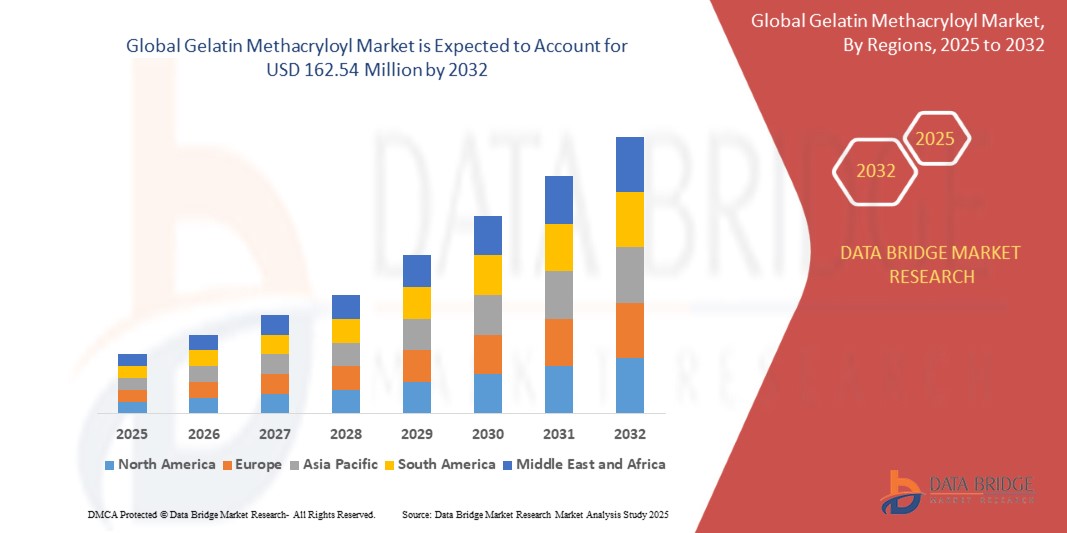
- The global gelatin methacryloyl market size was valued at USD 121.54 million in 2024 and is expected to reach USD 162.54 million by 2032, at a CAGR of 3.7% during the forecast period
- The market growth is largely fueled by the increasing adoption of advanced biomaterials in tissue engineering, regenerative medicine, and 3D bioprinting, where gelatin methacryloyl (GelMA) offers biocompatibility, tunable mechanical properties, and cell-adhesive functionality essential for replicating extracellular matrix environments
- Furthermore, rising research activity in cell-based therapies, organoid development, and personalized medicine is accelerating the demand for GelMA-based hydrogels across academic, clinical, and pharmaceutical sectors. These factors are collectively driving the expansion of the gelatin methacryloyl market by meeting the growing need for high-performance, customizable biomaterials in biomedical innovation
Gelatin Methacryloyl Market Analysis
- Gelatin methacryloyl (GelMA) is a photocrosslinkable hydrogel widely used in biomedical applications due to its excellent biocompatibility, biodegradability, and tunability in stiffness and degradation. It is particularly valuable in creating 3D cell culture systems, engineered tissues, and drug delivery platforms where mimicking natural tissue environments is critical
- The rising use of gelatin methacryloyl in regenerative therapies, coupled with advancements in biofabrication technologies and the increasing focus on reducing animal testing via in-vitro models, is propelling its demand globally across biotech, pharmaceutical, and research sectors
- North America dominated the gelatin methacryloyl market with a share of 42.8% in 2024, due to substantial investments in regenerative medicine and advanced biomedical research
- Asia-Pacific is expected to be the fastest growing region in the gelatin methacryloyl market during the forecast period due to growing investments in life sciences research, increasing adoption of bioprinting technologies, and a rising number of academic research initiatives
- Tissue engineering segment dominated the market with a market share of 39.1% in 2024, due to gelatin methacryloyl’s high biocompatibility, tunable mechanical properties, and support for cell adhesion and proliferation. It is widely used in regenerative medicine and scaffold fabrication to mimic natural extracellular matrix conditions. The growing demand for advanced biomaterials in orthopedic, cardiovascular, and cartilage repair applications has significantly boosted its use in tissue engineering. Rising R&D investments and collaborations among universities and biotech companies are also contributing to segment growth
Report Scope and Gelatin Methacryloyl Market Segmentation
|
Attributes |
Gelatin Methacryloyl Key Market Insights |
|
Segments Covered |
|
|
Countries Covered |
North America
Europe
Asia-Pacific
Middle East and Africa
South America
|
|
Key Market Players |
|
|
Market Opportunities |
|
|
Value Added Data Infosets |
In addition to the insights on market scenarios such as market value, growth rate, segmentation, geographical coverage, and major players, the market reports curated by the Data Bridge Market Research also include import export analysis, production capacity overview, production consumption analysis, price trend analysis, climate change scenario, supply chain analysis, value chain analysis, raw material/consumables overview, vendor selection criteria, PESTLE Analysis, Porter Analysis, and regulatory framework. |
Gelatin Methacryloyl Market Trends
Growing Use of Gelatin Methacryloyl in 3D Bioprinting and Organoids
- The gelatin methacryloyl market is experiencing rapid growth driven by its increasing adoption in advanced 3D bioprinting techniques, which enable creation of tissue-such as structures and organoids for regenerative medicine and drug testing
- For instance, research institutions and companies such as The gelatin methacryloyl Company and Cellink are developing customizable gelatin methacryloyl hydrogels optimized for cell viability and mechanical properties, supporting biofabrication of complex tissues and disease models
- GelMA's biocompatibility, tunable stiffness, and ability to mimic extracellular matrix (ECM) components make it ideal for organoid culture, stem cell encapsulation, and personalized medicine applications
- Advances in biofabrication technology combined with gelatin methacryloyl formulations enable scalable, precise, and reproducible manufacturing of 3D cell-laden constructs for pharmaceutical research and clinical therapies
- Rising investments in tissue engineering and regenerative medicine are accelerating innovations around gelatin methacryloyl composites integrated with growth factors or nanoparticles to enhance cell differentiation and functionality
- Collaborative projects between academic labs, biotech startups, and healthcare providers foster the commercialization of GelMA-based bioinks and scaffolds, expanding use cases from wound healing to cancer research
Gelatin Methacryloyl Market Dynamics
Driver
Advancements in Biomedical Research
- The expanding scope of biomedical research focused on regenerative therapies, drug screening platforms, and personalized medicine is a significant growth driver for the gelatin methacryloyl market, spurring demand for high-performance biomaterials
- For instance, increasing government and private funding targeted at bioprinting technologies and organoid development promotes the use of gelatin methacryloyl as a leading hydrogel for constructing biologically relevant microenvironments
- Research advancements in stem cell biology and 3D culture systems require hydrogels with precise mechanical and biochemical cues, which gelatin methacryloyl formulations increasingly fulfill, driving adoption in R&D and preclinical phases
- Growth in translational medicine and tissue engineering sectors is creating demand for scalable, GMP-compatible gelatin methacryloyl variants for clinical trials and therapeutic applications. The need for reproducible, high-throughput platforms for disease modeling and drug toxicity testing motivates innovation in GelMA-based bioinks tailored to different cell types and tissues
- Increasing global collaboration on biomaterials research accelerates technology transfer and product development, expanding gelatin methacryloyl applications beyond traditional lab-scale research
Restraint/Challenge
Competition from Alternative Material
- The gelatin methacryloyl market faces competitive challenges from alternative biomaterials such as alginate, polyethylene glycol (PEG) derivatives, collagen, and synthetic hydrogels that may offer advantages in specific performance criteria such as mechanical strength, degradation rate, or functionalization
- For instance, researchers and manufacturers sometimes prefer alternatives such as PEG-based hydrogels for better control over crosslinking density or alginate for its cost-effectiveness and availability, affecting GelMA’s market share in certain segments
- High variability and batch-to-batch differences in gelatin source and quality can hinder large-scale standardization and regulatory approval processes compared to fully synthetic competitors
- The complex synthesis and functionalization processes involved in producing gelatin methacryloyl at clinical-grade levels may increase costs and limit accessibility for some end users. Regulatory hurdles, including biocompatibility validation and sterilization challenges, can delay the commercialization of GelMA-based products relative to more established materials
- Continuous innovation in synthetic biomaterials and composite hydrogels presents evolving alternatives that could challenge GelMA’s predominance unless it adapts with new formulations and performance enhancements
Gelatin Methacryloyl Market Scope
The market is segmented on the basis of application and end-use.
• By Application
On the basis of application, the gelatin methacryloyl market is segmented into tissue engineering, 3D bioprinting, drug delivery, cell culture, wound healing, and others. The tissue engineering segment dominated the market with the largest revenue share of 39.1% in 2024, primarily due to gelatin methacryloyl’s high biocompatibility, tunable mechanical properties, and support for cell adhesion and proliferation. It is widely used in regenerative medicine and scaffold fabrication to mimic natural extracellular matrix conditions. The growing demand for advanced biomaterials in orthopedic, cardiovascular, and cartilage repair applications has significantly boosted its use in tissue engineering. Rising R&D investments and collaborations among universities and biotech companies are also contributing to segment growth.
The 3D bioprinting segment is expected to witness the fastest growth rate from 2025 to 2032, driven by increasing demand for customizable bioinks that enable precise construction of complex tissue structures. gelatin methacryloyl’s photo-crosslinking capability and adaptability in viscosity make it a preferred choice for extrusion-based and light-based printing techniques. As 3D bioprinting moves from experimental to clinical translation, gelatin methacryloyl’s role in producing vascularized tissues and organoids is expanding rapidly. Continuous innovation in bioprinter technologies and the rising interest in personalized medicine further support the segment’s projected growth.
• By End-Use
On the basis of end-use, the gelatin methacryloyl market is segmented into biotechnology, pharmaceutical, hospitals and clinics, and others. The biotechnology segment accounted for the largest market share in 2024, owing to extensive use of gelatin methacryloyl in lab-based research, especially in cell culture, tissue modeling, and drug screening platforms. Academic institutions and biotech firms rely on gelatin methacryloyl for creating physiologically relevant 3D models that support high-throughput biological assays. Increased funding for life sciences research and demand for synthetic tissue models to replace animal testing have further propelled this segment’s dominance in the market.
The hospitals and clinics segment is projected to grow at the fastest CAGR from 2025 to 2032, fueled by increasing clinical adoption of gelatin methacryloyl-based products in wound healing, surgical reconstruction, and drug-eluting implants. gelatin methacryloyl’s ability to be tailored for specific healing profiles and its role in facilitating cell migration and tissue regeneration are attracting attention in therapeutic settings. As more gelatin methacryloyl-based formulations receive regulatory approvals and transition from labs to bedside applications, hospitals are integrating them into next-generation medical treatments, thereby driving rapid segment expansion.
Gelatin Methacryloyl Market Regional Analysis
- North America dominated the gelatin methacryloyl market with the largest revenue share of 42.8% in 2024, driven by substantial investments in regenerative medicine and advanced biomedical research
- The region’s leadership is reinforced by a strong presence of research institutions, academic collaborations, and funding support for tissue engineering and drug delivery innovations
- Rapid adoption of 3D bioprinting technologies and the demand for biocompatible hydrogels in therapeutic applications contribute to the widespread use of gelatin methacryloyl across both academic and commercial research settings
U.S. Gelatin Methacryloyl Market Insight
The U.S. gelatin methacryloyl market captured the largest revenue share in 2024 within North America, primarily driven by an advanced biotechnology landscape and growing investments in personalized medicine. The U.S. leads in clinical trials and preclinical research using gelatin methacryloyl for applications such as wound healing, cartilage repair, and cancer models. Supportive regulatory frameworks and an expanding network of biofabrication startups are also fostering market growth. In addition, the increasing use of gelatin methacryloyl in translational research and patient-specific therapeutic models strengthens its market positioning.
Europe Gelatin Methacryloyl Market Insight
The Europe gelatin methacryloyl market is projected to register a steady CAGR throughout the forecast period, supported by rising research initiatives in bioengineering and medical device development. Government-backed funding for regenerative medicine, along with collaborations between universities and pharmaceutical companies, are expanding the scope of gelatin methacryloyl in applications such as scaffold design and drug delivery systems. The region’s strong emphasis on ethical alternatives to animal testing further drives gelatin methacryloyl demand in in-vitro testing platforms and 3D culture systems.
U.K. Gelatin Methacryloyl Market Insight
The U.K. gelatin methacryloyl market is anticipated to grow at a notable CAGR during the forecast period, fueled by increased focus on healthcare innovation and bioscience infrastructure. The country’s commitment to funding cell-based research and next-generation therapeutics has created a favorable environment for gelatin methacryloyl applications in tissue engineering and 3D bioprinting. Furthermore, the push for accelerated clinical translation and collaboration among academic institutions enhances the market’s growth trajectory.
Germany Gelatin Methacryloyl Market Insight
The Germany gelatin methacryloyl market is expected to expand at a solid CAGR, driven by a highly developed healthcare system and a strong emphasis on sustainable biomaterials. German research facilities and biotech firms are actively incorporating gelatin methacryloyl in biofabrication and regenerative therapies. Public-private partnerships and technological innovation in biomedical engineering foster an environment conducive to widespread gelatin methacryloyl utilization, especially in customized implant development and cellular therapy research.
Asia-Pacific Gelatin Methacryloyl Market Insight
The Asia-Pacific gelatin methacryloyl market is poised to grow at the fastest CAGR from 2025 to 2032, supported by growing investments in life sciences research, increasing adoption of bioprinting technologies, and a rising number of academic research initiatives. Countries such as China, Japan, and South Korea are rapidly advancing their capabilities in tissue engineering and regenerative medicine, fueling demand for high-performance hydrogel materials such as gelatin methacryloyl. Government support for biomedical innovation and expanding pharmaceutical R&D capabilities are contributing to rapid market penetration.
Japan Gelatin Methacryloyl Market Insight
The Japan gelatin methacryloyl market is gaining momentum due to its strong biotechnological infrastructure and early adoption of precision medicine strategies. Research in soft tissue reconstruction and organoid development is accelerating the use of gelatin methacryloyl in academic and hospital-based labs. Japan’s aging population also creates a high demand for regenerative healthcare solutions, encouraging the development of gelatin methacryloyl-based wound healing and cartilage repair products. Integration of gelatin methacryloyl into microfluidic and stem cell research applications continues to drive growth.
China Gelatin Methacryloyl Market Insight
The China gelatin methacryloyl market held the largest revenue share within Asia Pacific in 2024, supported by the country’s rapid expansion in biotechnology, regenerative medicine, and medical device sectors. Strong government funding, increasing academic-industry collaboration, and the presence of domestic manufacturers are fueling gelatin methacryloyl adoption across diverse applications such as 3D bioprinting and drug screening. The rising number of research institutions and emphasis on innovation make China a central hub for gelatin methacryloyl demand in the region.
Gelatin Methacryloyl Market Share
The gelatin methacryloyl industry is primarily led by well-established companies, including:
- The GelMA Company (France)
- Biomaterials and Tissue Engineering Research Group (Ireland)
- Cellink (Sweden)
- Thermo Fisher Scientific (U.S.)
- Sigma-Aldrich (Merck) (U.S.)
- Advanced BioMatrix (U.S.)
- BioGel (U.S.)
- Gelomics (Australia)
- Sophim (Portugal)
- Nzytech (Portugal)
- Caisson Laboratories (U.S.)
- Corning Incorporated (U.S.)
- GELITA AG (Germany)
- Zymeron Corporation (U.S.)
- Roquette Group (France)
Latest Developments in Global Gelatin Methacryloyl Market
- In 2025, Gelomics secured venture capital funding to scale up its manufacturing capacity and diversify its gelatin methacryloyl portfolio for niche biomedical fields, including ophthalmology and dental tissue engineering. This financial backing is expected to accelerate the company’s production capabilities, enhance R&D efforts, and expand its market presence globally. The investment marks a strategic move to meet rising demand for specialized gelatin methacryloyl solutions in regenerative medicine and clinical research
- In 2024, CELLINK introduced a new gelatin methacryloyl -based bioink formulation specifically designed to improve vascular tissue bioprinting. This advanced formulation enhances scaffold vascularization and structural integrity, critical for replicating complex biological tissues. By delivering a more functional and biocompatible bioink, the company reinforces its position as an innovation leader in the 3D bioprinting market and contributes to expanding gelatin methacryloyl applications in high-precision tissue fabrication
- In 2024, Advanced BioMatrix expanded its production facility by 35% to increase the output of its gelatin methacryloyl -based hydrogel products, particularly to meet the growing demand in the Asia-Pacific region. This capacity expansion enhances the company’s ability to serve global research institutions and biotech firms requiring scalable, high-quality gelatin methacryloyl solutions. The move positions Advanced BioMatrix as a key supplier in regions experiencing rapid growth in regenerative medicine and tissue engineering
- In July 2023, Sigma-Aldrich (Merck) announced the expansion of its Lenexa facility in Kansas, USA, by adding 9,100 square meters of laboratory and production space focused on manufacturing cell culture media. This expansion significantly strengthens the company’s capacity to support growing global demand for advanced cell culture solutions, which are critical in biopharmaceutical production and regenerative medicine. The move is expected to enhance supply chain resilience and accelerate the availability of high-quality media essential for applications such as 3D bioprinting and tissue engineering, thereby boosting the growth of the gelatin methacryloyl market
- In December 2022, Rousselot entered into a strategic agreement with Gelomics to develop ready-to-use 3D Cell Culture Kits utilizing X-PURE gelatin methacryloyl, which is photocrosslinkable and serves as its own extracellular matrix (ECM). This collaboration aims to streamline the use of gelatin methacryloyl in applications such as 3D bioprinting, 3D cell culture, and tissue engineering. By offering standardized, bioactive, and tunable gelatin methacryloyl -based kits, the partnership enhances product accessibility for researchers and biotech firms, supporting broader adoption of gelatin methacryloyl in advanced biomedical research and accelerating market growth gelatin methacryloyl

- Interactive Data Analysis Dashboard
- Company Analysis Dashboard for high growth potential opportunities
- Research Analyst Access for customization & queries
- Competitor Analysis with Interactive dashboard
- Latest News, Updates & Trend analysis
- Harness the Power of Benchmark Analysis for Comprehensive Competitor Tracking
Global Gelatin Methacryloyl Market, Supply Chain Analysis and Ecosystem Framework
To support market growth and help clients navigate the impact of geopolitical shifts, DBMR has integrated in-depth supply chain analysis into its Global Gelatin Methacryloyl Market research reports. This addition empowers clients to respond effectively to global changes affecting their industries. The supply chain analysis section includes detailed insights such as Global Gelatin Methacryloyl Market consumption and production by country, price trend analysis, the impact of tariffs and geopolitical developments, and import and export trends by country and HSN code. It also highlights major suppliers with data on production capacity and company profiles, as well as key importers and exporters. In addition to research, DBMR offers specialized supply chain consulting services backed by over a decade of experience, providing solutions like supplier discovery, supplier risk assessment, price trend analysis, impact evaluation of inflation and trade route changes, and comprehensive market trend analysis.
Data collection and base year analysis are done using data collection modules with large sample sizes. The stage includes obtaining market information or related data through various sources and strategies. It includes examining and planning all the data acquired from the past in advance. It likewise envelops the examination of information inconsistencies seen across different information sources. The market data is analysed and estimated using market statistical and coherent models. Also, market share analysis and key trend analysis are the major success factors in the market report. To know more, please request an analyst call or drop down your inquiry.
The key research methodology used by DBMR research team is data triangulation which involves data mining, analysis of the impact of data variables on the market and primary (industry expert) validation. Data models include Vendor Positioning Grid, Market Time Line Analysis, Market Overview and Guide, Company Positioning Grid, Patent Analysis, Pricing Analysis, Company Market Share Analysis, Standards of Measurement, Global versus Regional and Vendor Share Analysis. To know more about the research methodology, drop in an inquiry to speak to our industry experts.
Data Bridge Market Research is a leader in advanced formative research. We take pride in servicing our existing and new customers with data and analysis that match and suits their goal. The report can be customized to include price trend analysis of target brands understanding the market for additional countries (ask for the list of countries), clinical trial results data, literature review, refurbished market and product base analysis. Market analysis of target competitors can be analyzed from technology-based analysis to market portfolio strategies. We can add as many competitors that you require data about in the format and data style you are looking for. Our team of analysts can also provide you data in crude raw excel files pivot tables (Fact book) or can assist you in creating presentations from the data sets available in the report.













