




Global Gene Editing Tools Market
Market Size in USD Million
CAGR :
% 
 USD
815.20 Million
USD
2,685.49 Million
2025
2033
USD
815.20 Million
USD
2,685.49 Million
2025
2033
 Forecast Period Forecast Period |
2026 –2033 |
 Market Size (Base Year) Market Size (Base Year) |
USD 815.20 Million |
 Market Size (Forecast Year) Market Size (Forecast Year) |
USD 2,685.49 Million |
 CAGR CAGR |
% |
| Major Markets Players |
|
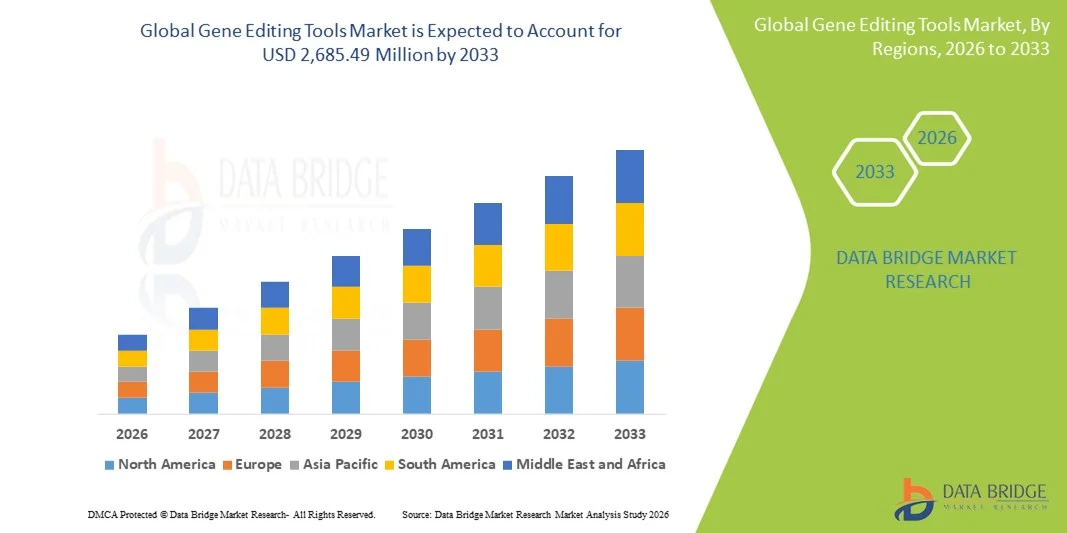
Gene Editing Tools Market Size
- The global gene editing tools market size was valued at USD 815.20 million in 2025 and is expected to reach USD 2,685.49 million by 2033, at a CAGR of 16.07% during the forecast period
- The market growth is largely driven by rapid advances in genome engineering technologies such as CRISPR-Cas systems, TALENs, and ZFNs, along with increasing research activity across academic, clinical, and biotechnology settings
- Furthermore, rising demand for precise, efficient, and scalable genetic modification tools in drug discovery, functional genomics, and therapeutic development is positioning gene editing tools as a cornerstone technology in modern life sciences. These converging factors are accelerating adoption across research and clinical pipelines, thereby significantly boosting overall market growth
Gene Editing Tools Market Analysis
- Gene editing tools, enabling precise modification, insertion, or deletion of genetic material, are increasingly vital components of modern life sciences and biotechnology workflows across research, clinical, and industrial applications due to their high accuracy, efficiency, and ability to target specific genomic sequences
- The escalating demand for gene editing tools is primarily fueled by rapid advancements in CRISPR-based technologies, growing investments in genomics research, and rising interest in personalized medicine and next-generation therapeutics
- North America dominated the gene editing tools market with the largest revenue share of 45.2% in 2025, characterized by strong research infrastructure, substantial government and private funding, and the presence of leading biotechnology and pharmaceutical companies, with the U.S. driving widespread adoption across academic research, drug discovery, and clinical development programs
- Asia-Pacific is expected to be the fastest growing region in the gene editing tools market during the forecast period due to expanding biotechnology ecosystems, increasing government support for genomics and precision medicine initiatives, and rising collaborations between academic institutions and biopharmaceutical companies
- The CRISPR/Cas segment dominated the gene editing tools market with a market share of 60.9% in 2025, driven by its superior precision, scalability, cost-effectiveness, and broad applicability across research, therapeutic development, and agricultural biotechnology
Report Scope and Gene Editing Tools Market Segmentation
|
Attributes |
Gene Editing Tools Key Market Insights |
|
Segments Covered |
|
|
Countries Covered |
North America
Europe
Asia-Pacific
Middle East and Africa
South America
|
|
Key Market Players |
|
|
Market Opportunities |
|
|
Value Added Data Infosets |
In addition to the insights on market scenarios such as market value, growth rate, segmentation, geographical coverage, and major players, the market reports curated by the Data Bridge Market Research also include in-depth expert analysis, patient epidemiology, pipeline analysis, pricing analysis, and regulatory framework |
Gene Editing Tools Market Trends
Advancements in CRISPR Precision and Next-Generation Editing Platforms
- A significant and accelerating trend in the global gene editing tools market is the rapid advancement of CRISPR-based technologies alongside next-generation platforms such as base editing and prime editing, which are enhancing precision, efficiency, and safety in genome modification
- For instance, Beam Therapeutics has advanced base editing platforms that enable single-nucleotide changes without inducing double-strand DNA breaks, significantly reducing off-target effects compared to earlier gene editing approaches
- Enhanced gene editing technologies are enabling researchers to achieve more accurate genetic modifications, improved targeting specificity, and reduced unintended mutations, which is critical for therapeutic development and clinical translation. For instance, prime editing tools are being increasingly adopted in functional genomics studies to correct disease-causing mutations with high fidelity
- The integration of advanced delivery systems, automation, and bioinformatics tools with gene editing platforms is facilitating streamlined workflows across research and biopharmaceutical development. Through unified platforms, researchers can design, execute, and analyze gene edits more efficiently across large-scale studies
- This trend toward more precise, versatile, and clinically viable gene editing systems is fundamentally reshaping expectations in genomics research and therapeutic innovation. Consequently, companies such as Editas Medicine are investing heavily in next-generation editing technologies to expand their clinical pipeline
- The demand for highly accurate, scalable, and safe gene editing tools is growing rapidly across academic research, biotechnology, and pharmaceutical sectors as stakeholders increasingly prioritize translational and therapeutic-ready solutions
Gene Editing Tools Market Dynamics
Driver
Rising Demand Driven by Genomic Research Expansion and Therapeutic Development
- The increasing focus on genomics research, coupled with the growing development of gene and cell therapies, is a significant driver accelerating the demand for advanced gene editing tools
- For instance, in March 2025, CRISPR Therapeutics reported progress in expanding its clinical pipeline for gene-edited therapies targeting hematological and genetic disorders, highlighting the growing reliance on robust editing tools in clinical programs
- As researchers and biopharmaceutical companies seek more effective ways to understand gene function and develop targeted treatments, gene editing tools provide unparalleled capabilities for disease modeling, target validation, and therapeutic discovery
- Furthermore, rising investments from governments and private organizations in precision medicine and life sciences research are reinforcing the adoption of gene editing technologies across academic institutions and commercial laboratories
- The ability of gene editing tools to accelerate drug discovery timelines, enable personalized medicine approaches, and support scalable therapeutic manufacturing is propelling their widespread adoption across both research and clinical environments
- The increasing use of gene editing tools in agricultural biotechnology for crop improvement, disease resistance, and yield enhancement is further driving demand beyond medical and research applications
Restraint/Challenge
Ethical Concerns and Regulatory Complexity
- Concerns surrounding ethical considerations, regulatory uncertainty, and potential off-target effects associated with gene editing technologies pose significant challenges to broader market adoption, particularly in clinical and human genome applications
- For instance, ongoing global debates regarding germline editing and stringent regulatory scrutiny in regions such as Europe have slowed the approval and commercialization of certain gene editing-based therapies
- Addressing these challenges through improved editing accuracy, transparent ethical frameworks, and clear regulatory pathways is essential for sustained market growth. Companies such as Intellia Therapeutics emphasize rigorous preclinical validation and regulatory engagement to mitigate ethical and safety concerns
- While technological advancements continue to reduce risks, lengthy approval timelines and complex compliance requirements can delay product development and increase costs for biotechnology firms
- Limited availability of skilled professionals with expertise in advanced gene editing techniques and bioinformatics can constrain adoption, particularly in emerging markets and smaller research institutions
- Overcoming these challenges through international regulatory harmonization, continued innovation in high-fidelity editing tools, and proactive stakeholder engagement will be critical to unlocking the full potential of the global gene editing tools market
Gene Editing Tools Market Scope
The market is segmented on the basis of product, application, disease application, and end-user.
- By Product
On the basis of product, the global gene editing tools market is segmented into CRISPR/Cas9, ZFNs, TALENs, viral systems, transposon systems, and others. The CRISPR/Cas9 segment dominated the market with the largest revenue share of 60.9% in 2025, driven by its high efficiency, simplicity of design, and cost-effectiveness compared to other gene editing platforms. CRISPR/Cas9 allows precise and scalable genome modification, making it the preferred choice across academic research, biotechnology, and pharmaceutical industries. Its broad applicability in gene knockout, gene insertion, and gene correction studies has accelerated its adoption. The technology’s compatibility with high-throughput screening and automation further strengthens its dominance. In addition, continuous improvements in CRISPR variants and delivery systems are expanding its clinical relevance. Strong funding support and widespread regulatory familiarity further reinforce this segment’s leadership position.
The TALENs segment is expected to witness the fastest growth during the forecast period, owing to its high specificity and reduced off-target effects relative to earlier gene editing technologies. TALENs are increasingly adopted in therapeutic research where precision and genomic safety are critical requirements. Their effectiveness in editing complex genomic regions that are less accessible to CRISPR systems supports their growing use. Rising clinical research activities and regulatory acceptance are also contributing to growth. Furthermore, TALENs are gaining traction in applications requiring permanent and stable gene modification. Increasing investment in next-generation therapeutic platforms is expected to sustain rapid growth in this segment.
- By Application
On the basis of application, the market is segmented into veterinary medicine, cell line engineering, bioremediation, food and brewing development, food waste management, bio sensing development, and others. The Cell Line Engineering segment dominated the market in 2025, driven by its extensive use in drug discovery, biologics production, and disease modeling. Gene editing tools are widely used to develop customized cell lines for target validation and functional genomics studies. The growing demand for biologics and biosimilars has increased reliance on genetically engineered cell lines. Pharmaceutical companies increasingly use gene-edited cell lines to accelerate R&D timelines. Integration of automation and high-throughput technologies further supports large-scale adoption. The central role of cell line engineering in translational research solidifies its dominant market position.
The Veterinary Medicine segment is projected to be the fastest growing during the forecast period, supported by increasing use of gene editing in animal health research and livestock improvement. Gene editing tools are being adopted to enhance disease resistance, productivity, and genetic quality in animals. Rising awareness of zoonotic diseases and food security is driving investment in veterinary genomics. Expanding biotechnology research in companion animal healthcare is also contributing to growth. Government initiatives supporting livestock genomics further accelerate adoption. These factors collectively position veterinary medicine as the fastest-growing application segment.
- By Disease Application
On the basis of disease application, the market is segmented into sickle cell disease, heart disease, diabetes, alzheimer’s disease, obesity, and others. The Sickle Cell Disease segment held the largest market share in 2025, driven by advanced clinical progress of gene editing-based therapies targeting this monogenic disorder. The well-defined genetic mutation underlying the disease makes it highly suitable for gene editing interventions. Successful clinical trial outcomes have increased confidence among researchers and investors. Regulatory support and orphan drug incentives further encourage development. Biopharmaceutical companies are heavily investing in curative therapies for sickle cell disease. These factors collectively contribute to the segment’s dominance.
The Alzheimer’s Disease segment is expected to witness the fastest growth during the forecast period, fueled by rising research efforts to understand genetic contributors to neurodegeneration. Increasing prevalence of Alzheimer’s disease globally is driving demand for innovative treatment approaches. Gene editing tools are being used extensively in disease modeling and target discovery. Advancements in brain-specific delivery technologies are improving feasibility. Growing funding for neuroscience research further accelerates adoption. This expanding research focus is driving rapid growth in this segment.
- By End-User
On the basis of end-user, the market is segmented into biotech and pharma companies, CROS, academic and research institutes, food industry, and others. The Biotech and Pharma Companies segment dominated the market in 2025, driven by extensive use of gene editing tools in drug discovery and therapeutic development. These companies leverage gene editing to accelerate target identification and validation processes. Strong financial resources enable investment in advanced technologies and infrastructure. Increasing clinical trial activity in gene and cell therapies further boosts demand. Strategic collaborations with academic institutions enhance innovation. This strong R&D focus sustains their leading market position.
The CROs segment is anticipated to grow at the fastest rate during the forecast period, driven by rising outsourcing of gene editing research by pharmaceutical companies. CROs provide specialized expertise and cost-efficient research services. Growing complexity of gene editing workflows increases reliance on external service providers. Expansion of gene therapy pipelines is boosting demand for CRO support. CROs also offer scalability and regulatory expertise. These advantages are accelerating rapid growth in this segment.
Gene Editing Tools Market Regional Analysis
- North America dominated the gene editing tools market with the largest revenue share of 45.2% in 2025, characterized by strong research infrastructure, substantial government and private funding, and the presence of leading biotechnology and pharmaceutical companies, with the U.S. driving widespread adoption across academic research, drug discovery, and clinical development programs
- Researchers and organizations in the region highly value the precision, scalability, and versatility offered by gene editing tools for applications such as drug discovery, disease modeling, and therapeutic development
- This widespread adoption is further supported by substantial government and private funding, a highly skilled scientific workforce, and a strong presence of leading biotechnology and pharmaceutical companies, establishing gene editing tools as a core technology across academic, clinical, and commercial research environments
U.S. Gene Editing Tools Market Insight
The U.S. gene editing tools market captured the largest revenue share within North America in 2025, fueled by strong federal and private funding for genomics research and the rapid advancement of CRISPR-based technologies. Research institutions and biopharmaceutical companies are increasingly prioritizing gene editing for drug discovery and therapeutic development. The growing pipeline of cell and gene therapies, combined with extensive clinical trial activity, further propels market growth. Moreover, the strong presence of leading gene editing companies and academic centers of excellence significantly contributes to market expansion.
Europe Gene Editing Tools Market Insight
The Europe gene editing tools market is projected to expand at a substantial CAGR throughout the forecast period, primarily driven by increasing investment in life sciences research and rising adoption of precision medicine. The growing emphasis on ethical research frameworks and regulatory compliance is shaping responsible adoption of gene editing technologies. European research institutions are increasingly leveraging gene editing for disease modeling and translational research. The region is experiencing steady growth across academic, clinical, and industrial research applications, supported by cross-border research collaborations.
U.K. Gene Editing Tools Market Insight
The U.K. gene editing tools market is anticipated to grow at a noteworthy CAGR during the forecast period, driven by strong government support for genomics and biomedical innovation. Increasing funding for academic research and biotechnology startups is accelerating the use of advanced gene editing platforms. The country’s focus on personalized medicine and rare disease research is encouraging broader adoption of gene editing tools. In addition, the U.K.’s well-established research infrastructure continues to support sustained market growth.
Germany Gene Editing Tools Market Insight
The Germany gene editing tools market is expected to expand at a considerable CAGR during the forecast period, fueled by strong industrial research capabilities and a focus on biotechnology innovation. Germany’s emphasis on precision engineering and scientific excellence supports the adoption of advanced gene editing technologies. The increasing use of gene editing in pharmaceutical research and industrial biotechnology is driving demand. In addition, strong regulatory oversight and emphasis on ethical research align with local research and industry expectations.
Asia-Pacific Gene Editing Tools Market Insight
The Asia-Pacific gene editing tools market is poised to grow at the fastest CAGR during the forecast period, driven by expanding biotechnology sectors, rising research investments, and supportive government initiatives in countries such as China, Japan, and India. Rapid development of academic research infrastructure and increasing collaboration with global biopharmaceutical companies are accelerating adoption. The region’s growing focus on genomics, agriculture biotechnology, and therapeutic innovation is further boosting demand. Moreover, improving access to advanced research tools is expanding the regional user base.
Japan Gene Editing Tools Market Insight
The Japan gene editing tools market is gaining momentum due to the country’s strong focus on advanced medical research and technological innovation. Japan places significant emphasis on precision medicine and regenerative therapies, driving adoption of gene editing technologies. Increasing use of gene editing in disease modeling and drug development is supporting market growth. Moreover, the country’s aging population is encouraging research into genetic and age-related diseases, further stimulating demand.
India Gene Editing Tools Market Insight
The India gene editing tools market accounted for a significant share within Asia-Pacific in 2025, attributed to expanding academic research, growing biotechnology investments, and increasing government support for genomics initiatives. India is emerging as a key hub for life sciences research, with rising adoption of gene editing tools in universities and research institutes. The growth of domestic biotechnology companies and contract research organizations is further supporting market expansion. In addition, national programs promoting innovation and translational research are strengthening India’s position in the global gene editing tools market.
Gene Editing Tools Market Share
The Gene Editing Tools industry is primarily led by well-established companies, including:
- Thermo Fisher Scientific Inc. (U.S.)
- Promega Corporation (U.S.)
- New England Biolabs (U.S.)
- Agilent Technologies, Inc. (U.S.)
- Bio-Rad Laboratories, Inc. (U.S.)
- Illumina, Inc. (U.S.)
- Takara Bio Inc. (Japan)
- Lonza (Switzerland)
- Twist Bioscience Corporation (U.S.)
- GenScript (China)
- Synthego Corporation (U.S.)
- Editas Medicine, Inc. (U.S.)
- CRISPR Therapeutics AG (Switzerland)
- Intellia Therapeutics, Inc. (U.S.)
- Sangamo Therapeutics, Inc. (U.S.)
- OriGene Technologies, Inc. (U.S.)
- Transposagen Biopharmaceuticals, Inc. (U.S.)
- Applied Biological Materials Inc. (Canada)
- Danaher (U.S.)
- Takara Holdings Inc. (Japan)
What are the Recent Developments in Global Gene Editing Tools Market?
- In October 2025, Metagenomi announced it is using Amazon Web Services’ custom AI chips (Inferentia) to accelerate the development of gene-editing tools aimed at precisely delivering gene-editing therapies inside the human body, representing a notable intersection of biotechnology and cloud-based AI computing
- In October 2025, MIT researchers developed a new precision gene editing tool that significantly reduces unintended DNA editing errors cutting error rates by up to ~60-fold which could make future gene therapies much safer and more reliable for treating genetic diseases
- In June 2025, Eli Lilly agreed to acquire CRISPR gene-editing biotech Verve Therapeutics for up to USD 1.3 billion, bolstering its pipeline with Verve’s base-editing therapies targeting the PCSK9 gene, marking one of the largest acquisitions in the CRISPR space and signaling strong pharmaceutical interest in gene-editing assets
- In May 2025, researchers in Philadelphia successfully treated a 9-month-old baby with a first-ever personalized CRISPR gene-editing therapy for a rare metabolic disorder, representing a historic milestone toward individualized gene-editing treatments for rare genetic diseases
- In July 2021, scientists reported that CRISPR/Cas9 gene editing can cause unexpected collateral DNA damage in cells, highlighting safety concerns and the need for improved precision and oversight in gene-editing applications a significant research milestone in understanding CRISPR limitations
SKU-
Get online access to the report on the World's First Market Intelligence Cloud

- Interactive Data Analysis Dashboard
- Company Analysis Dashboard for high growth potential opportunities
- Research Analyst Access for customization & queries
- Competitor Analysis with Interactive dashboard
- Latest News, Updates & Trend analysis
- Harness the Power of Benchmark Analysis for Comprehensive Competitor Tracking
Research Methodology
Data collection and base year analysis are done using data collection modules with large sample sizes. The stage includes obtaining market information or related data through various sources and strategies. It includes examining and planning all the data acquired from the past in advance. It likewise envelops the examination of information inconsistencies seen across different information sources. The market data is analysed and estimated using market statistical and coherent models. Also, market share analysis and key trend analysis are the major success factors in the market report. To know more, please request an analyst call or drop down your inquiry.
The key research methodology used by DBMR research team is data triangulation which involves data mining, analysis of the impact of data variables on the market and primary (industry expert) validation. Data models include Vendor Positioning Grid, Market Time Line Analysis, Market Overview and Guide, Company Positioning Grid, Patent Analysis, Pricing Analysis, Company Market Share Analysis, Standards of Measurement, Global versus Regional and Vendor Share Analysis. To know more about the research methodology, drop in an inquiry to speak to our industry experts.
Customization Available
Data Bridge Market Research is a leader in advanced formative research. We take pride in servicing our existing and new customers with data and analysis that match and suits their goal. The report can be customized to include price trend analysis of target brands understanding the market for additional countries (ask for the list of countries), clinical trial results data, literature review, refurbished market and product base analysis. Market analysis of target competitors can be analyzed from technology-based analysis to market portfolio strategies. We can add as many competitors that you require data about in the format and data style you are looking for. Our team of analysts can also provide you data in crude raw excel files pivot tables (Fact book) or can assist you in creating presentations from the data sets available in the report.












