


Generative AI Platforms for Drug Discovery Market Overview
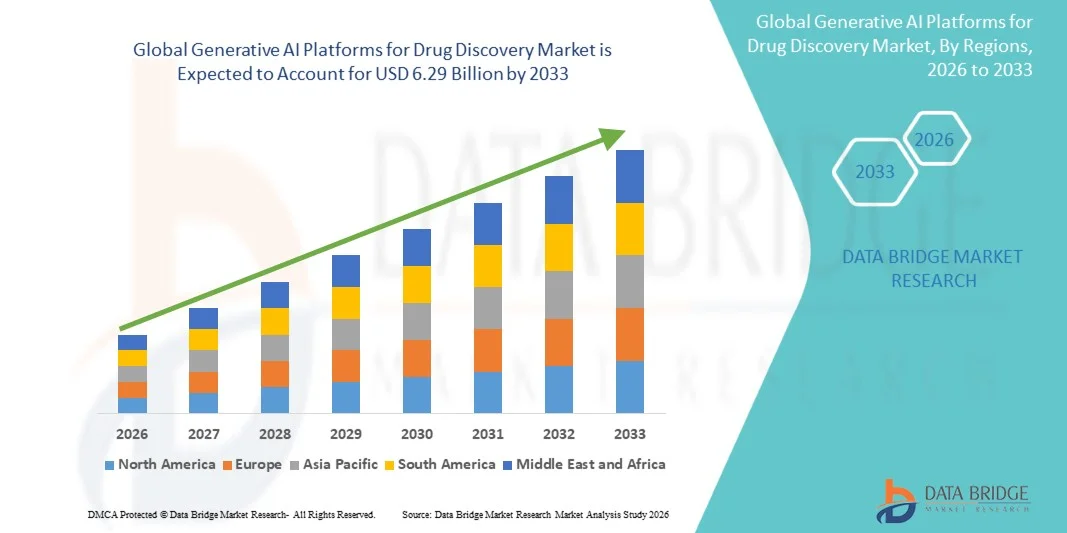
The Generative AI Platforms for Drug Discovery Market was valued at USD 1.96 billion in 2025 and is projected to reach USD 6.29 billion by 2033, growing at a CAGR of 15.70% from 2026 to 2033. The Generative AI Platforms for Drug Discovery Market is experiencing strong growth driven by increasing demand for accelerated and cost-effective drug development processes, rising adoption of AI-driven computational biology tools, and expanding applications across pharmaceutical research, biotechnology innovation, and precision medicine.
The growing complexity of disease biology, combined with the high cost and long timelines of traditional drug discovery, is pushing pharmaceutical and biotechnology companies to adopt generative AI platforms for faster target identification, molecule design, and lead optimization. These platforms leverage advanced machine learning models and large biological datasets to simulate and predict drug–target interactions with higher accuracy. In addition, increasing investments in AI-based R&D infrastructure, along with growing collaborations between AI technology providers and life science companies, is further accelerating market adoption.
Key Market Trends & Insights
- North America dominated the Generative AI Platforms for Drug Discovery Market with the largest revenue share of 44.6% in 2025, supported by strong presence of leading pharmaceutical and biotechnology companies, advanced AI/ML infrastructure, high R&D investments in drug development, and early adoption of generative AI technologies in precision medicine and molecular modeling. The region benefits from robust venture capital funding, strong regulatory innovation pathways, and increasing integration of AI-driven platforms in target identification and lead optimization workflows.
- The lead generation & optimization segment dominated the market with an estimated 38% share in 2025, owing to its widespread use in rapid virtual screening and molecule refinement.
- Asia-Pacific is expected to be the fastest-growing region at a CAGR of 24.3% from 2026 to 2033, fueled by rising investments in AI-driven healthcare innovation, expanding pharmaceutical manufacturing capabilities, growing adoption of digital drug discovery platforms, and increasing government support for AI and biotechnology integration across China, Japan, South Korea, and India.
- The pharmaceutical & biotechnology companies segment dominated the market by end user with a 58.9% share in 2025, owing to heavy investment in AI-enabled drug discovery pipelines, strong internal R&D capabilities, and strategic collaborations with AI technology providers to accelerate novel drug development and improve success rates in clinical translation.
Market Size & Forecast
- Global Market Value (2025): USD 1.96 Billion
- Expected Market Value (2033): USD 6.29 Billion
- Forecast CAGR (2026–2033): 15.70%
- Leading Region in 2025: North America
- Fastest Growing Region: Asia-Pacific
Report Scope and Generative AI Platforms for Drug Discovery Market Segmentation
|
Attributes |
Generative AI Platforms for Drug Discovery Key Market Insights |
|
Segments Covered |
|
|
Countries Covered |
North America · U.S. · Canada · Mexico Europe · Germany · France · U.K. · Netherlands · Switzerland · Belgium · Russia · Italy · Spain · Turkey · Rest of Europe Asia-Pacific · China · Japan · India · South Korea · Singapore · Malaysia · Australia · Thailand · Indonesia · Philippines · Rest of Asia-Pacific Middle East and Africa · Saudi Arabia · U.A.E. · South Africa · Egypt · Israel · Rest of Middle East and Africa South America · Brazil · Argentina · Rest of South America |
|
Key Market Players |
· Insilico Medicine (U.S.) · Recursion Pharmaceuticals (U.S.) · Exscientia plc (U.K.) · BenevolentAI (U.K.) · Atomwise Inc. (U.S.) · Schrödinger Inc. (U.S.) · CytoReason (Israel) · Isomorphic Labs (U.K.) · DeepMind (U.K.) · Valo Health (U.S.) · BioSymetrics Inc. (Canada) · XtalPi Inc. (China) · Iktos (France) · Aria Pharmaceuticals (U.S.) · Standigm Inc. (South Korea) · twoXAR Inc. (U.S.) · Enamine Ltd. (Ukraine) · Chemical.AI (China) · Owkin (France) · PathAI (U.S.) · NVIDIA Clara (U.S.) · Microsoft (U.S.) · Google DeepMind (U.K.) · Amazon Web Services (U.S.) · IBM Watson Health (U.S.) · AstraZeneca (U.K.) · Pfizer Inc. (U.S.) · Novartis AG (Switzerland) · Roche (Switzerland) · Sanofi (France) · Johnson & Johnson (U.S.) · Bristol Myers Squibb (U.S.) · GSK plc (U.K.) · Takeda Pharmaceutical Company (Japan) · Eli Lilly and Company (U.S.) · Bayer AG (Germany) |
|
Market Opportunities |
· AI-Driven Rare Disease Drug Development Expansion · Integration with Multi-Omics and Real-World Data (RWD) · AI-Enabled Drug Repurposing and Pipeline Optimization |
|
Value Added Data Infosets |
In addition to the insights on market scenarios such as market value, growth rate, segmentation, geographical coverage, and major players, the market reports curated by the Data Bridge Market Research also include in-depth expert analysis, geographically represented company-wise production and capacity, network layouts of distributors and partners, detailed and updated price trend analysis and deficit analysis of supply chain and demand. |
Generative AI Platforms for Drug Discovery Market Trends
Trend: Rapid Integration of AI-Driven Molecular Design and Drug Discovery Workflows
The Generative AI Platforms for Drug Discovery Market is witnessing strong growth as pharmaceutical and biotechnology companies increasingly adopt AI-driven models to accelerate drug design, reduce R&D costs, and improve success rates in clinical development. Generative AI enables the rapid creation and optimization of novel drug candidates by analyzing large-scale biological, chemical, and genomic datasets. In recent years, diffusion models, transformer-based architectures, and reinforcement learning techniques have significantly enhanced capabilities in de novo drug design, enabling faster identification of viable lead compounds. For instance, AI platforms are increasingly being used to generate novel small molecules with optimized binding affinity and improved pharmacokinetic properties, reducing early-stage drug discovery timelines from years to months.
Generative AI Platforms for Drug Discovery Market Dynamics
Key Market Driver: Increasing Adoption of AI for Target Identification and Lead Optimization
The rising demand for faster and more cost-efficient drug development is a major driver of the generative AI platforms market. Pharmaceutical companies are increasingly integrating AI models into target identification, molecule generation, and lead optimization workflows to improve R&D productivity and reduce failure rates in clinical trials. For instance, generative AI is being widely applied to predict protein-ligand interactions, design novel chemical structures, and optimize drug candidates with improved efficacy and safety profiles. The expansion of precision medicine and biologics development is further accelerating adoption across pharmaceutical and biotechnology firms. In addition, growing investment in AI-powered drug discovery startups and partnerships between pharma companies and AI technology providers is strengthening innovation in this space.
Key Restraint/Challenge: Data Limitations and High Computational Complexity
A major challenge for the Generative AI Platforms for Drug Discovery Market is the dependency on high-quality, structured biological and chemical datasets. Limited availability of labeled biomedical data and data privacy constraints can restrict model training accuracy and performance. In addition, the high computational cost associated with training large-scale generative AI models, including transformer-based architectures and multimodal drug discovery systems, presents a significant barrier. Integration with existing pharmaceutical R&D workflows and validation of AI-generated drug candidates through experimental and clinical processes further increases development time and cost.
Key Market Opportunity: Expansion of AI-Driven End-to-End Drug Discovery Platforms
The integration of generative AI with cloud computing, high-performance computing (HPC), and quantum-assisted modeling presents significant growth opportunities for the market. End-to-end AI-driven platforms are increasingly enabling seamless workflows from target identification to preclinical testing. Pharmaceutical companies are investing in AI-native drug discovery pipelines that combine molecular generation, toxicity prediction, and clinical trial simulation. For instance, AI models capable of generating de novo drug candidates and optimizing multi-target drug profiles are gaining traction in oncology, neurology, and rare disease research. Growing collaboration between biotech firms, academic institutions, and AI technology providers is expected to accelerate commercialization of generative AI-based drug discovery solutions across North America, Europe, and Asia-Pacific through 2033.
Bottom of Form
Generative AI Platforms for Drug Discovery Market Scope
The generative ai platforms for drug discovery market is segmented on the basis of drug discovery application type, end user type.
By Drug Discovery Application Type
On the basis of drug discovery application type, the Generative AI Platforms for Drug Discovery Market is segmented into Target Identification & Validation, Lead Generation & Optimization, De Novo Drug Design, Preclinical Prediction & Toxicity Modeling, and Clinical Trial Design & Optimization. The Lead Generation & Optimization segment dominated the market with an estimated 38% share in 2025, owing to its widespread use in rapid virtual screening and molecule refinement. This segment benefits from strong adoption of AI-driven QSAR models and structure–activity prediction tools that significantly reduce early-stage drug discovery timelines. Pharmaceutical companies increasingly rely on generative AI to accelerate hit-to-lead conversion and reduce experimental costs. Integration of cloud-based computing infrastructure and high-performance GPUs further enhances scalability of screening processes. Growing demand for oncology and rare disease therapeutics is strengthening adoption across global pharma R&D pipelines. Collaboration between biotech firms and AI technology providers is also accelerating innovation in this segment. Continuous improvements in predictive accuracy and molecular docking simulations are improving success rates. Overall, this segment remains the backbone of early-stage drug discovery workflows. It is expected to grow at a CAGR of approximately 22–28% from 2026 to 2033. Rising investment in computational drug discovery is further reinforcing its dominance. Increasing automation in screening processes is reducing dependency on wet-lab experimentation.
The De Novo Drug Design segment is projected to register the fastest growth with a CAGR of approximately 28–35% from 2026 to 2033, driven by advancements in generative deep learning models and diffusion-based AI architectures. This segment enables the creation of entirely novel molecular structures without relying on existing compound libraries. Pharmaceutical companies are increasingly adopting this approach to discover first-in-class drugs with improved specificity and safety profiles. Reinforcement learning techniques are being used to optimize binding affinity and molecular stability. Expanding use of multi-omics data integration is improving biological relevance of AI-generated compounds. Rapid growth in cloud-based AI infrastructure is supporting large-scale molecule generation. Biotech startups and academic collaborations are significantly contributing to innovation in this segment. Rising demand for precision medicine is accelerating adoption of de novo drug discovery platforms. Increasing computational power is enabling faster molecular simulation cycles. The segment currently holds an estimated 15–20% share in 2025 but is expanding rapidly due to disruptive innovation. Regulatory interest in AI-generated drug candidates is also increasing globally. Continuous algorithm improvements are expected to further enhance molecular novelty and accuracy.
By End User Type
On the basis of end user type, the Generative AI Platforms for Drug Discovery Market is segmented into Pharmaceutical & Biotechnology Companies, Contract Research Organizations (CROs), Academic & Research Institutes, and Healthcare & Precision Medicine Companies. The Pharmaceutical & Biotechnology Companies segment dominated the market with an estimated 52% share in 2025, driven by high R&D expenditure and large-scale integration of AI in drug discovery pipelines. These companies are actively deploying generative AI for target identification, lead optimization, and molecular design applications. Strong computational infrastructure and access to large proprietary datasets support advanced AI model training. Strategic partnerships with AI technology providers are accelerating adoption across global pharma leaders. Increasing pressure to reduce drug development timelines is a key growth driver. AI-enabled platforms are improving prediction accuracy in preclinical and clinical research stages. Companies are also investing in internal AI research labs and digital transformation initiatives. Expansion of precision medicine programs is further strengthening adoption. Regulatory compliance capabilities make large pharma firms early adopters of advanced technologies. AI is increasingly used for drug repurposing and multi-target optimization. Continuous pipeline optimization is improving clinical success rates. This segment is expected to grow at a CAGR of approximately 20–26% from 2026 to 2033.
The Contract Research Organizations (CROs) segment is projected to register the fastest growth with a CAGR of approximately 26–32% from 2026 to 2033, driven by rising outsourcing of drug discovery and clinical development activities. CROs are increasingly adopting generative AI to offer faster, scalable, and cost-efficient research services. These organizations provide AI-powered virtual screening, toxicity prediction, and lead optimization solutions. Growing demand from small and mid-sized biotech companies is boosting CRO expansion. Cloud-based AI platforms enable global service delivery without heavy infrastructure investment. Partnerships between CROs and AI startups are accelerating technology adoption. Increasing complexity of drug development is encouraging outsourcing trends worldwide. AI integration is improving throughput and reducing dependency on physical lab experiments. CROs are also leveraging AI to enhance predictive modeling accuracy. Regulatory outsourcing trends are strengthening CRO service portfolios. Flexible operational models make CROs highly adaptable to emerging technologies. This segment is becoming a key enabler of AI-driven drug discovery democratization globally.
Generative AI Platforms for Drug Discovery Market Regional Analysis
North America dominated the generative AI platforms for drug discovery market and accounted for the largest revenue share of 44.6% in 2025, supported by the strong presence of leading pharmaceutical and biotechnology companies, advanced AI/ML infrastructure, and high R&D investments in drug development. The region benefits from early adoption of generative AI technologies in precision medicine and molecular modeling, along with robust venture capital funding, supportive regulatory innovation pathways, and increasing integration of AI-driven platforms across target identification and lead optimization workflows. These factors collectively reinforce North America’s leadership in accelerating AI-enabled drug discovery innovation.
U.S. Generative AI Platforms for Drug Discovery Market Insight
The U.S. generative AI platforms for drug discovery market is witnessing strong growth due to the dominance of global pharmaceutical companies, rapid adoption of AI-based drug design tools, and significant investments in digital R&D infrastructure. The country’s strong ecosystem of biotech startups, cloud computing providers, and research institutions is enabling widespread use of generative AI in lead discovery, molecular simulation, and preclinical modeling. Increasing focus on precision medicine and faster drug development timelines continues to drive market expansion.
Europe Generative AI Platforms for Drug Discovery Market Insight
The Europe generative AI platforms for drug discovery market remains a key contributor to global revenue, supported by strong pharmaceutical research networks, advanced academic institutions, and increasing adoption of AI-enabled drug discovery technologies. The region is witnessing growing collaboration between biotech firms, universities, and technology providers to accelerate molecule discovery and optimize drug development pipelines. Favorable regulatory frameworks and strong emphasis on innovation-driven healthcare are further supporting market growth.
U.K. Generative AI Platforms for Drug Discovery Market Insight
The U.K. generative AI platforms for Drug Discovery market is expanding steadily, driven by strong biotechnology clusters, rising investment in AI-driven life sciences research, and increasing use of computational drug discovery platforms. Academic institutions and biotech startups are actively leveraging generative AI for target identification, molecular screening, and drug optimization, supported by government-backed innovation programs and industry collaborations.
Germany Generative AI Platforms for Drug Discovery Market Insight
The Germany generative AI platforms for drug discovery market is growing steadily due to strong pharmaceutical manufacturing capabilities, advanced chemical and biomedical research infrastructure, and increasing adoption of AI-powered drug discovery platforms. German research institutes and biotech companies are using generative AI for molecular modeling, toxicity prediction, and lead optimization, supported by ongoing investments in digital healthcare and life sciences innovation.
Asia-Pacific Generative AI Platforms for Drug Discovery Market Insight
The Asia-Pacific generative AI platforms for drug discovery market is expected to be the fastest-growing region at a CAGR of 24.3% from 2026 to 2033, fueled by rising investments in AI-driven healthcare innovation, expanding pharmaceutical manufacturing capabilities, and increasing adoption of digital drug discovery platforms. Growth is further supported by strong government initiatives promoting AI and biotechnology integration across China, Japan, South Korea, and India, along with rising collaborations between pharmaceutical companies, research institutes, and technology providers.
Japan Generative AI Platforms for Drug Discovery Market Insight
The Japan generative AI platforms for drug discovery market is witnessing steady growth due to strong pharmaceutical research capabilities, increasing adoption of AI in biomedical innovation, and rising focus on precision medicine. Japanese companies and academic institutes are leveraging generative AI for molecular design, biomarker identification, and drug screening, supported by national initiatives promoting digital transformation in healthcare.
China Generative AI Platforms for Drug Discovery Market Insight
The China Generative AI Platforms for Drug Discovery market is expanding rapidly due to strong government support for AI and biotech integration, increasing pharmaceutical R&D investments, and growing adoption of digital drug discovery platforms. Chinese biotech firms are increasingly using generative AI for target identification, lead optimization, and molecular modeling, supported by a rapidly scaling innovation ecosystem and expanding healthcare demand.
Generative AI Platforms for Drug Discovery Market Share
The Generative AI Platforms for Drug Discovery industry is primarily led by well-established companies, including:
- Insilico Medicine (U.S.)
- Recursion Pharmaceuticals (U.S.)
- Exscientia plc (U.K.)
- BenevolentAI (U.K.)
- Atomwise Inc. (U.S.)
- Schrödinger Inc. (U.S.)
- CytoReason (Israel)
- Isomorphic Labs (U.K.)
- DeepMind (U.K.)
- Valo Health (U.S.)
- BioSymetrics Inc. (Canada)
- XtalPi Inc. (China)
- Iktos (France)
- Aria Pharmaceuticals (U.S.)
- Standigm Inc. (South Korea)
- twoXAR Inc. (U.S.)
- Enamine Ltd. (Ukraine)
- AI (China)
- Owkin (France)
- PathAI (U.S.)
- NVIDIA Clara (U.S.)
- Microsoft (U.S.)
- Google DeepMind (U.K.)
- Amazon Web Services (U.S.)
- IBM Watson Health (U.S.)
- AstraZeneca (U.K.)
- Pfizer Inc. (U.S.)
- Novartis AG (Switzerland)
- Roche (Switzerland)
- Sanofi (France)
- Johnson & Johnson (U.S.)
- Bristol Myers Squibb (U.S.)
- GSK plc (U.K.)
- Takeda Pharmaceutical Company (Japan)
- Eli Lilly and Company (U.S.)
- Bayer AG (Germany)
Latest Developments in Generative AI Platforms for Drug Discovery Market
- In March 2021, Insilico Medicine advanced its Chemistry42 generative AI platform for de novo drug design, enabling AI-based generation and optimization of novel drug molecules. The platform integrated deep learning and reinforcement learning techniques to accelerate target identification, molecular design, and early-stage drug discovery workflows. It improved the efficiency of lead discovery by reducing dependence on traditional screening methods. The development strengthened adoption of AI-driven drug discovery platforms across biotechnology and pharmaceutical research
- In July 2022, Exscientia expanded its AI-driven drug discovery platform through collaborations with pharmaceutical companies to accelerate molecule design and optimization. The platform used machine learning models to improve drug candidate selection, molecular property prediction, and development efficiency. The advancement supported faster design-make-test cycles and increased adoption of AI-based approaches in pharmaceutical R&D pipelines
- In September 2023, Recursion Pharmaceuticals enhanced its AI-powered drug discovery platform by integrating large-scale biological datasets with machine learning models. The platform supported target identification, compound screening, and therapeutic candidate optimization. The development strengthened partnerships with pharmaceutical companies and highlighted the growing use of AI-driven approaches for accelerating drug discovery processes
- In May 2024, Insilico Medicine announced further progress of its Pharma.AI platform, supporting advancement of AI-designed drug candidates into preclinical and clinical development stages. The platform combined generative AI, biological data analysis, and molecular modeling to improve drug candidate discovery. This development demonstrated increasing commercialization of AI-generated therapeutics and adoption of AI platforms by global pharmaceutical companies
- In November 2025, Eli Lilly expanded its collaboration with Insilico Medicine to leverage generative AI technology for drug discovery and development. The partnership focused on using AI platforms for target identification, molecule generation, and lead optimization across therapeutic areas. The collaboration highlighted growing investment in AI-driven drug discovery and reinforced the role of generative AI platforms in future pharmaceutical innovation

- Interactive Data Analysis Dashboard
- Company Analysis Dashboard for high growth potential opportunities
- Research Analyst Access for customization & queries
- Competitor Analysis with Interactive dashboard
- Latest News, Updates & Trend analysis
- Harness the Power of Benchmark Analysis for Comprehensive Competitor Tracking
Data collection and base year analysis are done using data collection modules with large sample sizes. The stage includes obtaining market information or related data through various sources and strategies. It includes examining and planning all the data acquired from the past in advance. It likewise envelops the examination of information inconsistencies seen across different information sources. The market data is analysed and estimated using market statistical and coherent models. Also, market share analysis and key trend analysis are the major success factors in the market report. To know more, please request an analyst call or drop down your inquiry.
The key research methodology used by DBMR research team is data triangulation which involves data mining, analysis of the impact of data variables on the market and primary (industry expert) validation. Data models include Vendor Positioning Grid, Market Time Line Analysis, Market Overview and Guide, Company Positioning Grid, Patent Analysis, Pricing Analysis, Company Market Share Analysis, Standards of Measurement, Global versus Regional and Vendor Share Analysis. To know more about the research methodology, drop in an inquiry to speak to our industry experts.
Data Bridge Market Research is a leader in advanced formative research. We take pride in servicing our existing and new customers with data and analysis that match and suits their goal. The report can be customized to include price trend analysis of target brands understanding the market for additional countries (ask for the list of countries), clinical trial results data, literature review, refurbished market and product base analysis. Market analysis of target competitors can be analyzed from technology-based analysis to market portfolio strategies. We can add as many competitors that you require data about in the format and data style you are looking for. Our team of analysts can also provide you data in crude raw excel files pivot tables (Fact book) or can assist you in creating presentations from the data sets available in the report.












