What is the Genetically Modified (GMO) Seeds Market Size and Growth Rate?
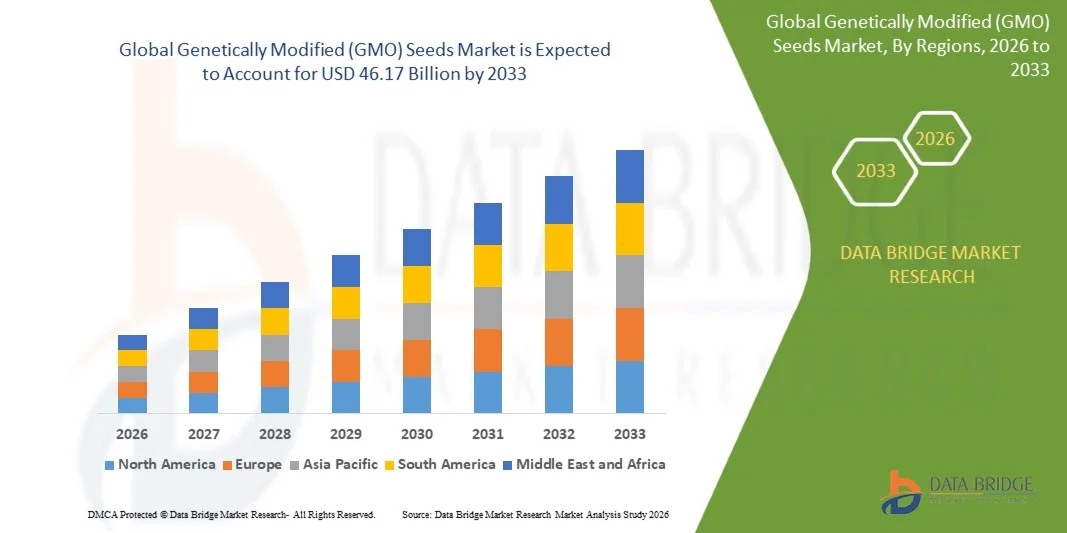
- As per Data Bridge Market Research analysis the genetically modified (GMO) seeds market was valued at USD 25.70 billion in 2025 and is projected to reach USD 46.17 billion by 2033, growing at a CAGR of 7.60% from 2026 to 2033.
- The market is experiencing steady growth driven by increasing demand for high-yield and pest-resistant crop varieties, rapid advancements in agricultural biotechnology, and expanding adoption of genetically modified seeds across commercial farming operations worldwide.
- The rising global food demand, coupled with increasing pressure to improve agricultural productivity, enhance crop resilience against pests and climate variability, and reduce crop losses, is encouraging farmers to adopt genetically modified seeds for sustainable and efficient crop production.
Market Size & Forecast
- Market Value (2025): USD 25.70 Billion
- Expected Market Value (2033): USD 46.17 Billion
- Forecast CAGR (2026–2033): 7.60%
- Leading Region in 2025: North America
- Fastest Growing Region: Asia-Pacific
What are the Major Takeaways of the Genetically Modified (GMO) Seeds Market?
- North America dominated the genetically modified (GMO) seeds market in 2025, supported by widespread adoption of advanced agricultural biotechnology, large-scale commercial farming, and strong demand for high-yield crop varieties.
- Asia-Pacific genetically modified (GMO) seeds market is expected to witness the fastest growth rate from 2026 to 2033, supported by increasing food demand, expanding agricultural production, and growing adoption of modern farming technologies across China, India, Australia, and Southeast Asia.
- The corn segment held the largest market revenue share in 2025 driven by its widespread cultivation, high adoption of genetically modified hybrids, and increasing demand for improved yield, insect resistance, and herbicide tolerance. GMO corn seeds are widely preferred due to their ability to enhance productivity while reducing crop losses and input costs.
- The soybean segment is projected to register the fastest growth from 2026 to 2033, driven by increasing global demand for animal feed, edible oil, and biofuel production. Rising adoption of herbicide-tolerant and high-yield soybean varieties is accelerating segment expansion.
- The herbicide tolerance segment held the largest market revenue share in 2025 driven by its extensive adoption across major row crops and its ability to improve weed management while reducing labor and production costs. Farmers increasingly prefer herbicide-tolerant seeds for efficient crop management and improved operational productivity.
- The insect resistance segment is projected to register the fastest growth from 2026 to 2033, driven by increasing demand for sustainable pest control solutions and reduced dependence on chemical insecticides. Growing adoption of advanced stacked-trait technologies is further accelerating segment expansion.
Report Scope and Genetically Modified (GMO) Seeds Market Segmentation
|
Attributes |
Genetically Modified (GMO) Seeds Key Market Insights |
|
Segments Covered |
|
|
Countries Covered |
North America
Europe
Asia-Pacific
Middle East and Africa
South America
|
|
Key Market Players |
|
|
Market Opportunities |
|
|
Value Added Data Infosets |
In addition to the insights on market scenarios such as market value, growth rate, segmentation, geographical coverage, and major players, the market reports curated by the Data Bridge Market Research also include import export analysis, production capacity overview, production consumption analysis, price trend analysis, climate change scenario, supply chain analysis, value chain analysis, raw material/consumables overview, vendor selection criteria, PESTLE Analysis, Porter Analysis, and regulatory framework. |
What is the Key Trend in the Genetically Modified (GMO) Seeds Market?
- Agricultural biotechnology companies are increasingly developing genetically modified seed varieties with multiple stacked traits that provide enhanced insect resistance, herbicide tolerance, and improved resilience to climate-related stresses, enabling farmers to achieve higher productivity with sustainable farming practices.
- For instance, in February 2025, Bayer announced advancements in its DEKALB and Asgrow seed portfolios by expanding biotechnology innovations and digital farming solutions designed to improve crop performance and sustainability across major agricultural markets.
- Seed developers are investing heavily in next-generation biotechnology, precision breeding, and digital agriculture platforms to improve crop yields while reducing pesticide use and optimizing farm productivity.
- For instance, in March 2025, Corteva Agriscience continued expanding its advanced seed trait technologies and gene-editing research to deliver improved corn and soybean varieties with enhanced productivity and environmental resilience.
- As global agriculture increasingly focuses on food security, climate resilience, and sustainable crop production, the adoption of genetically modified seeds is expected to accelerate, reinforcing biotechnology as a key trend across modern farming systems.
What are the Key Drivers of the Genetically Modified (GMO) Seeds Market?
- The growing global demand for higher agricultural productivity, improved crop resistance to pests and diseases, and enhanced tolerance to changing climatic conditions has significantly increased the adoption of genetically modified seeds worldwide.
- For instance, in August 2024, Bayer expanded the commercialization of its Short Stature Corn technology, designed to improve crop resilience, reduce lodging, and support higher productivity for growers.
- Agricultural biotechnology companies are continuously investing in advanced genetic traits, seed innovation, and digital farming technologies to help farmers maximize yields while improving resource efficiency and reducing production risks.
- For instance, in 2024, Corteva Agriscience continued expanding its Enlist E3 soybean and advanced corn trait portfolios to provide growers with enhanced weed management and higher yield potential across major agricultural regions.
- With increasing pressure to improve food production while minimizing environmental impact, genetically modified seeds are expected to remain essential for sustainable agriculture and long-term global food security.
Which Factors are Challenging the Growth of the Genetically Modified (GMO) Seeds Market?
- Genetically modified seeds continue to face stringent regulatory approval processes, varying government policies, and public concerns regarding biotechnology adoption across several countries.
- Lengthy product approvals, high research and development costs, and complex biosafety compliance requirements increase commercialization timelines and investment risks for biotechnology companies.
- For instance, in 2024, Bayer highlighted the importance of science-based regulatory frameworks and continued engagement with governments to accelerate innovation and commercialization of advanced biotechnology traits.
- Regulatory uncertainties, evolving labeling requirements, and varying public acceptance continue to challenge the widespread adoption of genetically modified seeds, particularly in regions with restrictive biotechnology policies, despite increasing global demand for high-yield and climate-resilient crop varieties.
How is the Genetically Modified (GMO) Seeds Market Segmented?
The market is segmented on the basis of product, trait, application, and sales channel.
- By Product
On the basis of product, the genetically modified (GMO) seeds market is segmented into corn, soybean, cotton, canola, potato, sugar beets, zucchini, alfalfa, papaya, apple, and other products. The corn segment held the largest market revenue share in 2025 driven by its widespread cultivation, high adoption of genetically modified hybrids, and increasing demand for improved yield, insect resistance, and herbicide tolerance. GMO corn seeds are widely preferred due to their ability to enhance productivity while reducing crop losses and input costs.
The soybean segment is projected to register the fastest growth from 2026 to 2033, driven by increasing global demand for animal feed, edible oil, and biofuel production. Rising adoption of herbicide-tolerant and high-yield soybean varieties is accelerating segment expansion.
- By Trait
On the basis of trait, the genetically modified (GMO) seeds market is segmented into herbicide tolerance and insect resistance. The herbicide tolerance segment held the largest market revenue share in 2025 driven by its extensive adoption across major row crops and its ability to improve weed management while reducing labor and production costs. Farmers increasingly prefer herbicide-tolerant seeds for efficient crop management and improved operational productivity.
The insect resistance segment is projected to register the fastest growth from 2026 to 2033, driven by increasing demand for sustainable pest control solutions and reduced dependence on chemical insecticides. Growing adoption of advanced stacked-trait technologies is further accelerating segment expansion.
- By Application
On the basis of application, the genetically modified (GMO) seeds market is segmented into oilseed seeds and cereals/grain seeds. The cereals/grain seeds segment held the largest market revenue share in 2025 driven by extensive cultivation of corn and other cereal crops across major agricultural regions. Increasing demand for higher crop productivity and climate-resilient seed varieties continues to support segment growth.
The oilseed seeds segment is projected to register the fastest growth from 2026 to 2033, driven by rising global demand for soybean and canola products, expanding biofuel production, and increasing adoption of genetically modified oilseed crops with enhanced agronomic traits.
- By Sales Channel
On the basis of sales channel, the genetically modified (GMO) seeds market is segmented into direct sales, modern trade, e-retailers, and other retail outlets. The direct sales segment held the largest market revenue share in 2025 driven by strong relationships between seed manufacturers and commercial growers, customized agronomic support, and reliable product availability. Direct distribution enables companies to provide technical guidance and improve customer engagement.
The e-retailers segment is projected to register the fastest growth from 2026 to 2033, driven by increasing digitalization of agricultural input sales, expanding internet penetration in rural areas, and growing farmer preference for convenient online purchasing platforms.
Which Region Holds the Largest Share of the Genetically Modified (GMO) Seeds Market?
- North America dominated the genetically modified (GMO) seeds market in 2025, supported by widespread adoption of advanced agricultural biotechnology, large-scale commercial farming, and strong demand for high-yield crop varieties.
- Farmers across the region increasingly utilize genetically modified seeds to improve crop productivity, enhance pest resistance, and optimize weed management. This widespread adoption is further supported by advanced farming practices, favorable regulatory approvals, and the strong presence of leading seed technology companies.
U.S. Genetically Modified (GMO) Seeds Market Insight
The U.S. genetically modified (GMO) seeds market captured the largest share within North America in 2025, fueled by the extensive cultivation of genetically modified corn, soybean, cotton, and canola crops. Farmers are increasingly prioritizing high-performance seed varieties that provide improved herbicide tolerance, insect resistance, and higher yields. The growing adoption of precision agriculture technologies and continuous innovation in biotechnology are further contributing to market expansion across the country.
Europe Genetically Modified (GMO) Seeds Market Insight
Europe genetically modified (GMO) seeds market is expected to witness the fastest growth rate from 2026 to 2033, primarily driven by increasing investments in agricultural biotechnology research, rising focus on sustainable farming, and growing demand for climate-resilient crop varieties. Expanding research activities and advancements in plant breeding technologies are supporting market development across the region where regulatory frameworks permit cultivation.
U.K. Genetically Modified (GMO) Seeds Market Insight
U.K. genetically modified (GMO) seeds market is expected to witness the fastest growth rate from 2026 to 2033, driven by increasing investments in agricultural innovation and supportive developments in crop biotechnology research. Rising focus on improving food security, enhancing crop productivity, and adopting advanced breeding technologies is expected to continue stimulating market growth.
Germany Genetically Modified (GMO) Seeds Market Insight
Germany genetically modified (GMO) seeds market is expected to witness the fastest growth rate from 2026 to 2033, fueled by increasing research activities in agricultural biotechnology and growing emphasis on sustainable crop production. The country's strong scientific infrastructure and focus on innovation continue to support advancements in seed technologies and precision agriculture applications.
Asia-Pacific Genetically Modified (GMO) Seeds Market Insight
The Asia-Pacific genetically modified (GMO) seeds market is expected to witness the fastest growth rate from 2026 to 2033, supported by increasing food demand, expanding agricultural production, and growing adoption of modern farming technologies across China, India, Australia, and Southeast Asia. Rising investments in biotechnology research and government initiatives aimed at improving agricultural productivity are further driving market growth across the region.
Japan Genetically Modified (GMO) Seeds Market Insight
Japan genetically modified (GMO) seeds market is expected to witness the fastest growth rate from 2026 to 2033 due to increasing investments in agricultural biotechnology research, precision farming, and sustainable crop production. Growing emphasis on food security and innovation in advanced breeding technologies is encouraging the adoption of improved seed technologies across the agricultural sector.
China Genetically Modified (GMO) Seeds Market Insight
The China genetically modified (GMO) seeds market accounted for the largest market share in Asia-Pacific in 2025, attributed to expanding agricultural modernization, increasing government support for biotechnology innovation, and rising demand for high-yield crop varieties. The country's continued investment in agricultural research, seed development, and advanced farming practices continues to drive the adoption of genetically modified seeds across major crop-growing regions.
Which are the Top Companies in Genetically Modified (GMO) Seeds Market?
The genetically modified (GMO) seeds industry is primarily led by well-established companies, including:
- Bayer AG (Germany)
- Corteva, Inc. (U.S.)
- BASF SE (Germany)
- Syngenta Crop Protection AG (Switzerland)
- KWS SAAT SE & Co. KGaA (Germany)
- Limagrain (France)
- Nufarm Limited (Australia)
- Land O'Lakes, Inc. (U.S.)
- Stine Seed Company (U.S.)
- JK Agri Genetics Limited (India)
- Mahyco Pvt. Ltd. (India)
- Calyxt, Inc. (U.S.)
- J.R. Simplot Company (U.S.)
- CANTERRA SEEDS Ltd. (Canada)
- Sakata Seed America, Inc. (U.S.)
What are Latest Developments in Genetically Modified (GMO) Seeds Market?
- In May 2026, Bayer AG entered into a strategic alliance with bp to scale the production of NewGold camelina as an intermediate oilseed crop for renewable diesel and sustainable aviation fuel across North America. The collaboration strengthens Bayer's biotechnology and seed portfolio while expanding sustainable feedstock production, supporting the adoption of advanced genetically modified crops and creating new growth opportunities for the GMO seeds market.
- In May 2026, Corteva, Inc. announced the launch of Vylor, Inc. as its independent seed and genetics business through a planned spin-off. The new company will leverage an extensive portfolio of germplasm and biotechnology patents to accelerate innovation in hybrid wheat, disease-resistant corn, gene editing, and biofuel crop traits, strengthening innovation and competitiveness in the global GMO seeds market.
- In March 2026, BASF SE announced an investment of CAD 27 million to expand its Canola Breeding Center of Innovation in Saskatoon, Canada. The expansion introduces advanced automation and precision-controlled breeding technologies to accelerate genomic selection and shorten hybrid canola development cycles, enhancing seed innovation and supporting the commercialization of next-generation genetically modified crop varieties.

- Interactive Data Analysis Dashboard
- Company Analysis Dashboard for high growth potential opportunities
- Research Analyst Access for customization & queries
- Competitor Analysis with Interactive dashboard
- Latest News, Updates & Trend analysis
- Harness the Power of Benchmark Analysis for Comprehensive Competitor Tracking
Data collection and base year analysis are done using data collection modules with large sample sizes. The stage includes obtaining market information or related data through various sources and strategies. It includes examining and planning all the data acquired from the past in advance. It likewise envelops the examination of information inconsistencies seen across different information sources. The market data is analysed and estimated using market statistical and coherent models. Also, market share analysis and key trend analysis are the major success factors in the market report. To know more, please request an analyst call or drop down your inquiry.
The key research methodology used by DBMR research team is data triangulation which involves data mining, analysis of the impact of data variables on the market and primary (industry expert) validation. Data models include Vendor Positioning Grid, Market Time Line Analysis, Market Overview and Guide, Company Positioning Grid, Patent Analysis, Pricing Analysis, Company Market Share Analysis, Standards of Measurement, Global versus Regional and Vendor Share Analysis. To know more about the research methodology, drop in an inquiry to speak to our industry experts.
Data Bridge Market Research is a leader in advanced formative research. We take pride in servicing our existing and new customers with data and analysis that match and suits their goal. The report can be customized to include price trend analysis of target brands understanding the market for additional countries (ask for the list of countries), clinical trial results data, literature review, refurbished market and product base analysis. Market analysis of target competitors can be analyzed from technology-based analysis to market portfolio strategies. We can add as many competitors that you require data about in the format and data style you are looking for. Our team of analysts can also provide you data in crude raw excel files pivot tables (Fact book) or can assist you in creating presentations from the data sets available in the report.