


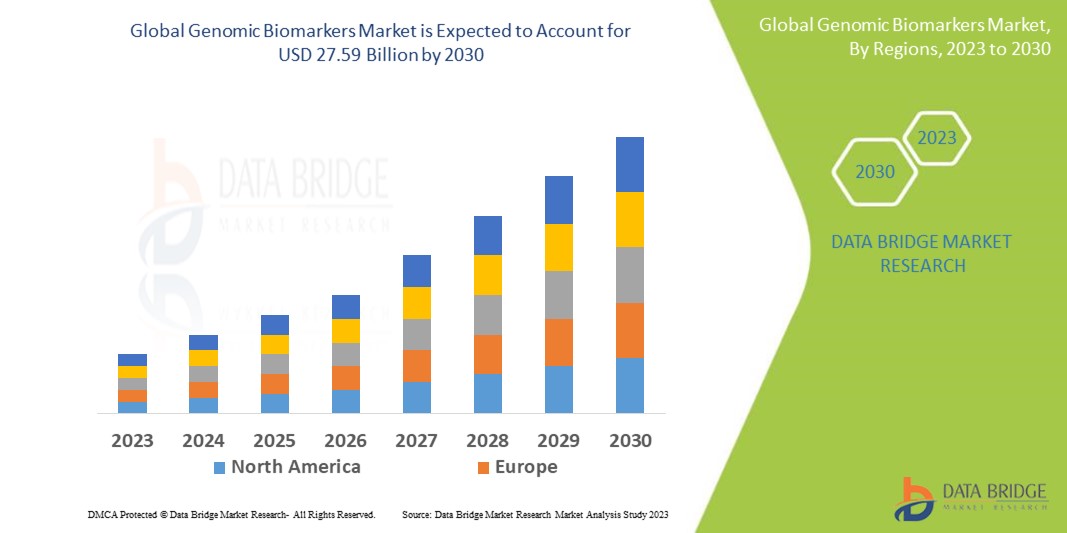
Genomic Biomarkers Market Analysis and Size
By 2040, there will be 27.5 million more cancer cases worldwide, according to the International Agency for Research on Cancer (IRAC). The causes of the increasing capacity include smoking, leading an unhealthy lifestyle, and not getting enough exercise. The burden is anticipated to increase beyond IRAC's prediction, offering more opportunities for specialized treatments. Biopharmaceutical companies are likely to prioritize the expansion of their oncology product lines, which is expected to boost this market's growth during the forecast period.
Data Bridge Market Research analyses that the genomic biomarkers market, which is USD 7.59 billion in 2022, is expected to reach USD 27.59 billion by 2030, at a CAGR of 17.5% from 2023 to 2030. In addition to the insights on market scenarios such as market value, growth rate, segmentation, geographical coverage, and major players, the market reports curated by the Data Bridge Market Research also include depth expert analysis, patient epidemiology, pipeline analysis, pricing analysis, and regulatory framework.
Genomic Biomarkers Market Scope and Segmentation
|
Report Metric |
Details |
|
Forecast Period |
2023 to 2030 |
|
Base Year |
2022 |
|
Historic Years |
2021 (Customizable to 2015 - 2020) |
|
Quantitative Units |
Revenue in USD Million, Volumes in Units, Pricing in USD |
|
Segments Covered |
Type (Predictive Biomarkers, Prognostic Biomarkers), Disease Indication (Oncology, Cardiovascular Diseases, Neurological Diseases, Renal Disorders, Others), Validation (Analytical Validation, Clinical Validation, Clinical Utility), End-User (Diagnostic and Research Laboratories, Hospitals, Others) |
|
Countries Covered |
U.S., Canada and Mexico in North America, Germany, France, U.K., Netherlands, Switzerland, Belgium, Russia, Italy, Spain, Turkey, Rest of Europe in Europe, China, Japan, India, South Korea, Singapore, Malaysia, Australia, Thailand, Indonesia, Philippines, Rest of Asia-Pacific (APAC) in the Asia-Pacific (APAC), Saudi Arabia, U.A.E, South Africa, Egypt, Israel, Rest of Middle East and Africa (MEA) as a part of Middle East and Africa (MEA), Brazil, Argentina and Rest of South America as part of South America |
|
Market Players Covered |
Thermo Fisher Scientific (U.S.), F. Hoffmann-La Roche Ltd (Switzerland), Myriad Genetics, Inc (U.S.), Eurofins Scientific (Luxembourg), QIAGEN (Germany), Bio-Rad Laboratories, Inc. (U.S.), MedGenome (India), Almac Group (U.K.), Sema4 (U.S.), GENOME LIFE SCIENCES (India), Creative Diagnostics (U.S.), FOUNDATION MEDICINE, INC. (U.S.) and Quanterix (U.S.) |
|
Market Opportunities |
|
Market Definition
Genomic biomarkers are DNA and RNA traits used as diagnostic indicators, disease characterization, and therapy selection tools. The body's response to treatment as well as pathological and physiological processes, are all represented by genomic biomarkers. Testing for genomic biomarkers can find molecular changes in a single gene, a group of genes, or a whole genome. A relationship between a genetic biomarker and the likelihood of developing a disease may or may not have strong supporting data. Functional laboratory evaluations and genetic epidemiology evidence are two variables that contribute to the clinical validity and usability of genomic biomarkers.
Genomic Biomarkers Market Dynamics
Drivers
- The rising number of patients with neurological diseases will propel the market growth
Genomics technology advancement and ongoing laboratory test development have improved the market situation. The Alzheimer's Society estimates that 5.8 million Americans over 50 will have Alzheimer's dementia in 2019, and this is expected to rise to 14 million by the year 2050. Hence, there is an urgent demand for genetic biomarkers that might support market expansion globally due to the rising number of patients with neurological diseases.
- Increased government healthcare spending will drive the market growth
The market is anticipated to grow due to factors such as the growing availability of genetic biomarkers in hospitals, increased government healthcare spending, and various hospital initiatives that treat chronic diseases. For instance, according to the Centers for Medicare & Medicaid Services (CMS), national health spending in the United States is expected to reach over USD 6.0 trillion by 2027 after increasing by an average of 5.5% year between 2018 and 2027. As a result, this component will be essential in expanding the genomic biomarkers market.
Opportunities
- The rising demand for genetic biomarkers will propel the market growth
The increased adoption of new technical innovations and modernization ideas in healthcare infrastructure encourages market expansion. In addition to these aspects, companion diagnostics and biomarkers have also gained significant importance in medical practice, ultimately promoting improved disease-specific diagnosis, therapy, and intensive care. As a result, genetic biomarkers are now in high demand from pharmaceutical companies and healthcare providers, greatly impacting the global market's expansion. Moreover, the market is anticipated to increase favorably due to the rising need for genetic biomarkers in prostate cancer.
Restraints/Challenges
- The inability to establish an adequate predictive value for the diagnosis of colon cancer will hinder the market growth
A few issues with the use and analysis of genetic biomarkers are anticipated to limit market expansion during the forecast period. According to an article released by the Intestinal Journal in November 2019, genomic biomarkers, such as miRNA found in stool samples, cannot be used as a stand-alone diagnostic tool for the detection of colon cancer.
This genomic biomarkers market report provides details of new recent developments, trade regulations, import-export analysis, production analysis, value chain optimization, market share, impact of domestic and localized market players, analyses opportunities in terms of emerging revenue pockets, changes in market regulations, strategic market growth analysis, market size, category market growths, application niches and dominance, product approvals, product launches, geographic expansions, technological innovations in the market. To gain more info on the genomic biomarkers market contact Data Bridge Market Research for an Analyst Brief, our team will help you take an informed market decision to achieve market growth.
Recent Developments
- In 2020, Clinical Genomics Delivery in everyday healthcare was completed under Color Genomics' U.S. program, the company announced in collaboration with NorthShore University Health System. Also, the business supported Sanford's Imagenetics genomes program, which will improve clinical judgment. This project is also to blame for the region's widespread use of genetic biomarkers.
- In 2020, Gilead Sciences, Inc. and Second Genome announced their four-year strategic partnership to find new potential targets and therapeutic candidates for treating IBD and identify biomarkers linked to clinical response (inflammatory bowel disease).
Global Genomic Biomarkers Market Scope
The genomic biomarkers market is segmented on the basis of type, disease indication, validation, and end-user. The growth amongst these segments will help you analyze meagre growth segments in the industries and provide the users with a valuable market overview and market insights to help them make strategic decisions for identifying core market applications.
Type
- Predictive Biomarkers
- Prognostic Biomarkers
Disease Indication
- Oncology
- Cardiovascular Diseases
- Neurological Diseases
- Renal Disorders
- Others
Validation
- Analytical Validation
- Clinical Validation
- Clinical Utility
End- User
- Diagnostic
- Research Laboratories
- Hospitals
- Others
Genomic Biomarkers Market Regional Analysis/Insights
The genomic biomarkers market is analysed and market size insights and trends are provided by country, type, disease indication, validation, and end-user as referenced above.
The countries covered in the genomic biomarkers market report are U.S., Canada and Mexico in North America, Germany, France, U.K., Netherlands, Switzerland, Belgium, Russia, Italy, Spain, Turkey, Rest of Europe in Europe, China, Japan, India, South Korea, Singapore, Malaysia, Australia, Thailand, Indonesia, Philippines, Rest of Asia-Pacific (APAC) in the Asia-Pacific (APAC), Saudi Arabia, U.A.E, South Africa, Egypt, Israel, Rest of Middle East and Africa (MEA) as a part of Middle East and Africa (MEA), Brazil, Argentina and Rest of South America as part of South America.
North America dominates the genomic biomarkers market because of the rise in genetic biomarkers for early disease diagnosis. For instance, Color Genomics, in partnership with North Shore University Health System, declared in January 2020 that the U.S. program's adoption of clinical genetics in routine healthcare had been completed.
Asia-Pacific is expected to grow at the highest growth rate in the forecast period of 2023 to 2030, owing to the expansion of healthcare infrastructure initiatives in the Asian economy and the abundance of extremely cutting-edge research facilities in developing countries such as China, India, and Japan. For instance, The Genome Asia 100K Project sequencing (WGS) project makes genetic discoveries possible throughout the Asian economy.
The country section of the report also provides individual market impacting factors and changes in regulation in the market domestically that impacts the current and future trends of the market. Data points like down-stream and upstream value chain analysis, technical trends and porter's five forces analysis, case studies are some of the pointers used to forecast the market scenario for individual countries. Also, the presence and availability of global brands and their challenges faced due to large or scarce competition from local and domestic brands, impact of domestic tariffs and trade routes are considered while providing forecast analysis of the country data.
Healthcare Infrastructure Growth Installed base and New Technology Penetration
The genomic biomarkers market also provides you with detailed market analysis for every country growth in healthcare expenditure for capital equipment, installed base of different kind of products for genomic biomarkers market, impact of technology using life line curves and changes in healthcare regulatory scenarios and their impact on the genomic biomarkers market. The data is available for historic period 2011-2021.
Competitive Landscape and Genomic Biomarkers Market Share Analysis
The genomic biomarkers market competitive landscape provides details by competitor. Details included are company overview, company financials, revenue generated, market potential, investment in research and development, new market initiatives, global presence, production sites and facilities, production capacities, company strengths and weaknesses, product launch, product width and breadth, application dominance. The above data points provided are only related to the companies' focus related to genomic biomarkers market.
Some of the major players operating in the genomic biomarkers market are:
- Thermo Fisher Scientific (U.S.)
- F. Hoffmann-La Roche Ltd (Switzerland)
- Myriad Genetics, Inc (U.S.)
- Eurofins Scientific (Luxembourg)
- QIAGEN (Germany)
- Bio-Rad Laboratories, Inc. (U.S.)
- MedGenome (India)
- Almac Group (U.K.)
- Sema4 (U.S.)
- GENOME LIFE SCIENCES (India)
- Creative Diagnostics (U.S.)
- FOUNDATION MEDICINE, INC. (U.S.)
- Quanterix (U.S.)

- Interactive Data Analysis Dashboard
- Company Analysis Dashboard for high growth potential opportunities
- Research Analyst Access for customization & queries
- Competitor Analysis with Interactive dashboard
- Latest News, Updates & Trend analysis
- Harness the Power of Benchmark Analysis for Comprehensive Competitor Tracking
Table of Content
1 INTRODUCTION
1.1 OBJECTIVES OF THE STUDY
1.2 MARKET DEFINITION
1.3 OVERVIEW OF GLOBAL GENOMIC BIOMARKERS MARKET
1.4 CURRENCY AND PRICING
1.5 LIMITATION
1.6 MARKETS COVERED
2 MARKET SEGMENTATION
2.1 KEY TAKEAWAYS
2.2 ARRIVING AT THE GLOBAL XX SIZE
2.2.1 VENDOR POSITIONING GRID
2.2.2 TECHNOLOGY LIFE LINE CURVE
2.2.3 TRIPOD DATA VALIDATION MODEL
2.2.4 MARKET GUIDE
2.2.5 MULTIVARIATE MODELLING
2.2.6 TOP TO BOTTOM ANALYSIS
2.2.7 CHALLENGE MATRIX
2.2.8 APPLICATION COVERAGE GRID
2.2.9 STANDARDS OF MEASUREMENT
2.2.10 VENDOR SHARE ANALYSIS
2.2.11 DATA POINTS FROM KEY PRIMARY INTERVIEWS
2.2.12 DATA POINTS FROM KEY SECONDARY DATABASES
2.3 GLOBAL GENOMIC BIOMARKERS MARKET: RESEARCH SNAPSHOT
2.4 ASSUMPTIONS
3 MARKET OVERVIEW
3.1 DRIVERS
3.2 RESTRAINTS
3.3 OPPORTUNITIES
3.4 CHALLENGES
4 EXECUTIVE SUMMARY
5 PREMIUM INSIGHTS
5.1 PESTEL ANALYSIS
5.2 PORTER’S FIVE FORCES MODEL
6 INDUSTRY INSIGHTS
6.1 MICRO AND MACRO ECONOMIC FACTORS
6.2 PENETRATION AND GROWTH PROSPECT MAPPING
6.3 KEY PRICING STRATEGIES
6.4 INTERVIEWS WITH SPECIALIST
6.5 ANALYIS AND RECOMMENDATION
7 INTELLECTUAL PROPERTY (IP) PORTFOLIO
7.1 PATENT QUALITY AND STRENGTH
7.2 PATENT FAMILIES
7.3 LICENSING AND COLLABORATIONS
7.4 COMPETITIVE LANDSCAPE
7.5 IP STRATEGY AND MANAGEMENT
7.6 OTHER
8 COST ANALYSIS BREAKDOWN
9 TECHNONLOGY ROADMAP
10 INNOVATION TRACKER AND STRATEGIC ANALYSIS
10.1 MAJOR DEALS AND STRATEGIC ALLIANCES ANALYSIS
10.1.1 JOINT VENTURES
10.1.2 MERGERS AND ACQUISITIONS
10.1.3 LICENSING AND PARTNERSHIP
10.1.4 TECHNOLOGY COLLABORATIONS
10.1.5 STRATEGIC DIVESTMENTS
10.2 NUMBER OF PRODUCTS IN DEVELOPMENT
10.3 STAGE OF DEVELOPMENT
10.4 TIMELINES AND MILESTONES
10.5 INNOVATION STRATEGIES AND METHODOLOGIES
10.6 RISK ASSESSMENT AND MITIGATION
10.7 FUTURE OUTLOOK
11 REGULATORY COMPLIANCE
11.1 REGULATORY AUTHORITIES
11.2 REGULATORY CLASSIFICATIONS
11.2.1 CLASS I
11.2.2 CLASS II
11.2.3 CLASS III
11.3 REGULATORY SUBMISSIONS
11.4 INTERNATIONAL HARMONIZATION
11.5 COMPLIANCE AND QUALITY MANAGEMENT SYSTEMS
11.6 REGULATORY CHALLENGES AND STRATEGIES
12 OPPUTUNITY MAP ANALYSIS
13 VALUE CHAIN ANALYSIS
14 GLOBAL GENOMICS BIOMARKERS MARKET, BY TYPE
14.1 OVERVIEW
14.2 PREDICTIVE BIOMARKER
14.3 PROGNOSIS BIOMARKER
15 GLOBAL GENOMICS BIOMARKERS MARKET, BY TARGET SITE
15.1 OVERVIEW
15.2 BRCA1
15.3 BRCA2
15.4 EGFR
15.5 ATM
15.6 CHEK1
15.7 CHEK2
15.8 CDK12
15.9 CDK4
15.1 FANCL
15.11 FANCD2
15.12 PALB2
15.13 RAD51B
15.14 RAD51C
15.15 RAD51D
15.16 ALK
15.17 BRAF
15.17.1 V600E
15.17.2 V600K
15.17.3 V600 MUTATION-POSITIVE
15.17.4 OTHERS
15.18 ROS1
15.19 OTHERS
16 GLOBAL GENOMICS BIOMARKERS MARKET, BY VALIDATION
16.1 OVERVIEW
16.2 ANALYTICAL VALIDATION
16.3 CLINICAL VALIDATION
17 GLOBAL GENOMICS BIOMARKERS MARKET, BY TECHNOLOGY
17.1 OVERVIEW
17.2 FUNCTIONAL GENOMICS BIOMARKERS
17.3 EPIGENOMICS BIOMARKERS
17.4 TRANSCRIPTOMICS
17.5 METAGENOMICS BIOMARKERS
17.6 SINGLE-CELL GENOMICS BIOMARKERS
17.7 CRISPR GENOME EDITING TECHNOLOGY
17.8 OTHERS
18 GLOBAL GENOMICS BIOMARKERS MARKET, BY APPLICATION
18.1 OVERVIEW
18.2 CLINICAL
18.3 CANCER
18.3.1 BREAST CANCER
18.3.2 COLORECTAL CANCER
18.3.3 OVARIAN CANCER
18.3.4 PROSTATE CANCER
18.3.5 SOLID CANCER
18.3.6 OTHERS
18.4 INFECTIOUS DISEASES
18.5 CARDIOVASCULAR
18.6 NEUROLOGICAL
18.7 RENAL
18.8 OTHERS
18.9 RESEARCH
18.1 DRUG SCREENING
18.11 TARGET IDENTIFICATION
18.12 BIOMARKER DISCOVERY
18.13 PROTEIN-PROTEIN INTERACTION STUDIES
18.14 PROTEIN THERAPEUTICS
18.15 DISEASE DIAGNOSIS AND MONITORING
18.16 OTHERS
19 GLOBAL GENOMICS BIOMARKERS MARKET, BY END USER
19.1 OVERVIEW
19.2 HOSPITALS & CLINICS
19.3 DIAGNOSTIC CENTERS
19.4 PHARMACEUTICAL & BIOTECHNOLOGY COMPANIES
19.5 RESEARCH & ACADEMIC INSTITUTES
19.6 OTHERS
20 GLOBAL GENOMICS BIOMARKERS MARKET, BY DISTRIBTION CHANNEL
20.1 OVERVIEW
20.2 DIRECT TENDERS
20.3 RETAIL SALES
20.4 ONLINE SALES
20.5 OTHERS
21 GLOBAL GENOMIC BIOMARKERS MARKET, SWOT AND DBMR ANALYSIS
22 GLOBAL GENOMIC BIOMARKERS MARKET, COMPANY LANDSCAPE
22.1 COMPANY SHARE ANALYSIS: GLOBAL
22.2 COMPANY SHARE ANALYSIS: NORTH AMERICA
22.3 COMPANY SHARE ANALYSIS: EUROPE
22.4 COMPANY SHARE ANALYSIS: ASIA-PACIFIC
22.5 MERGERS & ACQUISITIONS
22.6 NEW PRODUCT DEVELOPMENT & APPROVALS
22.7 EXPANSIONS
22.8 REGULATORY CHANGES
22.9 PARTNERSHIP AND OTHER STRATEGIC DEVELOPMENTS
23 GLOBAL GENOMIC BIOMARKERS MARKET, BY REGION
GLOBAL GENOMIC BIOMARKERS MARKET, (ALL SEGMENTATION PROVIDED ABOVE IS REPRESENTED IN THIS CHAPTER BY COUNTRY)
23.1 NORTH AMERICA
23.1.1 U.S.
23.1.2 CANADA
23.1.3 MEXICO
23.2 EUROPE
23.2.1 GERMANY
23.2.2 U.K.
23.2.3 ITALY
23.2.4 FRANCE
23.2.5 SPAIN
23.2.6 RUSSIA
23.2.7 SWITZERLAND
23.2.8 TURKEY
23.2.9 BELGIUM
23.2.10 NETHERLANDS
23.2.11 DENMARK
23.2.12 SWEDEN
23.2.13 POLAND
23.2.14 NORWAY
23.2.15 FINLAND
23.2.16 REST OF EUROPE
23.3 ASIA-PACIFIC
23.3.1 JAPAN
23.3.2 CHINA
23.3.3 SOUTH KOREA
23.3.4 INDIA
23.3.5 SINGAPORE
23.3.6 THAILAND
23.3.7 INDONESIA
23.3.8 MALAYSIA
23.3.9 PHILIPPINES
23.3.10 AUSTRALIA
23.3.11 NEW ZEALAND
23.3.12 VIETNAM
23.3.13 TAIWAN
23.3.14 REST OF ASIA-PACIFIC
23.4 SOUTH AMERICA
23.4.1 BRAZIL
23.4.2 ARGENTINA
23.4.3 REST OF SOUTH AMERICA
23.5 MIDDLE EAST AND AFRICA
23.5.1 SOUTH AFRICA
23.5.2 EGYPT
23.5.3 BAHRAIN
23.5.4 UNITED ARAB EMIRATES
23.5.5 KUWAIT
23.5.6 OMAN
23.5.7 QATAR
23.5.8 SAUDI ARABIA
23.5.9 REST OF MEA
23.6 KEY PRIMARY INSIGHTS: BY MAJOR COUNTRIES
24 GLOBAL GENOMIC BIOMARKERS MARKET, COMPANY PROFILE
24.1 MYRIAD GENETICS
24.1.1 COMPANY OVERVIEW
24.1.2 REVENUE ANALYSIS
24.1.3 GEOGRAPHIC PRESENCE
24.1.4 PRODUCT PORTFOLIO
24.1.5 RECENT DEVELOPMENTS
24.2 ALMAC GROUP
24.2.1 COMPANY OVERVIEW
24.2.2 REVENUE ANALYSIS
24.2.3 GEOGRAPHIC PRESENCE
24.2.4 PRODUCT PORTFOLIO
24.2.5 RECENT DEVELOPMENTS
24.3 QAIGEN
24.3.1 COMPANY OVERVIEW
24.3.2 REVENUE ANALYSIS
24.3.3 GEOGRAPHIC PRESENCE
24.3.4 PRODUCT PORTFOLIO
24.3.5 RECENT DEVELOPMENTS
24.4 MEDGENOME
24.4.1 COMPANY OVERVIEW
24.4.2 REVENUE ANALYSIS
24.4.3 GEOGRAPHIC PRESENCE
24.4.4 PRODUCT PORTFOLIO
24.4.5 RECENT DEVELOPMENTS
24.5 SEMA4
24.5.1 COMPANY OVERVIEW
24.5.2 REVENUE ANALYSIS
24.5.3 GEOGRAPHIC PRESENCE
24.5.4 PRODUCT PORTFOLIO
24.5.5 RECENT DEVELOPMENTS
24.6 F. HOFFMAN LA ROCHE LTD
24.6.1 COMPANY OVERVIEW
24.6.2 REVENUE ANALYSIS
24.6.3 GEOGRAPHIC PRESENCE
24.6.4 PRODUCT PORTFOLIO
24.6.5 RECENT DEVELOPMENTS
24.7 THERMOFISHER SCIENTIFIC INC.
24.7.1 COMPANY OVERVIEW
24.7.2 REVENUE ANALYSIS
24.7.3 GEOGRAPHIC PRESENCE
24.7.4 PRODUCT PORTFOLIO
24.7.5 RECENT DEVELOPMENTS
24.8 ILLUMINA INC.
24.8.1 COMPANY OVERVIEW
24.8.2 REVENUE ANALYSIS
24.8.3 GEOGRAPHIC PRESENCE
24.8.4 PRODUCT PORTFOLIO
24.8.5 RECENT DEVELOPMENTS
24.9 DISCOVERY LIFE SCIENCES
24.9.1 COMPANY OVERVIEW
24.9.2 REVENUE ANALYSIS
24.9.3 GEOGRAPHIC PRESENCE
24.9.4 PRODUCT PORTFOLIO
24.9.5 RECENT DEVELOPMENTS
24.1 CREATIVE DIAGNOSTICS
24.10.1 COMPANY OVERVIEW
24.10.2 REVENUE ANALYSIS
24.10.3 GEOGRAPHIC PRESENCE
24.10.4 PRODUCT PORTFOLIO
24.10.5 RECENT DEVELOPMENTS
24.11 QUNATERIX
24.11.1 COMPANY OVERVIEW
24.11.2 REVENUE ANALYSIS
24.11.3 GEOGRAPHIC PRESENCE
24.11.4 PRODUCT PORTFOLIO
24.11.5 RECENT DEVELOPMENTS
24.12 CD GENOMICS
24.12.1 COMPANY OVERVIEW
24.12.2 REVENUE ANALYSIS
24.12.3 GEOGRAPHIC PRESENCE
24.12.4 PRODUCT PORTFOLIO
24.12.5 RECENT DEVELOPMENTS
24.13 BGI
24.13.1 COMPANY OVERVIEW
24.13.2 REVENUE ANALYSIS
24.13.3 GEOGRAPHIC PRESENCE
24.13.4 PRODUCT PORTFOLIO
24.13.5 RECENT DEVELOPMENTS
24.14 TAKARA BIO INC
24.14.1 COMPANY OVERVIEW
24.14.2 REVENUE ANALYSIS
24.14.3 GEOGRAPHIC PRESENCE
24.14.4 PRODUCT PORTFOLIO
24.14.5 RECENT DEVELOPMENTS
24.15 MERCK KGAA
24.15.1 COMPANY OVERVIEW
24.15.2 REVENUE ANALYSIS
24.15.3 GEOGRAPHIC PRESENCE
24.15.4 PRODUCT PORTFOLIO
24.15.5 RECENT DEVELOPMENTS
24.16 GENWIZ
24.16.1 COMPANY OVERVIEW
24.16.2 REVENUE ANALYSIS
24.16.3 GEOGRAPHIC PRESENCE
24.16.4 PRODUCT PORTFOLIO
24.16.5 RECENT DEVELOPMENTS
25 RELATED REPORTS
26 CONCLUSION
27 QUESTIONNAIRE
28 ABOUT DATA BRIDGE MARKET RESEARCH

Data collection and base year analysis are done using data collection modules with large sample sizes. The stage includes obtaining market information or related data through various sources and strategies. It includes examining and planning all the data acquired from the past in advance. It likewise envelops the examination of information inconsistencies seen across different information sources. The market data is analysed and estimated using market statistical and coherent models. Also, market share analysis and key trend analysis are the major success factors in the market report. To know more, please request an analyst call or drop down your inquiry.
The key research methodology used by DBMR research team is data triangulation which involves data mining, analysis of the impact of data variables on the market and primary (industry expert) validation. Data models include Vendor Positioning Grid, Market Time Line Analysis, Market Overview and Guide, Company Positioning Grid, Patent Analysis, Pricing Analysis, Company Market Share Analysis, Standards of Measurement, Global versus Regional and Vendor Share Analysis. To know more about the research methodology, drop in an inquiry to speak to our industry experts.
Data Bridge Market Research is a leader in advanced formative research. We take pride in servicing our existing and new customers with data and analysis that match and suits their goal. The report can be customized to include price trend analysis of target brands understanding the market for additional countries (ask for the list of countries), clinical trial results data, literature review, refurbished market and product base analysis. Market analysis of target competitors can be analyzed from technology-based analysis to market portfolio strategies. We can add as many competitors that you require data about in the format and data style you are looking for. Our team of analysts can also provide you data in crude raw excel files pivot tables (Fact book) or can assist you in creating presentations from the data sets available in the report.













