


Geofoams Market Overview
As per Data Bridge Market Research Analysis the global geofoams market was valued at in 2025 and is projected to reach USD 862.30 million by 2033, growing at a CAGR of 6.90% from 2026 to 2033. The market is experiencing steady growth driven by increasing investments in transportation infrastructure projects, rising demand for lightweight fill materials in construction applications, and growing adoption of sustainable geotechnical engineering solutions across developed and emerging economies.
The increasing need for cost-effective and durable infrastructure development, combined with growing concerns regarding soil instability, settlement control, and load reduction in construction projects, is compelling engineers and contractors to adopt advanced geofoam materials in transportation and civil engineering applications. Expanded polystyrene geofoam is increasingly replacing conventional soil aUSD 505.63 millionnd aggregate fill materials in many projects, offering lightweight characteristics, improved thermal insulation, faster installation, and reduced structural stress on roads, bridges, railways, and retaining structures. In addition, rapid urbanization, expansion of smart transportation infrastructure, and increasing investments in flood mitigation and slope stabilization projects are further accelerating geofoam adoption globally, enabling construction companies to improve project efficiency, lower excavation requirements, and reduce long-term maintenance costs across infrastructure development activities.
Key Market Trends & Insights
- · North America dominated the geofoams market with the largest revenue share of 39.4% in 2025, supported by strong investments in highway modernization, bridge rehabilitation, airport infrastructure expansion, and increasing adoption of geofoam materials in slope stabilization and embankment construction applications.
- · Asia-Pacific is expected to be the fastest-growing region, recording a CAGR of 8.3% from 2026 to 2033. Growth is driven by rapid urbanization, expanding smart city initiatives, increasing railway and highway construction projects, and rising government investments in resilient transportation and flood mitigation infrastructure across China, Japan, India, and Southeast Asia.
- The Embankments segment held the largest market revenue share of approximately 36.4% in 2025 driven by increasing utilization of geofoam materials in highway construction, bridge approaches, railway embankments, and soft soil infrastructure projects. Geofoams are widely preferred in embankment applications because of their lightweight properties, reduced settlement pressure, and ability to improve long-term structural stability in transportation infrastructure developments.
- The Slope Stabilization segment is projected to register the fastest growth at a CAGR of 8.2% from 2026 to 2033, driven by rising investments in landslide prevention projects, flood mitigation infrastructure, and hillside urban construction activities. Increasing deployment of geofoam systems in climate-resilient infrastructure and retaining wall applications is accelerating segment expansion globally.
- The Expanded Polystyrene Geofoams segment accounted for the largest market revenue share of approximately 78.6% in 2025 driven by its cost-effectiveness, lightweight characteristics, ease of installation, and widespread usage across transportation and civil engineering applications. Expanded polystyrene geofoams are extensively utilized in roadways, bridge structures, and insulation systems because of their superior compressive strength and moisture resistance properties.
- The Extruded Polystyrene Geofoam segment is projected to witness steady growth from 2026 to 2033 supported by increasing demand for higher thermal insulation performance and enhanced durability in specialized infrastructure and underground construction applications. Growing adoption in cold-region infrastructure projects and commercial insulation systems is supporting segment growth.
- The Road and Highway Construction segment captured the largest market revenue share of approximately 48.9% in 2025 driven by increasing investments in highway expansion, smart transportation infrastructure, and bridge modernization projects globally. Geofoam materials are increasingly integrated into road construction projects to reduce soil settlement, improve load distribution, and accelerate project completion timelines.
- The Airport Runways and Taxiways segment is expected to register the fastest growth at a CAGR of 8.7% from 2026 to 2033 driven by rising airport modernization initiatives, expansion of aviation infrastructure, and increasing need for lightweight fill materials capable of supporting high-load runway systems in weak soil environments.
Market Size & Forecast
- Global Market Value (2025): USD 505.63 Million
- Expected Market Value (2033): USD 862.30 Million
- Forecast CAGR (2026–2033): 6.90%
- Leading Region in 2025: North America
- Fastest Growing Region: Asia-Pacific
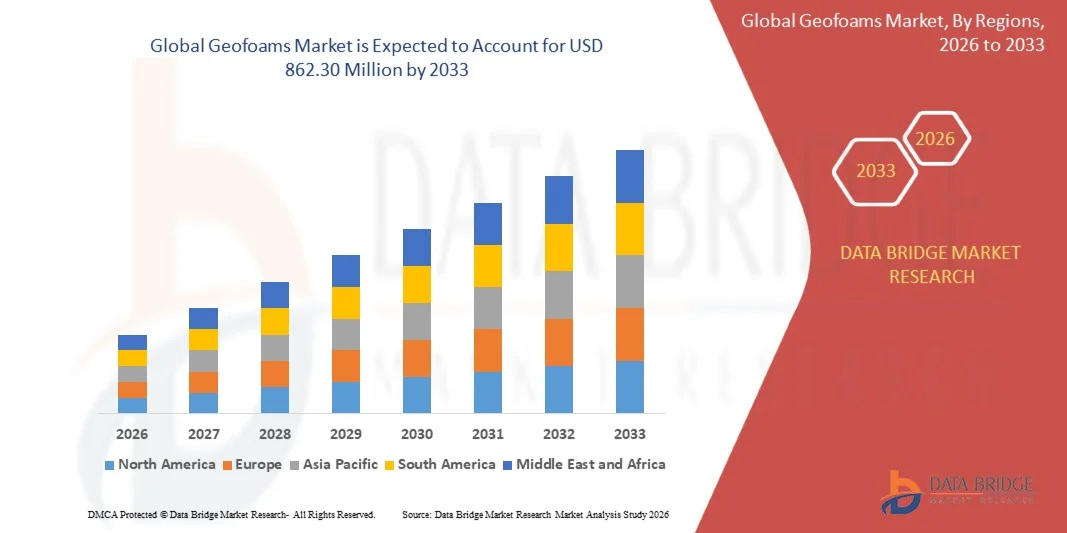
Report Scope and Geofoams Market Segmentation
|
Attributes |
Geofoams Key Market Insights |
|
Segments Covered |
· By Application: Void Fill, Slope Stabilization, Embankments, Retaining Structures, Insulation, and Others · By Type: Expanded Polystyrene Geofoams and Extruded Polystyrene Geofoam · By End Users: Road and Highway Construction, Building and Infrastructure, Airport Runways and Taxiways, and Others |
|
Countries Covered |
North America · U.S. · Canada · Mexico Europe · Germany · France · U.K. · Netherlands · Switzerland · Belgium · Russia · Italy · Spain · Turkey · Rest of Europe Asia-Pacific · China · Japan · India · South Korea · Singapore · Malaysia · Australia · Thailand · Indonesia · Philippines · Rest of Asia-Pacific Middle East and Africa · Saudi Arabia · U.A.E. · South Africa · Egypt · Israel · Rest of Middle East and Africa South America · Brazil · Argentina · Rest of South America |
|
Key Market Players |
• Carlisle (U.S.) |
|
Market Opportunities |
• Increasing Adoption Of Lightweight Fill Materials In Transportation Infrastructure |
|
Value Added Data Infosets |
In addition to the insights on market scenarios such as market value, growth rate, segmentation, geographical coverage, and major players, the market reports curated by the Data Bridge Market Research also include import export analysis, production capacity overview, production consumption analysis, price trend analysis, climate change scenario, supply chain analysis, value chain analysis, raw material/consumables overview, vendor selection criteria, PESTLE Analysis, Porter Analysis, and regulatory framework. |
Global Geofoams Market Trends
Trend: Rising Adoption Of Lightweight And Sustainable Infrastructure Fill Materials
Increasing demand for lightweight, durable, and environmentally efficient construction materials across transportation, commercial, and civil engineering sectors is accelerating adoption of geofoam solutions globally. Conventional soil and aggregate fill materials increase structural load, require extensive excavation, and create settlement-related challenges in infrastructure projects, encouraging engineers to utilize geofoam materials with lower density and improved load distribution characteristics.
In modern transportation infrastructure projects, contractors are increasingly integrating geofoam materials, For instance for road embankments, bridge abutments, and railway stabilization systems, to reduce structural stress and improve construction efficiency while minimizing settlement risks. In flood-prone and unstable soil regions, geofoams are being utilized to support slope stabilization, retaining wall systems, and underground utility protection applications, improving long-term infrastructure durability and reducing maintenance requirements.
The rapid expansion of urban transportation networks and smart city development projects is also increasing demand for lightweight geotechnical materials capable of accelerating construction timelines and lowering excavation requirements. In addition, cold-region infrastructure projects increasingly rely on geofoams because of their thermal insulation properties and ability to reduce frost heave impacts in highways and railway systems. Large-scale transportation projects completed during 2025 across Scandinavia and Canada integrating expanded polystyrene geofoam embankment systems demonstrated reductions of nearly 20–30% in construction load pressure and significant improvements in long-term soil stability under high-moisture conditions
Global Geofoams Market Dynamics
Key Market Driver: Rising Investments In Transportation And Civil Infrastructure Development
Governments and private infrastructure developers worldwide are significantly increasing investments in transportation modernization, urban infrastructure expansion, and resilient construction projects. Growing concerns regarding soil settlement, weak foundation conditions, and structural load management are creating strong demand for lightweight geotechnical materials capable of improving construction performance and reducing long-term infrastructure damage.
Construction companies and civil engineering firms are increasingly deploying geofoam solutions to improve road stability, reduce lateral earth pressure, and accelerate project execution across bridges, highways, railways, and airport infrastructure developments. Infrastructure developers are actively utilizing geofoams, For instance in embankment construction and retaining wall systems, to minimize excavation volumes and reduce pressure on underlying utility networks and soft soil foundations.
Similarly, climate-resilient infrastructure projects are increasingly integrating geofoam materials to improve flood mitigation and slope stabilization performance in vulnerable urban areas. Real-world highway expansion projects conducted during 2024 in Norway and the U.S. demonstrated settlement reductions of approximately 40–60% after replacing conventional soil fill with lightweight geofoam systems in weak soil construction environments
Key Restraint/Challenge: Flammability Concerns And Limited Awareness In Emerging Markets
Despite increasing adoption, geofoam materials face challenges associated with flammability risks, long-term environmental concerns, and limited awareness among contractors in developing economies. Expanded polystyrene geofoam requires protective design measures and fire-resistant treatment during storage and construction activities, increasing operational complexity for certain infrastructure projects.
In addition, transportation and handling of large geofoam blocks can create logistical challenges for contractors operating in remote or highly congested urban construction sites. Limited technical expertise and lower awareness regarding geofoam engineering applications further restrict market penetration in emerging infrastructure markets where conventional fill materials remain more widely accepted.
Engineering assessments indicate that improper installation or insufficient protective covering in geofoam-based construction systems can increase exposure to hydrocarbon contamination and fire-related structural risks, creating additional compliance requirements for infrastructure developers and contractors globally
Key Market Opportunity: Expansion Of Smart City And Sustainable Infrastructure Projects
Rapid urbanization, increasing smart city investments, and growing focus on sustainable infrastructure development are creating significant opportunities for geofoam manufacturers and construction material suppliers globally. Modern urban infrastructure projects increasingly require lightweight, recyclable, and energy-efficient materials capable of improving structural performance while reducing environmental impact and project completion timelines.
Governments and infrastructure agencies are increasingly exploring geofoam systems, For instance for underground transit systems, green roof applications, and flood-resistant urban infrastructure, to improve construction flexibility and reduce structural stress in densely populated metropolitan regions. In transportation infrastructure, rising deployment of high-speed rail corridors and smart highway systems is accelerating demand for lightweight fill materials capable of supporting large-scale engineering projects on weak soil foundations.
In addition, advancements in recyclable geofoam materials and improved manufacturing technologies are enhancing product durability and sustainability performance, opening opportunities across transportation, commercial construction, and coastal infrastructure markets in Asia-Pacific and North America. Smart infrastructure projects announced during 2025 across Japan and the Netherlands reported project cost reductions of nearly 15–20% and faster construction completion timelines after integrating geofoam-based lightweight embankment systems into urban transportation developments.
Global Geofoams Market Scope
The market is segmented on the basis of application, type, and end users.
- By Application
On the basis of application, the geofoams market is segmented into Void Fill, Slope Stabilization, Embankments, Retaining Structures, Insulation, and Others. The Embankments segment held the largest market revenue share of approximately 36.4% in 2025 driven by increasing utilization of geofoam materials in highway construction, bridge approaches, railway embankments, and soft soil infrastructure projects. Geofoams are widely preferred in embankment applications because of their lightweight properties, reduced settlement pressure, and ability to improve long-term structural stability in transportation infrastructure developments.
The Slope Stabilization segment is projected to register the fastest growth at a CAGR of 8.2% from 2026 to 2033, driven by rising investments in landslide prevention projects, flood mitigation infrastructure, and hillside urban construction activities. Increasing deployment of geofoam systems in climate-resilient infrastructure and retaining wall applications is accelerating segment expansion globally.
- By Type
On the basis of type, the geofoams market is segmented into Expanded Polystyrene Geofoams and Extruded Polystyrene Geofoam. The Expanded Polystyrene Geofoams segment accounted for the largest market revenue share of approximately 78.6% in 2025 driven by its cost-effectiveness, lightweight characteristics, ease of installation, and widespread usage across transportation and civil engineering applications. Expanded polystyrene geofoams are extensively utilized in roadways, bridge structures, and insulation systems because of their superior compressive strength and moisture resistance properties.
The Extruded Polystyrene Geofoam segment is projected to witness steady growth from 2026 to 2033 supported by increasing demand for higher thermal insulation performance and enhanced durability in specialized infrastructure and underground construction applications. Growing adoption in cold-region infrastructure projects and commercial insulation systems is supporting segment growth.
- By End Users
On the basis of end users, the geofoams market is segmented into Road and Highway Construction, Building and Infrastructure, Airport Runways and Taxiways, and Others. The Road and Highway Construction segment captured the largest market revenue share of approximately 48.9% in 2025 driven by increasing investments in highway expansion, smart transportation infrastructure, and bridge modernization projects globally. Geofoam materials are increasingly integrated into road construction projects to reduce soil settlement, improve load distribution, and accelerate project completion timelines.
The Airport Runways and Taxiways segment is expected to register the fastest growth at a CAGR of 8.7% from 2026 to 2033 driven by rising airport modernization initiatives, expansion of aviation infrastructure, and increasing need for lightweight fill materials capable of supporting high-load runway systems in weak soil environments.
Global Geofoams Market Regional Analysis
North America Geofoams Market Insight
North America dominated the geofoams market with the largest revenue share of 39.4% in 2025, supported by increasing investments in highway expansion, bridge rehabilitation, and smart transportation infrastructure projects. Contractors and civil engineering firms across the region highly value geofoam materials because of their lightweight properties, superior load distribution performance, and ability to reduce soil settlement in weak foundation conditions. This widespread adoption is further supported by stringent infrastructure safety standards, rising climate-resilient construction initiatives, and growing utilization of geofoams in road embankments, retaining structures, and airport infrastructure modernization projects.
U.S. Geofoams Market Insight
The U.S. geofoams market captured the largest revenue share in 2025 within North America, fueled by large-scale federal transportation infrastructure investments and increasing adoption of lightweight fill materials in highway and railway projects. Infrastructure developers are increasingly prioritizing construction efficiency, reduced excavation requirements, and long-term structural durability through geofoam integration. The growing demand for flood mitigation systems, bridge stabilization projects, and sustainable urban infrastructure development is further accelerating market expansion across the country. Moreover, increasing investments under transportation modernization and resilient infrastructure programs are significantly contributing to geofoam deployment in commercial and civil engineering applications.
Europe Geofoams Market Insight
The Europe geofoams market is expected to witness the fastest growth rate from 2026 to 2033, primarily driven by increasing investments in sustainable transportation infrastructure and rising focus on environmentally efficient construction materials. The growth of railway modernization projects, coupled with increasing slope stabilization and flood protection initiatives, is fostering adoption of geofoam systems across the region. European contractors are also attracted to the reduced environmental impact, thermal insulation properties, and faster project completion timelines offered by geofoam solutions. The region is experiencing significant growth across transportation corridors, urban infrastructure, and cold-region construction applications where lightweight geotechnical materials are increasingly replacing conventional soil fill systems.
U.K. Geofoams Market Insight
The U.K. geofoams market is expected to witness the fastest growth rate from 2026 to 2033, driven by increasing infrastructure redevelopment activities and growing focus on sustainable urban transportation systems. In addition, rising concerns regarding flood resilience, land stability, and underground utility protection are encouraging contractors and municipalities to adopt lightweight geofoam materials in civil engineering projects. The U.K.’s increasing investment in railway modernization and smart city infrastructure development is expected to continue supporting geofoam market expansion over the forecast period.
Germany Geofoams Market Insight
The Germany geofoams market is expected to witness the fastest growth rate from 2026 to 2033, fueled by rising demand for advanced geotechnical engineering solutions and increasing investments in transportation and commercial infrastructure projects. Germany’s strong emphasis on engineering innovation, infrastructure durability, and sustainable construction practices is supporting geofoam adoption in road embankments, bridge approaches, and underground infrastructure systems. The integration of lightweight fill materials into climate-resilient infrastructure development is also becoming increasingly prevalent, aligning with the country’s long-term environmental and urban development objectives.
Asia-Pacific Geofoams Market Insight
The Asia-Pacific geofoams market is expected to witness the fastest growth rate from 2026 to 2033, supported by rapid urbanization, increasing infrastructure spending, and expansion of transportation networks across China, Japan, India, and Southeast Asia. The region’s growing focus on smart city development, high-speed rail infrastructure, and highway modernization projects is driving adoption of geofoam materials in geotechnical construction applications. Furthermore, increasing government investments in flood control systems, airport expansion projects, and sustainable urban infrastructure are accelerating market growth across the region.
Japan Geofoams Market Insight
The Japan geofoams market is expected to witness the fastest growth rate from 2026 to 2033 due to increasing investments in earthquake-resilient infrastructure, tunnel stabilization systems, and transportation modernization projects. The Japanese market places strong emphasis on lightweight and high-performance construction materials capable of reducing structural load and improving infrastructure durability in seismic regions. The integration of geofoam systems in railway embankments, underground transit infrastructure, and slope stabilization applications is fueling market growth. Moreover, Japan’s advanced engineering capabilities and focus on disaster-resistant urban infrastructure are expected to further support adoption of geofoam technologies.
China Geofoams Market Insight
The China geofoams market accounted for the largest market revenue share in Asia Pacific in 2025, attributed to the country’s rapid infrastructure expansion, urban development projects, and increasing investments in high-speed rail and highway construction. China remains one of the largest construction markets globally, and geofoam materials are becoming increasingly popular in transportation infrastructure, bridge stabilization, and flood mitigation applications. The government’s focus on smart cities, resilient infrastructure, and large-scale transportation connectivity projects, alongside rising availability of cost-effective geofoam materials from domestic manufacturers, is significantly propelling market growth in China.
Top Companies in Geofoams Market
The Geofoams industry is primarily led by well-established companies, including:
• Carlisle (U.S.)
• Amvic Inc. (Canada)
• ACH Foam Technologies, Inc. (U.S.)
• Insulation Corporation of America (U.S.)
• AFM Corporation (U.S.)
• Jablite (U.K.)
• ThermaFoam, LLC (U.S.)
• Expol (New Zealand)
• Airfoam. (U.S.)
• Légerlite (Canada)
• Benchmark Foam Inc. (U.S.)
• Mega Packaging Corporation (Philippines)
• STARRFOAM (U.S.)
• Foamex (U.K.)
• Universal Foam Products. (U.S.)
• GALAXY POLYSTYRENE LLC. (U.A.E.)
• Technopol SA (Poland)
• Akzo Nobel N.V. (Netherlands)
• Evonik Industries AG (Germany)
• BASF SE (Germany)
• DuPont (U.S.)
• Autonomic Materials, Inc. (U.S.)
• Honeywell International Inc. (U.S.)
• Huntsman International LLC (U.S.)
• LyondellBasell Industries Holdings B.V. (Netherlands)
Latest Developments in Global Geofoams Market
- In 2023, Atlas Molded Products announced a production capacity expansion initiative across its manufacturing facilities in the U.S. to address rising demand for geofoam materials in transportation and civil engineering applications. The expansion is focused on increasing supply capabilities for road embankments, building foundations, slope stabilization systems, and lightweight infrastructure fill projects. This development is expected to strengthen the company’s market presence, improve supply chain responsiveness, and support growing infrastructure modernization activities across North America.
- In 2022, ACH Foam Technologies completed the acquisition of Geofoam International as part of its strategic expansion in the geofoam and lightweight construction materials industry. The acquisition was aimed at enhancing ACH Foam Technologies’ product portfolio and strengthening its expertise in geofoam-based fill solutions for transportation and geotechnical engineering projects. This development is expected to improve product innovation capabilities, expand customer reach, and accelerate adoption of lightweight geofoam systems in large-scale infrastructure and civil construction applications globally.

- Interactive Data Analysis Dashboard
- Company Analysis Dashboard for high growth potential opportunities
- Research Analyst Access for customization & queries
- Competitor Analysis with Interactive dashboard
- Latest News, Updates & Trend analysis
- Harness the Power of Benchmark Analysis for Comprehensive Competitor Tracking
Global Geofoams Market, Supply Chain Analysis and Ecosystem Framework
To support market growth and help clients navigate the impact of geopolitical shifts, DBMR has integrated in-depth supply chain analysis into its Global Geofoams Market research reports. This addition empowers clients to respond effectively to global changes affecting their industries. The supply chain analysis section includes detailed insights such as Global Geofoams Market consumption and production by country, price trend analysis, the impact of tariffs and geopolitical developments, and import and export trends by country and HSN code. It also highlights major suppliers with data on production capacity and company profiles, as well as key importers and exporters. In addition to research, DBMR offers specialized supply chain consulting services backed by over a decade of experience, providing solutions like supplier discovery, supplier risk assessment, price trend analysis, impact evaluation of inflation and trade route changes, and comprehensive market trend analysis.
Data collection and base year analysis are done using data collection modules with large sample sizes. The stage includes obtaining market information or related data through various sources and strategies. It includes examining and planning all the data acquired from the past in advance. It likewise envelops the examination of information inconsistencies seen across different information sources. The market data is analysed and estimated using market statistical and coherent models. Also, market share analysis and key trend analysis are the major success factors in the market report. To know more, please request an analyst call or drop down your inquiry.
The key research methodology used by DBMR research team is data triangulation which involves data mining, analysis of the impact of data variables on the market and primary (industry expert) validation. Data models include Vendor Positioning Grid, Market Time Line Analysis, Market Overview and Guide, Company Positioning Grid, Patent Analysis, Pricing Analysis, Company Market Share Analysis, Standards of Measurement, Global versus Regional and Vendor Share Analysis. To know more about the research methodology, drop in an inquiry to speak to our industry experts.
Data Bridge Market Research is a leader in advanced formative research. We take pride in servicing our existing and new customers with data and analysis that match and suits their goal. The report can be customized to include price trend analysis of target brands understanding the market for additional countries (ask for the list of countries), clinical trial results data, literature review, refurbished market and product base analysis. Market analysis of target competitors can be analyzed from technology-based analysis to market portfolio strategies. We can add as many competitors that you require data about in the format and data style you are looking for. Our team of analysts can also provide you data in crude raw excel files pivot tables (Fact book) or can assist you in creating presentations from the data sets available in the report.













