




Global Geomarketing Market
Market Size in USD Billion
CAGR :
% 
 USD
22.22 Billion
USD
129.13 Billion
2025
2033
USD
22.22 Billion
USD
129.13 Billion
2025
2033
 Forecast Period Forecast Period |
2026 –2033 |
 Market Size (Base Year) Market Size (Base Year) |
USD 22.22 Billion |
 Market Size (Forecast Year) Market Size (Forecast Year) |
USD 129.13 Billion |
 CAGR CAGR |
% |
| Major Markets Players |
|
Geomarketing Market Size
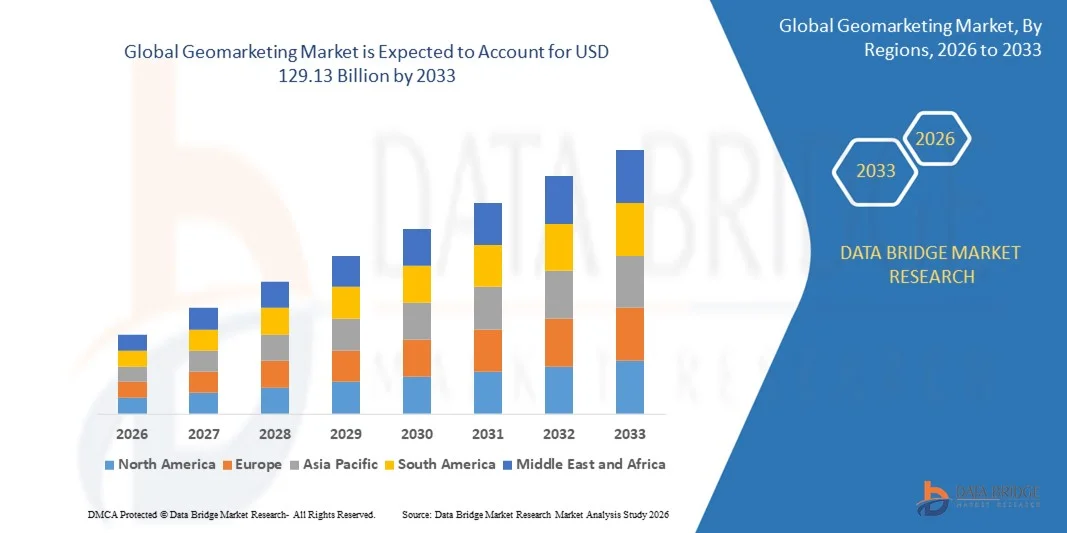
- The global geomarketing market size was valued at USD 22.22 billion in 2025 and is expected to reach USD 129.13 billion by 2033, at a CAGR of 24.60% during the forecast period
- The market growth is largely fueled by the growing adoption of location-based analytics, mobile marketing strategies, and advanced spatial intelligence tools across industries, leading to more data-driven marketing and operational decisions
- Furthermore, increasing demand from businesses for personalized, real-time, and targeted customer engagement solutions is establishing geomarketing as a critical tool for enhancing marketing efficiency and optimizing sales and service delivery. These converging factors are accelerating the adoption of geomarketing technologies, thereby significantly boosting the market’s expansion
Geomarketing Market Analysis
- Geomarketing, leveraging location data, geospatial analytics, and real-time insights, is becoming an essential component of modern marketing and operational strategies for retail, logistics, transportation, and service industries due to its ability to enhance customer targeting, improve operational efficiency, and optimize resource allocation
- The escalating demand for geomarketing solutions is primarily driven by increasing smartphone penetration, growth of e-commerce, rising use of AI and cloud-based analytics, and the need for businesses to deliver location-aware, personalized marketing campaigns and services
- North America dominated the geomarketing market with a share of 37.75% in 2025, due to increasing adoption of location-based marketing solutions and advanced analytics by enterprises across retail, BFSI, and eCommerce sectors
- Asia-Pacific is expected to be the fastest growing region in the geomarketing market during the forecast period due to rapid urbanization, rising smartphone penetration, and government initiatives supporting smart city projects in countries such as China, Japan, and India
- Cloud-based segment dominated the market with a market share of 70.92% in 2025, due to the scalability, flexibility, and cost-effectiveness of cloud solutions for processing large volumes of location data. Cloud deployment enables real-time analytics, cross-platform integration, and remote access, allowing businesses to quickly adapt marketing strategies and monitor campaign effectiveness
Report Scope and Geomarketing Market Segmentation
|
Attributes |
Geomarketing Key Market Insights |
|
Segments Covered |
|
|
Countries Covered |
North America
Europe
Asia-Pacific
Middle East and Africa
South America
|
|
Key Market Players |
|
|
Market Opportunities |
|
|
Value Added Data Infosets |
In addition to the market insights such as market value, growth rate, market segments, geographical coverage, market players, and market scenario, the market report curated by the Data Bridge Market Research team includes in-depth expert analysis, import/export analysis, pricing analysis, production consumption analysis, and pestle analysis. |
Geomarketing Market Trends
Rising Adoption of Location-Based Analytics and Real-Time Customer Insights
- A prominent trend in the geomarketing market is the increasing adoption of location-based analytics and real-time customer insights, driven by businesses’ need to deliver highly personalized and context-aware marketing campaigns. This trend is transforming how retailers, service providers, and digital platforms engage with consumers by leveraging precise geographic and behavioral data
- For instance, companies such as Uber and Starbucks utilize advanced location analytics to optimize promotional offers, location-specific advertising, and store placement strategies. These applications enhance customer engagement and support data-driven decision-making in highly competitive markets
- The integration of mobile GPS, geofencing, and beacon technologies is expanding across sectors, allowing brands to trigger context-sensitive notifications and promotions. This is elevating geomarketing as a core tool for businesses seeking instant and relevant consumer interaction
- Retailers and e-commerce platforms are increasingly combining location intelligence with purchase history and demographic data to refine targeting strategies and drive sales conversion. This is fostering a shift toward precision marketing that maximizes ROI and strengthens brand loyalty
- The use of real-time insights in geomarketing is accelerating innovations in customer journey mapping, footfall analysis, and market segmentation. These capabilities provide businesses with actionable intelligence that supports strategic planning, resource allocation, and competitive advantage
- Global expansion of location-based services and connected devices is further fueling geomarketing adoption, as companies across regions aim to enhance operational efficiency and customer experience. This trend underscores the growing significance of geo-intelligence in modern marketing strategies
Geomarketing Market Dynamics
Driver
Increasing Demand for Personalized and Targeted Marketing Solutions
- The rising emphasis on delivering personalized customer experiences is driving demand for geomarketing solutions that enable precise segmentation, contextual messaging, and location-based promotions. Businesses are leveraging these solutions to improve engagement, enhance loyalty, and increase conversion rates
- For instance, Esri provides advanced location intelligence platforms that allow retailers and brands to analyze spatial data, segment markets, and optimize campaigns based on real-world customer behavior. These solutions help companies deliver highly targeted marketing initiatives with measurable impact
- The proliferation of smartphones and connected devices is creating rich datasets that enable brands to tailor offers, messaging, and content in real time. Geomarketing tools help synthesize this data into actionable insights, supporting more effective campaign execution
- Companies are increasingly integrating geomarketing with CRM, social media, and advertising platforms to align messaging across channels. This convergence strengthens campaign consistency and ensures messaging relevance for different customer segments
- Rising competition in retail, hospitality, and service sectors is motivating companies to adopt geomarketing for hyper-local targeting and dynamic promotions. This adoption supports the creation of more engaging, data-driven customer experiences that drive growth
Restraint/Challenge
Data Privacy and Regulatory Compliance Concerns
- The geomarketing market faces significant challenges due to stringent data privacy laws, consumer consent requirements, and evolving regulations such as GDPR and CCPA. Compliance with these rules requires sophisticated governance, anonymization protocols, and risk management processes
- For instance, Google has updated its location services policies to ensure compliance with global privacy regulations, impacting how advertisers access and use location-based data. Companies must continuously adapt strategies to avoid fines, reputational risk, and legal exposure
- Consumers are increasingly concerned about how their location data is collected, stored, and utilized, which can hinder adoption and engagement with geo-targeted campaigns. Companies need transparent policies and opt-in mechanisms to maintain trust
- The complexity of managing large-scale location datasets while adhering to privacy standards increases operational costs and requires specialized expertise. Firms must invest in secure infrastructure and skilled personnel to navigate these challenges effectively
- Balancing the demand for hyper-personalized marketing with regulatory compliance remains a critical constraint. Organizations must develop innovative solutions that respect privacy while delivering actionable geo-insights, ensuring sustainable market growth
Geomarketing Market Scope
The market is segmented on the basis of technology, location, deployment mode, vertical, and component.
- By Technology
On the basis of technology, the geomarketing market is segmented into Bluetooth, Global Positioning System (GPS), Radio-Frequency Identification (RFID), Wi-Fi, and Near-Field Communication (NFC). The GPS segment dominated the market with the largest revenue share in 2025, driven by its ability to provide precise location data for businesses seeking to optimize marketing strategies and customer engagement. Organizations leverage GPS-based geomarketing to deliver location-specific promotions, track footfall patterns, and analyze consumer behavior with high accuracy. The widespread adoption of smartphones with integrated GPS technology further reinforces this segment’s dominance, enabling seamless integration with mobile apps and analytics platforms.
The Bluetooth segment is anticipated to witness the fastest growth rate from 2026 to 2033, fueled by its low power consumption and ability to enable proximity-based marketing campaigns. For instance, companies such as Estimote provide Bluetooth beacon solutions that allow retailers to send personalized offers to nearby consumers in real time. The technology’s ease of deployment, compatibility with mobile devices, and support for localized engagement strategies make it particularly appealing for indoor retail environments and events.
- By Location
On the basis of location, the geomarketing market is segmented into indoor and outdoor. The outdoor segment held the largest market share in 2025, driven by the increasing adoption of GPS-based solutions for mapping customer locations, analyzing mobility patterns, and conducting location-targeted campaigns in public spaces. Retailers, real estate firms, and tourism operators leverage outdoor geomarketing to optimize ad placements, foot traffic, and service accessibility. The segment benefits from advancements in geospatial analytics and mobile tracking, enabling marketers to capture and analyze consumer behavior over wide geographic areas.
The indoor segment is expected to register the fastest CAGR from 2026 to 2033, owing to rising demand for precision location tracking within malls, airports, and large commercial facilities. For instance, companies such as Cisco provide indoor positioning systems that allow businesses to guide customers, optimize store layouts, and deliver targeted promotions. Indoor geomarketing solutions offer businesses enhanced operational insights and a direct channel for personalized engagement, contributing to their growing adoption.
- By Deployment Mode
On the basis of deployment mode, the geomarketing market is segmented into cloud-based and on-premises. The cloud-based segment dominated the market with the largest share of 70.92% in 2025, driven by the scalability, flexibility, and cost-effectiveness of cloud solutions for processing large volumes of location data. Cloud deployment enables real-time analytics, cross-platform integration, and remote access, allowing businesses to quickly adapt marketing strategies and monitor campaign effectiveness. Organizations increasingly prefer cloud-based geomarketing platforms to enhance collaboration, reduce IT overhead, and integrate seamlessly with CRM and analytics tools.
The on-premises segment is expected to witness the fastest growth from 2026 to 2033, fueled by enterprises that require greater data security, privacy, and control over sensitive location information. For instance, large banking and retail chains implement on-premises geomarketing solutions to comply with stringent data protection regulations while maintaining robust analytics capabilities. The segment benefits from customization options and the ability to handle complex enterprise workflows, driving its growing adoption.
- By Vertical
On the basis of vertical, the geomarketing market is segmented into retail and eCommerce, healthcare and life sciences, travel and hospitality, banking, financial services, and insurance (BFSI), media and entertainment, telecommunications and IT, and others. The retail and eCommerce segment dominated the market in 2025, driven by the need to optimize customer engagement, enhance personalized marketing, and increase foot traffic through targeted campaigns. Retailers leverage geomarketing tools to track shopping behavior, deliver location-specific offers, and improve overall customer experience. The integration of mobile apps, loyalty programs, and location analytics further strengthens the segment’s dominance.
The travel and hospitality segment is expected to register the fastest CAGR from 2026 to 2033, fueled by rising demand for location-based services that enhance traveler experiences. For instance, platforms such as TripAdvisor and Expedia use geomarketing insights to recommend nearby attractions, restaurants, and events, providing personalized travel suggestions. The vertical benefits from location analytics for route optimization, marketing campaigns, and service personalization, contributing to its rapid growth.
- By Component
On the basis of component, the geomarketing market is segmented into software and services. The software segment dominated the market in 2025, driven by the increasing adoption of advanced analytics, mapping, and visualization tools that enable businesses to interpret location data effectively. Geomarketing software provides real-time insights, predictive analytics, and integration with CRM systems, allowing companies to make data-driven marketing decisions. Enterprises leverage software solutions to design campaigns, analyze customer movement patterns, and optimize engagement strategies efficiently.
The services segment is expected to witness the fastest growth rate from 2026 to 2033, fueled by rising demand for consulting, deployment, and support services in geomarketing. For instance, companies such as Esri provide location analytics services that assist organizations in implementing tailored geomarketing strategies. Services offer the advantage of expert guidance, customization, and continuous optimization, enabling businesses to maximize the value of geomarketing solutions.
Geomarketing Market Regional Analysis
- North America dominated the geomarketing market with the largest revenue share of 37.75% in 2025, driven by increasing adoption of location-based marketing solutions and advanced analytics by enterprises across retail, BFSI, and eCommerce sectors
- Consumers and businesses in the region highly value actionable insights from location intelligence, enabling hyper-local campaigns, personalized promotions, and improved customer engagement
- This widespread adoption is further supported by advanced technological infrastructure, high internet penetration, and strong investment in data-driven marketing strategies, positioning North America as a leading market for geomarketing solutions
U.S. Geomarketing Market Insight
The U.S. geomarketing market captured the largest revenue share in 2025 within North America, fueled by increasing investments in location intelligence and mobile advertising platforms. Companies are prioritizing data-driven strategies to enhance customer acquisition and retention through location-based insights. Google Maps and Foursquare’s business solutions enable brands to deliver hyper-local campaigns and improve foot traffic to physical stores. The growing integration of geomarketing with CRM systems and AI-powered analytics further accelerates market expansion. Moreover, the rising demand for real-time consumer insights and omnichannel marketing campaigns strengthens the U.S. geomarketing ecosystem.
Europe Geomarketing Market Insight
The Europe geomarketing market is projected to expand at a significant CAGR throughout the forecast period, driven by the increasing use of geospatial analytics and digital marketing initiatives. The implementation of GDPR and other data privacy regulations is shaping the adoption of ethical and secure geomarketing practices. TomTom’s location-based services support businesses in targeting consumers while complying with privacy norms. Rising urbanization and the growth of e-commerce platforms are fostering the demand for precise location-based marketing solutions. In addition, European retailers and service providers are investing in omnichannel strategies to enhance personalized customer experiences.
U.K. Geomarketing Market Insight
The U.K. geomarketing market is anticipated to grow at a noteworthy CAGR during the forecast period, driven by the adoption of mobile apps, GPS technologies, and customer analytics platforms. Retailers and local businesses are increasingly using location intelligence to optimize marketing campaigns and improve conversion rates. Tesco leverages geomarketing insights to send personalized promotions to customers in specific regions. The strong digital infrastructure, coupled with widespread smartphone usage, continues to support market growth. Moreover, the focus on enhancing customer engagement and loyalty is encouraging businesses to invest in advanced geomarketing solutions.
Germany Geomarketing Market Insight
The Germany geomarketing market is expected to expand at a considerable CAGR during the forecast period, fueled by advanced data analytics adoption and demand for precision marketing. German enterprises are increasingly utilizing location-based insights to optimize supply chains, retail operations, and targeted campaigns. Deutsche Telekom provides geomarketing solutions for businesses to identify consumer patterns and preferences accurately. The country’s strong emphasis on technological innovation and data privacy compliance further drives adoption. In addition, the integration of geomarketing with AI and IoT platforms is enhancing marketing efficiency across sectors.
Asia-Pacific Geomarketing Market Insight
The Asia-Pacific geomarketing market is poised to grow at the fastest CAGR during 2026–2033, driven by rapid urbanization, rising smartphone penetration, and government initiatives supporting smart city projects in countries such as China, Japan, and India. Businesses are increasingly adopting geomarketing to reach mobile-first consumers and optimize retail operations. Alibaba’s location-based marketing tools enable brands to target customers across online and offline channels. The expanding e-commerce ecosystem and growth of cloud-based analytics platforms are accelerating market adoption. In addition, the affordability of location intelligence solutions is broadening access for small and medium-sized enterprises across the region.
Japan Geomarketing Market Insight
The Japan geomarketing market is gaining traction due to high mobile penetration, smart city developments, and demand for data-driven marketing strategies. Japanese businesses emphasize real-time insights for retail optimization, transportation planning, and customer engagement. Rakuten leverages location analytics to enhance personalized promotions and loyalty programs. The growing trend of integrating geomarketing with IoT devices and AI-based analytics further fuels growth. Moreover, Japan’s aging population is encouraging businesses to adopt location-based solutions for better service accessibility and convenience.
China Geomarketing Market Insight
The China geomarketing market accounted for the largest revenue share in Asia-Pacific in 2025, attributed to the country’s vast consumer base, high digital adoption, and rapid urbanization. Location-based marketing is becoming increasingly essential for retail, e-commerce, and food delivery services. Meituan uses geomarketing insights to optimize promotions, delivery routes, and customer engagement. The country’s growing smart city initiatives and integration of AI with geospatial analytics are driving the market. In addition, strong domestic technology providers and affordable geomarketing solutions are supporting adoption across urban and semi-urban regions.
Geomarketing Market Share
The geomarketing industry is primarily led by well-established companies, including:
- Microsoft (U.S.)
- IBM (U.S.)
- Cisco Systems (U.S.)
- Oracle (U.S.)
- Adobe (U.S.)
- Salesforce (U.S.)
- Software AG (Germany)
- Esri (U.S.)
- Telefonaktiebolaget LM Ericsson (Sweden)
- Qualcomm Technologies, Inc. (U.S.)
- PlotProjects B.V (Netherlands)
- Xtremepush (Ireland)
- MobileBridge (U.S.)
- Hyper (U.S.)
- Reveal Mobile, Inc. (U.S.)
- Galigeo (France)
- Navigine (Russia)
- Airship (U.S.)
- Bluedot (Australia)
- Foursquare (U.S.)
- LocationGuru Solutions Pvt. Ltd (India)
Latest Developments in Global Geomarketing Market
- In June 2025, Microsoft reported cloud revenue of USD 42.4 billion, reflecting a 20% year-on-year increase, largely driven by the growing adoption of Azure location services. This growth underscores the rising demand for cloud-based location intelligence in the geomarketing sector, enabling businesses to leverage real-time spatial data for enhanced customer targeting, route optimization, and market expansion strategies. The strong performance positions Microsoft as a key provider of scalable, enterprise-ready geomarketing solutions, supporting both large organizations and emerging enterprises
- In May 2025, Cisco recorded USD 14.1 billion in overall revenue and secured over USD 600 million in AI infrastructure orders specifically for edge-enabled analytics. This development highlights Cisco’s role in empowering geomarketing through advanced AI and edge computing capabilities, allowing businesses to process location-based data closer to the source for faster, more accurate insights. The deployment of edge-enabled analytics is expected to improve real-time decision-making, personalized marketing campaigns, and operational efficiency across retail, logistics, and service industries
- In April 2025, Oracle reported fiscal year revenue of USD 57.4 billion, with cloud services—including location intelligence—growing by 14%. This growth emphasizes the increasing reliance of businesses on Oracle’s spatial analytics capabilities for geomarketing applications, including customer segmentation, site selection, and geospatial campaign optimization. By expanding access to cloud-based location intelligence, Oracle supports organizations in transforming raw location data into actionable insights, enhancing marketing effectiveness and operational performance
- In May 2024, IBM announced updates to its watsonx platform, introducing new data and automation capabilities designed to make AI more accessible and cost-effective for businesses. These enhancements directly impact the geomarketing market by providing more flexible and powerful tools for analyzing location-based data, enabling highly targeted marketing strategies and more precise consumer insights. The improvements facilitate better integration of AI-driven analytics into marketing workflows, helping businesses optimize campaigns, increase engagement, and drive revenue growth
- In February 2023, HERE Technologies partnered with Cognizant to advance geomarketing capabilities across multiple sectors. The collaboration integrated HERE’s location platform, offering real-time traffic, weather, and point-of-interest data, with Cognizant’s spatial intelligence solutions. This partnership enabled businesses in retail, ride-hailing, logistics, manufacturing, and automotive industries to improve customer targeting, service delivery, and operational efficiency through accurate, location-based insights. The joint initiative reinforced the importance of combining geospatial data with AI-driven analytics for enhanced marketing precision and smarter business decision-making
SKU-
Get online access to the report on the World's First Market Intelligence Cloud

- Interactive Data Analysis Dashboard
- Company Analysis Dashboard for high growth potential opportunities
- Research Analyst Access for customization & queries
- Competitor Analysis with Interactive dashboard
- Latest News, Updates & Trend analysis
- Harness the Power of Benchmark Analysis for Comprehensive Competitor Tracking
Research Methodology
Data collection and base year analysis are done using data collection modules with large sample sizes. The stage includes obtaining market information or related data through various sources and strategies. It includes examining and planning all the data acquired from the past in advance. It likewise envelops the examination of information inconsistencies seen across different information sources. The market data is analysed and estimated using market statistical and coherent models. Also, market share analysis and key trend analysis are the major success factors in the market report. To know more, please request an analyst call or drop down your inquiry.
The key research methodology used by DBMR research team is data triangulation which involves data mining, analysis of the impact of data variables on the market and primary (industry expert) validation. Data models include Vendor Positioning Grid, Market Time Line Analysis, Market Overview and Guide, Company Positioning Grid, Patent Analysis, Pricing Analysis, Company Market Share Analysis, Standards of Measurement, Global versus Regional and Vendor Share Analysis. To know more about the research methodology, drop in an inquiry to speak to our industry experts.
Customization Available
Data Bridge Market Research is a leader in advanced formative research. We take pride in servicing our existing and new customers with data and analysis that match and suits their goal. The report can be customized to include price trend analysis of target brands understanding the market for additional countries (ask for the list of countries), clinical trial results data, literature review, refurbished market and product base analysis. Market analysis of target competitors can be analyzed from technology-based analysis to market portfolio strategies. We can add as many competitors that you require data about in the format and data style you are looking for. Our team of analysts can also provide you data in crude raw excel files pivot tables (Fact book) or can assist you in creating presentations from the data sets available in the report.












