


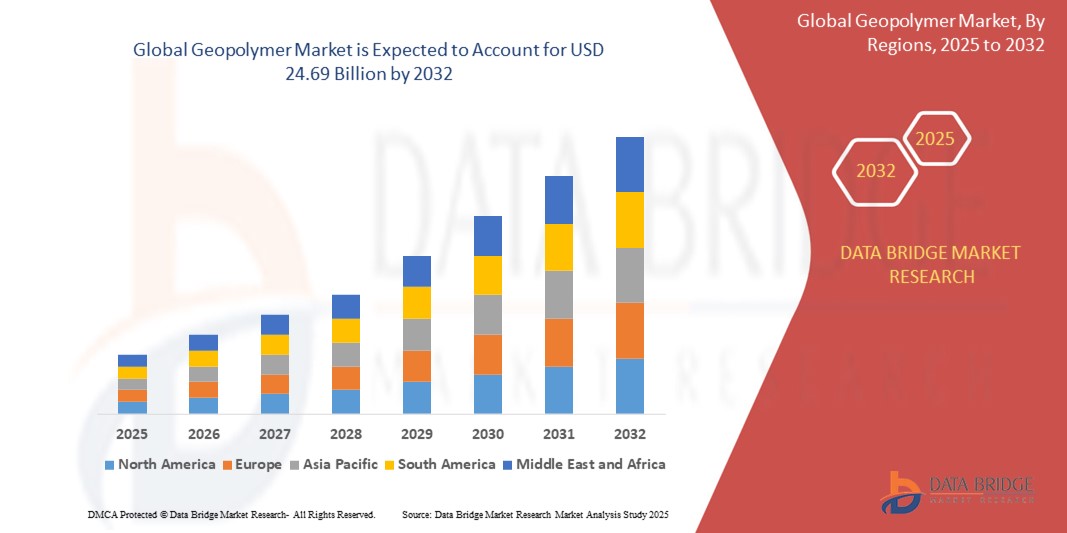
Geopolymer Market Size
- The global geopolymer market size was valued at USD 9.81 billion in 2024 and is expected to reach USD 24.69 billion by 2032, at a CAGR of 12.23% during the forecast period
- The market growth is primarily driven by the increasing demand for sustainable and eco-friendly construction materials, advancements in geopolymer technology, and growing awareness of reducing carbon emissions in the construction industry.
- In addition, the rising adoption of geopolymers in infrastructure and industrial applications, coupled with their superior durability and resistance to extreme conditions, is accelerating market expansion.
Geopolymer Market Analysis
- Geopolymers, known for their sustainable and high-performance properties, are gaining traction as alternatives to traditional cement-based materials in construction, industrial, and decorative applications due to their low carbon footprint, high strength, and resistance to heat and chemicals
- The demand for geopolymers is fueled by increasing environmental regulations, the push for green building initiatives, and the need for cost-effective, durable materials in infrastructure and industrial sectors
- Asia-Pacific dominated the geopolymer market with the largest revenue share of 42.5% in 2024, driven by rapid urbanization, large-scale infrastructure projects, and strong government support for sustainable construction practices, particularly in countries such as China and India
- Middle East and Africa is expected to be the fastest-growing region during the forecast period, propelled by increasing investments in infrastructure development and the adoption of innovative construction materials in emerging economies
- The Geopolymer Concrete segment dominated the largest market revenue share of 34.6% in 2024, driven by its eco-friendly profile, superior durability, and reduced carbon emissions compared to traditional Portland cement
Report Scope and Geopolymer Market Segmentation
|
Attributes |
Geopolymer Key Market Insights |
|
Segments Covered |
|
|
Countries Covered |
North America
Europe
Asia-Pacific
Middle East and Africa
South America
|
|
Key Market Players |
|
|
Market Opportunities |
|
|
Value Added Data Infosets |
In addition to the insights on market scenarios such as market value, growth rate, segmentation, geographical coverage, and major players, the market reports curated by the Data Bridge Market Research also include import export analysis, production capacity overview, production consumption analysis, price trend analysis, climate change scenario, supply chain analysis, value chain analysis, raw material/consumables overview, vendor selection criteria, PESTLE Analysis, Porter Analysis, and regulatory framework. |
Geopolymer Market Trends
“Increasing Adoption of Sustainable and Eco-Friendly Construction Materials”
- The global geopolymer market is experiencing a significant trend toward the adoption of sustainable and eco-friendly construction materials
- Geopolymers, utilizing industrial by-products such as fly ash and slag, significantly reduce carbon emissions compared to traditional Portland cement, aligning with global sustainability goals
- Advanced research and development are enhancing the performance of geopolymer materials, improving their mechanical strength, durability, and resistance to chemical and thermal degradation
- For instance, companies are developing geopolymer-based concrete that reduces CO2 emissions by up to 70%, with applications in roads, pavements, and precast panels, as seen in projects such as the fly ash-based geopolymer road in Odisha, India, in June 2020
- This trend is increasing the appeal of geopolymers for environmentally conscious consumers, governments, and construction companies, particularly in infrastructure and building construction
- Geopolymer technologies are being tailored for specific applications, such as fire-resistant coatings, high-temperature ceramics, and waste encapsulation, further expanding their market potential
Geopolymer Market Dynamics
Driver
“Growing Demand for Low-Carbon Construction and Infrastructure Development”
- The rising global demand for sustainable construction materials, driven by environmental regulations and the need to reduce greenhouse gas emissions, is a major driver for the geopolymer market
- Geopolymers offer a low-carbon alternative to Portland cement, reducing CO2 emissions by 40-80% in construction applications such as bridges, tunnels, and roads
- Government initiatives, particularly in Asia-Pacific, are promoting the use of geopolymers in large-scale infrastructure projects, such as China’s New Infrastructure plan and India’s $1.4 trillion construction market projection by 2025
- The increasing use of geopolymers in transportation infrastructure, including railroad sleepers and precast panels, enhances durability and reduces maintenance costs
- Rapid urbanization and industrialization in emerging economies, particularly in Asia-Pacific, are boosting the adoption of geopolymer-based materials to meet infrastructure demands sustainably
Restraint/Challenge
“High Initial Costs and Lack of Standardization”
- The high initial costs associated with the production, testing, and integration of geopolymer materials can be a significant barrier, particularly for small-scale construction firms and in emerging markets
- The lack of standardized guidelines and prescriptive regulations for geopolymer use in construction limits widespread commercial adoption, as current standards often favor traditional Portland cement
- Concerns about long-term durability and field performance data, which are still being established, deter some investors and builders from adopting geopolymer technologies
- The variability in raw material availability, such as fly ash and slag, which depend on regional industrial outputs, poses supply chain challenges
- These factors, combined with limited awareness about geopolymer benefits in some regions, can hinder market growth, particularly in cost-sensitive markets or areas with stringent regulatory frameworks
Geopolymer market Scope
The market is segmented on the basis of product type, application, and end user.
- By Product Type
On the basis of product type, the global geopolymer market is segmented into geopolymer concrete, geopolymer binder, and others. The Geopolymer Concrete segment dominated the largest market revenue share of 34.6% in 2024, driven by its eco-friendly profile, superior durability, and reduced carbon emissions compared to traditional Portland cement.
The Geopolymer Binder segment is expected to witness robust growth from 2025 to 2032. This growth is driven by the increasing demand for sustainable construction materials, stringent environmental regulations pushing for lower carbon footprints, and advancements in geopolymer binder technologies that enhance their performance and broaden their application.
- By Application
On the basis of application, the global geopolymer market is segmented into cement and concrete, furnace and reactor insulators, composites, decorative artifacts, and others. The Cement and Concrete segment is expected to hold the largest market revenue share, primarily due to the widespread adoption of geopolymers as a sustainable and high-performance alternative to traditional cement and concrete in various construction activities.
The Composites segment is anticipated to experience significant growth from 2025 to 2032. This growth is attributed to the increasing demand for lightweight, high-strength, and fire-resistant materials in various industries such as aerospace, automotive, and construction, where geopolymers offer excellent performance characteristics.
- By End User
On the basis of end user, the global geopolymer market is segmented into transportation infrastructure, building construction, infrastructure, industrial, art and decoration, offshore, and others. The Building Construction segment is expected to hold the largest market revenue share. This is driven by the rapidly growing construction activities globally, particularly in residential and commercial sectors, coupled with the increasing emphasis on sustainable building materials that offer reduced environmental impact and enhanced durability.
The Transportation Infrastructure segment is anticipated to witness rapid growth from 2025 to 2032. The increasing investment in road, bridge, and railway construction, along with the need for long-lasting and environmentally friendly materials that can withstand harsh conditions, is propelling the adoption of geopolymers in this sector.
Geopolymer Market Regional Analysis
- Asia-Pacific dominated the geopolymer market with the largest revenue share of 42.5% in 2024, driven by rapid urbanization, large-scale infrastructure projects, and strong government support for sustainable construction practices, particularly in countries such as China and India
- Consumers and industries prioritize geopolymer products for their eco-friendly properties, high durability, and resistance to heat and chemicals, particularly in regions with growing infrastructure needs
- Growth is supported by advancements in geopolymer technology, such as enhanced concrete formulations and binders, alongside rising applications in OEM and aftermarket segments across construction and industrial sectors
Japan Geopolymer Market Insight
Japan’s geopolymer market is expected to witness rapid growth due to strong consumer and industry preference for high-quality, sustainable materials that enhance infrastructure durability and environmental performance. The presence of major construction firms and the integration of geopolymer products in OEM projects accelerate market penetration. Rising interest in aftermarket applications for composites and decorative artifacts also contributes to growth.
China Geopolymer Market Insight
China holds the largest share of the Asia-Pacific geopolymer market, propelled by rapid urbanization, rising infrastructure investments, and increasing demand for eco-friendly construction solutions. The country’s growing middle class and focus on sustainable urban development support the adoption of geopolymer concrete and binders. Strong domestic manufacturing capabilities and competitive pricing enhance market accessibility.
Middle East and Africa Geopolymer Market Insight
The Middle East and Africa region is expected to witness the fastest growth rate in the geopolymer market, driven by increasing infrastructure projects and a growing focus on sustainable construction practices. Demand for geopolymer concrete, binders, and composites is rising due to their durability and resistance to harsh environmental conditions. Government initiatives promoting green building standards and investments in transportation and industrial infrastructure further accelerate market expansion.
U.S. Geopolymer Market Insight
The U.S. geopolymer market is expected to witness significant growth, fueled by strong demand for sustainable construction materials and increasing awareness of geopolymer concrete’s environmental benefits. The trend toward green building certifications and stringent regulations on carbon emissions further boosts market expansion. The integration of geopolymer products in infrastructure projects and industrial applications complements aftermarket growth, creating a robust market ecosystem.
Europe Geopolymer Market Insight
The Europe geopolymer market is expected to witness significant growth, supported by regulatory emphasis on sustainable construction and energy-efficient materials. Consumers and industries seek geopolymer concrete and binders that offer superior strength and thermal insulation. Growth is prominent in both new construction projects and retrofitting, with countries such as Germany and France showing notable adoption due to environmental concerns and urban development needs.
U.K. Geopolymer Market Insight
The U.K. market for geopolymer products is expected to witness rapid growth, driven by demand for sustainable building materials and energy-efficient infrastructure solutions in urban and suburban areas. Increased interest in eco-friendly construction and rising awareness of geopolymer benefits, such as reduced carbon footprint, encourage adoption. Evolving regulations promoting green construction influence consumer and industry choices, balancing performance with compliance.
Germany Geopolymer Market Insight
Germany is expected to witness rapid growth in the geopolymer market, attributed to its advanced construction and manufacturing sectors and high consumer focus on sustainability and energy efficiency. German industries prefer technologically advanced geopolymer products, such as concrete and binders that enhance durability and reduce environmental impact. The integration of these materials in premium construction projects and aftermarket applications supports sustained market growth.
Geopolymer Market Share
The geopolymer industry is primarily led by well-established companies, including:
- Wagner Global (Australia)
- Zeobond Pty Ltd (Australia)
- ASK Chemicals (Germany)
- Schlumberger Limited (U.S.)
- Milsuch asn & Company (U.S.)
- Corning Inc. (U.S.)
- Proton Ventures (Netherlands)
- Nu-core (U.S.)
- Wagners Holding Company Ltd (Australia)
- Alchemy Geopolymer (Australia)
- Banah UK Ltd (U.K.)
- AFS Technology (U.S.)
- Azelis (Belgium)
What are the Recent Developments in Global Geopolymer Market?
- In December 2023, Betolar launched low-carbon concrete paving products in the UAE through a strategic collaboration with Fujairah Concrete Products (FCP). Unveiled at the Big 5 Global construction event in Dubai, the products are based on Betolar’s Geoprime solution—a cement-free, geopolymer-based technology that utilizes industrial side streams to significantly reduce CO₂ emissions. Designed and tested for the Middle East market, the paving stones meet local and international standards for strength, water absorption, and wear resistance. This partnership marks a major step toward sustainable construction practices in the region
- In March 2023, Schlumberger Ltd. (now SLB) introduced EcoShield, a geopolymer-based, cement-free well construction system designed to dramatically reduce the environmental footprint of upstream oil and gas operations. EcoShield eliminates up to 85% of embodied CO₂ emissions compared to traditional Portland cement systems, while delivering industry-standard zonal isolation capabilities. The system uses locally sourced natural materials and industrial waste streams, reducing both manufacturing and transport-related emissions. This breakthrough reflects SLB’s commitment to decarbonizing well construction and advancing sustainable technologies in the energy sector
- In February 2022, Inland Pipe Rehabilitation (IPR), a leading U.S. trenchless infrastructure solutions provider, announced a definitive agreement to acquire Inliner from Granite Construction Inc. Inliner, known for its geopolymer liner, UV-cured-in-place pipe solutions, and construction management services, enhances IPR’s capabilities in wastewater and stormwater rehabilitation. The merger expands IPR’s North American footprint, strengthens its manufacturing capacity, and supports its strategy to deliver minimally disruptive, cost-effective solutions for aging underground infrastructure. This acquisition builds on IPR’s growth under J.F. Lehman & Company, following its earlier purchase of Murphy Pipeline Contractors
- In June 2021, Norwegian architecture firm Snøhetta partnered with startup Saferock to develop geopolymer concrete—a sustainable alternative to traditional Portland cement. Made from industrial waste by-products such as mining residues and power plant ash, this innovative material reduces carbon emissions by over 70% compared to conventional concrete. The project aims to produce CO₂-neutral concrete by 2025, aligning with global climate goals and promoting circular economy principles. Geopolymers also offer superior chemical resistance, thermal stability, and low permeability, making them ideal for eco-conscious construction applications
- In October 2020, UK engineering and construction firm Keltbray Group signed a limited exclusivity license with Wagners and Capital Concrete to supply and install Earth Friendly Concrete® (EFC)—a geopolymer-based, zero-cement concrete—across the UK. Manufactured by Wagners, EFC uses blast furnace slag and fly ash as binders, offering up to 50% reduction in embodied carbon compared to traditional mixes. Keltbray committed to placing 11,000m³ of EFC by June 2021, supporting the UK’s decarbonization goals and promoting sustainable infrastructure. The partnership reflects growing demand for low-carbon construction materials and innovation in temporary and permanent works

- Interactive Data Analysis Dashboard
- Company Analysis Dashboard for high growth potential opportunities
- Research Analyst Access for customization & queries
- Competitor Analysis with Interactive dashboard
- Latest News, Updates & Trend analysis
- Harness the Power of Benchmark Analysis for Comprehensive Competitor Tracking
Global Geopolymer Market, Supply Chain Analysis and Ecosystem Framework
To support market growth and help clients navigate the impact of geopolitical shifts, DBMR has integrated in-depth supply chain analysis into its Global Geopolymer Market research reports. This addition empowers clients to respond effectively to global changes affecting their industries. The supply chain analysis section includes detailed insights such as Global Geopolymer Market consumption and production by country, price trend analysis, the impact of tariffs and geopolitical developments, and import and export trends by country and HSN code. It also highlights major suppliers with data on production capacity and company profiles, as well as key importers and exporters. In addition to research, DBMR offers specialized supply chain consulting services backed by over a decade of experience, providing solutions like supplier discovery, supplier risk assessment, price trend analysis, impact evaluation of inflation and trade route changes, and comprehensive market trend analysis.
Data collection and base year analysis are done using data collection modules with large sample sizes. The stage includes obtaining market information or related data through various sources and strategies. It includes examining and planning all the data acquired from the past in advance. It likewise envelops the examination of information inconsistencies seen across different information sources. The market data is analysed and estimated using market statistical and coherent models. Also, market share analysis and key trend analysis are the major success factors in the market report. To know more, please request an analyst call or drop down your inquiry.
The key research methodology used by DBMR research team is data triangulation which involves data mining, analysis of the impact of data variables on the market and primary (industry expert) validation. Data models include Vendor Positioning Grid, Market Time Line Analysis, Market Overview and Guide, Company Positioning Grid, Patent Analysis, Pricing Analysis, Company Market Share Analysis, Standards of Measurement, Global versus Regional and Vendor Share Analysis. To know more about the research methodology, drop in an inquiry to speak to our industry experts.
Data Bridge Market Research is a leader in advanced formative research. We take pride in servicing our existing and new customers with data and analysis that match and suits their goal. The report can be customized to include price trend analysis of target brands understanding the market for additional countries (ask for the list of countries), clinical trial results data, literature review, refurbished market and product base analysis. Market analysis of target competitors can be analyzed from technology-based analysis to market portfolio strategies. We can add as many competitors that you require data about in the format and data style you are looking for. Our team of analysts can also provide you data in crude raw excel files pivot tables (Fact book) or can assist you in creating presentations from the data sets available in the report.













