


Glanders Treatment Market Overview
The Glanders Treatment Market was valued at USD 1.50 billion in 2025 and is projected to reach USD 2.53 billion by 2033, growing at a CAGR of 6.80% from 2026 to 2033. The market is experiencing consistent growth driven by increasing prevalence of rare infectious diseases, rising awareness regarding zoonotic infections, expanding government focus on biodefense preparedness, and growing investments in advanced anti-infective therapies and diagnostic technologies. The rising incidence of bacterial infections affecting both humans and animals, combined with increasing surveillance initiatives by public health and veterinary organizations, is supporting demand for effective Glanders treatment solutions globally.
The growing concern regarding infectious disease outbreaks and cross-border transmission risks is compelling healthcare authorities, veterinary agencies, and research organizations to strengthen early diagnosis and treatment infrastructure for glanders management. In addition, advancements in antimicrobial therapies, molecular diagnostics, and infectious disease monitoring systems are improving disease detection and patient management outcomes. Expanding research activities focused on rare bacterial diseases and increasing collaboration between government agencies and pharmaceutical companies are further supporting market growth across both developed and emerging regions.
Key Market Trends & Insights
- North America dominated the Glanders Treatment Market with the largest revenue share of 35.12% in 2025, supported by advanced infectious disease surveillance systems, strong biodefense preparedness programs, and increasing government investments in rare bacterial disease research and antimicrobial stockpiling.
- The tetracyclines segment dominated the market with a share of 38.64% in 2025 due to its widespread use as a first-line antimicrobial therapy for bacterial zoonotic infections, including glanders
- Asia-Pacific is expected to be the fastest-growing region at a CAGR of 7.3% from 2026 to 2033, fueled by increasing awareness regarding zoonotic infections, expanding veterinary healthcare infrastructure, and rising infectious disease monitoring initiatives in China, India, and Southeast Asia.
- The Gentamicin segment is projected to register the fastest CAGR of 6.9% from 2026 to 2033, reflecting increasing adoption of aminoglycoside-based combination therapies for severe bacterial infections and growing focus on advanced antimicrobial treatment protocols.
- Hospital Pharmacy dominates the distribution channel category with a 46.28% revenue share in 2025, supported by high hospitalization rates for infectious disease management, availability of prescription antibiotics, and strong integration with critical care and infectious disease treatment facilities.
- Online Pharmacies are expected to witness significant growth with a CAGR of 6.7% from 2026 to 2033, driven by increasing digital healthcare adoption, expanding e-pharmacy accessibility, and rising preference for convenient medicine procurement solutions across emerging healthcare markets.
- The Ciprofloxacin segment remains a key treatment category, supported by increasing use of fluoroquinolone antibiotics in bacterial infection management, growing antimicrobial research activities, and rising government focus on biodefense-related infectious disease preparedness programs globally.
Market Size & Forecast
- Global Market Value (2025): USD 1.50 Billion
- Expected Market Value (2033): USD 2.53 Billion
- Forecast CAGR (2026–2033): 6.80%
- Leading Region in 2025: North America
- Fastest Growing Region: Asia-Pacific
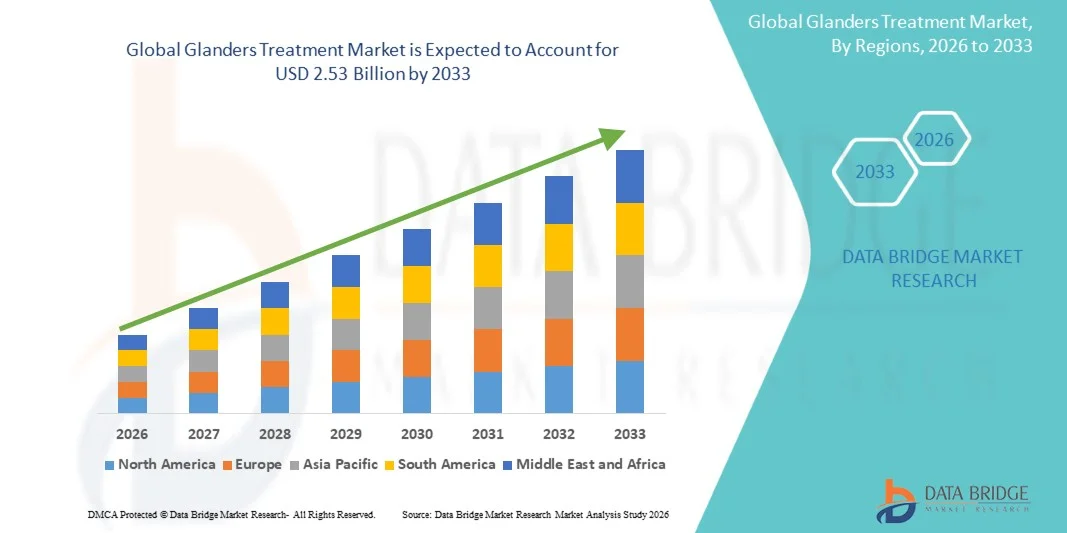
Report Scope and Glanders Treatment Market Segmentation
|
Attributes |
Glanders Treatment Key Market Insights |
|
Segments Covered |
|
|
Countries Covered |
North America · U.S. · Canada · Mexico Europe · Germany · France · U.K. · Netherlands · Switzerland · Belgium · Russia · Italy · Spain · Turkey · Rest of Europe Asia-Pacific · China · Japan · India · South Korea · Singapore · Malaysia · Australia · Thailand · Indonesia · Philippines · Rest of Asia-Pacific Middle East and Africa · Saudi Arabia · U.A.E. · South Africa · Egypt · Israel · Rest of Middle East and Africa South America · Brazil · Argentina · Rest of South America |
|
Key Market Players |
• Pfizer Inc. (U.S.) |
|
Market Opportunities |
· Expansion of Rare Infectious Disease Surveillance Programs · Growing Demand for Advanced Antimicrobial Therapies · Increasing Adoption of Molecular Diagnostic Technologies |
|
Value Added Data Infosets |
In addition to the insights on market scenarios such as market value, growth rate, segmentation, geographical coverage, and major players, the market reports curated by the Data Bridge Market Research also include in-depth expert analysis, geographically represented company-wise production and capacity, network layouts of distributors and partners, detailed and updated price trend analysis and deficit analysis of supply chain and demand. |
Glanders Treatment Market Trends
Trend: Rising Focus on Zoonotic Disease Surveillance & Rare Bacterial Infection Management
Healthcare authorities and infectious disease research organizations are increasingly focusing on surveillance and management of rare zoonotic infections such as Glanders due to growing concerns regarding cross-border disease transmission and biodefense preparedness. Improved adoption of molecular diagnostic technologies, PCR-based pathogen identification, and antimicrobial susceptibility testing is supporting earlier detection and treatment of glanders infections in both humans and animals. In addition, veterinary health agencies and public health institutions are strengthening monitoring programs for equine diseases, particularly in regions with active livestock trade. For instance, the World Organisation for Animal Health (WOAH) continues to classify glanders as a notifiable disease, encouraging stricter disease reporting and surveillance programs globally.
Glanders Treatment Market Dynamics
Key Market Driver: Increasing Government Focus on Rare Infectious Disease Preparedness
The growing global focus on infectious disease preparedness and zoonotic disease control is a major driver for the Glanders Treatment Market. Governments, defense organizations, and healthcare agencies are increasingly investing in advanced antimicrobial therapies and rapid diagnostic infrastructure to manage rare bacterial infections caused by Burkholderia mallei. The increasing prevalence of zoonotic disease outbreaks and rising awareness regarding occupational exposure risks among veterinarians, laboratory personnel, and livestock handlers are further supporting treatment demand. According to global public health estimates, zoonotic diseases account for more than 60% of known infectious diseases worldwide, increasing the importance of effective bacterial infection monitoring and treatment strategies. In addition, rising investments in antibiotic stockpiling and infectious disease biodefense programs are strengthening market growth across North America and Europe.
Key Restraint/Challenge: Limited Patient Population & High Treatment Complexity
A major challenge in the Glanders Treatment Market is the extremely low incidence of the disease, which limits commercial incentives for large-scale drug development and clinical research activities. Treatment typically requires prolonged administration of high-potency antibiotics such as tetracyclines, gentamicin, ciprofloxacin, and streptomycin, increasing healthcare costs and patient management complexity. In addition, delayed diagnosis due to non-specific symptoms and limited awareness among healthcare providers continues to hinder timely treatment initiation. Many low- and middle-income countries also face inadequate laboratory infrastructure for accurate bacterial identification and antimicrobial testing. Furthermore, strict biosafety handling requirements for Burkholderia mallei increase operational and research costs for healthcare and diagnostic institutions globally.
Key Market Opportunity: Expansion of Advanced Molecular Diagnostics & Antimicrobial Research
The increasing advancement of molecular diagnostics and targeted antimicrobial research presents a significant growth opportunity for the Glanders Treatment Market. Expanding adoption of rapid PCR testing, genomic sequencing platforms, and AI-assisted infectious disease analytics is improving diagnostic efficiency and supporting early treatment intervention. Pharmaceutical and biotechnology companies are also investing in next-generation antimicrobial therapies and rare infectious disease research programs to address antibiotic resistance challenges. In addition, growing collaborations between veterinary health agencies, biodefense organizations, and infectious disease research institutes are accelerating innovation in rare bacterial disease management. The expansion of telemedicine and digital infectious disease surveillance systems is further improving access to specialist consultations and outbreak monitoring, particularly across emerging healthcare markets in Asia-Pacific, Latin America, and the Middle East.
Glanders Treatment Market Scope
The Glanders Treatment market is segmented on the basis of treatment and distribution channel.
- By Treatment
On the basis of treatment, the Glanders Treatment Market is segmented into tetracyclines, ciprofloxacin, streptomycin, novobiocin, and gentamicin. The tetracyclines segment dominated the market with a share of 38.64% in 2025 due to its widespread use as a first-line antimicrobial therapy for bacterial zoonotic infections, including glanders. High clinical preference for doxycycline-based regimens, strong availability across hospital settings, and increasing physician familiarity with tetracycline-class antibiotics are supporting segment dominance. In addition, tetracyclines are extensively utilized for long-duration infection management and post-exposure prophylaxis in suspected glanders cases. Growing government focus on infectious disease preparedness and biodefense response programs is further increasing demand for broad-spectrum antibiotics globally. The presence of established pharmaceutical manufacturers, favorable treatment accessibility, and inclusion in antimicrobial treatment protocols continue to strengthen market penetration. Rising investments in rare bacterial disease research and improved infectious disease surveillance programs across North America and Europe are also reinforcing the leading position of this segment in the global market.
The ciprofloxacin segment is expected to witness the fastest CAGR of 7.1% from 2026 to 2033, driven by increasing adoption of fluoroquinolone-based therapies for severe bacterial infections and rising antimicrobial resistance concerns. Ciprofloxacin is gaining strong clinical acceptance due to its high bioavailability, broad-spectrum bacterial coverage, and effectiveness in treating systemic glanders infections. Increasing utilization in emergency infectious disease management programs and growing hospital stockpiling of critical antibiotics are further accelerating segment growth. In addition, expanding research activities focused on advanced antibacterial therapies and combination treatment approaches are supporting future market expansion. Healthcare providers are increasingly adopting ciprofloxacin-based regimens for rapid infection control and improved patient outcomes, particularly in critical care and infectious disease centers. Growing investments in hospital antibiotic stewardship programs and improved access to infectious disease diagnostics across emerging economies are further contributing to segment growth globally.
- By Distribution Channel
On the basis of distribution channel, the Glanders Treatment Market is segmented into hospital pharmacy, retail pharmacy, online pharmacies, and others. The hospital pharmacy segment dominated the market with a share of 46.28% in 2025 due to the high dependence on hospital-based infectious disease treatment and administration of prescription antibiotics for glanders management. Hospitals remain the primary treatment centers for severe bacterial infections requiring specialized monitoring, intravenous antimicrobial administration, and supportive care services. Increasing patient admissions related to rare infectious diseases, rising government investments in public healthcare infrastructure, and growing adoption of rapid molecular diagnostics are supporting segment growth. In addition, hospital pharmacies benefit from strong antibiotic supply networks, infectious disease management protocols, and access to critical care medications required for zoonotic bacterial infection treatment. The increasing presence of infectious disease specialists, microbiology laboratories, and emergency response units within hospitals is further strengthening the dominance of this segment. Rising awareness regarding antimicrobial resistance management and stricter hospital infection control policies are also contributing to increased demand for hospital pharmacy-based treatment distribution globally.
The online pharmacies segment is expected to witness the fastest CAGR of 6.8% from 2026 to 2033, driven by the rapid expansion of digital healthcare platforms and increasing adoption of e-pharmacy services worldwide. Growing internet penetration, rising patient preference for convenient medicine delivery services, and improving accessibility to prescription antibiotics are accelerating segment growth. Online pharmacies are increasingly integrating telemedicine consultation services, digital prescription management, and doorstep delivery models, improving treatment accessibility for patients in remote and underserved regions. In addition, advancements in healthcare e-commerce infrastructure and increasing smartphone adoption across Asia-Pacific and Latin America are supporting market expansion. The growing focus on contactless healthcare services and digital pharmaceutical distribution following post-pandemic healthcare transformation is further boosting adoption. Regulatory improvements supporting licensed online medicine sales and increasing investments in healthcare logistics and cold-chain delivery systems are also contributing to strong future growth of the online pharmacies segment globally.
Glanders Treatment Market Regional Analysis
North America dominated the Glanders Treatment market and accounted for the largest revenue share of 35.12% in 2025, supported by advanced infectious disease surveillance systems, strong biodefense preparedness programs, and increasing government investments in rare bacterial disease research and antimicrobial stockpiling. The region also benefits from robust healthcare infrastructure, growing adoption of molecular diagnostic technologies, and the presence of leading pharmaceutical and infectious disease research organizations. Increasing focus on zoonotic disease preparedness, rapid bacterial detection, and antimicrobial resistance management continues to strengthen North America’s leadership position in the global market.
U.S. Glanders Treatment Market Insight
The U.S. Glanders Treatment market is witnessing strong growth due to rising investments in infectious disease preparedness programs, biodefense initiatives, and advanced antimicrobial therapy development. The country’s strong healthcare infrastructure, extensive research capabilities, and increasing adoption of rapid molecular diagnostics are driving market demand across hospitals, infectious disease centers, and government health agencies. In addition, growing focus on zoonotic disease surveillance, emergency antibiotic stockpiling, and rare bacterial infection management is accelerating treatment adoption across the United States.
Europe Glanders Treatment Market Insight
The Europe Glanders Treatment market remains a major contributor to global revenue, driven by strong government support for infectious disease monitoring, advanced veterinary healthcare systems, and increasing research activities related to zoonotic bacterial infections. The widespread use of molecular diagnostics, antimicrobial stewardship programs, and public health surveillance initiatives is supporting market expansion across the region. Increasing investments in biodefense preparedness, rare infectious disease management, and healthcare laboratory infrastructure continue to enhance the adoption of glanders treatment solutions throughout Europe.
U.K. Glanders Treatment Market Insight
The U.K. Glanders Treatment market is experiencing steady growth, supported by rising investments in infectious disease diagnostics, veterinary surveillance systems, and advanced antimicrobial treatment programs. Increasing government focus on zoonotic disease prevention, laboratory preparedness, and public health safety initiatives is contributing to market expansion. Furthermore, growing integration of genomic testing, rapid bacterial identification technologies, and digital healthcare monitoring systems is improving disease detection and treatment efficiency across the U.K. healthcare sector.
Germany Glanders Treatment Market Insight
The Germany Glanders Treatment market is expanding steadily due to the country’s advanced healthcare infrastructure, strong infectious disease research capabilities, and increasing adoption of next-generation molecular diagnostics. Healthcare institutions, microbiology laboratories, and veterinary research centers are increasingly utilizing advanced bacterial detection technologies for early diagnosis and treatment monitoring. Continuous advancements in antimicrobial therapy research, genomic sequencing technologies, and public health preparedness programs are further supporting market growth in Germany.
Asia-Pacific Glanders Treatment Market Insight
The Asia-Pacific Glanders Treatment market is expected to witness rapid growth, driven by increasing awareness regarding zoonotic infections, expanding veterinary healthcare infrastructure, and rising infectious disease monitoring initiatives across China, India, and Southeast Asia. Growing government focus on livestock disease control, increasing adoption of molecular diagnostic technologies, and rising healthcare investments are supporting regional market expansion. Additionally, improving access to antibiotics, expanding infectious disease surveillance networks, and increasing public health awareness programs are accelerating market growth across Asia-Pacific.
Japan Glanders Treatment Market Insight
The Japan Glanders Treatment market is witnessing consistent growth due to rising investments in infectious disease diagnostics, healthcare innovation, and antimicrobial research programs. Hospitals, research institutes, and public health organizations are increasingly adopting advanced bacterial detection technologies and rapid molecular testing platforms to improve early diagnosis and treatment outcomes. Moreover, increasing focus on healthcare preparedness, zoonotic disease monitoring, and precision diagnostic technologies is further contributing to market growth in Japan.
China Glanders Treatment Market Insight
The China Glanders Treatment market is growing rapidly, driven by expanding healthcare infrastructure, increasing government focus on infectious disease surveillance, and rising investments in veterinary and public health systems. Growing adoption of PCR-based diagnostics, antimicrobial treatment programs, and laboratory automation technologies is significantly boosting market demand. In addition, increasing awareness regarding zoonotic bacterial infections, rising healthcare expenditure, and expanding disease monitoring initiatives are positioning China as one of the fastest-growing markets for glanders treatment globally.
Glanders Treatment Market Share
The Glanders Treatment industry is primarily led by well-established companies, including:
- Pfizer Inc. (U.S.)
- Merck & Co., Inc. (U.S.)
- Johnson & Johnson (U.S.)
- GlaxoSmithKline plc (U.K.)
- Sanofi S.A. (France)
- Bayer AG (Germany)
- Novartis AG (Switzerland)
- F. Hoffmann-La Roche Ltd. (Switzerland)
- Abbott Laboratories (U.S.)
- Bristol-Myers Squibb Company (U.S.)
- Eli Lilly and Company (U.S.)
- Teva Pharmaceutical Industries Ltd. (Israel)
- AstraZeneca PLC (U.K.)
- Cipla Limited (India)
- Sun Pharmaceutical Industries Ltd. (India)
- Dr. Reddy’s Laboratories Ltd. (India)
- Lupin Limited (India)
- Aurobindo Pharma Limited (India)
- Viatris Inc. (U.S.)
- Bausch Health Companies Inc. (Canada)
- Zydus Lifesciences Limited (India)
- Torrent Pharmaceuticals Ltd. (India)
- Amneal Pharmaceuticals, Inc. (U.S.)
- Hikma Pharmaceuticals PLC (U.K.)
- Melinta Therapeutics, LLC (U.S.)
- Paratek Pharmaceuticals, Inc. (U.S.)
- Shionogi & Co., Ltd. (Japan)
- Takeda Pharmaceutical Company Limited (Japan)
- Sumitomo Pharma Co., Ltd. (Japan)
- Kyowa Kirin Co., Ltd. (Japan)
- Endo International plc (Ireland)
- Alkem Laboratories Ltd. (India)
- Glenmark Pharmaceuticals Ltd. (India)
- Wockhardt Ltd. (India)
Latest Developments in Glanders Treatment Market
- In October 2021, researchers from the University of Texas Medical Branch published significant findings on progress in Burkholderia vaccine development, including vaccine candidates targeting Burkholderia mallei, the bacterium responsible for glanders. The study highlighted advancements in immunization strategies, outer membrane protein targeting, and intracellular bacterial vaccine platforms, supporting future therapeutic and preventive approaches for glanders treatment
- In June 2021, scientists published a comparative non-human primate aerosol model study for glanders caused by Burkholderia mallei, helping advance the development of medical countermeasures, diagnostics, and therapeutic research. The study identified African Green Monkeys as an effective model for acute inhalational glanders research, strengthening future drug and biodefense treatment development efforts
- In October 2022, researchers from the Defence Science and Technology Laboratory and MerLion Pharmaceuticals GmbH reported positive results for finafloxacin in a murine inhalational glanders model. The study demonstrated that finafloxacin showed strong bacterial clearance capabilities against Burkholderia mallei, supporting its potential as an alternative post-exposure therapeutic option for glanders treatment
- In April 2026, veterinary and infectious disease researchers published a comprehensive review on glanders covering treatment strategies, antimicrobial resistance patterns, zoonotic transmission risks, and vaccine development pipelines. The report highlighted increasing international collaboration between veterinary health agencies and infectious disease research organizations to strengthen glanders surveillance, diagnosis, and therapeutic innovation

- Interactive Data Analysis Dashboard
- Company Analysis Dashboard for high growth potential opportunities
- Research Analyst Access for customization & queries
- Competitor Analysis with Interactive dashboard
- Latest News, Updates & Trend analysis
- Harness the Power of Benchmark Analysis for Comprehensive Competitor Tracking
Data collection and base year analysis are done using data collection modules with large sample sizes. The stage includes obtaining market information or related data through various sources and strategies. It includes examining and planning all the data acquired from the past in advance. It likewise envelops the examination of information inconsistencies seen across different information sources. The market data is analysed and estimated using market statistical and coherent models. Also, market share analysis and key trend analysis are the major success factors in the market report. To know more, please request an analyst call or drop down your inquiry.
The key research methodology used by DBMR research team is data triangulation which involves data mining, analysis of the impact of data variables on the market and primary (industry expert) validation. Data models include Vendor Positioning Grid, Market Time Line Analysis, Market Overview and Guide, Company Positioning Grid, Patent Analysis, Pricing Analysis, Company Market Share Analysis, Standards of Measurement, Global versus Regional and Vendor Share Analysis. To know more about the research methodology, drop in an inquiry to speak to our industry experts.
Data Bridge Market Research is a leader in advanced formative research. We take pride in servicing our existing and new customers with data and analysis that match and suits their goal. The report can be customized to include price trend analysis of target brands understanding the market for additional countries (ask for the list of countries), clinical trial results data, literature review, refurbished market and product base analysis. Market analysis of target competitors can be analyzed from technology-based analysis to market portfolio strategies. We can add as many competitors that you require data about in the format and data style you are looking for. Our team of analysts can also provide you data in crude raw excel files pivot tables (Fact book) or can assist you in creating presentations from the data sets available in the report.












