


Glass Bonding Adhesive Market Overview
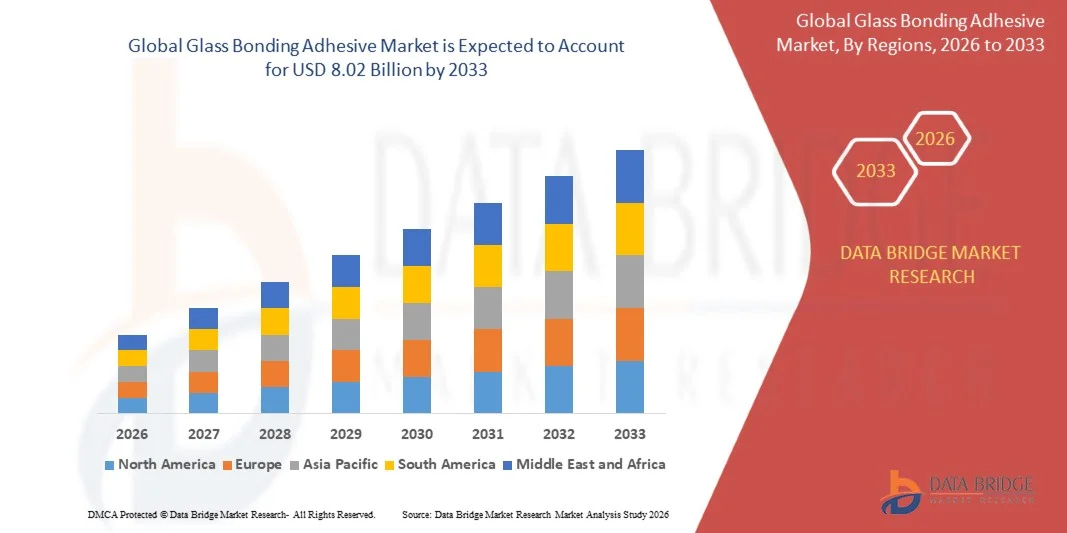
The Glass Bonding Adhesive Market was valued at USD 4.37 billion in 2025 and is projected to reach USD 8.02 billion by 2033, growing at a CAGR of 7.90% from 2026 to 2033. The Glass Bonding Adhesive Market is experiencing steady growth driven by rising demand for lightweight and durable bonding solutions, increasing adoption of advanced adhesive technologies across automotive, construction, electronics, and aerospace industries, and the growing shift toward replacing traditional mechanical fastening methods with efficient adhesive bonding systems.
The increasing use of glass components in vehicle windshields, panoramic roofs, displays, and smart glass applications, combined with growing demand for high-performance adhesives offering superior strength, flexibility, weather resistance, and thermal stability, is encouraging manufacturers to adopt advanced glass bonding solutions. Polyurethane, epoxy, and silicone-based adhesives are increasingly being utilized across automotive assembly, architectural glazing, consumer electronics, and renewable energy applications, providing enhanced durability, improved aesthetics, and faster manufacturing processes.
Key Market Trends & Insights
- North America dominated the Glass Bonding Adhesive Market with the largest revenue share of 34.1% in 2025, supported by advanced manufacturing capabilities, strong automotive production, expanding electronics industries, and increasing demand for high-performance bonding solutions.
- The silicone adhesives segment dominated the market with a 36.8% share in 2025, owing to its extensive adoption across automotive, construction, electronics, and industrial applications due to excellent flexibility, high durability, superior weather resistance, and strong bonding performance.
- Asia-Pacific is expected to be the fastest-growing regional market, registering a CAGR of 2% from 2026 to 2033, driven by expanding automotive production, rapid electronics manufacturing growth, increasing infrastructure development, and rising demand from China, India, Japan, and South Korea.
- UV curable epoxy and UV curable cyanoacrylate adhesives represent the fastest-growing type segment, projected to grow at a CAGR of nearly 7.0% during 2026–2033, due to increasing demand for high-speed curing, precision bonding, and miniaturized component assembly in electronics, optics, and medical applications.
Market Size & Forecast
- Global Market Value (2025): USD 4.37 Billion
- Expected Market Value (2033): USD 8.02 Billion
- Forecast CAGR (2026–2033): 7.90%
- Leading Region in 2025: North America
- Fastest Growing Region: Asia-Pacific
Report Scope and Glass Bonding Adhesive Market Segmentation
|
Attributes |
Glass Bonding Adhesive Key Market Insights |
|
Segments Covered |
|
|
Countries Covered |
North America · U.S. · Canada · Mexico Europe · Germany · France · U.K. · Netherlands · Switzerland · Belgium · Russia · Italy · Spain · Turkey · Rest of Europe Asia-Pacific · China · Japan · India · South Korea · Singapore · Malaysia · Australia · Thailand · Indonesia · Philippines · Rest of Asia-Pacific Middle East and Africa · Saudi Arabia · U.A.E. · South Africa · Egypt · Israel · Rest of Middle East and Africa South America · Brazil · Argentina · Rest of South America |
|
Key Market Players |
• Henkel AG & Co. KGaA (Germany) |
|
Market Opportunities |
· Growing Adoption of Lightweight Materials in Automotive Applications · Rising Demand for Smart Glass and Advanced Electronics Applications · Expansion of Sustainable and High-Performance Adhesive Technologies |
|
Value Added Data Infosets |
In addition to the insights on market scenarios such as market value, growth rate, segmentation, geographical coverage, and major players, the market reports curated by the Data Bridge Market Research also include in-depth expert analysis, geographically represented company-wise production and capacity, network layouts of distributors and partners, detailed and updated price trend analysis and deficit analysis of supply chain and demand. |
Glass Bonding Adhesive Market Trends
Trend: Rising Adoption of Glass Bonding Adhesives in Automotive & Advanced Electronics Applications
Manufacturers across automotive, electronics, medical devices, and industrial sectors are increasingly adopting high-performance Glass Bonding Adhesives to achieve lightweight, durable, and precision assembly solutions. The growing shift toward LED-based automotive lighting, advanced driver assistance systems (ADAS), touch displays, optical sensors, and smart electronic components is accelerating demand for reliable glass-to-metal, glass-to-plastic, and glass-to-glass bonding technologies. For instance, automotive manufacturers are increasingly using UV-curable and silicone-based adhesives in headlamp assemblies and display systems due to their resistance to vibration, temperature fluctuations, and environmental exposure. The expansion of electric vehicles (EVs) and smart vehicle interiors is further increasing the requirement for advanced glass bonding solutions with improved optical clarity and structural performance.
Glass Bonding Adhesive Market Dynamics
Key Market Driver: Increasing Demand from Automotive and Electronics Manufacturing
The rapid growth of automotive electrification, advanced lighting systems, consumer electronics, and optical display technologies is creating significant demand for glass bonding adhesives. Automotive OEMs are adopting adhesive bonding solutions for applications such as automobile headlamps, instrument panels, sensors, and display modules to reduce component weight and improve durability compared with traditional mechanical fastening methods. According to industry trends, global vehicle production exceeding 90 million units annually continues to support demand for automotive adhesive technologies. In electronics, the increasing adoption of smartphones, wearable devices, industrial displays, and optical equipment is driving the use of UV-curable adhesives that enable precise, fast, and clean bonding processes for miniaturized components.
Key Restraint/Challenge: High Material Cost and Technical Requirements for Advanced Adhesives
A major challenge in the Glass Bonding Adhesive Market is the higher cost associated with advanced adhesive formulations, including UV-curable epoxies, specialty silicones, and high-performance polyurethane adhesives. These materials often require controlled processing conditions, specialized curing equipment, and skilled handling to achieve optimal bonding strength and long-term reliability. Industries such as medical devices, electronics, and optical equipment require adhesives with strict performance characteristics, including low shrinkage, chemical resistance, thermal stability, and optical transparency, increasing manufacturing complexity and overall production costs.
For instance, precision applications such as optical glass lenses and medical imaging equipment require adhesives capable of maintaining alignment accuracy and performance over extended operating periods, creating additional qualification and testing requirements for manufacturers.
Key Market Opportunity: Growth of Smart Devices, EVs, and Advanced Optical Technologies
The increasing integration of smart technologies, electric vehicles, and advanced optical systems presents significant growth opportunities for glass bonding adhesive manufacturers. The rising adoption of EV battery displays, digital cockpits, head-up displays (HUDs), cameras, and sensor-based systems is driving demand for adhesives that provide strong bonding performance while maintaining lightweight construction. In addition, advancements in UV-curable adhesive technologies are enabling faster production cycles and improved automation in electronics and industrial assembly.
The expansion of manufacturing hubs across Asia-Pacific, particularly in China, India, Japan, and South Korea, is creating new opportunities for adhesive suppliers as these regions continue to witness strong growth in automotive production, electronics manufacturing, and industrial automation.
Glass Bonding Adhesive Market Scope
The Glass Bonding Adhesive Market is segmented on the basis of type, bonding nature, application, and end user.
- By Type
On the basis of type, the Glass Bonding Adhesive Market is segmented into silicone adhesives, polyurethane adhesives, UV curable cyanoacrylate adhesives, UV curable epoxy adhesives, and others. The Silicone Adhesives segment dominated the market with a 36.8% share in 2025, owing to its extensive adoption across automotive, construction, electronics, and industrial applications due to excellent flexibility, high durability, superior weather resistance, and strong bonding performance. Silicone adhesives provide long-term stability under extreme temperature variations, moisture exposure, and environmental conditions, making them highly suitable for glass bonding applications. The segment is further supported by increasing demand for automotive glazing solutions, architectural glass installations, and advanced industrial bonding technologies. Growing preference for lightweight materials and replacement of traditional mechanical fastening methods with adhesive bonding solutions are strengthening the market position of silicone adhesives.
The UV curable epoxy adhesives segment is projected to register the fastest growth at a CAGR of 7.2% from 2026 to 2033, driven by increasing demand for high-precision and rapid-curing adhesive solutions across electronics, optical devices, medical equipment, and industrial applications. These adhesives offer excellent optical clarity, high bonding strength, chemical resistance, and faster curing capabilities, making them suitable for advanced glass bonding requirements. Rising adoption of miniaturized electronic components, display technologies, and optical assemblies is accelerating demand for UV-curable epoxy adhesives. In addition, advancements in adhesive formulations and increasing focus on efficient manufacturing processes are expected to support strong segment growth during the forecast period.
- By Bonding Nature
On the basis of bonding nature, the Glass Bonding Adhesive Market is segmented into substrate, obstruction, temperature, bond area and gap, and stress. The Substrate segment dominated the market with a 34.5% share in 2025, owing to increasing applications requiring strong adhesion between glass and different materials such as metals, plastics, ceramics, and composites. Substrate bonding solutions are widely used in automotive, electronics, industrial assembly, and construction applications due to their ability to provide high mechanical strength and improved product durability. The growing adoption of adhesive bonding technologies as an alternative to welding, screws, and mechanical fastening methods is driving segment expansion. Increasing demand for lightweight structures, improved aesthetics, and enhanced product performance is further supporting the dominance of this segment.
The temperature segment is expected to witness the fastest CAGR of 6.9% from 2026 to 2033, driven by rising demand for glass bonding adhesives capable of maintaining performance under high-temperature and fluctuating environmental conditions. Automotive, aerospace, electronics, and industrial applications require adhesives with superior thermal resistance and long-term stability. Manufacturers are increasingly developing advanced silicone, epoxy, and polyurethane formulations to withstand extreme operating environments. Growing demand for durable bonding solutions in electric vehicles, electronic systems, and industrial equipment is expected to accelerate the adoption of temperature-resistant glass bonding adhesives.
- By Application
On the basis of application, the Glass Bonding Adhesive Market is segmented into automobile headlamps, optical displays for equipment, glassware, stemware, equipment panels, art glass, bevel bonding, optical glass lenses, crystal figurines, point of sale displays, and others. The automobile headlamps segment dominated the market with a 28.7% share in 2025, supported by increasing vehicle production, growing adoption of advanced lighting systems, and rising demand for lightweight and durable automotive components. Glass bonding adhesives are widely used in headlamp assemblies to provide strong sealing, vibration resistance, moisture protection, and improved structural performance. The increasing integration of LED lighting, adaptive lighting systems, and advanced automotive designs is further driving demand. In addition, the growth of electric vehicles and smart automotive technologies is creating new opportunities for adhesive-based headlamp bonding solutions.
The optical displays for equipment segment is anticipated to witness the fastest CAGR of 7.4% from 2026 to 2033, driven by increasing adoption of advanced displays, touchscreens, optical equipment, and electronic devices requiring transparent and reliable bonding solutions. UV-curable adhesives are gaining popularity in these applications due to their excellent optical performance, fast curing ability, and precise bonding characteristics. The rapid growth of consumer electronics, industrial display systems, medical devices, and smart technologies is contributing to segment expansion. Increasing demand for high-resolution displays and compact electronic designs is expected to further accelerate market growth.
- By End User
On the basis of end user, the Glass Bonding Adhesive Market is segmented into furniture, electronics, medical, transportation, and industrial assembly. The Transportation segment dominated the market with a 31.6% share in 2025, due to increasing usage of glass bonding adhesives in automotive, aerospace, railway, and specialty vehicle applications. The segment growth is supported by rising demand for lightweight vehicles, improved safety features, enhanced aesthetics, and durable glass assemblies. Automotive manufacturers are increasingly adopting adhesive bonding solutions for windshields, panoramic roofs, displays, and structural glass components. Furthermore, the growing production of electric vehicles and increasing integration of smart glass technologies are strengthening the adoption of glass bonding adhesives in transportation applications.
The electronics segment is expected to witness the fastest CAGR of 7.5% from 2026 to 2033, driven by increasing demand for smartphones, displays, sensors, optical devices, and electronic components requiring high-performance glass bonding solutions. The expansion of consumer electronics, wearable devices, and smart technologies is creating strong demand for transparent, durable, and precision bonding adhesives. UV-curable and epoxy adhesives are increasingly preferred in electronic manufacturing due to their fast processing, reliability, and superior performance. In addition, continuous innovation in electronic device designs and increasing miniaturization trends are expected to support rapid growth of this segment.
Glass Bonding Adhesive Market Regional Analysis
North America dominated the Glass Bonding Adhesive Market and accounted for the largest revenue share of 34.1% in 2025, supported by advanced manufacturing capabilities, strong automotive production, expanding electronics industries, and increasing demand for high-performance bonding solutions. The region benefits from the presence of leading automotive manufacturers, electronics companies, and industrial assembly sectors that are adopting advanced adhesive technologies for applications such as automobile headlamps, optical displays, medical equipment, and precision assemblies. Growing demand for lightweight materials, durable bonding solutions, and advanced glass-based components across automotive and industrial applications continues to strengthen North America’s position in the global market.
U.S. Glass Bonding Adhesive Market Insight
The U.S. Glass bonding adhesive market is experiencing significant growth due to rising demand from automotive, electronics, medical, and industrial manufacturing sectors. The country’s strong automotive ecosystem, increasing electric vehicle production, and growing adoption of advanced display and lighting technologies are driving the use of glass bonding adhesives. In addition, increasing investments in semiconductor manufacturing, optical equipment, and high-performance electronic components are supporting demand for UV-curable, silicone, and epoxy adhesive solutions. The presence of major adhesive manufacturers and continuous innovation in bonding technologies further contribute to market expansion.
Europe Glass Bonding Adhesive Market Insight
The Europe glass bonding adhesive market represents a significant share of global revenue, driven by strong automotive manufacturing, advanced industrial capabilities, and increasing adoption of lightweight and durable bonding technologies. Countries across the region are witnessing growing demand for adhesives in automotive lighting systems, electronic displays, medical devices, and industrial equipment. Strict quality standards, sustainability initiatives, and the shift toward electric and connected vehicles are encouraging manufacturers to adopt advanced glass bonding solutions for improved performance and reliability.
U.K. Glass Bonding Adhesive Market Insight
The U.K. glass bonding adhesive market is witnessing steady growth, supported by increasing demand from automotive, electronics, healthcare, and industrial assembly applications. The country’s focus on advanced manufacturing, electric vehicle development, and high-precision engineering is contributing to greater adoption of specialized adhesive technologies. Growing investments in optical systems, medical equipment, and smart electronic devices are further creating opportunities for glass bonding adhesive suppliers in the U.K. market.
Germany Glass Bonding Adhesive Market Insight
The Germany glass bonding adhesive market is expanding steadily due to its strong automotive manufacturing base, advanced engineering capabilities, and high adoption of innovative bonding technologies. Automotive OEMs and suppliers are increasingly utilizing glass bonding adhesives for applications including vehicle lighting, displays, sensors, and lightweight component assembly. Germany’s leadership in automotive innovation, industrial automation, and electric vehicle production is supporting the adoption of high-performance adhesives across multiple industries.
Asia-Pacific Glass Bonding Adhesive Market Insight
The Asia-Pacific glass bonding adhesive market is expected to witness the fastest growth, registering a CAGR of 7.2% from 2026 to 2033, driven by expanding automotive production, rapid electronics manufacturing growth, increasing infrastructure development, and rising demand from China, India, Japan, and South Korea. The region is benefiting from the growing presence of automotive manufacturing hubs, consumer electronics production centers, and industrial assembly facilities. Increasing adoption of smartphones, optical displays, electric vehicles, and advanced vehicle components is creating strong demand for silicone, polyurethane, and UV-curable adhesive solutions.
Japan Glass Bonding Adhesive Market Insight
The Japan glass bonding adhesive market is growing consistently due to the country’s strong automotive industry, advanced electronics manufacturing, and focus on precision engineering. Japanese manufacturers are increasingly adopting glass bonding adhesives for applications such as optical lenses, electronic displays, automotive lighting systems, and medical devices. Continuous innovation in miniaturized electronics, robotics, and electric mobility solutions is further supporting market growth in Japan.
China Glass Bonding Adhesive Market Insight
The China Glass Bonding Adhesive market is expanding rapidly, supported by increasing automotive production, large-scale electronics manufacturing, and growing industrial development. The country’s strong position in electric vehicle production, consumer electronics, and smart manufacturing is driving demand for advanced bonding solutions. Rising investments in automotive R&D, display technologies, optical equipment, and industrial automation are accelerating the adoption of glass bonding adhesives, positioning China as one of the key growth markets globally.
Glass Bonding Adhesive Market Share
The glass bonding adhesive industry is primarily led by well-established companies, including:
- Henkel AG & Co. KGaA (Germany)
- 3M Company (U.S.)
- H.B. Fuller Company (U.S.)
- Sika AG (Switzerland)
- Dow Inc. (U.S.)
- Huntsman Corporation (U.S.)
- Arkema S.A. (France)
- Bostik SA (France)
- Master Bond Inc. (U.S.)
- Permabond LLC (U.S.)
- Dymax Corporation (U.S.)
- DELO Industrial Adhesives (Germany)
- Parker Hannifin Corporation (U.S.)
- LORD Corporation (U.S.)
- Illinois Tool Works Inc. (U.S.)
- RPM International Inc. (U.S.)
- Avery Dennison Corporation (U.S.)
- PPG Industries Inc. (U.S.)
- Momentive Performance Materials Inc. (U.S.)
- Wacker Chemie AG (Germany)
- Kömmerling Chemische Fabrik GmbH (Germany)
- ThreeBond Holdings Co., Ltd. (Japan)
- Panacol-Elosol GmbH (Germany)
- KIWO (Germany)
- Parson Adhesives Inc. (U.S.)
- Scigrip (U.S.)
- Chemence Inc. (U.S.)
- Weicon GmbH & Co. KG (Germany)
- Master Bond Inc. (U.S.)
- Loxeal S.p.A. (Italy)
- Permabond Engineering Adhesives Ltd. (United Kingdom)
- Tremco Incorporated (U.S.)
- Kafuter Adhesives (China)
- Shanghai Kangda New Materials Co., Ltd. (China)
- Hubei Huitian New Materials Co., Ltd. (China)
- Guangdong Orient Resin Co., Ltd. (China)
- Jowat SE (Germany)
- AICA Kogyo Co., Ltd. (Japan)
- Nagase ChemteX Corporation (Japan)
Latest Developments in Glass Bonding Adhesive Market
- In March 2023, Sika AG, a global provider of specialty chemicals and adhesive solutions, announced the launch of SikaTack ULTIMATE, a new primerless auto glass replacement adhesive designed to deliver a 30-minute Minimum Drive Away Time (MDAT). The polyurethane-based adhesive improves installation efficiency by eliminating the need for traditional glass and ceramic frit pre-treatment while providing high-strength bonding performance for automotive glass applications. This launch highlights the industry’s shift toward faster curing, simplified processing, and advanced glass bonding technologies for automotive applications
- In February 2024, Henkel AG & Co. KGaA introduced Loctite 4011S and Loctite 4061S, next-generation cyanoacrylate-based instant adhesives developed for medical device applications. The new adhesives were formulated without CMR (Carcinogenic, Mutagenic, or Reprotoxic) ingredients and were designed to provide improved safety, heat resistance, and bonding performance for applications including catheters, tube sets, surgical robots, and medical equipment housings. This development reflects the growing demand for specialized glass and component bonding solutions in the healthcare and precision manufacturing sectors
- In January 2023, Sika AG highlighted its advanced automotive adhesive technologies, including Sikaflex polyurethane adhesives and SikaPower structural adhesive solutions, at the Car Body Engineering Conference 2023. The company showcased solutions designed for lightweight vehicle manufacturing, mixed-material bonding, and structural applications, supporting the automotive industry’s transition toward electric vehicles and advanced vehicle designs. This development demonstrates the increasing role of adhesive technologies in replacing traditional mechanical fastening methods in vehicle production
- In September 2024, Henkel AG & Co. KGaA expanded its adhesive technology portfolio with the launch of Pattex No More Nails Stick & Peel, an innovative removable adhesive solution capable of bonding surfaces including glass and PVC. The product introduced a high-strength yet removable bonding approach, supporting growing demand for flexible adhesive solutions across consumer, construction, and decorative applications. This launch reflects continued innovation toward easy-to-use and sustainable bonding technologies
- In May 2025, Sika AG launched Sikaflex P2G Premium, a new primerless auto glass replacement adhesive designed for enhanced automotive glass bonding performance. The solution offers a 3-hour Minimum Drive-Away Time (MDAT), improved temperature performance, and simplified installation without requiring glass or frit pre-treatment. The launch supports increasing automotive demand for efficient, durable, and high-performance glass bonding solutions as vehicle designs become more advanced

- Interactive Data Analysis Dashboard
- Company Analysis Dashboard for high growth potential opportunities
- Research Analyst Access for customization & queries
- Competitor Analysis with Interactive dashboard
- Latest News, Updates & Trend analysis
- Harness the Power of Benchmark Analysis for Comprehensive Competitor Tracking
Global Glass Bonding Adhesives Market, Supply Chain Analysis and Ecosystem Framework
To support market growth and help clients navigate the impact of geopolitical shifts, DBMR has integrated in-depth supply chain analysis into its Global Glass Bonding Adhesives Market research reports. This addition empowers clients to respond effectively to global changes affecting their industries. The supply chain analysis section includes detailed insights such as Global Glass Bonding Adhesives Market consumption and production by country, price trend analysis, the impact of tariffs and geopolitical developments, and import and export trends by country and HSN code. It also highlights major suppliers with data on production capacity and company profiles, as well as key importers and exporters. In addition to research, DBMR offers specialized supply chain consulting services backed by over a decade of experience, providing solutions like supplier discovery, supplier risk assessment, price trend analysis, impact evaluation of inflation and trade route changes, and comprehensive market trend analysis.
Data collection and base year analysis are done using data collection modules with large sample sizes. The stage includes obtaining market information or related data through various sources and strategies. It includes examining and planning all the data acquired from the past in advance. It likewise envelops the examination of information inconsistencies seen across different information sources. The market data is analysed and estimated using market statistical and coherent models. Also, market share analysis and key trend analysis are the major success factors in the market report. To know more, please request an analyst call or drop down your inquiry.
The key research methodology used by DBMR research team is data triangulation which involves data mining, analysis of the impact of data variables on the market and primary (industry expert) validation. Data models include Vendor Positioning Grid, Market Time Line Analysis, Market Overview and Guide, Company Positioning Grid, Patent Analysis, Pricing Analysis, Company Market Share Analysis, Standards of Measurement, Global versus Regional and Vendor Share Analysis. To know more about the research methodology, drop in an inquiry to speak to our industry experts.
Data Bridge Market Research is a leader in advanced formative research. We take pride in servicing our existing and new customers with data and analysis that match and suits their goal. The report can be customized to include price trend analysis of target brands understanding the market for additional countries (ask for the list of countries), clinical trial results data, literature review, refurbished market and product base analysis. Market analysis of target competitors can be analyzed from technology-based analysis to market portfolio strategies. We can add as many competitors that you require data about in the format and data style you are looking for. Our team of analysts can also provide you data in crude raw excel files pivot tables (Fact book) or can assist you in creating presentations from the data sets available in the report.













