


What is the Glass Reinforced Plastics (GRP) Pipes Market Size and Growth Rate?
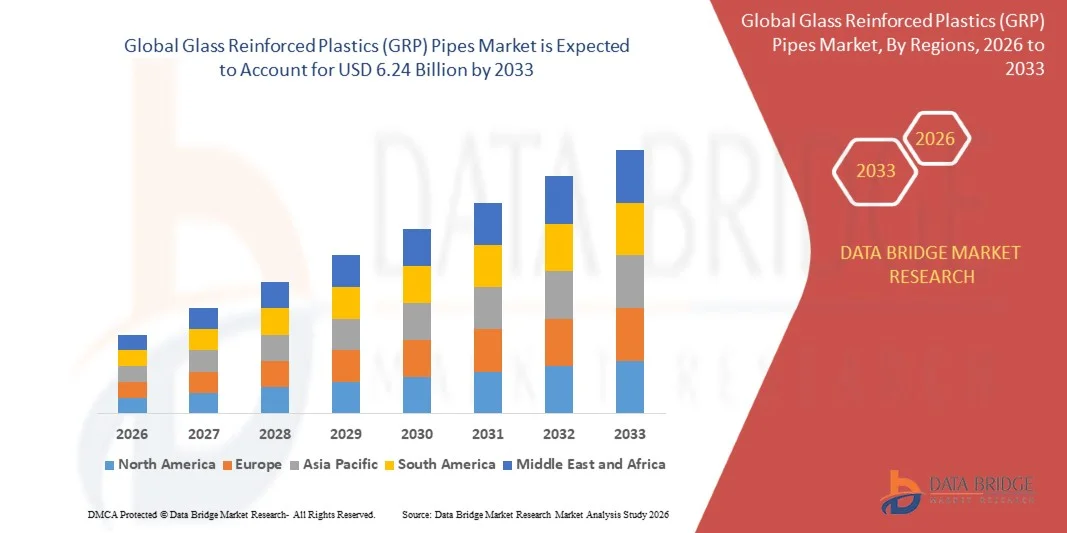
- As per Data Bridge Market Research analysis, the glass reinforced plastics (GRP) pipes market was valued at USD 4.45 billion in 2025 and is projected to reach USD 6.24 billion by 2033, growing at a CAGR of 4.32% from 2026 to 2033.
- The market is experiencing consistent growth driven by rising investments in water and wastewater infrastructure, increasing replacement of conventional metal pipelines, expanding industrial fluid transportation, and growing adoption of corrosion-resistant and low-maintenance piping systems.
- The increasing need for durable and lightweight pipeline infrastructure, combined with rapid urbanization, water-network modernization, and expansion of oil and gas, chemical, irrigation, and desalination projects, is compelling municipalities and industrial operators to adopt GRP pipes. Their corrosion resistance, long service life, lower maintenance requirements, and ease of installation are supporting wider replacement of traditional steel and concrete piping systems.
Market Size & Forecast
- Global Market Value (2025): USD 4.45 Billion
- Expected Market Value (2033): USD 6.24 Billion
- Forecast CAGR (2026–2033): 4.32%
- Leading Region in 2025: North America
- Fastest Growing Region: Asia Pacific
What are the Major Takeaways of the Glass Reinforced Plastics (GRP) Pipes Market?
- North America dominated the glass reinforced plastics (GRP) pipes market with the largest revenue share of 38% in 2025, supported by aging water infrastructure, replacement of conventional pipelines, and increasing adoption of corrosion-resistant piping systems.
- Asia-Pacific is expected to be the fastest-growing region at a CAGR of 7.0% from 2026 to 2033, fueled by rapid urbanization, expanding water and wastewater infrastructure, and rising investments in industrial and desalination projects.
- The industrial type segment led the market with a 80% share in 2025, driven by its extensive use across water transmission, wastewater treatment, oil and gas, chemical processing, irrigation, and industrial fluid-handling applications.
- Decorative type is the fastest-growing type, projected to register a CAGR of 6.5%, reflecting the surge in use of GRP materials in architectural, landscaping, construction, and aesthetic applications
- The pressure pipes segment dominated the product type category with a 35% revenue share in 2025, led by extensive application in water transmission, irrigation, industrial fluid transportation, and other pressurized systems.
- Polyester accounted for 45% of the market share in 2025, preferred by its broad application in water, irrigation, sewage, and industrial piping
- The sewage segment is the fastest-growing application category, with a CAGR of 4.3%, driven by increasing investment in wastewater collection, sewage treatment, and sanitation infrastructure.
Report Scope and Glass Reinforced Plastics (GRP) Pipes Market Segmentation
|
Attributes |
Glass Reinforced Plastics (GRP) Pipes Key Market Insights |
|
Segments Covered |
|
|
Countries Covered |
North America
Europe
Asia-Pacific
Middle East and Africa
South America
|
|
Key Market Players |
|
|
Market Opportunities |
|
|
Value Added Data Infosets |
In addition to the insights on market scenarios such as market value, growth rate, segmentation, geographical coverage, and major players, the market reports curated by the Data Bridge Market Research also include import export analysis, production capacity overview, production consumption analysis, price trend analysis, climate change scenario, supply chain analysis, value chain analysis, raw material/consumables overview, vendor selection criteria, PESTLE Analysis, Porter Analysis, and regulatory framework. |
What is the Key Trend in the Glass Reinforced Plastics (GRP) Pipes Market?
- GRP pipe adoption is increasingly shifting toward trenchless rehabilitation and long-distance water infrastructure, as lightweight construction, corrosion resistance, and fewer joints support efficient installation in difficult urban and underground environments.
- For instance, in July 2025, SUPERLIT announced the supply of 4,720 meters of GRP pipes, ranging from DN 500 mm to DN 1,800 mm, for the Afak Sewerage Project in Iraq. The project demonstrates the use of GRP piping in modern sewerage and underground infrastructure development.
- Digital condition monitoring is emerging as an important trend, with utilities exploring inspection technologies that identify weak spots, joint deterioration, and ageing-related failures before they disrupt water treatment operations overall.
- Manufacturers are increasingly developing application-specific GRP systems using advanced resins, glass fibres, and optimized winding technologies to improve chemical resistance, pressure performance, durability, and suitability for demanding infrastructure industrial applications.
- For instance, in March 2025, SUPERLIT announced that its GRP pipes were being supplied for a major infrastructure project in Texas, highlighting growing use of corrosion-resistant GRP piping in U.S. water-management infrastructure. The company specifically cited durability, leak-proof performance, and corrosion resistance as characteristics supporting the application.
- Municipalities and industrial operators are increasingly selecting GRP pipes for sustainable infrastructure upgrades because their corrosion resistance and lower maintenance requirements can extend service life while reducing recurring repair requirements.
What are the Key Drivers of the Glass Reinforced Plastics (GRP) Pipes Market?
- The growing investment in water and wastewater infrastructure is increasing demand for GRP pipes because utilities require corrosion-resistant, lightweight, durable systems for municipal networks, sewage transportation, treatment facilities, and water transmission.
- For instance, in December 2024, SUPERLIT announced the supply of approximately 14 km of GRP pipes, with diameters ranging from DN 600 to DN 3,000 mm, for the Reyhanlı Dam Irrigation 1st Phase Completion Project in Türkiye. The project is intended to provide irrigation services to approximately 117,380 decares of agricultural land, demonstrating demand for large-diameter GRP pipes in agricultural water infrastructure
- Rapid urbanization and population growth are encouraging governments to expand water supply and sanitation networks, increasing demand for GRP pipes that offer installation, compared with conventional materials and reduced maintenance.
- Expansion of desalination projects is supporting GRP pipe adoption because seawater and treated-water systems require materials capable of resisting corrosion and chemical exposure under demanding operating conditions for service periods.
- For instance, in December 2024, Thames Water installed GRP lining in London's Northern Outfall Sewer as part of a USD 92.5 million upgrade. The company stated that the GRP solution would improve the durability of the Victorian sewer and help maintain reliable wastewater services as London's population increases.
- Increasing irrigation modernization is creating demand for GRP pipelines, particularly in agricultural regions where durable, lightweight systems can support efficient water distribution across large areas while reducing maintenance and leakage.
Which Factors are Challenging the Growth of the Glass Reinforced Plastics (GRP) Pipes Market?
- High procurement and installation costs can restrict GRP pipe adoption in price-sensitive projects, particularly when buyers compare composite systems with established alternatives and prioritize lower capital expenditure over lifecycle benefits.
- For instance, in September 2023, researchers from Tata Steel reported a premature failure of a buried GFRP pipeline during hydrostatic testing at a construction site in India. The failure highlights the sensitivity of GRP/GFRP piping to material quality, manufacturing characteristics, and installation conditions, which can increase testing, quality-control, and replacement requirements.
- Limited availability of specialized installation expertise can create project challenges because GRP systems require appropriate handling, joining, bedding, alignment, and installation practices to achieve expected structural and hydraulic performance consistently
- GRP pipelines can experience deterioration from prolonged ultraviolet exposure and poor lamination workmanship, creating inspection, repair, and maintenance requirements that can increase operational risks for exposed or improperly installed systems.
- For instance, in February 2023, an Engineering Failure Analysis study examined a GFRP sewage pipe that failed after 15 years of service in an oilfield in China. The investigation identified resin degradation, insufficient curing, cavity defects, low resin content, and weakened fiber–resin bonding, demonstrating the potential for long-term material degradation and associated maintenance challenges.
- Volatility in resin and glass-fibre input costs can pressure manufacturers’ margins and project pricing, particularly when fluctuations in feedstock markets make procurement costs less predictable for infrastructure contracts and tenders.
How is the Glass Reinforced Plastics (GRP) Pipes Market Segmented?
The glass reinforced plastics (GRP) pipes market is segmented on the basis of type, product type, resin type, and application.
- By Type
On the basis of type, the GRP pipes market is segmented into industrial type and decorative type. The industrial type segment dominated the market with an estimated 80% share in 2025, owing to its extensive use across water transmission, wastewater treatment, oil and gas, chemical processing, irrigation, and industrial fluid-handling applications. Industrial GRP pipes offer strong resistance to corrosion, chemicals, moisture, and demanding operating environments. Their lightweight construction supports easier transportation and installation compared with many conventional metallic piping systems. The pipes are also suitable for applications requiring reliable long-term fluid transportation and reduced maintenance requirements. Growing investment in industrial facilities, water infrastructure, and wastewater-management systems is supporting continued adoption.
The decorative type segment is projected to register the fastest growth at an estimated CAGR of 6.5% from 2026 to 2033, supported by increasing use of GRP materials in architectural, landscaping, construction, and aesthetic applications. Decorative GRP products can be manufactured in customized shapes, designs, and surface finishes. Their lightweight characteristics make them relatively easy to transport and install in architectural applications. Resistance to moisture and corrosion also supports their use in selected outdoor and building environments. Growing investment in commercial buildings, hospitality infrastructure, recreational facilities, and urban beautification is creating additional demand. Improvements in composite manufacturing are enabling greater design flexibility and customization.
- By Product Type
On the basis of product type, the GRP pipes market is segmented into pressure pipes, non-pressure pipes, filament wound GRP pipes, centrifugally cast GRP pipes, hand lay-up GRP pipes, pultruded GRP pipes, and other GRP pipes. The pressure pipes segment dominated the market with an estimated 35% share in 2025, driven by extensive application in water transmission, irrigation, industrial fluid transportation, and other pressurized systems. GRP pressure pipes provide high strength while maintaining corrosion resistance and relatively low weight. Their smooth internal surfaces support efficient fluid movement and help reduce friction-related losses. They are widely used where consistent pressure performance and long service life are required.
The filament wound GRP pipes segment is projected to register the fastest growth at an estimated CAGR of 7.0% from 2026 to 2033, owing to the manufacturing process's ability to provide high strength and controlled reinforcement. Filament winding enables glass fibers to be positioned according to required mechanical and pressure-resistance characteristics. This makes the technology suitable for demanding water, industrial, chemical, and energy applications. Manufacturers can customize the reinforcement structure according to specific operating requirements. Increasing demand for lightweight and corrosion-resistant alternatives to conventional metallic pipes is supporting adoption. Automation and improvements in filament-winding technology are also improving manufacturing consistency.
- By Resin Type
On the basis of resin type, the GRP pipes market is segmented into epoxy, polyester, and vinyl ester. The polyester segment dominated the market with an estimated 45% share in 2025, supported by its broad application in water, irrigation, sewage, and industrial piping. Polyester resin provides a balance of mechanical performance, corrosion resistance, processability, and cost efficiency. It is compatible with several GRP manufacturing techniques and is therefore widely used in large-scale pipe production. Its availability and established manufacturing base further support its extensive adoption. Demand for cost-effective corrosion-resistant piping in municipal and agricultural infrastructure is contributing to segment growth.
The vinyl ester segment is projected to register the fastest growth at an estimated CAGR of 6.8% from 2026 to 2033, driven by increasing demand for GRP pipes in chemically aggressive and highly corrosive environments. Vinyl ester resins provide strong chemical resistance and are suitable for demanding industrial applications. They are increasingly used in chemical processing, wastewater, oil and gas, and other applications where resistance to aggressive fluids is important. Their performance characteristics can support longer service life in challenging operating conditions. Increasing replacement of corrosion-prone metallic piping is creating additional demand for higher-performance resin systems. Improvements in resin formulations are also expanding the range of applications for vinyl ester GRP pipes.
- By Application
On the basis of application, the GRP pipes market is segmented into oil and gas, chemical, sewage, irrigation, and others. The irrigation segment dominated the market with a 38.7% share in 2025, supported by extensive demand for durable water-conveyance systems in agricultural infrastructure. GRP pipes provide strong corrosion resistance, making them suitable for long-term transportation of irrigation water. Their smooth internal surfaces support efficient water flow and can help reduce friction losses. Lightweight construction also facilitates transportation and installation across agricultural projects. Increasing agricultural water requirements and investment in irrigation infrastructure are supporting continued demand. GRP pipes are particularly suitable for long-distance water conveyance where durability and hydraulic efficiency are important.
The sewage segment is projected to register the fastest growth at a CAGR of 4.3% from 2026 to 2033, driven by increasing investment in wastewater collection, sewage treatment, and sanitation infrastructure. GRP pipes provide resistance to corrosion caused by aggressive substances encountered in wastewater systems. Their smooth internal surface can support efficient sewage flow and reduce the potential for deposits. Growing urbanization is increasing pressure on existing sewer networks and creating demand for infrastructure modernization. Governments and municipalities are also strengthening wastewater collection and treatment systems. The need to improve wastewater management and reduce leakage is supporting the use of durable piping materials.
Which Region Holds the Largest Share of the Glass Reinforced Plastics (GRP) Pipes Market?
- North America dominated the glass reinforced plastics (GRP) pipes market with the largest revenue share of 38% in 2025, supported by aging water infrastructure, replacement of conventional pipelines, and increasing adoption of corrosion-resistant piping systems.
- The region also benefits from increasing adoption of lightweight, durable, and corrosion-resistant piping solutions across water transmission, sewage, irrigation, chemical, and oil and gas applications. Growing infrastructure replacement requirements, expansion of municipal water systems, and demand for long-lasting pipeline materials continue to strengthen North America’s position in the global market.
U.S. Glass Reinforced Plastics (GRP) Pipes Market Insight
U.S. GRP pipes market is witnessing strong growth due to rising investments in water and wastewater infrastructure, pipeline rehabilitation, and industrial fluid-handling systems. The country’s aging water infrastructure, along with increasing adoption of lightweight, corrosion-resistant, and durable piping solutions, is driving demand across municipal, industrial, irrigation, and oil and gas applications. In addition, growing emphasis on reducing pipeline maintenance requirements and improving the service life of water and wastewater networks is accelerating GRP pipe adoption across infrastructure projects and industrial facilities.
Asia-Pacific Glass Reinforced Plastics (GRP) Pipes Market Insight
The Asia-Pacific GRP pipes market is expected to witness rapid growth, driven by increasing urbanization, expanding water infrastructure, and rising investments in irrigation and wastewater-management systems across countries such as China, India, and Japan. Growing demand for corrosion-resistant and lightweight piping solutions, along with increasing industrialization and infrastructure development, is supporting regional market expansion. In addition, rising investments in desalination, municipal water networks, chemical processing, and agricultural irrigation are accelerating GRP pipe adoption across public and industrial applications.
Japan Glass Reinforced Plastics (GRP) Pipes Market Insight
The Japan GRP pipes market is witnessing consistent growth due to rising investments in water infrastructure modernization, wastewater management, and advanced pipeline systems. Municipal utilities, industrial facilities, and infrastructure developers are increasingly adopting GRP pipes for applications requiring corrosion resistance, durability, and efficient fluid transportation. Moreover, increasing focus on replacing aging infrastructure, improving pipeline reliability, and reducing maintenance requirements is further contributing to market growth in Japan.
China Glass Reinforced Plastics (GRP) Pipes Market Insight
The China GRP pipes market is growing rapidly, driven by increasing urbanization, expanding municipal water networks, and rising investments in wastewater and irrigation infrastructure. Growing adoption of corrosion-resistant and lightweight piping systems across water supply, industrial, chemical, and sewage applications is significantly boosting market demand. In addition, rising investments in large-scale infrastructure projects, water conservation initiatives, and industrial development are positioning China as one of the important markets for GRP pipes globally.
U.K. Glass Reinforced Plastics (GRP) Pipes Market Insight
The U.K. GRP pipes market is experiencing steady growth, supported by rising adoption of corrosion-resistant piping solutions in water, wastewater, sewage, and infrastructure rehabilitation applications. Increasing investments in aging water and sewer networks and growing demand for durable, low-maintenance pipeline systems are contributing to market growth. Furthermore, the use of GRP materials for pipeline rehabilitation and infrastructure modernization is improving system durability and operational efficiency, supporting the U.K. market for GRP pipes.
Germany Glass Reinforced Plastics (GRP) Pipes Market Insight
The Germany GRP pipes market is expanding steadily due to the country’s strong industrial base, advanced infrastructure capabilities, and increasing demand for durable pipeline systems. Industrial companies, municipal utilities, and infrastructure developers are increasingly utilizing GRP pipes for water, wastewater, chemical, and industrial fluid-handling applications. Continuous investments in infrastructure modernization, corrosion-resistant materials, and efficient water-management systems, along with increasing emphasis on reducing maintenance requirements, are further driving market growth in Germany.
Which are the Top Companies in Glass Reinforced Plastics (GRP) Pipes Market?
The glass reinforced plastics (GRP) pipes industry is primarily led by well-established companies, including:
- Amiblu Holding GmbH (Austria)
- Future Pipe Industries (UAE)
- Saudi Arabian Amiantit Company (Saudi Arabia)
- SUPERLIT Boru Sanayi A.Ş. (Türkiye)
- Hengrun Group Co., Ltd. (China)
- Farassan Manufacturing and Industrial Co. (Iran)
- Abu Dhabi Pipe Factory (UAE)
- Smithline Composites (UAE)
- Plasticon Composites (Netherlands)
- Composite Pipes Industry LLC (UAE)
- APS Advanced Piping Systems (Australia)
- Bel Composite Industries (UAE)
- Industrial Plastic Systems (U.S.)
- Sarplast S.p.A. (Italy)
- Graphite India Limited (India)
- EPP Composites Pvt. Ltd. (India)
- Kinflare Group (China)
- Augusta Fiberglass Coatings, Inc. (U.S.)
- China National Building Material Company Limited (China)
- Shandong Longquan Pipeline Engineering Co., Ltd. (China)
What are Latest Developments in Glass Reinforced Plastics (GRP) Pipes Market?
- In March 2025, SUPERLIT announced that it had completed shipments of high-performance GRP pipes for a major infrastructure project in Texas, supporting water-management infrastructure in the U.S. The project highlighted the use of GRP pipes for their durability, leak-proof performance, corrosion resistance, and long-term infrastructure benefits.
- In December 2024, SUPERLIT announced the supply of approximately 14 kilometers of GRP pipes for the Reyhanlı Dam Irrigation 1st Phase Completion Project in Türkiye. The pipes, ranging from DN 600 to DN 3,000 mm, are being used to support irrigation infrastructure and improve the efficient use of water resources for agricultural development.
- In May 2023, SUPERLIT announced the completion of deliveries of GRP pipes for a water treatment plant in Dakar, Senegal. The project involved DN 1,000 and DN 1,100 GRP pipes, demonstrating the application of GRP piping in water-treatment infrastructure and the continued deployment of composite piping solutions in African water projects.
- In January 2023, Thames Water announced a USD 92.5 million upgrade of London's Northern Outfall Sewer, with GRP pipes included as part of the modernization work. The project was designed to improve the resilience of the Victorian sewer system, with GRP selected to provide reliable infrastructure performance as the capital's population increases.
- In September 2021, SUPERLIT announced that GRP pipes and fittings were being supplied for the Edirne Meriç Irrigation Project in Türkiye. The project included a 23-kilometer pipeline using GRP pipes ranging from DN 600 to DN 1,500 mm, supporting the modernization of irrigation infrastructure and agricultural water distribution.

- Interactive Data Analysis Dashboard
- Company Analysis Dashboard for high growth potential opportunities
- Research Analyst Access for customization & queries
- Competitor Analysis with Interactive dashboard
- Latest News, Updates & Trend analysis
- Harness the Power of Benchmark Analysis for Comprehensive Competitor Tracking
Global Glass Reinforced Plastics Grp Pipes Market, Supply Chain Analysis and Ecosystem Framework
To support market growth and help clients navigate the impact of geopolitical shifts, DBMR has integrated in-depth supply chain analysis into its Global Glass Reinforced Plastics Grp Pipes Market research reports. This addition empowers clients to respond effectively to global changes affecting their industries. The supply chain analysis section includes detailed insights such as Global Glass Reinforced Plastics Grp Pipes Market consumption and production by country, price trend analysis, the impact of tariffs and geopolitical developments, and import and export trends by country and HSN code. It also highlights major suppliers with data on production capacity and company profiles, as well as key importers and exporters. In addition to research, DBMR offers specialized supply chain consulting services backed by over a decade of experience, providing solutions like supplier discovery, supplier risk assessment, price trend analysis, impact evaluation of inflation and trade route changes, and comprehensive market trend analysis.
Data collection and base year analysis are done using data collection modules with large sample sizes. The stage includes obtaining market information or related data through various sources and strategies. It includes examining and planning all the data acquired from the past in advance. It likewise envelops the examination of information inconsistencies seen across different information sources. The market data is analysed and estimated using market statistical and coherent models. Also, market share analysis and key trend analysis are the major success factors in the market report. To know more, please request an analyst call or drop down your inquiry.
The key research methodology used by DBMR research team is data triangulation which involves data mining, analysis of the impact of data variables on the market and primary (industry expert) validation. Data models include Vendor Positioning Grid, Market Time Line Analysis, Market Overview and Guide, Company Positioning Grid, Patent Analysis, Pricing Analysis, Company Market Share Analysis, Standards of Measurement, Global versus Regional and Vendor Share Analysis. To know more about the research methodology, drop in an inquiry to speak to our industry experts.
Data Bridge Market Research is a leader in advanced formative research. We take pride in servicing our existing and new customers with data and analysis that match and suits their goal. The report can be customized to include price trend analysis of target brands understanding the market for additional countries (ask for the list of countries), clinical trial results data, literature review, refurbished market and product base analysis. Market analysis of target competitors can be analyzed from technology-based analysis to market portfolio strategies. We can add as many competitors that you require data about in the format and data style you are looking for. Our team of analysts can also provide you data in crude raw excel files pivot tables (Fact book) or can assist you in creating presentations from the data sets available in the report.













