


What is the Glass-reinforced Substrate Market Size and Growth Rate?
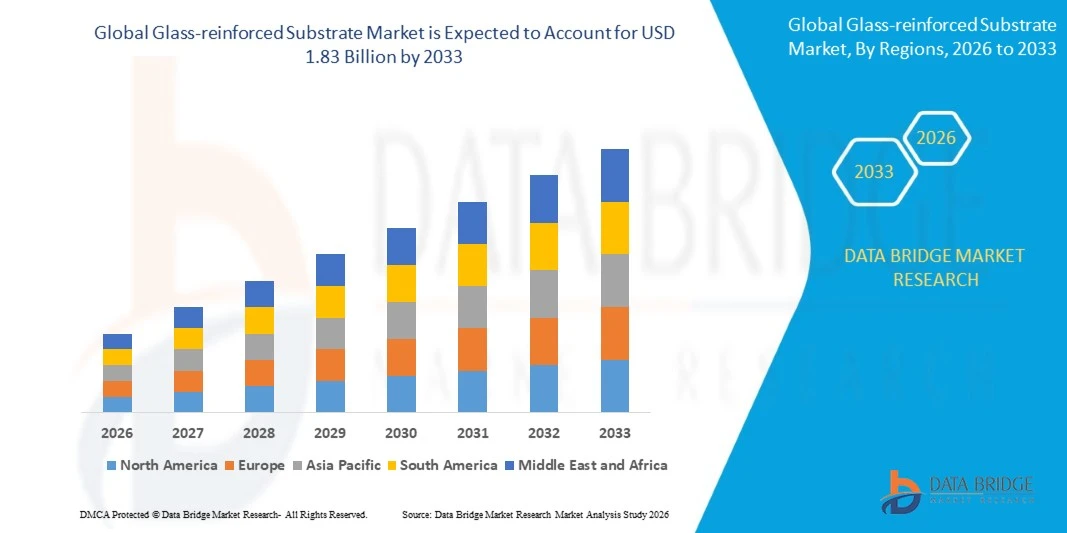
- As per Data Bridge Market Research analysis, the glass-reinforced substrate market was valued at USD 1.35 billion in 2025 and is projected to reach USD 1.83 billion by 2033, growing at a CAGR of 3.90% from 2026 to 2033.
- The market is experiencing steady growth driven by rising demand for dimensionally stable, thermally reliable laminates used in IC package substrates, high-speed printed circuit boards, and power electronics, together with growing deployment of AI servers, data center networking equipment, and automotive electronics.
- The increasing complexity of semiconductor packages, larger substrate footprints, higher layer counts, and the shift toward low-dielectric and low-CTE glass reinforcement are supporting market adoption. Glass-reinforced substrates are being applied across semiconductor packaging, printed circuit boards, and AI servers, offering the mechanical strength, heat resistance, and electrical insulation required for next-generation electronic systems.
Market Size & Forecast
- Global Market Value (2025): USD 1.35 billion
- Expected Market Value (2033): USD 1.83 billion
- Forecast CAGR (2026–2033): 3.90%
- Leading Region in 2025: Asia-Pacific
- Fastest Growing Region: North America
What are the Major Takeaways of the Glass-reinforced Substrate Market?
- Asia-Pacific dominated the glass-reinforced substrate market with the largest revenue share of 62.42% in 2025, supported by the concentration of printed circuit board, copper-clad laminate, and IC substrate manufacturing in China, Taiwan, Japan, and South Korea, along with the presence of leading glass cloth and laminate producers.
- North America is expected to be the fastest-growing region at a CAGR of 5.30% from 2026 to 2033, fueled by rising investment in domestic semiconductor packaging, AI server assembly, and advanced PCB capacity.
- The epoxy glass laminates (FR-4 type) segment led the type category with a 54.81% share in 2025, supported by its balanced cost, strength, and insulation properties across rigid printed circuit boards.
- BT resin glass laminates is the fastest-growing type segment, projected to register a CAGR of 5.60% from 2026 to 2033, supported by its low thermal expansion and heat resistance in memory and logic package substrates.
- The e-glass segment led the glass cloth grade category with a 63.23% share in 2025, supported by its low cost and broad use in standard laminates.
- The high-speed pcbs segment led the application category with a 39.78% share in 2025, supported by the volume of server, switch, and networking boards.
- IC package substrates is the fastest-growing application segment, projected to register a CAGR of 6.90% from 2026 to 2033, driven by rising substrate size and layer counts in AI accelerator and memory packages.
Report Scope and Glass-reinforced Substrate Market Segmentation
|
Attributes |
Glass-reinforced Substrate Key Market Insights |
|
Segments Covered |
|
|
Countries Covered |
North America
Europe
Asia-Pacific
Middle East and Africa
South America
|
|
Key Market Players |
|
|
Market Opportunities |
|
|
Value Added Data Infosets |
In addition to the insights on market scenarios such as market value, growth rate, segmentation, geographical coverage, and major players, the market reports curated by the Data Bridge Market Research also include in-depth expert analysis, geographically represented company-wise production and capacity, network layouts of distributors and partners, detailed and updated price trend analysis and deficit analysis of supply chain and demand. |
What is the Key Trend in the Glass-reinforced Substrate Market?
- Glass-reinforced substrates are shifting from commodity FR-4 laminates toward engineered, high-performance materials in which glass cloth grade, resin chemistry, and laminate construction are tuned for warpage control, signal integrity, and thermal reliability in AI-class packages and boards.
- For instance, in February 2026, according to DIGITIMES, Nittobo plans to launch a next-generation T-glass cloth in 2028, reflecting the move toward advanced low-CTE glass reinforcement for larger and more complex package substrates.
- Substrate and laminate makers are qualifying alternative glass cloth sources and blended constructions, including partial substitution of premium layers with standard-grade glass, to ease supply pressure while maintaining package reliability.
- For instance, in January 2026, according to TVBS News, Taiwan’s Unimicron reported January revenue of USD 321 million, up 34.5% year over year, with capacity utilization above 90%, highlighting how advanced package substrate demand is pulling high-grade glass-reinforced materials through the supply chain.
- Vertical coordination between glass cloth suppliers, laminate producers, and substrate manufacturers, including long-term supply contracts, is becoming a defining feature of the market.
- As AI accelerators, networking silicon, and automotive electronics continue to increase package size and board complexity, glass-reinforced substrates are expected to remain the structural backbone of electronic interconnects, with growth concentrated in low-CTE and low-Dk grades.
What are the Key Drivers of the Glass-reinforced Substrate Market?
- The rapid build-out of AI servers and data center infrastructure has significantly increased demand for large, high-layer-count package substrates and high-speed boards that depend on glass-reinforced laminates for dimensional stability and electrical performance.
- For instance, in January 2026, according to TVBS News, Unimicron raised its 2026 capital expenditure from NTD 25 billion to more than NTD 34 billion, with roughly 70% earmarked for ABF substrate expansion to support advanced packaging platforms, underscoring the scale of investment in substrate capacity.
- Growing content of electronics in vehicles, expanding 5G and high-speed networking equipment, and continued consumer device production provide a stable base of demand for mainstream FR-4 and BT-based laminates.
- For instance, in August 2026, according to Nikkei Asia, Nittobo reported April–June 2026 revenue of JPY 34.0 billion, up 21% year over year, with net profit rising 84% to JPY 5.7 billion, and committed JPY 80 billion (USD 550 million) to expand semiconductor materials production in Japan and Taiwan.
- Rising board sizes, layer counts, and thermal loads are increasing the glass-reinforced material content per device, supporting value growth even where unit volumes are mature.
What Factors Are Challenging the Growth of the Glass-reinforced Substrate Market?
- The supply of premium low-CTE glass cloth is concentrated among a very small number of producers, and qualification of new suppliers requires lengthy testing, which can limit capacity additions and create allocation risk for substrate and laminate makers.
- For instance, in February 2026, according to heise online, Nittobo was reported to hold around 90% of the semiconductor-grade glass fiber cloth segment, and Apple staff were reported to have traveled to Japan in autumn 2025 to secure supply quotas, highlighting the degree of supply concentration.
- Capacity additions in glass cloth, resin, and copper-clad laminate take several quarters to come online, creating periods of shortage that raise input costs and extend lead times for downstream manufacturers.
- For instance, in June 2026, according to Macworld (citing Nikkei), Nittobo’s new glass cloth capacity was not expected to be ready until late 2027, prolonging supply tightness for chip substrate producers and their customers.
- Price volatility, cyclical consumer electronics demand, and competition from emerging glass-core and alternative substrate technologies can add uncertainty to long-term investment decisions, particularly for producers focused on standard-grade laminates.
- Environmental and energy-intensity requirements in glass fiber melting and resin processing also add compliance and cost pressure across the value chain.
How is the Glass-reinforced Substrate Market Segmented?
The glass-reinforced substrate market is segmented on the basis of type, glass cloth grade, application, and end user.
- By Type
On the basis of type, the glass-reinforced substrate market is segmented into epoxy glass laminates (FR-4 type), BT resin glass laminates, polyimide glass laminates, and others. The epoxy glass laminates segment dominated the market with a 54.81% share in 2025, supported by its favorable balance of cost, mechanical strength, and electrical insulation. FR-4 type materials remain the workhorse for rigid printed circuit boards across consumer electronics, industrial equipment, and telecommunications. Mature supply chains, broad process compatibility, and wide availability from laminate producers continue to sustain demand.
The BT resin glass laminates segment is projected to register the fastest growth at a CAGR of 5.60% from 2026 to 2033, driven by its low thermal expansion and high heat resistance in memory and logic package substrates. Demand is supported by rising use of BT-based substrates in mobile processors, memory modules, and RF packages. Expanding semiconductor packaging capacity in Asia-Pacific and growing requirements for fine-line, warpage-resistant substrates are further strengthening adoption.
- By Glass Cloth Grade
On the basis of glass cloth grade, the glass-reinforced substrate market is segmented into E-glass, low-Dk glass, low-CTE glass (T-glass), and others. The E-glass segment dominated the market with a 63.23% share in 2025, supported by its widespread use in standard laminates and its competitive cost. E-glass cloth offers adequate electrical and mechanical performance for most mainstream boards, and a large, diversified supplier base ensures stable availability for high-volume applications.
The low-CTE glass (T-glass) segment is projected to register the fastest growth at a CAGR of 7.40% from 2026 to 2033, driven by its ability to control warpage in large, high-layer-count AI and high-performance computing package substrates. Limited qualified supply and strong demand from advanced packaging customers support premium pricing, while new capacity additions and the qualification of additional glass cloth suppliers are expected to broaden availability over the forecast period.
- By Application
On the basis of application, the glass-reinforced substrate market is segmented into IC package substrates, high-speed PCBs, power electronics modules, RF & antenna boards, and others. The high-speed PCBs segment dominated the application category with a 39.78% share in 2025, supported by the volume of server, switch, and networking boards that rely on glass-reinforced laminates. Rising signal speeds and board layer counts are increasing the importance of stable dielectric properties and dimensional control.
The IC package substrates segment is projected to register the fastest growth at a CAGR of 6.90% from 2026 to 2033, driven by the rapid increase in substrate area and layer counts for AI accelerators, networking chips, and high-bandwidth memory packages. Heavy capacity investment by substrate manufacturers and long-term supply agreements with chip designers are reinforcing demand for high-grade glass-reinforced materials in this segment.
- By End User
On the basis of end user, the glass-reinforced substrate market is segmented into consumer electronics, data centers & computing, automotive, telecommunications, industrial, and others. The consumer electronics segment dominated the end-user category with a 33.84% share in 2025, supported by large production volumes of smartphones, laptops, tablets, and wearables that use glass-reinforced boards and package substrates. Continuous product refresh cycles and growing content per device sustain steady material consumption.
The data centers & computing segment is projected to register the fastest growth at a CAGR of 7.20% from 2026 to 2033, driven by large-scale AI server deployment, higher-speed switching equipment, and growing demand for low-loss, dimensionally stable laminates. Hyperscaler capital expenditure and the transition to larger accelerator packages are creating sustained demand for premium glass-reinforced substrates.
Which Region Holds the Largest Share of the Glass-reinforced Substrate Market?
- Asia-Pacific dominated the glass-reinforced substrate market with the largest revenue share of 62.42% in 2025, supported by the concentration of printed circuit board, copper-clad laminate, and IC substrate manufacturing in China, Taiwan, Japan, and South Korea, along with the presence of leading glass cloth and laminate producers.
- The region also benefits from a dense electronics supply chain, large-scale production of servers, smartphones, and networking equipment, and continued capacity additions for high-end laminates and package substrates. Strong demand from data centers, consumer electronics, and automotive electronics continues to strengthen Asia-Pacific’s position in the global market.
U.S. Glass-reinforced Substrate Market Insight
The U.S. glass-reinforced substrate market is witnessing steady growth due to rising investment in domestic semiconductor packaging, AI server assembly, and advanced printed circuit board manufacturing. The country’s strong base of hyperscale data center operators, aerospace and defense electronics, and high-reliability laminate producers is supporting demand for high-performance materials. In addition, policy support for onshore chip and packaging capacity is encouraging local qualification of advanced laminates and glass-reinforced substrates.
Asia-Pacific Glass-reinforced Substrate Market Insight
The Asia-Pacific glass-reinforced substrate market is expected to witness strong growth, driven by the region’s concentration of PCB, copper-clad laminate, and IC substrate manufacturing across countries such as China, Japan, and South Korea. Large-scale electronics production, continuous capacity expansion by substrate makers, and the presence of leading glass cloth suppliers support regional leadership. Growing demand from AI servers, smartphones, and automotive electronics is further accelerating adoption of advanced glass-reinforced materials.
Japan Glass-reinforced Substrate Market Insight
The Japan glass-reinforced substrate market is witnessing consistent growth due to the country’s leadership in specialty glass cloth, resins, and high-performance laminate materials. Japanese suppliers play a central role in low-CTE and low-Dk glass reinforcement used in advanced package substrates, and ongoing capacity investment is strengthening domestic output. Strong collaboration between materials makers, substrate manufacturers, and semiconductor companies continues to support market growth.
China Glass-reinforced Substrate Market Insight
The China glass-reinforced substrate market is growing rapidly, driven by the world’s largest PCB and laminate manufacturing base and increasing investment in domestic glass cloth and high-speed laminate capability. Expanding AI server, networking, and electric vehicle production is boosting demand for higher-grade materials. In addition, localization efforts by laminate and glass fiber producers are positioning China as a key growth market for glass-reinforced substrates.
U.K. Glass-reinforced Substrate Market Insight
The U.K. glass-reinforced substrate market is experiencing steady growth, supported by demand from aerospace, defense, medical electronics, and industrial control applications that require high-reliability laminates. Specialist PCB manufacturers and research institutions are adopting advanced glass-reinforced materials for RF, high-frequency, and harsh-environment boards. Growing interest in compound semiconductor and photonics packaging is also supporting demand for specialized substrates.
Germany Glass-reinforced Substrate Market Insight
The Germany glass-reinforced substrate market is expanding steadily due to the country’s strong automotive electronics, industrial automation, and power electronics base. Demand for thermally robust, high-reliability laminates is rising with vehicle electrification and advanced driver assistance systems. Germany’s emphasis on quality, functional safety, and precision manufacturing continues to support adoption of high-performance glass-reinforced substrates across European supply chains.
Which are the Top Companies in Glass-reinforced Substrate Market?
The glass-reinforced substrate industry is primarily led by well-established companies, including:
- Nitto Boseki Co., Ltd. (Nittobo) (Japan)
- Isola Group (U.S.)
- Panasonic Industry Co., Ltd. (Japan)
- Resonac Holdings Corporation (Japan)
- Mitsubishi Gas Chemical Company, Inc. (Japan)
- Doosan Corporation Electro-Materials (South Korea)
- Shengyi Technology Co., Ltd. (China)
- Kingboard Holdings Limited (China)
- Nan Ya Plastics Corporation (Taiwan)
- Taiwan Union Technology Corporation (Taiwan)
- Elite Material Co., Ltd. (Taiwan)
- ITEQ Corporation (Taiwan)
- Rogers Corporation (U.S.)
- Taconic (U.S.)
- Park Aerospace Corp. (U.S.)
- AGC Inc. (Japan)
- Nippon Electric Glass Co., Ltd. (Japan)
- Taiwan Glass Industry Corporation (Taiwan)
- Owens Corning (U.S.)
- Ventec International Group (Taiwan)
What are Latest Developments in Glass-reinforced Substrate Market?
- In August 2026, Nittobo committed JPY 80 billion (USD550 million) to expand semiconductor materials production in Japan and Taiwan, including T-glass, according to Nikkei Asia. The investment is aimed at strengthening production capacity for high-performance glass materials used in advanced semiconductor packaging. In Taiwan, Nittobo is targeting a doubling of T-glass capacity from 2025 levels by March 2028, supporting growing demand from advanced substrate manufacturers.
- In February 2026, Nittobo announced plans to launch a next-generation T-glass glass fiber cloth in 2028, according to DIGITIMES. The new material is being developed to address increasing performance requirements in advanced semiconductor packaging, particularly among package substrate manufacturers. The development strengthens Nittobo’s position in high-performance glass fiber materials while supporting substrate makers seeking materials capable of meeting evolving requirements for advanced package architectures.
- In January 2026, Unimicron Technology increased its planned 2026 capital expenditure from NTD 25 billion to more than NTD 34 billion, with approximately 70% allocated to ABF substrate expansion, according to TVBS News. The higher investment reflects strengthening demand for advanced substrates used in high-performance computing and AI applications. The expansion is expected to increase production capacity and support the company’s response to growing advanced packaging requirements.
- In early 2026, Powertech Technology acquired a former AUO display fabrication facility for USD 221 million to repurpose it for ABF substrate production, according to TVBS News. The acquisition provides Powertech with additional manufacturing infrastructure for expanding its advanced substrate operations. Converting an existing semiconductor-related facility into ABF production capacity also supports faster capacity deployment while positioning the company to address increasing demand associated with AI and high-performance computing applications.
- In February 2026, Taiwan-based substrate manufacturer Kinsus was reported to be increasing spending to secure ABF and glass cloth supplies for advanced substrates, according to heise online, citing DIGITIMES. The move reflects growing pressure on the advanced packaging supply chain as demand for AI and high-performance computing applications increases. Securing key substrate materials strengthens Kinsus’ ability to maintain production continuity and support expanding advanced substrate requirements.

- Interactive Data Analysis Dashboard
- Company Analysis Dashboard for high growth potential opportunities
- Research Analyst Access for customization & queries
- Competitor Analysis with Interactive dashboard
- Latest News, Updates & Trend analysis
- Harness the Power of Benchmark Analysis for Comprehensive Competitor Tracking
Global Glass Reinforced Substrate Market, Supply Chain Analysis and Ecosystem Framework
To support market growth and help clients navigate the impact of geopolitical shifts, DBMR has integrated in-depth supply chain analysis into its Global Glass Reinforced Substrate Market research reports. This addition empowers clients to respond effectively to global changes affecting their industries. The supply chain analysis section includes detailed insights such as Global Glass Reinforced Substrate Market consumption and production by country, price trend analysis, the impact of tariffs and geopolitical developments, and import and export trends by country and HSN code. It also highlights major suppliers with data on production capacity and company profiles, as well as key importers and exporters. In addition to research, DBMR offers specialized supply chain consulting services backed by over a decade of experience, providing solutions like supplier discovery, supplier risk assessment, price trend analysis, impact evaluation of inflation and trade route changes, and comprehensive market trend analysis.
Data collection and base year analysis are done using data collection modules with large sample sizes. The stage includes obtaining market information or related data through various sources and strategies. It includes examining and planning all the data acquired from the past in advance. It likewise envelops the examination of information inconsistencies seen across different information sources. The market data is analysed and estimated using market statistical and coherent models. Also, market share analysis and key trend analysis are the major success factors in the market report. To know more, please request an analyst call or drop down your inquiry.
The key research methodology used by DBMR research team is data triangulation which involves data mining, analysis of the impact of data variables on the market and primary (industry expert) validation. Data models include Vendor Positioning Grid, Market Time Line Analysis, Market Overview and Guide, Company Positioning Grid, Patent Analysis, Pricing Analysis, Company Market Share Analysis, Standards of Measurement, Global versus Regional and Vendor Share Analysis. To know more about the research methodology, drop in an inquiry to speak to our industry experts.
Data Bridge Market Research is a leader in advanced formative research. We take pride in servicing our existing and new customers with data and analysis that match and suits their goal. The report can be customized to include price trend analysis of target brands understanding the market for additional countries (ask for the list of countries), clinical trial results data, literature review, refurbished market and product base analysis. Market analysis of target competitors can be analyzed from technology-based analysis to market portfolio strategies. We can add as many competitors that you require data about in the format and data style you are looking for. Our team of analysts can also provide you data in crude raw excel files pivot tables (Fact book) or can assist you in creating presentations from the data sets available in the report.













