


Glow Discharge Mass Spectrometry Market Size
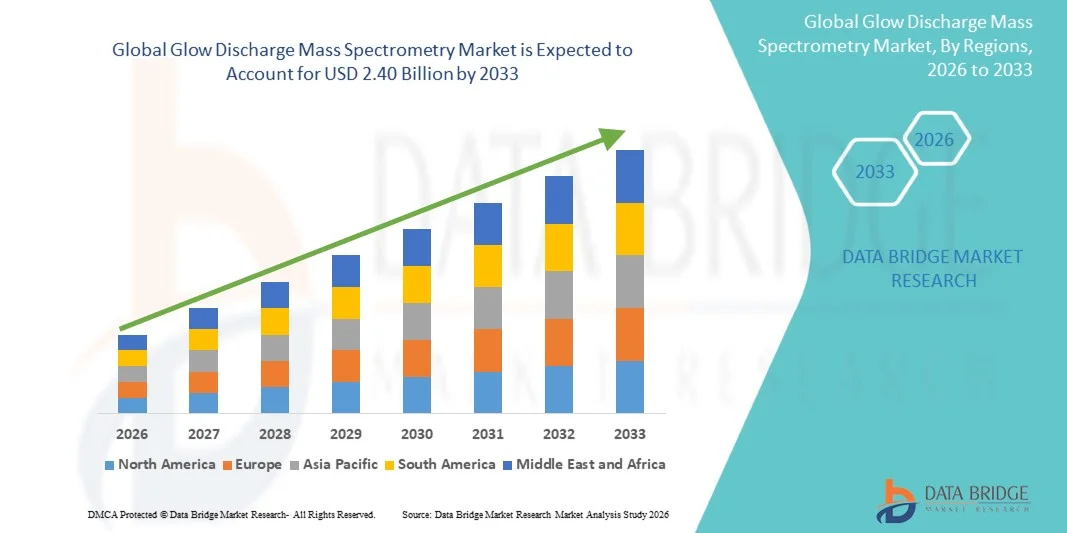
- The global glow discharge mass spectrometry market size was valued at USD 1.32 billion in 2025 and is expected to reach USD 2.40 billion by 2033, at a CAGR of 7.80% during the forecast period
- The market growth is largely fueled by the increasing adoption of high-precision elemental analysis technologies and continuous advancements in analytical instrumentation, enabling industries such as semiconductors, metallurgy, environmental testing, and pharmaceuticals to achieve ultra-trace detection and improved material purity assessment. The rising need for accurate impurity profiling in manufacturing processes is significantly boosting the demand for Glow Discharge Mass Spectrometry solutions
- Furthermore, the growing preference for highly sensitive, reliable, and rapid analytical methods is positioning GDMS as a critical tool for material quality assurance and contamination control across various high-tech industries. The capability of GDMS to deliver superior detection limits, minimal sample preparation, and consistent performance is accelerating its adoption, thereby significantly enhancing the overall growth of the Glow Discharge Mass Spectrometry market
Glow Discharge Mass Spectrometry Market Analysis
- Glow Discharge Mass Spectrometry (GDMS), a highly sensitive analytical technique used for ultra-trace elemental analysis, is becoming increasingly essential across industries such as semiconductors, metallurgy, pharmaceuticals, environmental testing, and advanced materials. Its ability to detect impurities at parts-per-billion (ppb) to parts-per-trillion (ppt) levels is driving widespread adoption for quality control and material certification
- The growing demand for high-purity materials, stricter regulatory requirements, and rising investments in advanced manufacturing technologies are the key factors fueling the rapid expansion of the GDMS market. Industries are increasingly prioritizing accurate elemental profiling, leading to higher adoption of GDMS systems for their precision, reproducibility, and minimal sample preparation
- North America dominated the glow discharge mass spectrometry market with the largest revenue share of approximately 37.6% in 2025, supported by strong technological infrastructure, high R&D spending, and a concentrated presence of semiconductor and aerospace industries that require ultra-trace elemental analysis. The U.S. continues to lead the region due to ongoing innovation in analytical instrumentation and increasing investments in material purity testing
- Asia-Pacific is expected to be the fastest-growing region in the glow discharge mass Spectrometry market during the forecast period, with an estimated CAGR of around 12.4%, driven by rapid industrialization, expansion of semiconductor manufacturing hubs, and increasing adoption of advanced analytical techniques in countries such as China, Japan, South Korea, and Taiwan
- The Industry segment accounted for the largest market revenue share of 67.9% in 2025, driven by the increasing requirement for high-purity material certification across sectors such as semiconductors, metallurgy, aerospace, electric vehicles, and advanced manufacturing
Report Scope and Glow Discharge Mass Spectrometry Market Segmentation
|
Attributes |
Glow Discharge Mass Spectrometry Key Market Insights |
|
Segments Covered |
|
|
Countries Covered |
North America
Europe
Asia-Pacific
Middle East and Africa
South America
|
|
Key Market Players |
|
|
Market Opportunities |
|
|
Value Added Data Infosets |
In addition to the insights on market scenarios such as market value, growth rate, segmentation, geographical coverage, and major players, the market reports curated by the Data Bridge Market Research also include in-depth expert analysis, patient epidemiology, pipeline analysis, pricing analysis, and regulatory framework. |
Glow Discharge Mass Spectrometry Market Trends
“Growing Adoption of High-Resolution GDMS for Trace Metal Analysis in Semiconductor & Electronics Manufacturing”
- A major and accelerating trend in the global glow discharge mass spectrometry (GDMS) market is the increasing adoption of high-resolution and ultra-trace elemental analysis systems by the semiconductor, microelectronics, and advanced materials industries. These industries require extremely low detection limits—often in the parts-per-billion (ppb) or parts-per-trillion (ppt) range—for impurity control, making GDMS a preferred analytical technique
- For instance, leading manufacturers are integrating high-resolution GDMS solutions that enable precise quantification of conductive and non-conductive materials, supporting stringent purity demands for wafers, integrated circuits, and compound semiconductors
- Several companies, such as Thermo Fisher Scientific and HORIBA, have reported increased demand for GDMS systems due to the accelerating global production of silicon wafers, GaN/SiC power devices, and nano-structured electronic components
- This trend is further supported by the shift toward miniaturization in electronic devices, which requires rigorous impurity profiling of metals, alloys, and thin films
- In addition, the surge in electric vehicle (EV) battery manufacturing and renewable energy components has led to a higher need for purity verification of cathode materials, copper foils, and rare-earth metals—expanding the application scope of GDMS
- The market is witnessing growing interest in automated, software-enhanced GDMS platforms capable of real-time data visualization, multi-element mapping, and rapid sample throughput
- As industries continue prioritizing material purity, the adoption of high-resolution GDMS equipment is expected to rise significantly across Asia-Pacific, Europe, and North America
Glow Discharge Mass Spectrometry Market Dynamics
Driver
“Rising Demand for Ultra-Trace Elemental Analysis in High-Purity Metals and Semiconductor Manufacturing”
- A key driver in the Glow Discharge Mass Spectrometry market is the growing need across semiconductor, aerospace, metallurgy, and advanced manufacturing sectors for ultra-trace elemental analysis to ensure material reliability and purity
- For instance, semiconductor foundries increasingly require highly sensitive analytical tools to monitor impurities in wafers and substrates to enhance device performance and reduce failure risks
- In March 2024, several industry reports highlighted expanded adoption of GDMS technologies by global wafer producers for impurity certification, supporting the rapid growth of 5G, AI chips, and power electronics manufacturing
- GDMS provides a strong advantage due to its ability to detect more than 70 elements simultaneously with minimal sample preparation, enabling faster quality control cycles
- The growing production of high-density electronic components, LEDs, aerospace alloys, and precision medical devices further fuels demand for GDMS-based material validation
- The technique’s capability to analyze conductive, non-conductive, and fragile materials makes it a preferred choice over competing analytical technologies such as ICP-MS or SIMS in many industrial applications
- As global industries continue shifting toward high-performance materials and nano-structured compounds, ultra-trace impurity monitoring has become essential, strongly driving market growth
Restraint/Challenge
“High Instrument Cost and Need for Skilled Operators”
- A significant restraint impacting the glow discharge mass spectrometry market is the high upfront cost of GDMS instruments, which often exceeds that of other elemental analysis equipment, limiting adoption among small and mid-sized laboratories
- The specialized nature of GDMS requires highly trained analysts to operate the equipment, interpret complex multi-element spectra, and perform calibration, creating operational barriers for organizations with limited technical expertise
- For instance, several laboratory surveys conducted in 2023–2024 indicated that many research facilities prefer alternative mass spectrometry solutions due to lower instrument cost and easier routine operation
- The cost of consumables, regular maintenance, and periodic system recalibration further increases overall ownership expenses for end users
- In addition, the lack of widespread training programs and certified GDMS professionals in developing regions restricts broader deployment
- While technological advancements are gradually improving automation and reducing the learning curve, the high investment requirement and limited operational awareness still pose challenges
- Addressing these constraints through cost-optimized GDMS models, automated workflows, and global training programs will be crucial for broader market penetration in the coming years
Glow Discharge Mass Spectrometry Market Scope
The market is segmented on the basis of type and application.
• By Type
On the basis of type, the Global Glow Discharge Mass Spectrometry (GDMS) market is segmented into dc-GDMS and rf-GDMS. The dc-GDMS segment dominated the largest market revenue share of 61.4% in 2025, driven by its established reputation for delivering ultra-trace elemental analysis and its strong suitability for conductive materials such as high-purity metals and alloys. Industries rely heavily on dc-GDMS due to its proven ability to provide accurate impurity profiles at ppt and ppb levels, making it essential in semiconductor wafer production, aerospace materials certification, and precision metallurgy. The market also sees strong demand for dc-GDMS due to its operational stability, lower long-term maintenance requirements, and widespread familiarity among industrial users. Furthermore, dc-GDMS benefits from standardized analytical workflows, which enhance its reliability and ease of integration into existing industrial quality-control processes. Manufacturers also prefer dc-GDMS for bulk material analysis, rapid sputtering performance, and its ability to support high-throughput industrial environments. Its continued adoption is supported by growing demand for purity validation in wafer fabrication, metal refining, and advanced electronics manufacturing, reinforcing dc-GDMS as the dominant segment.
The rf-GDMS segment is anticipated to witness the fastest growth rate of 18.9% from 2026 to 2033, fueled by increasing adoption in advanced research fields and industries requiring analysis of non-conductive and complex materials. rf-GDMS offers superior versatility, enabling impurity analysis in ceramics, insulators, thin films, high-entropy alloys, and composite materials where dc-GDMS cannot be used effectively. Its enhanced plasma stability and ability to analyze both conductive and non-conductive materials make it particularly attractive for nanotechnology, photovoltaic R&D, optoelectronics, and scientific research institutions. rf-GDMS is increasingly adopted due to its capability to deliver detailed multi-element analysis with improved detection limits, supporting material innovation in emerging technologies. Additionally, the growing demand for advanced materials in EV batteries, renewable energy systems, and semiconductor packaging is driving the rapid adoption of rf-GDMS systems. As global research spending expands and material science programs intensify, rf-GDMS is expected to remain the fastest-growing type segment throughout the forecast period.
• By Application
On the basis of application, the Global Glow Discharge Mass Spectrometry market is segmented into Industry and Scientific Research. The Industry segment accounted for the largest market revenue share of 67.9% in 2025, driven by the increasing requirement for high-purity material certification across sectors such as semiconductors, metallurgy, aerospace, electric vehicles, and advanced manufacturing. Industrial manufacturers rely heavily on GDMS due to its ability to detect a broad range of elemental impurities quickly and accurately, ensuring compliance with strict global quality standards. The adoption of GDMS in industrial applications is supported by rising production of high-purity metals, specialty alloys, and semiconductor wafers, all of which require precise contamination control. The scalability, reproducibility, and multi-element detection capability of GDMS make it a preferred solution for continuous industrial workflows. Furthermore, rapid expansion of wafer foundries, battery manufacturing facilities, and advanced electronics production in regions such as China, South Korea, Japan, Germany, and the U.S. continues to amplify demand for GDMS in industrial settings. These factors collectively solidify the dominance of the Industry segment.
The Scientific Research segment is expected to witness the fastest CAGR of 20.3% from 2026 to 2033, driven by the growing emphasis on material innovation, nanotechnology development, and fundamental elemental characterization across academic institutions, government laboratories, and private R&D centers. Scientific researchers increasingly rely on GDMS for its ability to provide highly sensitive, multi-elemental analysis with minimal sample preparation, supporting experimentation in areas such as quantum materials, thin-film coatings, superconductors, advanced ceramics, and high-entropy alloys. The segment is also expanding due to rising global investment in nanomaterial research, semiconductor advancements, and next-generation energy technologies. Furthermore, the ability of GDMS to analyze complex, non-conductive, and experimental materials makes rf-GDMS especially valuable in research environments. Growing collaborations between universities and high-tech industries, along with increased government funding for material science programs, are accelerating adoption. As research complexity increases and demand for deep elemental profiling rises, the Scientific Research segment will continue to be the fastest-growing application category.
Glow Discharge Mass Spectrometry Market Regional Analysis
- North America dominated the glow discharge mass spectrometry market with the largest revenue share of approximately 37.6% in 2025
- Supported by strong technological infrastructure, high R&D spending, and a concentrated presence of semiconductor and aerospace industries that require ultra-trace elemental analysis
- The region benefits from the widespread adoption of advanced analytical technologies for material purity testing, microelectronics manufacturing, and high-reliability components
U.S. Glow Discharge Mass Spectrometry Market Insight
The U.S. glow discharge mass spectrometry market captured the largest revenue share within North America in 2025, driven by its advanced semiconductor ecosystem, strong aerospace and defense sector, and the ongoing transition toward high-purity materials used in EV batteries, optics, and microelectronics. Continuous development of high-resolution GDMS instruments, along with strategic collaborations among national laboratories, universities, and analytical technology providers, is accelerating market expansion. The demand for ultra-low detection limits in industrial quality assurance continues to propel the adoption of GDMS across research institutions and specialized manufacturing facilities.
Europe Glow Discharge Mass Spectrometry Market Insight
The Europe glow discharge mass spectrometry market is projected to expand at a steady CAGR throughout the forecast period, supported by stringent regulatory standards related to material quality, environmental compliance, and industrial safety. The increasing adoption of high-precision analytical technologies in advanced manufacturing sectors—including automotive electronics, renewable energy equipment, and aerospace components—is driving GDMS uptake. Countries across the region are investing in improved laboratory infrastructure and R&D capabilities, while manufacturers increasingly prefer GDMS for trace metal analysis to ensure quality consistency and regulatory adherence.
U.K. Glow Discharge Mass Spectrometry Market Insight
The U.K. glow discharge mass spectrometry market is anticipated to grow at a notable pace, supported by rising investments in scientific research, nanotechnology, and advanced material development. The country’s strong presence in aerospace manufacturing and medical device production drives demand for ultra-trace elemental analysis. Additionally, the rapid expansion of university-led material science programs and collaborative research initiatives is increasing the use of GDMS for purity validation, alloy development, and surface chemistry studies.
Germany Glow Discharge Mass Spectrometry Market Insight
The Germany glow discharge mass spectrometry market is expected to expand at a significant CAGR during the forecast period, driven by the nation’s strong industrial base, focus on manufacturing excellence, and high standards for material integrity. Germany’s leadership in automotive engineering, precision manufacturing, and electronics encourages the adoption of GDMS to ensure high-purity inputs and strict component qualification. The market also benefits from Germany’s technological emphasis on innovation, quality assurance, and sustainable industrial practices, with GDMS increasingly integrated into analytical workflows.
Asia-Pacific Glow Discharge Mass Spectrometry Market Insight
The Asia-Pacific glow discharge mass spectrometry market is poised to grow at the fastest CAGR of approximately 12.4% during the forecast period, propelled by rapid industrialization, expanding semiconductor fabrication hubs, and increased government investments in scientific research and analytical instrumentation. Countries such as China, Japan, South Korea, and Taiwan are heavily investing in microelectronics, EV batteries, and high-purity materials manufacturing, driving substantial demand for ultra-trace elemental analysis technologies. As APAC strengthens its role as a major global manufacturing center, GDMS adoption is accelerating across both industrial and research applications.
Japan Glow Discharge Mass Spectrometry Market Insight
The Japan glow discharge mass spectrometry market is gaining momentum due to the country’s long-standing technological leadership, extensive semiconductor production capabilities, and demand for ultra-reliable materials in precision electronics. The Japanese market prioritizes accurate elemental analysis for next-generation devices, optical materials, and high-performance alloys. Strong R&D culture, combined with continuous innovation in materials science and nanotechnology, is contributing to increased GDMS deployment across laboratories and industrial facilities.
China Glow Discharge Mass Spectrometry Market Insight
The China glow discharge mass spectrometry market for one of the largest revenue shares in the Asia-Pacific region in 2025, driven by rapid industrial growth, expanding microelectronics manufacturing, and increasing government support for high-end analytical technology. China’s strong focus on semiconductor self-reliance, advanced battery development, and high-purity materials manufacturing significantly elevates GDMS demand. The presence of skilled domestic producers, cost-effective manufacturing capabilities, and large-scale R&D initiatives further accelerate market penetration across both commercial and academic sectors.
Glow Discharge Mass Spectrometry Market Share
The Glow Discharge Mass Spectrometry industry is primarily led by well-established companies, including:
- Thermo Fisher Scientific (U.S.)
- HORIBA Scientific (Japan)
- Shimadzu Corporation (Japan)
- Analytik Jena (Germany)
- AMETEK Scientific Instruments (U.S.)
- Hiden Analytical (U.K.)
- LECO Corporation (U.S.)
- SGX Sensortech (U.K.)
- Rigaku Corporation (Japan)
- Extrel CMS (U.S.)
- Kore Technology (U.K.)
- Nu Instruments (U.K.)
- TOFWERK (Switzerland)
- Intertek Group (U.K.)
- Pfeiffer Vacuum (Germany)
- IONTOF GmbH (Germany)
- Eurofins Scientific (Luxembourg)
Latest Developments in Global Glow Discharge Mass Spectrometry Market
- In March 2025, a leading analytical instrument manufacturer launched a new generation of Glow Discharge Mass Spectrometers featuring enhanced sensitivity and faster analysis times, aimed at improving precision in elemental analysis across semiconductor and materials science industries — a move expected to broaden GDMS adoption in ultra-trace analysis and industrial quality control globally
- In February 2025, a major technology provider announced a strategic partnership with a global research institute to develop next-generation GDMS technology integrating AI-driven data analytics for improved spectral interpretation, accelerating innovation and enabling more automated and intelligent GDMS applications in complex material characterization
- In January 2025, a key player in the mass spectrometry sector announced the acquisition of a specialized sensor technology company to enhance the precision and reliability of its GDMS systems, supporting vertical integration and technological advancement to make next-generation GDMS solutions more robust and competitive worldwide
- In December 2024, a prominent GDMS equipment manufacturer announced expansion of production capacity with the opening of a new manufacturing and R&D facility focused on scalable production, aimed at addressing increasing global demand and shortening supply chain timelines for GDMS instruments
- In April 2024, Mass Spectrometry Instruments Ltd. sponsored the 6th International Glow Discharge Spectroscopy Symposium in Liverpool (21–24 April 2024), where the company showcased updates to its GD90 Trace glow discharge instruments, including a new fully automated RF system complementing DC and RF modes, reflecting continued technology diffusion and community engagement in glow discharge analysis

- Interactive Data Analysis Dashboard
- Company Analysis Dashboard for high growth potential opportunities
- Research Analyst Access for customization & queries
- Competitor Analysis with Interactive dashboard
- Latest News, Updates & Trend analysis
- Harness the Power of Benchmark Analysis for Comprehensive Competitor Tracking
Data collection and base year analysis are done using data collection modules with large sample sizes. The stage includes obtaining market information or related data through various sources and strategies. It includes examining and planning all the data acquired from the past in advance. It likewise envelops the examination of information inconsistencies seen across different information sources. The market data is analysed and estimated using market statistical and coherent models. Also, market share analysis and key trend analysis are the major success factors in the market report. To know more, please request an analyst call or drop down your inquiry.
The key research methodology used by DBMR research team is data triangulation which involves data mining, analysis of the impact of data variables on the market and primary (industry expert) validation. Data models include Vendor Positioning Grid, Market Time Line Analysis, Market Overview and Guide, Company Positioning Grid, Patent Analysis, Pricing Analysis, Company Market Share Analysis, Standards of Measurement, Global versus Regional and Vendor Share Analysis. To know more about the research methodology, drop in an inquiry to speak to our industry experts.
Data Bridge Market Research is a leader in advanced formative research. We take pride in servicing our existing and new customers with data and analysis that match and suits their goal. The report can be customized to include price trend analysis of target brands understanding the market for additional countries (ask for the list of countries), clinical trial results data, literature review, refurbished market and product base analysis. Market analysis of target competitors can be analyzed from technology-based analysis to market portfolio strategies. We can add as many competitors that you require data about in the format and data style you are looking for. Our team of analysts can also provide you data in crude raw excel files pivot tables (Fact book) or can assist you in creating presentations from the data sets available in the report.













