


What is Glue Laminated Timber Market Size and Growth Rate ?
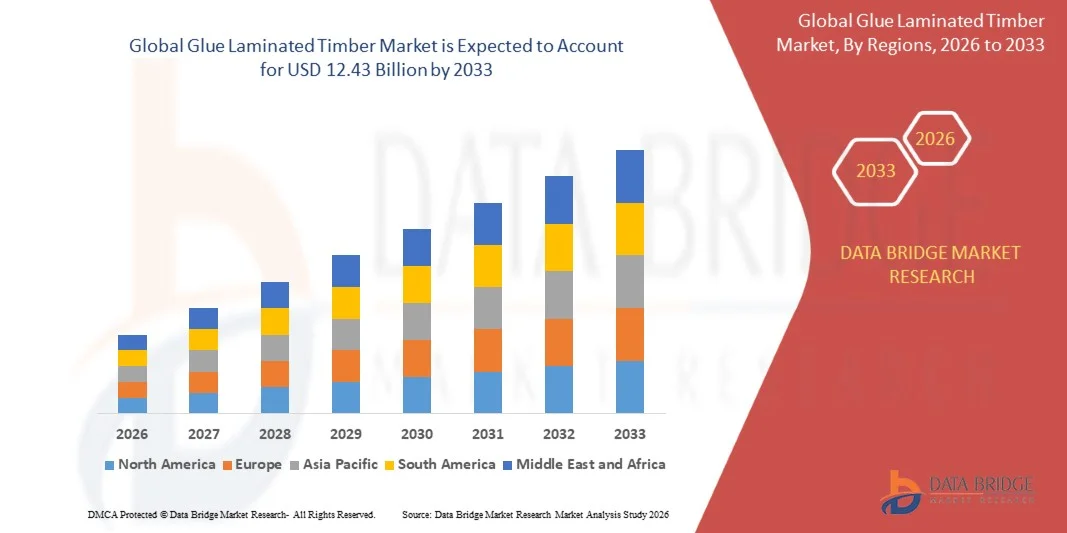
- As per Data Bridge Market Research Analysis the Global glue laminated timber market size was valued at USD 8.62 billion in 2025 and is expected to reach USD 12.43 billion by 2033, at a CAGR of 4.68% during the forecast period
- The market growth is largely fueled by the increasing adoption of sustainable and eco-friendly construction materials, along with advancements in engineered wood technology, leading to broader use of glue laminated timber in both residential and commercial projects
- Furthermore, rising demand for structurally efficient, lightweight, and aesthetically versatile building solutions is positioning GLT as a preferred material for modern construction. These converging factors are accelerating the adoption of glue laminated timber, thereby significantly driving market growth
Market Size & Forecast
- Global Market Value (2025): USD 8.62 Billion
- Expected Market Value (2033): USD 12.43 Billion
- Forecast CAGR (2026–2033):4.68%
Glue Laminated Timber Market Analysis
- Glue laminated timber, offering engineered, high-strength wood components for beams, trusses, and other structural elements, is increasingly vital in modern construction due to its load-bearing capacity, design flexibility, and sustainability benefits in both residential and commercial applications
- The escalating demand for GLT is primarily fueled by growing awareness of low-carbon building solutions, government initiatives promoting green construction, and a rising preference for prefabricated and modular timber elements that reduce construction time and material waste
- Asia-Pacific dominated the glue laminated timber market with a share of 42.4% in 2025, due to rapid urbanization, rising investments in sustainable construction, and a growing preference for eco-friendly structural materials in both residential and commercial projects
- North America is expected to be the fastest growing region in the glue laminated timber market during the forecast period due to rising demand for sustainable construction, increased adoption of engineered timber in residential and commercial projects, and focus on low-carbon building solutions
- Residential segment dominated the market with a market share of 48.3% in 2025, due to rising consumer preference for sustainable and aesthetically appealing construction materials. GLT is widely adopted in homes for floor beams, roof structures, and decorative ceiling applications, offering a combination of strength, durability, and natural wood aesthetics. Builders and architects value GLT for its lightweight yet robust characteristics, allowing for faster construction cycles. Residential projects increasingly emphasize eco-friendly and low-carbon materials, positioning GLT as a preferred choice. The segment also benefits from government initiatives promoting sustainable housing. Availability of modular GLT elements for homes enhances efficiency and reduces on-site labor requirements, supporting its strong market position.
Report Scope and Glue Laminated Timber Market Segmentation
|
Attributes |
Glue Laminated Timber Key Market Insights |
|
Segments Covered |
|
|
Countries Covered |
North America
Europe
Asia-Pacific
Middle East and Africa
South America
|
|
Key Market Players |
|
|
Market Opportunities |
|
|
Value Added Data Infosets |
In addition to the insights on market scenarios such as market value, growth rate, segmentation, geographical coverage, and major players, the market reports curated by the Data Bridge Market Research also include import export analysis, production capacity overview, production consumption analysis, price trend analysis, climate change scenario, supply chain analysis, value chain analysis, raw material/consumables overview, vendor selection criteria, PESTLE Analysis, Porter Analysis, and regulatory framework. |
What is Key Trend in Glue Laminated Timber Market ?
“Rising Adoption of Sustainable and Eco-Friendly Construction Materials”
- A significant trend in the glue laminated timber market is the increasing adoption of engineered wood products as sustainable alternatives to steel and concrete, driven by the growing emphasis on low-carbon and environmentally friendly construction practices. This trend is elevating the role of GLT as a preferred material for both residential and commercial construction projects worldwide
- For instance, Setra Group AB is supplying glue laminated timber for multi-story residential and commercial buildings in Sweden, promoting energy-efficient and environmentally sustainable construction practices. Such initiatives demonstrate GLT’s ability to reduce carbon footprints while maintaining structural performance
- Architectural applications are increasingly leveraging GLT for aesthetic and structural versatility, enabling long-span beams, open interiors, and innovative ceiling designs. This is positioning glue laminated timber as a critical material in modern architecture where sustainability and design flexibility are paramount
- Infrastructure projects, including pedestrian bridges and public buildings, are adopting GLT due to its strength-to-weight ratio and eco-friendliness. Companies such as Calvert Company are supplying custom glulam beams for bridge projects in Oregon, showcasing the growing acceptance of engineered timber in civil construction
- The construction industry is witnessing a shift toward prefabricated and modular structures where GLT elements can be produced off-site and assembled rapidly. This rising incorporation is reinforcing the overall transition toward sustainable, efficient, and aesthetically appealing building solutions across global markets
- Demand for certified and sustainably sourced timber is growing, with organizations such as FSC (Forest Stewardship Council) and PEFC (Programme for the Endorsement of Forest Certification) supporting GLT adoption through certification programs. This trend enhances trust and promotes wider use in environmentally conscious projects
Glue Laminated Timber Market Dynamics
Driver
“Growing Demand for Prefabricated and Modular Building Solutions”
- The growing focus on prefabricated and modular construction methods is driving demand for GLT, which offers precision-engineered, high-strength components that reduce on-site labor and accelerate project timelines. These benefits make GLT an increasingly preferred choice for developers and architects
- For instance, Binderholz GmbH is providing modular GLT solutions for commercial and residential buildings in Austria, facilitating rapid construction while maintaining high structural standards. This is enabling builders to meet tight project schedules efficiently
- The increasing need for lightweight yet durable materials in multi-story buildings and large-span structures is further fueling adoption of GLT. Engineered timber beams and trusses provide both stability and design flexibility, making them suitable for modern construction requirements
- Growing urbanization and housing demands are pushing developers to adopt off-site manufacturing methods where GLT can be prefabricated and delivered ready for assembly. This trend is reinforcing the preference for GLT over conventional timber and concrete materials
- The rising emphasis on sustainability and low-carbon construction in commercial and institutional buildings is accelerating GLT uptake. Companies such as Pfeifer Group are developing innovative glulam products that integrate seamlessly with prefabricated construction systems, enhancing market growth
Restraint/Challenge
“High Production and Raw Material Costs”
- The glue laminated timber market faces challenges due to the high cost of raw timber, energy-intensive processing, and the specialized equipment required for manufacturing glulam beams and trusses. These factors increase overall production expenses and limit cost flexibility for manufacturers
- For instance, Canfor Corporation invests heavily in advanced milling and glulam fabrication facilities to maintain quality, which adds to operational costs and affects pricing competitiveness. Managing supply chain costs for sustainably sourced timber remains a critical challenge
- The reliance on certified, high-quality softwood species for glulam production further elevates costs, particularly as demand grows for sustainable and FSC- or PEFC-certified products. This can constrain adoption in cost-sensitive projects
- Maintaining dimensional accuracy, strength, and durability standards during fabrication requires skilled labor and strict quality control processes. These steps extend production timelines and contribute to higher operational expenditure across the supply chain
- Scaling production to meet rising demand while ensuring consistent quality and sustainability compliance continues to be a limiting factor. Manufacturers must balance performance, cost, and environmental standards to remain competitive in the expanding GLT market
Glue Laminated Timber Market Scope
The market is segmented on the basis of shape, application, and end-user.
• By Shape
On the basis of shape, the glue laminated timber market is segmented into straight, cambered, and custom. The straight segment dominated the market with the largest revenue share in 2025, driven by its versatility and ease of use in standard construction projects. Straight GLT beams are preferred by architects and builders for their structural reliability and straightforward installation in residential and commercial buildings. The segment also benefits from compatibility with automated fabrication processes, reducing labor costs and construction time. Manufacturers provide a wide range of sizes and finishes in straight GLT, enhancing its adoption across diverse structural applications. Homeowners and contractors often select straight shapes for their predictability in load-bearing capacity and design simplicity. The segment’s popularity is further strengthened by availability from multiple suppliers ensuring steady supply chains.
The cambered segment is anticipated to witness the fastest growth rate from 2026 to 2033, fueled by increasing demand in commercial and architectural projects requiring curved or arching structural elements. For instance, companies such as Binderholz are focusing on cambered GLT for innovative bridges and curved roof designs. Cambered timber offers enhanced load distribution and aesthetic appeal, making it suitable for iconic constructions. Its adoption is also rising in modern residential projects seeking unique interior and exterior designs. Builders increasingly prefer cambered shapes for creating open spaces without intermediate supports, improving structural efficiency. The growing focus on architectural flexibility and design-driven projects is expected to drive long-term growth of this segment.
• By Application
On the basis of application, the glue laminated timber market is segmented into residential, commercial, and industrial. The residential segment dominated the market with the largest share of 48.3% in 2025 due to rising consumer preference for sustainable and aesthetically appealing construction materials. GLT is widely adopted in homes for floor beams, roof structures, and decorative ceiling applications, offering a combination of strength, durability, and natural wood aesthetics. Builders and architects value GLT for its lightweight yet robust characteristics, allowing for faster construction cycles. Residential projects increasingly emphasize eco-friendly and low-carbon materials, positioning GLT as a preferred choice. The segment also benefits from government initiatives promoting sustainable housing. Availability of modular GLT elements for homes enhances efficiency and reduces on-site labor requirements, supporting its strong market position.
The commercial segment is projected to witness the fastest CAGR from 2026 to 2033, driven by expanding urban infrastructure and large-scale office, retail, and hospitality constructions. For instance, companies such as KLH Massivholz are supplying GLT for multi-story commercial buildings and large public spaces. Commercial adoption is fueled by GLT’s ability to span longer distances without intermediate supports, providing open, flexible floor plans. Its fire-resistant and seismic-compliant properties make it suitable for building codes in urban areas. Architects increasingly prefer GLT in commercial designs for its modern aesthetic and sustainability credentials. The growing emphasis on low-carbon, visually appealing commercial spaces is expected to drive accelerated growth in this segment.
• By End User
On the basis of end user, the glue laminated timber market is segmented into floor beams, window and door headers, furniture, stairs, ceiling structures, trusses and supporting columns, roof beams, and others. The floor beams segment dominated the market with the largest revenue share in 2025, driven by consistent demand in residential and commercial construction for structural stability. GLT floor beams provide superior load-bearing capacity and dimensional stability compared to traditional solid wood beams, making them preferred by builders and architects. The segment benefits from the ability of GLT to reduce material waste while offering customizable lengths and finishes. For large-scale housing and commercial projects, floor beams ensure faster construction with reduced need for additional supports. The segment is also supported by rising adoption in sustainable and green building certifications. Manufacturers continue to invest in production lines optimized for floor beam fabrication, reinforcing market dominance.
The trusses and supporting columns segment is expected to witness the fastest growth from 2026 to 2033, fueled by increasing adoption in industrial and large commercial structures requiring high-strength timber elements. For instance, companies such as Structurlam are deploying GLT trusses and columns in warehouses and sports complexes. GLT trusses offer flexibility in spanning large spaces while maintaining load-bearing efficiency. Industrial projects increasingly rely on pre-fabricated trusses for rapid installation and structural precision. The segment’s growth is supported by demand for sustainable alternatives to steel and concrete in large-scale construction. Aesthetic appeal combined with structural performance drives the adoption of GLT in supporting columns and trusses, ensuring continued market expansion.
Glue Laminated Timber Market Regional Analysis
- Asia-Pacific dominated the glue laminated timber market with the largest revenue share of 42.4% in 2025, driven by rapid urbanization, rising investments in sustainable construction, and a growing preference for eco-friendly structural materials in both residential and commercial projects
- The region’s cost-effective timber production, expansion of modern infrastructure projects, and increasing adoption of prefabricated construction techniques are accelerating market growth
- The availability of skilled labor, favorable government policies promoting green building practices, and rising awareness about low-carbon construction solutions are contributing to increased consumption of GLT across diverse sectors
China Glue Laminated Timber Market Insight
China held the largest share in the Asia-Pacific glue laminated timber market in 2025, owing to its expansive construction industry, robust wood processing infrastructure, and strong government support for sustainable building materials. The country’s large-scale residential and commercial projects, coupled with adoption of advanced GLT fabrication technologies, are key growth drivers. Rising exports of engineered timber products and investments in modular and prefabricated construction solutions further strengthen demand.
India Glue Laminated Timber Market Insight
India is witnessing the fastest growth in the Asia-Pacific region, fueled by increasing adoption of sustainable construction practices, expansion of commercial and hospitality projects, and government initiatives supporting eco-friendly building materials. For instance, initiatives under “Housing for All” and smart city development are boosting the use of GLT in both urban and semi-urban areas. Growing awareness of low-carbon alternatives to concrete and steel, coupled with investments in timber processing facilities, is driving robust market expansion.
Europe Glue Laminated Timber Market Insight
The Europe glue laminated timber market is expanding steadily, supported by stringent building regulations, growing preference for renewable construction materials, and adoption of GLT in large-scale commercial and residential projects. Countries in the region emphasize sustainable sourcing, energy-efficient building design, and eco-friendly structural solutions, enhancing demand for engineered timber. Increasing use of GLT in architectural and structural applications, such as multi-story buildings and bridges, is further propelling market growth.
Germany Glue Laminated Timber Market Insight
Germany’s GLT market is driven by its leadership in precision engineering, high-quality construction standards, and focus on sustainable building practices. Strong collaboration between manufacturers, research institutions, and construction companies fosters continuous innovation in timber-based construction. Demand is particularly strong for multi-story buildings, trusses, and supporting columns using GLT due to structural reliability and design flexibility.
U.K. Glue Laminated Timber Market Insight
The U.K. market is supported by a mature construction industry, growing focus on sustainable and low-carbon building materials, and increasing adoption of GLT in residential, commercial, and public infrastructure projects. Investments in green buildings, prefabricated construction solutions, and innovative timber designs are driving market expansion. For instance, architectural firms are increasingly integrating GLT in open-space commercial layouts and modern residential designs.
North America Glue Laminated Timber Market Insight
North America is projected to grow at the fastest CAGR from 2026 to 2033, driven by rising demand for sustainable construction, increased adoption of engineered timber in residential and commercial projects, and focus on low-carbon building solutions. The region’s advanced construction technologies, coupled with strong awareness of eco-friendly materials, are accelerating GLT adoption.
U.S. Glue Laminated Timber Market Insight
The U.S. accounted for the largest share in the North America market in 2025, underpinned by a robust construction industry, strong sustainability initiatives, and increasing adoption of prefabricated and modular building solutions. The country’s focus on renewable and engineered timber, investments in architectural innovations, and presence of key GLT manufacturers further strengthen its market position. Rising demand for large-span beams, roof structures, and trusses in commercial and institutional projects continues to support market growth.
Glue Laminated Timber Market Share
The glue laminated timber industry is primarily led by well-established companies, including:
- Canfor Corporation (U.S.)
- Eugen Decker Holzindustrie KG (Germany)
- Setra Group AB (Sweden)
- Schilliger Holz AG (Switzerland)
- Binderholz GmbH (Austria)
- HASSLACHER Holding GmbH (Austria)
- FFOREST TIMBER ENGINEERING LTD. (U.K.)
- B&K Structures (U.S.)
- Buckland Timber (U.K.)
- HESS TIMBER GmbH (Germany)
- Boise Cascade (U.S.)
- Ledinek (Slovenia)
- Mayr-Melnhof Holz Gaishorn GmbH (Austria)
- Structural Wood Systems (U.S.)
- Pfeifer Group (Austria)
Latest Developments in Global Glue Laminated Timber Market
- In 2025, Setra Group appointed Anna Lindh as CEO to lead expansion in engineered wood products. This strategic leadership change is expected to accelerate growth in the company’s glue-laminated timber and mass timber segments, enabling Setra Group to capture greater market share in sustainable construction materials. The move signals the company’s focus on scaling production, strengthening distribution networks, and responding to rising demand for eco-friendly structural timber solutions across Europe and North America
- In 2025, Pfeifer Group acquired a 30% minority stake in a Scandinavian startup specializing in innovative glulam solutions. This investment aims to enhance Pfeifer Group’s R&D capabilities, fostering the development of advanced and customized glue-laminated timber products. The acquisition is expected to broaden the company’s product portfolio, improve competitive positioning, and support the adoption of glulam in both residential and commercial construction markets, contributing to overall industry growth
- In 2024, Calvert Company secured a contract to supply custom glue-laminated timber beams for a pedestrian bridge project in Oregon. This development highlights the growing utilization of glulam in U.S. infrastructure and civil engineering projects. By delivering specialized timber solutions for public works, Calvert Company reinforces the role of engineered wood in modern construction, promoting sustainable alternatives to steel and concrete while driving market adoption
- In May 2024, Canfor Corporation announced the acquisition of the El Dorado lumber manufacturing facility in Union County, Arkansas, from Resolute El Dorado Inc., a Domtar Corporation affiliate, for USD 73 million. This strategic acquisition is expected to strengthen Canfor’s operations in the Southern Pine market through enhanced vertical integration and collaborative opportunities. The expansion improves production capacity and distribution efficiency, solidifying Canfor’s presence in the U.S. lumber and engineered timber sector
- In August 2023, Boise Cascade entered an agreement to acquire Brockway-Smith Company (BROSCO), a leading wholesale distributor of doors and millwork, for USD 172 million, including two distribution centers in Hatfield, MA, and Portland, ME. This acquisition is poised to expand Boise Cascade’s market reach in the Northeast, strengthen its millwork business, and improve supply chain capabilities. The deal supports the company’s broader strategy to enhance product offerings and capture growing demand for high-quality timber and millwork solutions

- Interactive Data Analysis Dashboard
- Company Analysis Dashboard for high growth potential opportunities
- Research Analyst Access for customization & queries
- Competitor Analysis with Interactive dashboard
- Latest News, Updates & Trend analysis
- Harness the Power of Benchmark Analysis for Comprehensive Competitor Tracking
Global Glue Laminated Timber Market, Supply Chain Analysis and Ecosystem Framework
To support market growth and help clients navigate the impact of geopolitical shifts, DBMR has integrated in-depth supply chain analysis into its Global Glue Laminated Timber Market research reports. This addition empowers clients to respond effectively to global changes affecting their industries. The supply chain analysis section includes detailed insights such as Global Glue Laminated Timber Market consumption and production by country, price trend analysis, the impact of tariffs and geopolitical developments, and import and export trends by country and HSN code. It also highlights major suppliers with data on production capacity and company profiles, as well as key importers and exporters. In addition to research, DBMR offers specialized supply chain consulting services backed by over a decade of experience, providing solutions like supplier discovery, supplier risk assessment, price trend analysis, impact evaluation of inflation and trade route changes, and comprehensive market trend analysis.
Data collection and base year analysis are done using data collection modules with large sample sizes. The stage includes obtaining market information or related data through various sources and strategies. It includes examining and planning all the data acquired from the past in advance. It likewise envelops the examination of information inconsistencies seen across different information sources. The market data is analysed and estimated using market statistical and coherent models. Also, market share analysis and key trend analysis are the major success factors in the market report. To know more, please request an analyst call or drop down your inquiry.
The key research methodology used by DBMR research team is data triangulation which involves data mining, analysis of the impact of data variables on the market and primary (industry expert) validation. Data models include Vendor Positioning Grid, Market Time Line Analysis, Market Overview and Guide, Company Positioning Grid, Patent Analysis, Pricing Analysis, Company Market Share Analysis, Standards of Measurement, Global versus Regional and Vendor Share Analysis. To know more about the research methodology, drop in an inquiry to speak to our industry experts.
Data Bridge Market Research is a leader in advanced formative research. We take pride in servicing our existing and new customers with data and analysis that match and suits their goal. The report can be customized to include price trend analysis of target brands understanding the market for additional countries (ask for the list of countries), clinical trial results data, literature review, refurbished market and product base analysis. Market analysis of target competitors can be analyzed from technology-based analysis to market portfolio strategies. We can add as many competitors that you require data about in the format and data style you are looking for. Our team of analysts can also provide you data in crude raw excel files pivot tables (Fact book) or can assist you in creating presentations from the data sets available in the report.













