What is the Gluten Feed Market Size and Growth Rate?
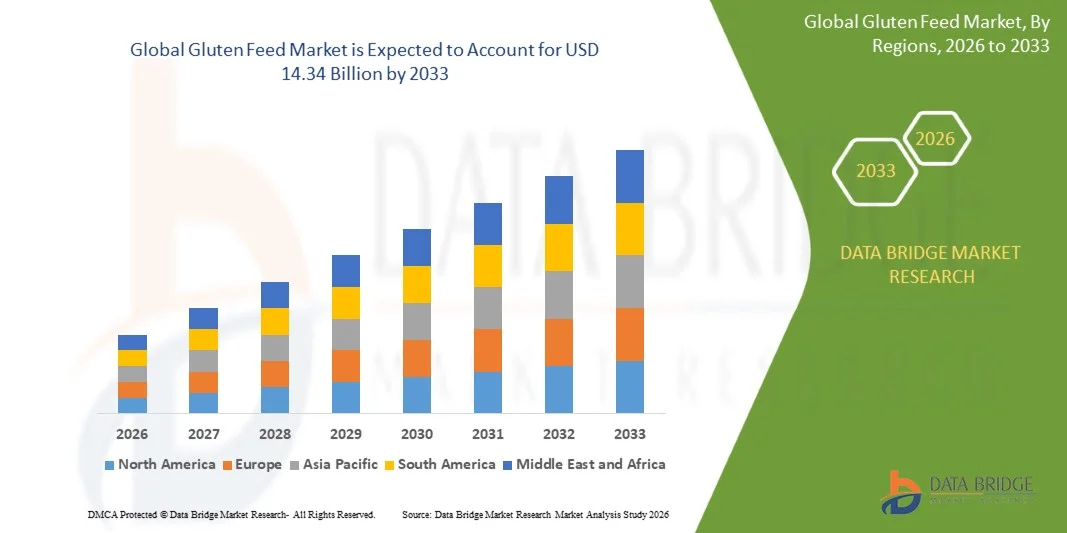
- As per Data Bridge Market Research analysis, the gluten feed market was valued at USD 8.80 billion in 2025 and is projected to reach USD 14.34 billion by 2033, growing at a CAGR of 6.30% from 2026 to 2033.
- The market is experiencing growth driven by demand for economical and nutritionally valuable feed ingredients, increasing livestock production, expansion of grain-processing industries, and greater utilization of agricultural co-products in animal nutrition. Corn gluten feed remains an important feed ingredient generated through corn wet milling, while technological advances in corn processing are supporting the development of higher-protein and specialty feed ingredients. Current USDA market reporting confirms active commercial trading of both dry and wet corn gluten feed in the U.S. market.
- Increasing emphasis on resource efficiency and circular-economy practices is encouraging grain processors and biofuel producers to maximize the value of protein, fibre, energy, and other co-products generated during grain processing.
Market Size & Forecast
- Global Market Value (2025): USD 8.80 Billion
- Expected Market Value (2033): USD 14.34 Billion
- Forecast CAGR (2026–2033): 6.30%
- Leading Region in 2025: North America
- Fastest Growing Region: Asia-Pacific
What are the Major Takeaways of the Gluten Feed Market?
- North America dominated the gluten feed market with a 35.40% revenue share in 2025, supported by its strong corn-processing industry, established livestock farming practices, and demand for cost-effective animal feed ingredients.
- Asia-Pacific is expected to be the fastest-growing region with a CAGR of 4.5%, driven by rising livestock production, increasing consumption of animal protein, expansion of the animal feed industry, and growing adoption of sustainable feed solutions.
- The corn segment led the source category with a 45.11% share in 2025, supported by the widespread availability of corn-based co-products from corn wet milling and ethanol production.
- The wheat segment is projected to be the fastest-growing source segment, with a 4.5% CAGR, supported by increasing wheat processing activities and demand for alternative cereal-based feed ingredients.
- The cattle segment dominated the livestock category with a 35.33% revenue share in 2025, owing to extensive utilization of gluten feed in dairy and beef cattle diets.
- Dry gluten feed accounted for a 55.14% share in 2025, supported by its longer shelf life, ease of transportation, storage convenience, and widespread use in commercial feed manufacturing.
- The biofuels segment is identified as the fastest-growing application category, with a 4.3% CAGR, supported by increasing corn processing and ethanol production activities that generate valuable feed co-products.
Report Scope and Gluten Feed Market Segmentation
|
Attributes |
Gluten Feed Key Market Insights |
|
Segments Covered |
|
|
Countries Covered |
North America
Europe
Asia-Pacific
Middle East and Africa
South America
|
|
Key Market Players |
|
|
Market Opportunities |
|
|
Value Added Data Infosets |
In addition to the insights on market scenarios such as market value, growth rate, segmentation, geographical coverage, and major players, the market reports curated by the Data Bridge Market Research also include import export analysis, production capacity overview, production consumption analysis, price trend analysis, climate change scenario, supply chain analysis, value chain analysis, raw material/consumables overview, vendor selection criteria, PESTLE Analysis, Porter Analysis, and regulatory framework. |
What is the Key Trend in the Gluten Feed Market?
- Sustainable animal nutrition is becoming an important trend as feed manufacturers increasingly utilize grain-processing co-products as economical sources of protein, fibre, and energy.
- The growing emphasis on circular-economy practices is encouraging the conversion of agricultural and grain-processing co-products into value-added animal-feed ingredients.
- In April 2026, USDA Agricultural Marketing Service market data reported active commercial prices for both corn gluten feed pellets and wet corn gluten feed in the U.S., confirming continued commercial availability and trading of these products.
- In May 2025, the U.S. Grains Council promoted corn fermented protein at the Fourth Forum on the Development and Utilization of Feed Resources in Qingdao, China, with discussions covering applications in aquaculture, poultry, and swine diets. The development illustrates increasing technical interest in higher-value corn-derived protein ingredients.
- Regulatory terminology is also evolving. AAFCO revised the names of corn gluten meal and corn gluten feed to corn protein meal and corn protein feed, respectively, while Canada's CFIA incorporated the revised terminology as alternative ingredient names. This change is relevant to product labelling, regulatory alignment, and cross-border trade.
- In April 2024, Green Plains introduced Sequence, a specialty feed ingredient combining corn and yeast protein at a minimum concentration of 60%, produced using proprietary mechanical separation technology. The development demonstrates the industry's movement toward higher-value protein ingredients from corn-processing and biofuel-related feedstock streams.
- Feed manufacturers are increasingly exploring customized protein and energy ingredients to meet the nutritional requirements of cattle, poultry, swine, and aquaculture species.
What are the Key Drivers of the Gluten Feed Market?
- The rising global demand for meat, dairy, aquaculture products, and animal protein is increasing demand for economical and nutritionally efficient feed ingredients.
- Expanding livestock and aquaculture production, particularly in emerging economies, is encouraging feed manufacturers to diversify protein and energy sources.
- The increasing availability of corn-processing co-products from wet milling and bioethanol production is supporting the supply of protein-, fiber-, and energy-rich feed ingredients.
- In January 2026, POET announced an expansion of its Shelbyville, Indiana bioprocessing facility that will double bioethanol production from 98 million gallons to 193 million gallons and also double dried distillers grains and corn-oil output. While dried distillers grains are distinct from corn gluten feed, the investment demonstrates continued expansion of the broader corn-processing co-product ecosystem supporting animal nutrition.
- Feed producers and livestock operators are integrating corn-derived feed ingredients into balanced rations because of their nutritional value and potential contribution to feed-cost management.
- China's ongoing efforts to reduce dependence on soybean meal and investigate alternative protein sources are creating additional interest in high-protein corn and other alternative feed ingredients. Reuters reported in 2025 that China's policy direction included greater use of alternatives such as high-protein corn, microbial protein, insect protein, and synthetic amino acids.
What Factors are Challenging the Growth of the Gluten Feed Market?
- Fluctuations in corn prices and raw material availability create challenges for gluten feed manufacturers by affecting production costs and overall product pricing stability. Changes in agricultural output, weather conditions, and crop yield variations can impact the availability of corn-based by-products used in gluten feed production.
- For instance, in June 2023, the Food and Agriculture Organization (FAO) reported continued volatility in global cereal markets, including maize price fluctuations driven by production conditions, supply constraints, and trade uncertainties, which can increase cost pressures for corn-derived feed ingredients.
- Competition from alternative feed ingredients, including soybean meal, distillers grains, and other protein sources, limits the wider adoption of gluten feed in certain livestock feed formulations. Small-scale livestock producers in developing regions may face challenges related to awareness, accessibility, and availability of processed gluten feed products.
- For instance, in May 2024, the U.S. Department of Agriculture (USDA) highlighted fluctuations in global corn production forecasts due to changing weather conditions and crop outlooks, creating uncertainty in corn availability and impacting corn-based industries, including animal feed production.
- The impact of raw material price volatility, supply uncertainties, and competition from substitute feed ingredients continues to challenge market expansion, particularly in price-sensitive livestock production markets.
How is the Gluten Feed Market Segmented?
The gluten feed market is segmented on the basis of source, livestock, form, application, and end use.
- By Source
On the basis of source, the gluten feed market is segmented into barley, wheat, rye, corn, maize, and others. The corn segment dominated the market with an estimated share of 45.11% in 2025, owing to the widespread availability of corn-based co-products generated from corn wet milling and ethanol production processes. Corn gluten feed is widely used as an economical source of protein, fibre, and energy in livestock diets, particularly for cattle and poultry. The increasing production of corn globally and expansion of corn processing industries are supporting the availability of corn gluten feed products. Its cost-effectiveness compared with conventional protein ingredients is encouraging adoption among feed manufacturers. Growing demand for sustainable feed ingredients derived from agricultural by-products is further strengthening the segment’s growth. The established supply chain and nutritional benefits of corn gluten feed continue to make corn the leading source category globally.
The wheat segment is projected to witness the fastest growth with an estimated CAGR of 4.3% during the forecast period, driven by increasing wheat processing activities and rising demand for alternative cereal-based feed ingredients. Wheat gluten feed provides valuable protein and fibre content, making it suitable for livestock nutrition applications. Growing adoption of wheat-based feed solutions in regions with strong wheat production is supporting market expansion. Feed manufacturers are increasingly exploring diversified cereal sources to reduce dependence on single raw materials and manage feed cost fluctuations. Advancements in grain processing technologies are improving the availability and quality of wheat-derived feed products. Rising demand for sustainable and locally available feed ingredients is expected to accelerate the growth of the wheat segment.
- By Livestock
On the basis of livestock, the gluten feed market is segmented into poultry, swine, aquatic animals, cattle, equine, pet animals, and others. The cattle segment dominated the market with an estimated share of 35.33% in 2025, supported by the extensive use of gluten feed as a nutritional ingredient in dairy and beef cattle diets. Gluten feed provides digestible fibre, protein, and energy, which support improved feed efficiency and animal productivity. The increasing global demand for milk and dairy products is driving the adoption of cost-effective cattle feed solutions. Livestock producers are increasingly incorporating gluten feed into balanced rations to improve animal growth and maintain production efficiency. The availability of corn gluten feed from large-scale grain processing industries further supports cattle feed applications. Strong adoption across dairy-producing regions continues to maintain cattle’s leading position in the market.
The aquatic animals segment is expected to register the fastest growth with an estimated CAGR of 5.6% during the forecast period, driven by increasing aquaculture production and rising demand for sustainable feed ingredients. Aquaculture producers are increasingly seeking alternative nutritional sources to reduce dependency on traditional marine-based feed ingredients. Gluten-based feed ingredients provide protein and energy components that support aquatic animal growth and feed efficiency. Expansion of fish farming activities in Asia-Pacific and other emerging regions is increasing demand for specialized aquaculture feed formulations. Growing focus on sustainable aquaculture practices is encouraging the use of plant-based feed ingredients. Increasing investments in aquafeed innovation are expected to support the rapid growth of this segment.
- By Form
On the basis of form, the gluten feed market is segmented into dry, liquid, and pelleted. The dry form segment dominated the market with an estimated share of 55.14% in 2025, owing to its longer shelf life, ease of transportation, and widespread adoption in commercial animal feed manufacturing. Dry gluten feed is preferred by feed producers due to its stability, storage convenience, and compatibility with various feed formulations. It can be easily incorporated into balanced rations for cattle, poultry, and other livestock species. The increasing demand for efficient feed logistics and large-scale feed production is supporting the segment’s dominance. Dry formulations also reduce handling challenges compared with liquid alternatives. Their cost advantages and widespread availability continue to drive adoption globally.
The pelleted form segment is expected to witness the fastest growth with an estimated CAGR of 5.0% during the forecast period, driven by increasing demand for convenient, nutrient-dense, and easy-to-handle animal feed products. Pelleting improves feed digestibility, reduces wastage, and enhances nutrient utilization in livestock. Feed manufacturers are increasingly adopting pelleting technologies to improve product quality and operational efficiency. Growing commercial livestock farming is increasing the requirement for processed feed formats. Pelleted gluten feed products also offer advantages in storage and transportation, making them suitable for large-scale farming operations. Rising adoption of modern feed processing technologies is expected to accelerate segment growth.
- By Application
On the basis of application, the gluten feed market is segmented into animal feed, pet food, biofuels, and food processing. The animal feed segment dominated the market with an estimated share of 70.51% in 2025, driven by increasing global livestock production and rising demand for economical nutritional feed ingredients. Gluten feed is extensively used in cattle, poultry, and swine diets due to its protein and fibre content. Growing consumption of meat and dairy products is increasing the need for efficient livestock nutrition solutions. Feed manufacturers are adopting gluten feed as a cost-effective alternative to traditional feed ingredients. The expansion of commercial farming operations is further supporting market demand. Strong utilization across multiple livestock categories continues to make animal feed the largest application segment.
The biofuels segment is expected to grow at a CAGR of 4.3% during the forecast period, supported by increasing corn processing and ethanol production activities that generate valuable feed co-products. The expansion of biofuel industries is improving the availability of corn-derived feed ingredients. Growing emphasis on circular economy practices is encouraging the utilization of agricultural by-products in animal nutrition. Ethanol producers are increasingly focusing on maximizing the value of co-products generated during processing. Rising renewable energy investments are indirectly supporting the supply of feed ingredients derived from grain processing. Increasing integration between biofuel production and animal feed industries is expected to create new growth opportunities.
- By End Use
On the basis of end use, the gluten feed market is segmented into livestock, poultry, aquaculture, and companion animals. The livestock segment dominated the market with an estimated share of 40.45% in 2025, owing to extensive utilization of gluten feed in cattle and ruminant nutrition. Livestock producers use gluten feed to improve feed efficiency, support animal growth, and reduce overall feeding costs. Increasing global demand for dairy and meat products is strengthening the requirement for affordable feed solutions. Gluten feed provides essential nutrients while supporting sustainable utilization of agricultural co-products. Expansion of livestock farming activities across developing economies is further increasing adoption. The segment’s established consumption base continues to drive its market leadership.
The aquaculture segment is projected to be the fastest-growing end-use segment with an estimated CAGR of 5.4% during the forecast period, driven by rapid expansion of fish farming and increasing demand for sustainable aquafeed solutions. Aquaculture producers are adopting alternative feed ingredients to improve feed sustainability and reduce reliance on traditional resources. Gluten feed offers nutritional benefits that support aquatic animal growth and feed conversion efficiency. Rising seafood consumption globally is encouraging investment in aquaculture production. Increasing research into plant-based aquafeed formulations is creating new opportunities for gluten feed utilization. Growing focus on sustainable food production is expected to accelerate adoption within aquaculture applications.
Which Region Holds the Largest Share of the Gluten Feed Market?
- North America dominated the gluten feed market with the largest revenue share of 35.40% in 2025, supported by the strong presence of corn processing industries, well-established livestock farming practices, and increasing demand for cost-effective animal feed ingredients.
- The region also benefits from extensive corn production capacity, advanced animal feed manufacturing infrastructure, and widespread adoption of gluten feed in cattle, poultry, and livestock nutrition applications. Increasing demand for high-quality animal protein, rising livestock production, and the availability of corn-based co-products from ethanol and grain processing industries continue to strengthen North America’s leadership position in the global market.
U.S. Gluten Feed Market Insight
The U.S. gluten feed market is witnessing steady growth due to the country’s strong corn processing industry, expanding livestock production, and high demand for cost-effective animal feed ingredients. The country’s large-scale corn production capacity and established feed manufacturing infrastructure are driving demand for corn gluten feed across cattle, poultry, and other livestock applications. In addition, increasing utilization of corn-based co-products from ethanol production and growing focus on sustainable animal nutrition are accelerating gluten feed adoption across the U.S. livestock sector. The U.S. Department of Agriculture (USDA) reported that the U.S. remains the world’s largest corn producer, supporting the availability of corn-derived feed ingredients for animal nutrition applications.
Canada Gluten Feed Market Insight
Canada’s gluten feed market is supported by established livestock production, particularly dairy and beef cattle, alongside a well-developed grain-processing and animal-feed industry. Demand is influenced by the need for cost-effective protein and fiber sources and the growing utilization of grain-processing co-products in livestock nutrition. Increasing emphasis on feed efficiency and sustainable resource utilization is also supporting adoption. Regulatory developments, including updated terminology for corn-derived feed ingredients, are expected to influence product labeling and market practices across Canada.
Asia-Pacific Gluten Feed Market Insight
The Asia-Pacific gluten feed market is expected to witness rapid growth, driven by rising livestock production, increasing demand for animal protein, and expanding feed manufacturing activities across countries such as China, India, and Japan. Growing adoption of alternative feed ingredients, increasing investments in animal nutrition technologies, and rising commercial farming activities are supporting regional market expansion. Additionally, the increasing focus on sustainable livestock production and improving feed efficiency is accelerating gluten feed adoption across emerging economies. The Food and Agriculture Organization (FAO) reported that Asia-Pacific accounts for a significant share of global livestock production, with continued growth in meat and dairy demand supporting expansion of animal feed markets.
China Gluten Feed Market Insight
China’s gluten feed market is expanding due to rising livestock production, growing demand for animal protein, and increasing adoption of cost-effective feed ingredients. The country’s large poultry, swine, dairy, and aquaculture industries support consistent demand for protein- and fiber-rich feed materials. Growing corn processing and utilization of agricultural co-products are further supporting market development. Additionally, efforts to improve feed efficiency, diversify protein sources, and promote sustainable animal nutrition are creating opportunities for gluten feed manufacturers and suppliers across China.
Japan Gluten Feed Market Insight
The Japan gluten feed market is witnessing consistent growth due to increasing demand for efficient animal nutrition solutions, advanced feed manufacturing practices, and efforts to improve livestock productivity. Feed manufacturers and livestock producers are increasingly adopting processed feed ingredients such as gluten feed to optimize animal diets and reduce dependence on conventional feed sources. Moreover, Japan’s focus on sustainable agriculture practices and efficient utilization of agricultural by-products is further contributing to market growth. Japan’s Ministry of Agriculture, Forestry and Fisheries (MAFF) highlights the country’s continued focus on improving feed self-sufficiency and utilizing alternative feed resources to support livestock production.
Which are the Top Companies in Gluten Feed Market?
The gluten feed industry is primarily led by well-established companies, including:
- Ingredion (U.S.)
- ADM (U.S.)
- Cargill, Incorporated (U.S.)
- Tate & Lyle (U.K.)
- Bunge Global SA (Switzerland)
- The Andersons, Inc. (U.S.)
- POET, LLC (U.S.)
- Green Plains Inc. (U.S.)
- Valero (U.S.)
- AGRANA Beteiligungs-AG (Austria)
- Tereos S.A. (France)
- Roquette Frères (France)
- CropEnergies AG (Germany)
- Vivergo Fuels Limited (U.K.)
- MGP (U.S.)
- Fufeng Group Limited (China)
- Tereos Starch & Sweeteners Europe (France)
- Amilina AB (Lithuania)
- Kraus Global Ltd. (Canada)
What are Latest Developments in Gluten Feed Market?
- In April 2026, USDA Agricultural Marketing Service reported commercial prices for corn gluten feed pellets and wet corn gluten feed in the United States. The report included regional prices for dry corn gluten feed pellets and wet corn gluten feed, providing current evidence of active commercial trade in these products.
- In January 2026, POET announced the expansion of its Shelbyville, Indiana bioprocessing facility, which will double ethanol production and also double dried distillers grains and corn-oil output. Although dried distillers grains are a separate corn-processing co-product from corn gluten feed, the investment highlights continued expansion and valorization of corn-derived animal-feed co-products.
- In May 2025, the U.S. Grains Council promoted corn fermented protein at the Fourth Forum on the Development and Utilization of Feed Resources in Qingdao, China. Technical discussions focused on incorporating corn fermented protein into aquaculture, poultry, and swine diets.
- In 2025, the Canadian Food Inspection Agency updated its feed-ingredient framework to include “corn protein meal” and “corn protein feed” as alternative names associated with the established corn gluten meal and corn gluten feed ingredients, aligning Canadian terminology with revised U.S. nomenclature.
- In April 2024, Green Plains introduced Sequence, a specialty feed ingredient produced from a combination of corn and yeast protein at a minimum concentration of 60%. The product was developed using proprietary mechanical separation technology and illustrates the increasing commercialization of higher-value corn-derived protein ingredients.
- In April 2025, Nectar Origin launched Manka Cattle Feed in India, a cattle-nutrition product positioned around protein, fats, probiotics, and other nutrients. While the product is not itself a gluten-feed product, the launch reflects continuing investment in specialized cattle nutrition and formulated feed solutions in the Indian market.

- Interactive Data Analysis Dashboard
- Company Analysis Dashboard for high growth potential opportunities
- Research Analyst Access for customization & queries
- Competitor Analysis with Interactive dashboard
- Latest News, Updates & Trend analysis
- Harness the Power of Benchmark Analysis for Comprehensive Competitor Tracking
Data collection and base year analysis are done using data collection modules with large sample sizes. The stage includes obtaining market information or related data through various sources and strategies. It includes examining and planning all the data acquired from the past in advance. It likewise envelops the examination of information inconsistencies seen across different information sources. The market data is analysed and estimated using market statistical and coherent models. Also, market share analysis and key trend analysis are the major success factors in the market report. To know more, please request an analyst call or drop down your inquiry.
The key research methodology used by DBMR research team is data triangulation which involves data mining, analysis of the impact of data variables on the market and primary (industry expert) validation. Data models include Vendor Positioning Grid, Market Time Line Analysis, Market Overview and Guide, Company Positioning Grid, Patent Analysis, Pricing Analysis, Company Market Share Analysis, Standards of Measurement, Global versus Regional and Vendor Share Analysis. To know more about the research methodology, drop in an inquiry to speak to our industry experts.
Data Bridge Market Research is a leader in advanced formative research. We take pride in servicing our existing and new customers with data and analysis that match and suits their goal. The report can be customized to include price trend analysis of target brands understanding the market for additional countries (ask for the list of countries), clinical trial results data, literature review, refurbished market and product base analysis. Market analysis of target competitors can be analyzed from technology-based analysis to market portfolio strategies. We can add as many competitors that you require data about in the format and data style you are looking for. Our team of analysts can also provide you data in crude raw excel files pivot tables (Fact book) or can assist you in creating presentations from the data sets available in the report.