What is the Gluten-Free Snacks Market Size and Growth Rate?
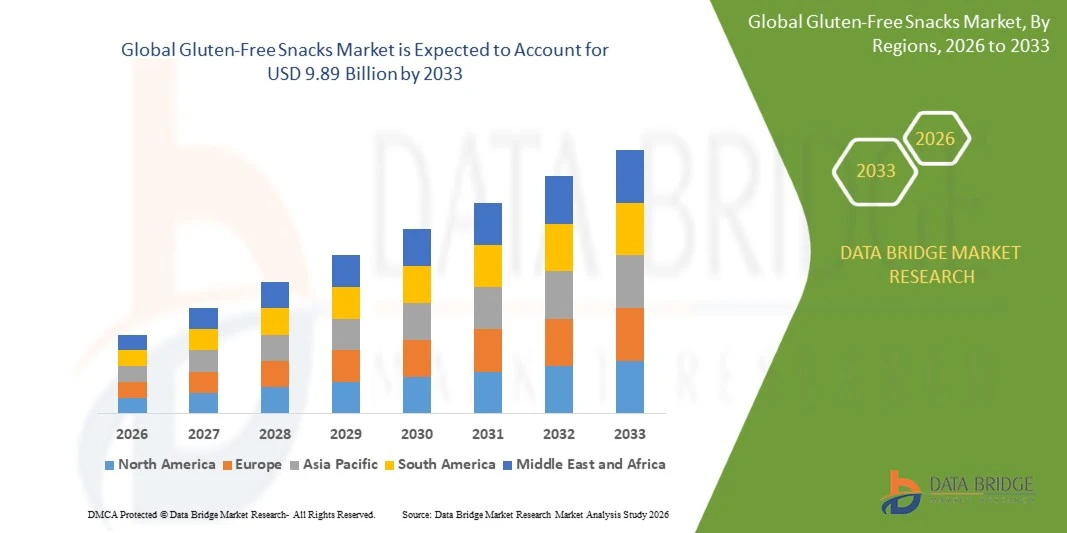
- As per Data Bridge Market Research analysis, the gluten-free snacks market was valued at USD 5.15 billion in 2025 and is projected to reach USD 9.89 billion by 2033, growing at a CAGR of 8.50% from 2026 to 2033.
- The market is experiencing consistent growth driven by rising awareness of celiac disease and gluten sensitivity, increasing demand for convenient and healthier snacking options, and expanding availability of gluten-free products across supermarkets and online retail channels.
- The growing adoption of gluten-free diets, combined with demand for diverse flavors and improved product quality, is encouraging manufacturers to develop innovative snacks using alternative ingredients such as rice, corn, quinoa, and other gluten-free grains. These developments are expanding consumer choices across chips, crackers, cookies, and snack bars, positioning gluten-free snacks as an increasingly accessible option for consumers with dietary restrictions and health-conscious preferences.
Market Size & Forecast
- Global Market Value (2025): USD 5.15 Billion
- Expected Market Value (2033): USD 9.89 Billion
- Forecast CAGR (2026–2033): 8.50%
- Leading Region in 2025: North America
- Fastest Growing Region: Asia Pacific
What are the Major Takeaways of the Gluten-Free Snacks Market?
- North America dominated the gluten-free snacks market with the largest revenue share of 38.6% in 2025, supported by high consumer awareness of celiac disease, established specialty food retail networks, and strong demand for gluten-free product
- Asia-Pacific is expected to be the fastest-growing region at a CAGR of 10.3% from 2026 to 2033, fueled by rising health awareness, expanding middle-class spending, and increasing demand for gluten-free snacks in China, India, Japan, and Australia.
- The chips and crisps segment led the market with a 38.4% share in 2025, driven by the widespread consumer preference for convenient, ready-to-eat savory snacks.
- Snack bars are the fastest-growing product type, projected to register a CAGR of 9.4%, reflecting the surge in demand for convenient, portable, and nutritionally focused snacks.
- The plant source segment dominated the source category with a 75% revenue share in 2025, led by the extensive use of rice, corn, potatoes, nuts, seeds, legumes, and other naturally gluten-free ingredients
- Hotels and restaurants accounted for 45% of the market share in 2025, preferred increasing demand for gluten-free food options across hotels, restaurants, cafés, and quick-service establishments.
- The educational institutions segment is the fastest-growing application category, with a CAGR of 8.5%, driven by increasing awareness of celiac disease and gluten sensitivity, rising demand for inclusive school meal programs, and growing adoption of gluten-free snacks to accommodate students
Report Scope and Gluten-Free Snacks Market Segmentation
|
Attributes |
Gluten-Free Snacks Key Market Insights |
|
Segments Covered |
|
|
Countries Covered |
North America
Europe
Asia-Pacific
Middle East and Africa
South America
|
|
Key Market Players |
|
|
Market Opportunities |
|
|
Value Added Data Infosets |
In addition to the insights on market scenarios such as market value, growth rate, segmentation, geographical coverage, and major players, the market reports curated by the Data Bridge Market Research also include in-depth expert analysis, pricing analysis, brand share analysis, consumer survey, demography analysis, supply chain analysis, value chain analysis, raw material/consumables overview, vendor selection criteria, PESTLE Analysis, Porter Analysis, and regulatory framework. |
What is the Key Trend in the Gluten-Free Snacks Market?
- Food manufacturers are increasingly expanding gluten-free snack portfolios with familiar flavors and improved textures to attract consumers seeking dietary safety without compromising taste and convenience.
- For instance, in April 2025, Arnott’s introduced Gluten Free Jatz biscuits and Gluten Free Barbecue Shapes in Australia, expanding its savory snack range for consumers avoiding gluten.
- Product innovation is increasingly focused on familiar snack formats, including crackers, biscuits, chips, and baked snacks, helping brands appeal to both consumers with gluten-related disorders and broader health-conscious audiences.
- Manufacturers are also developing products with alternative grains, cleaner ingredient profiles, and varied flavor combinations to differentiate their offerings in an increasingly competitive snack market.
- For instance, in May 2025, Kameda LT Foods launched Krispy Hopu in a sweet-and-salty flavor under its Kari Kari brand, offering a roasted, gluten-free, vegan rice-based snack without palm oil
- As manufacturers continue prioritizing taste, convenience, and product variety, innovation in gluten-free snack formulations is expected to strengthen consumer appeal and broaden market adoption.
What are the Key Drivers of the Gluten-Free Snacks Market?
- The rising awareness of celiac disease and gluten sensitivity is increasing demand for gluten-free snacks that help consumers manage medically necessary dietary restrictions while maintaining convenient eating habits.
- For instance, in May 2025, Kameda LT Foods launched Krispy Hopu under its Kari Kari brand, a roasted, gluten-free, vegan rice-based snack in a sweet-and-salty flavor, reflecting growing demand for convenient, better-for-you snack alternatives
- Consumers are increasingly seeking accessible gluten-free alternatives across supermarkets, specialty food stores, and online platforms, encouraging manufacturers to expand distribution and product availability.
- Clearer labeling standards and greater consumer understanding of gluten cross-contact are also encouraging demand for products with verified gluten-free claims and dependable manufacturing practices.
- For instance, in February 2024, Mintel reported that 82% of consumers who eat or previously ate gluten-free foods had not been diagnosed with celiac disease, highlighting the role of broader consumer preferences and perceived wellness benefits in expanding demand beyond medically necessary diets.
- With growing awareness of gluten-related disorders and increasing availability of familiar snack alternatives, manufacturers are positioned to expand product portfolios and reach a broader consumer base.
What Factors are Challenging the Growth of the Gluten-Free Snacks Market?
- Gluten-free snacks can involve higher production costs due to alternative ingredients, specialized processing, certification requirements, and measures needed to prevent cross-contact with gluten-containing ingredients.
- For instance, in May 2024, a study published in the Indian Journal of Gastroenterology analyzed 485 gluten-free food products and 790 conventional counterparts available in Delhi supermarkets and online stores. The study found that gluten-free products were 232% more expensive on average, creating an affordability barrier for consumers who depend on these products.
- These additional costs can translate into higher retail prices, limiting affordability for price-sensitive consumers and households that rely on gluten-free products for medical reasons.
- The higher cost of specialized ingredients and production controls, combined with potential nutritional trade-offs such as lower protein and fiber in some product categories, creates challenges for manufacturers seeking to deliver affordable, nutritionally balanced snacks.
- For instance, in October 2024, research published in Nutrition Bulletin examined 1,058 products in the Greek retail market, including 408 gluten-free products. The study found that gluten-free staple foods were more expensive than comparable conventional products, while gluten-free non-staple foods, including chips and sweets, did not show the same overall price disadvantage.
- These affordability and formulation challenges can restrict adoption among budget-conscious consumers and increase pressure on brands to maintain taste, nutritional quality, and competitive pricing. Consequently, cost-effective ingredient sourcing and improved product formulations remain important to the market's long-term expansion.
How is the Gluten-Free Snacks Market Segmented?
The gluten-free snacks market is segmented on the basis of product type, source, application, and distribution channel.
- By Product Type
On the basis of product type, the gluten-free snacks market is segmented into bakery snacks, chips and crisps, cookies and biscuits, crackers and pretzels, snack bars, popcorn and extruded snacks, nuts and seeds, and confectionery snacks. The chips and crisps segment dominated the market with an estimated 38.4% share in 2025, owing to widespread consumer preference for convenient, ready-to-eat savory snacks. Potato-, corn-, and rice-based chips are suitable for gluten-free formulations when ingredients and processing practices prevent gluten cross-contact. These products are widely available through supermarkets, convenience stores, and online retail platforms. Manufacturers are introducing innovative flavors, baked varieties, and reduced-fat formulations to attract health-conscious consumers. Single-serve packaging and multipacks are further supporting consumption across households and on-the-go occasions.
The snack bars segment is projected to register the fastest growth at a CAGR of 9.4% from 2026 to 2033, driven by rising demand for convenient, portable, and nutritionally focused snacks. Gluten-free snack bars made with nuts, seeds, dried fruits, certified gluten-free oats, and alternative grains appeal to consumers seeking quick energy between meals. Increasing interest in high-protein, high-fiber, and plant-based formulations is encouraging product innovation. Manufacturers are also expanding their offerings with low-sugar and clean-label ingredients. The growing popularity of fitness-oriented lifestyles and convenient breakfast alternatives is supporting demand. Expansion through e-commerce and specialty food retailers is further improving access to gluten-free snack bars.
- By Source
On the basis of source, the gluten-free snacks market is segmented into animal source and plant source. The plant source segment is estimated to dominate the market with share of 75% in 2025, supported by the extensive use of rice, corn, potatoes, nuts, seeds, legumes, and other naturally gluten-free ingredients. Plant-derived ingredients provide manufacturers with versatile options for developing chips, crackers, cookies, snack bars, and extruded snacks. Rice and corn are particularly useful in gluten-free formulations because they can provide desirable textures and serve as alternatives to wheat-based ingredients. Growing consumer interest in plant-based foods and recognizable ingredients is further strengthening demand. The availability of diverse plant ingredients also enables manufacturers to develop products for different flavor and nutritional preferences.
The animal source segment is projected to witness growth at CAGR of 7.0% from 2026 to 2033, supported by demand for protein-rich snacks made with ingredients such as dairy proteins, cheese, eggs, and meat. Cheese-based snacks, meat crisps, and protein snack products can provide alternatives to conventional carbohydrate-focused snacks when formulated without gluten-containing ingredients. Rising interest in high-protein diets is encouraging manufacturers to expand savory snack portfolios. These products can appeal to consumers seeking convenient protein intake during work, travel, and fitness activities. Product innovation involving seasoning, shelf stability, and portion-controlled packaging is further supporting the category.
- By Application
On the basis of application, the gluten-free snacks market is segmented into educational institutions, hotels and restaurants, and others. The hotels and restaurants segment dominated the application category with share of 45% in 2025, driven by increasing demand for gluten-free food options across hotels, restaurants, cafés, and quick-service establishments. Growing awareness of celiac disease and gluten sensitivity is encouraging food-service providers to expand their gluten-free snack offerings. Rising tourism and hospitality activity is further supporting demand for specialized dietary options. Restaurants are increasingly offering gluten-free bakery products, crackers, and packaged snacks to accommodate diverse consumer preferences. Improved menu labeling and careful food-handling practices are also strengthening consumer confidence.
The educational institutions segment is projected to grow at a CAGR of 8.5% from 2026 to 2033, as schools, colleges, and universities increasingly accommodate students with specific dietary requirements. Providing gluten-free snacks can help institutions offer suitable choices to students with celiac disease or medically necessary gluten avoidance. Packaged products with clear ingredient information and appropriate allergen controls can simplify procurement and distribution. Demand may also be supported by greater awareness among parents, school administrators, and food-service providers. Individually packaged snacks can be convenient for cafeterias, vending machines, and school events.
- By Distribution Channel
On the basis of distribution channel, the gluten-free snacks market is segmented into conventional stores, hotels and restaurants, educational institutes, specialty services, and hospitals and drug stores. The conventional stores segment is estimated to dominate the market with share of 71.7% in 2025, supported by the wide availability of gluten-free snacks in supermarkets, hypermarkets, grocery stores, and convenience outlets. These retailers offer consumers access to multiple product categories, including chips, crackers, cookies, snack bars, and nuts. Dedicated gluten-free shelves and clear packaging labels can help shoppers identify suitable products more easily. Established retail networks also enable manufacturers to reach consumers across urban and suburban markets. Promotional activities, competitive pricing, and multipack options can further encourage repeat purchases. Broad accessibility and established shopping habits support the importance of conventional stores in gluten-free snack distribution.
The specialty services segment is projected to witness strong growth at a CAGR of 9.0% from 2026 to 2033, driven by demand for products tailored to consumers with celiac disease, gluten sensitivity, and specific dietary preferences. Specialty health-food retailers and dedicated gluten-free outlets often provide a wider assortment of niche products than conventional stores. These channels can help consumers find certified gluten-free products, specialty bakery snacks, and products with specific ingredient profiles. Knowledgeable retail staff and detailed product information can also improve the shopping experience. Online specialty retailers and subscription-based services can extend access to consumers in locations with limited physical retail options. Increasing product diversity and demand for reliable dietary information are expected to support this distribution channel.
Which Region Holds the Largest Share of the Gluten-Free Snacks Market?
- North America dominated the gluten-free snacks market with the largest revenue share of 38.6% in 2025, supported by high consumer awareness of celiac disease, established specialty food retail networks, and strong demand for gluten-free product
- The region also benefits from well-established food labeling standards, growing demand for convenient and healthier snacking options, and increasing product innovation across chips, crackers, cookies, and snack bars. Expanding online grocery platforms and the presence of established food manufacturers continue to strengthen North America's position in the global market.
U.S. Gluten-Free Snacks Market Insight
The U.S. gluten-free snacks market is witnessing strong growth due to rising awareness of celiac disease, increasing diagnosis of gluten-related disorders, and growing demand for convenient dietary alternatives. The country’s established packaged food industry, along with the widespread availability of gluten-free chips, crackers, cookies, and snack bars, is driving demand across retail and e-commerce channels. In addition, clear gluten-free labeling standards and increasing consumer interest in diverse snack formulations are accelerating product innovation across supermarkets, specialty food stores, and online platforms.
Asia-Pacific Gluten-Free Snacks Market Insight
The Asia-Pacific gluten-free snacks market is expected to witness rapid growth, driven by increasing health awareness, expanding urban populations, and rising demand for convenient packaged foods across countries such as China, India, Japan, and Australia. Growing interest in alternative grains, including rice, millet, and quinoa, is supporting the development of diverse gluten-free snack products. In addition, expanding modern retail infrastructure, increasing e-commerce penetration, and growing availability of specialty dietary foods are supporting regional market expansion.
Japan Gluten-Free Snacks Market Insight
The Japan gluten-free snacks market is witnessing consistent growth due to increasing consumer interest in dietary diversity, product quality, and convenient snacking options. Manufacturers and retailers are expanding the availability of rice-based crackers, gluten-free confectionery, and alternative-grain snacks to accommodate changing consumer preferences. Moreover, Japan’s established packaged food industry, strong retail infrastructure, and growing interest in clearly labeled specialty food products are contributing to market development. Continued product innovation and the availability of traditional snack formats made with gluten-free ingredients are further supporting demand.
China Gluten-Free Snacks Market Insight
The China gluten-free snacks market is growing steadily, driven by rising health awareness, expanding urban consumer populations, and increasing demand for convenient packaged snacks. Growing interest in rice-based products and alternative ingredients is encouraging manufacturers to develop gluten-free crackers, chips, biscuits, and other snack varieties. In addition, the expansion of e-commerce platforms, modern supermarkets, and specialty food retailers is improving product accessibility. Increasing product diversification and the growing availability of imported and domestically produced specialty foods are supporting market development across China.
U.K. Gluten-Free Snacks Market Insight
The U.K. gluten-free snacks market is experiencing steady growth, supported by increasing awareness of celiac disease and demand for convenient alternatives to conventional snack products. Established supermarkets, specialty retailers, and online platforms provide consumers with access to gluten-free biscuits, crackers, chips, and snack bars. Furthermore, clear food labeling requirements and ongoing product innovation are encouraging manufacturers to improve product variety and accessibility. Growing interest in plant-based ingredients, alternative grains, and improved snack formulations is further contributing to market growth in the U.K.
Germany Gluten-Free Snacks Market Insight
The Germany gluten-free snacks market is expanding steadily due to increasing awareness of gluten-related disorders, demand for specialized dietary products, and the country’s well-developed packaged food industry. Consumers are increasingly seeking gluten-free bakery snacks, crackers, biscuits, and savory products through supermarkets, discount retailers, and specialty food stores. Continuous innovation in alternative-grain ingredients, product formulations, and packaging is improving consumer choice. In addition, established food safety and labeling requirements, together with growing interest in convenient and varied snack options, are supporting market development in Germany.
Which are the Top Companies in Gluten-Free Snacks Market?
The gluten-free snacks industry is primarily led by well-established companies, including:
- Mondelez International, Inc. (U.S.)
- General Mills, Inc. (U.S.)
- PepsiCo, Inc. (U.S.)
- The Hershey Company (U.S.)
- The Hain Celestial Group, Inc. (U.S.)
- Utz Brands, Inc. (U.S.)
- Conagra Brands, Inc. (U.S.)
- Dr. Schär AG / SPA (Italy)
- Amy's Kitchen, Inc. (U.S.)
- Barilla G. e R. Fratelli S.p.A. (Italy)
- Lotus Bakeries N.V. (Belgium)
- Lundberg Family Farms (U.S.)
- Edward & Sons Trading Co. (U.S.)
- Quinn Foods LLC (U.S.)
- RW Garcia Co. (U.S.)
- Kellanova (U.S.)
- Flowers Foods, Inc. (U.S.)
- Real Foods Pty Ltd (Australia)
- Orgran (Australia)
- Good Mills Deutschland GmbH (Germany)
What are Latest Developments in Gluten-Free Snacks Market?
- In April 2025, Arnott’s announced the launch of Gluten Free Jatz biscuits and Gluten Free Barbecue Shapes in Australia, expanding its savory gluten-free snack portfolio. The products were developed to offer consumers avoiding gluten familiar snack options while retaining the brand’s established taste and quality. The launch extended Arnott’s gluten-free range and improved the availability of savory alternatives for consumers with celiac disease or gluten sensitivity.
- In May 2024, Mondelēz International announced the launch of its first-ever Chips Ahoy! Gluten Free chocolate chip cookies in the United States. The new product expanded the brand’s established cookie portfolio to include a certified gluten-free option, responding to demand for familiar treats suitable for gluten-avoiding consumers. The launch highlighted the growing focus among major snack manufacturers on extending mainstream brands into the gluten-free category.
- In July 2023, FitJoy announced the launch of a new line of grain-free crackers, introducing Classic, White Cheddar, and Pepper Jack Cheese varieties. The products were developed as alternatives to conventional crackers and were described as gluten-free certified, grain-free, dairy-free, and nut-free. The launch expanded consumer choice in the savory snack category and demonstrated continued innovation in allergen-conscious snack formulations.
- In December 2023, CauliPuffs announced the launch of its gluten-free puffed snack range, made using cauliflower, rice, and corn. The products were introduced in flavors including White Cheddar, Honey BBQ, and Vegan Salt & Pepper, offering consumers alternatives to traditional puffed snacks. The launch emphasized baked preparation and the use of alternative ingredients, reflecting manufacturers’ efforts to diversify gluten-free snack choices and appeal to consumers seeking different ingredient profiles.
- In March 2021, MadeGood Foods announced the introduction of Star Puffed Crackers, expanding its portfolio into the savory snack category. The gluten-free, dairy-free, and organic crackers were launched in Sea Salt, Cheddar, and Pizza flavors and included nutrients from six fruit and vegetable sources. The products were designed for everyday snacking, school lunches, and on-the-go consumption. This development demonstrated continued innovation in gluten-free snacks combining dietary suitability with ingredient diversity and convenient formats.

- Interactive Data Analysis Dashboard
- Company Analysis Dashboard for high growth potential opportunities
- Research Analyst Access for customization & queries
- Competitor Analysis with Interactive dashboard
- Latest News, Updates & Trend analysis
- Harness the Power of Benchmark Analysis for Comprehensive Competitor Tracking
Global Gluten Free Snacks Market, Supply Chain Analysis and Ecosystem Framework
To support market growth and help clients navigate the impact of geopolitical shifts, DBMR has integrated in-depth supply chain analysis into its Global Gluten Free Snacks Market research reports. This addition empowers clients to respond effectively to global changes affecting their industries. The supply chain analysis section includes detailed insights such as Global Gluten Free Snacks Market consumption and production by country, price trend analysis, the impact of tariffs and geopolitical developments, and import and export trends by country and HSN code. It also highlights major suppliers with data on production capacity and company profiles, as well as key importers and exporters. In addition to research, DBMR offers specialized supply chain consulting services backed by over a decade of experience, providing solutions like supplier discovery, supplier risk assessment, price trend analysis, impact evaluation of inflation and trade route changes, and comprehensive market trend analysis.
Data collection and base year analysis are done using data collection modules with large sample sizes. The stage includes obtaining market information or related data through various sources and strategies. It includes examining and planning all the data acquired from the past in advance. It likewise envelops the examination of information inconsistencies seen across different information sources. The market data is analysed and estimated using market statistical and coherent models. Also, market share analysis and key trend analysis are the major success factors in the market report. To know more, please request an analyst call or drop down your inquiry.
The key research methodology used by DBMR research team is data triangulation which involves data mining, analysis of the impact of data variables on the market and primary (industry expert) validation. Data models include Vendor Positioning Grid, Market Time Line Analysis, Market Overview and Guide, Company Positioning Grid, Patent Analysis, Pricing Analysis, Company Market Share Analysis, Standards of Measurement, Global versus Regional and Vendor Share Analysis. To know more about the research methodology, drop in an inquiry to speak to our industry experts.
Data Bridge Market Research is a leader in advanced formative research. We take pride in servicing our existing and new customers with data and analysis that match and suits their goal. The report can be customized to include price trend analysis of target brands understanding the market for additional countries (ask for the list of countries), clinical trial results data, literature review, refurbished market and product base analysis. Market analysis of target competitors can be analyzed from technology-based analysis to market portfolio strategies. We can add as many competitors that you require data about in the format and data style you are looking for. Our team of analysts can also provide you data in crude raw excel files pivot tables (Fact book) or can assist you in creating presentations from the data sets available in the report.