


What is the Irritable Bowel Syndrome (IBS) Market Size and Growth Rate?
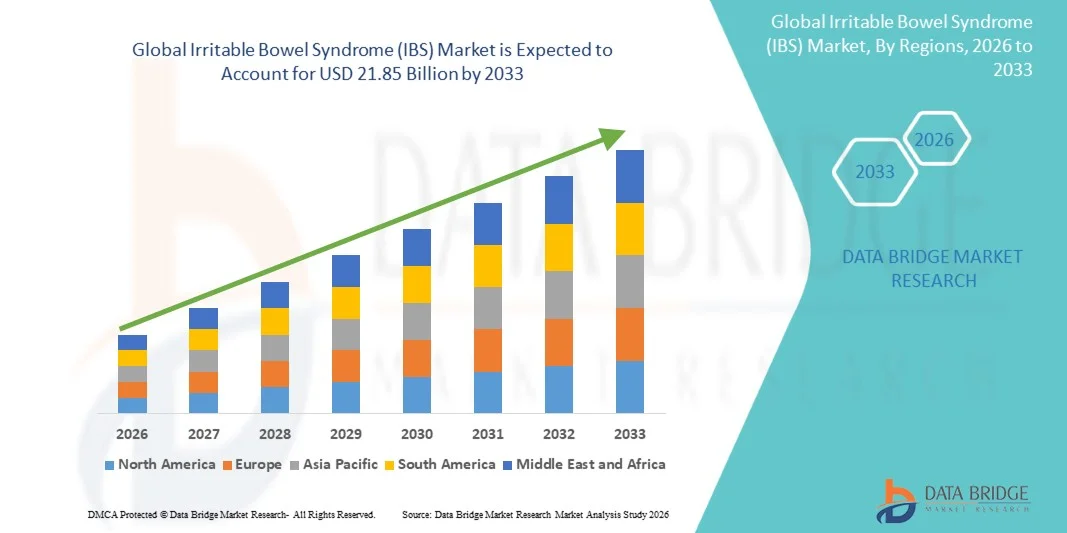
- As per Data Bridge Market Research Analysis the global Irritable Bowel Syndrome (IBS) market size was valued at USD 8.28 billion in 2025 and is expected to reach USD 21.85 billion by 2033, at a CAGR of 12.90% during the forecast period
- The market growth is largely fueled by the increasing prevalence of gastrointestinal disorders, rising awareness about digestive health, and growing advancements in diagnostic and therapeutic approaches, leading to improved identification and management of irritable bowel syndrome across healthcare settings
- Furthermore, the rising patient demand for effective, personalized, and long-term treatment solutions is establishing IBS therapies as a critical focus area in gastroenterology. These converging factors are accelerating the uptake of irritable bowel syndrome (IBS) solutions, thereby significantly boosting the market growth
Market Size & Forecast
- Global Market Value (2025): USD 8.28 billion
- Expected Market Value (2033): USD 21.85 billion
- Forecast CAGR (2026–2033): 12.90%
What are the Major Takeaways of Irritable Bowel Syndrome (IBS) Market?
- Irritable bowel syndrome (IBS), a common gastrointestinal disorder affecting the large intestine, is gaining increased attention due to its high global prevalence and impact on quality of life. The growing focus on digestive health, along with advancements in diagnostic methods and treatment options, is making IBS management a key area within gastroenterology care
- The escalating demand for IBS treatments is primarily driven by rising awareness among patients, increasing diagnosis rates, and a growing preference for personalized and long-term management solutions, including dietary interventions, probiotics, and pharmacological therapies
- North America dominated the irritable bowel syndrome (IBS) market with a revenue share of approximately 39.8% in 2025, supported by advanced healthcare infrastructure, high awareness levels, and strong availability of approved treatment options. The U.S. leads the region due to a large patient pool and continuous research and development activities
- Asia-Pacific is expected to be the fastest-growing region in the irritable bowel syndrome (IBS) market during the forecast period, driven by increasing healthcare awareness, rising disposable incomes, improving access to medical care, and a growing prevalence of gastrointestinal disorders in countries such as China and India
- The IBS-C segment held the largest market revenue share of 42.9% in 2025, driven by its higher diagnosis rate and the availability of a wide range of targeted treatment options
Report Scope and Irritable Bowel Syndrome (IBS) Market Segmentation
|
Attributes |
Irritable Bowel Syndrome (IBS) Key Market Insights |
|
Segments Covered |
|
|
Countries Covered |
North America
Europe
Asia-Pacific
Middle East and Africa
South America
|
|
Key Market Players |
|
|
Market Opportunities |
|
|
Value Added Data Infosets |
|
What is the Key Trend in the Irritable Bowel Syndrome (IBS) Market?
“Growing Focus on Personalized Treatment and Microbiome-Based Therapies”
- A significant and accelerating trend in the global Irritable Bowel Syndrome (IBS) market is the increasing focus on personalized treatment approaches and the development of microbiome-based therapies
- Advances in understanding the gut-brain axis and the role of gut microbiota are enabling the development of targeted therapies tailored to individual patient profiles and symptom patterns
- For instance, the use of probiotics, prebiotics, and dietary interventions such as low FODMAP diets is gaining traction as part of individualized IBS management strategies
- In addition, pharmaceutical companies are investing in novel drug development aimed at addressing specific IBS subtypes, such as IBS with constipation (IBS-C) and IBS with diarrhea (IBS-D)
- The integration of digital health tools for symptom tracking and patient monitoring is further supporting personalized care and improving treatment adherence
- Increasing awareness among patients and healthcare providers regarding the importance of tailored treatment approaches is contributing to improved clinical outcomes
- This shift towards precision medicine is reshaping treatment paradigms and driving innovation in the Irritable Bowel Syndrome (IBS) market
Irritable Bowel Syndrome (IBS) Market Dynamics
Driver
“Rising Prevalence of Gastrointestinal Disorders and Increasing Awareness”
- The increasing prevalence of gastrointestinal disorders, particularly Irritable Bowel Syndrome (IBS), is a major driver for market growth
- Factors such as changing dietary habits, rising stress levels, sedentary lifestyles, and growing incidence of mental health conditions are contributing to the increasing burden of IBS globally
- For instance, IBS affects a significant proportion of the global population, leading to a growing demand for effective diagnostic and therapeutic solutions
- Increasing awareness regarding IBS and its symptoms is encouraging more patients to seek medical consultation and treatment
- Furthermore, advancements in diagnostic techniques and improved accessibility to healthcare services are supporting early diagnosis and management of the condition
- The growing availability of over-the-counter medications, prescription drugs, and non-pharmacological treatment options is further driving market expansion
- These factors collectively are significantly contributing to the growth of the Irritable Bowel Syndrome (IBS) market
Restraint/Challenge
“Lack of Definitive Cure and Variability in Treatment Outcomes”
- One of the major challenges in the Irritable Bowel Syndrome (IBS) market is the absence of a definitive cure, as the condition is chronic and varies significantly among individual
- The heterogeneity of symptoms and underlying causes makes it difficult to develop universally effective treatment options
- For instance, patients often respond differently to the same treatment, requiring a trial-and-error approach that can delay symptom relief and affect patient satisfaction
- In addition, misdiagnosis or delayed diagnosis due to symptom overlap with other gastrointestinal disorders can hinder effective disease management
- Limited awareness in certain regions and social stigma associated with digestive disorders may also prevent patients from seeking timely medical care
- Furthermore, the high cost of long-term management, including medications, dietary modifications, and consultations, can pose a financial burden on patients
- Addressing these challenges through continued research, improved diagnostic accuracy, and development of targeted therapies will be essential for sustained market growth
How is the Irritable Bowel Syndrome (IBS) Market Segmented?
The market is segmented on the basis of drug type, medical condition, distribution channel, and end-users.
• By Drug Type
On the basis of drug type, the Irritable Bowel Syndrome (IBS) market is segmented into Lubiprostone, Linaclotide, Eluxadoline, Rifaximin, Alosetron, and others. The Linaclotide segment dominated the largest market revenue share of 38.7% in 2025, driven by its strong efficacy in treating IBS with constipation (IBS-C) and its widespread clinical adoption across major healthcare markets. Linaclotide works by increasing intestinal fluid secretion and accelerating transit, making it highly effective in managing chronic constipation and abdominal pain. Its favorable safety profile and regulatory approvals in multiple regions further support its dominance. Physicians widely prescribe this drug due to its consistent therapeutic outcomes and patient compliance. Increasing awareness about IBS treatment options is also contributing to higher prescription rates. In addition, growing diagnosis rates of IBS-C are fueling demand for targeted therapies like Linaclotide. The availability of branded formulations and ongoing clinical studies further strengthen its market presence. Pharmaceutical companies are also investing in expanding indications and improving accessibility. Rising healthcare expenditure and better patient access to medications continue to drive segment growth. Overall, its clinical effectiveness and strong adoption rate maintain its leading position in the market.
The Rifaximin segment is anticipated to witness the fastest growth rate of 22.3% from 2026 to 2033, fueled by its increasing use in treating IBS with diarrhea (IBS-D) and its unique mechanism as a gut-targeted antibiotic. Rifaximin is gaining popularity due to its minimal systemic absorption and targeted action on gut microbiota, reducing symptoms such as bloating and diarrhea. The growing recognition of gut microbiome imbalance as a key factor in IBS is driving its adoption. In addition, increasing clinical evidence supporting its efficacy is encouraging physicians to prescribe it more frequently. The drug’s ability to provide long-term symptom relief with repeat treatment cycles further enhances its appeal. Rising prevalence of IBS-D globally is also supporting demand. Pharmaceutical companies are focusing on expanding its indications and improving patient access. Favorable reimbursement scenarios in developed regions further contribute to growth. Moreover, increasing patient preference for effective and well-tolerated therapies is boosting its uptake. As research on microbiome-targeted treatments advances, the segment is expected to grow rapidly over the forecast period.
• By Medical Condition
On the basis of medical condition, the Irritable Bowel Syndrome (IBS) market is segmented into IBS-Constipation (IBS-C), IBS-Diarrhea (IBS-D), and Mixed. The IBS-C segment held the largest market revenue share of 42.9% in 2025, driven by its higher diagnosis rate and the availability of a wide range of targeted treatment options. IBS-C is more commonly reported among patients, particularly in women, leading to increased demand for effective therapies. The segment benefits from strong clinical awareness and established treatment guidelines. In addition, advancements in pharmacological treatments specifically targeting constipation symptoms are supporting growth. Increasing patient awareness and healthcare access are also contributing to higher diagnosis rates. The availability of multiple approved drugs for IBS-C enhances treatment options and patient outcomes. Growing focus on improving quality of life for patients further drives demand. Moreover, lifestyle factors such as poor diet and stress are increasing the prevalence of IBS-C. Continuous research and development activities are also supporting innovation in this segment. Overall, strong clinical focus and treatment availability maintain its dominance.
The IBS-D segment is expected to witness the fastest CAGR of 21.6% from 2026 to 2033, driven by rising awareness and improved diagnosis of diarrhea-predominant IBS. Increasing prevalence of gastrointestinal infections and gut microbiome disturbances is contributing to segment growth. The availability of targeted therapies such as Rifaximin and Eluxadoline is enhancing treatment outcomes. Patients are increasingly seeking medical attention due to the severity and impact of symptoms on daily life. Advancements in diagnostic techniques are also improving identification of IBS-D cases. Growing research on gut health and microbiota is supporting the development of innovative therapies. In addition, rising healthcare expenditure is enabling better access to treatment. Pharmaceutical companies are focusing on expanding their IBS-D drug portfolios. Increasing patient preference for effective symptom relief is also driving demand. As awareness and treatment options continue to improve, the segment is expected to grow significantly.
• By Distribution Channel
On the basis of distribution channel, the Irritable Bowel Syndrome (IBS) market is segmented into hospital pharmacies, online pharmacies, and retail pharmacies. The retail pharmacies segment accounted for the largest market revenue share of 47.5% in 2025, driven by their widespread presence and easy accessibility for patients. Retail pharmacies serve as the primary point of purchase for prescription and over-the-counter IBS medications. The segment benefits from strong consumer trust and convenience. In addition, pharmacists play a key role in guiding patients on medication usage. Increasing availability of IBS drugs in retail outlets further supports growth. The expansion of pharmacy chains and improved supply chain networks enhance accessibility. Rising awareness about IBS treatments is also driving higher footfall in retail pharmacies. Moreover, the availability of both branded and generic drugs increases affordability. The segment also benefits from strong distribution networks in both urban and rural areas. Continuous improvements in pharmacy services further strengthen market presence.
The online pharmacies segment is anticipated to witness the fastest growth rate of 23.1% from 2026 to 2033, fueled by the rapid adoption of e-commerce and digital healthcare platforms. Online pharmacies offer convenience, home delivery, and competitive pricing, attracting a growing number of consumers. Increasing internet penetration and smartphone usage are supporting segment growth. Patients with chronic conditions such as IBS prefer online platforms for repeat medication purchases. In addition, the COVID-19 pandemic accelerated the shift toward digital healthcare services. Online platforms also provide access to a wider range of medications and information. Technological advancements and secure payment systems enhance user experience. Growing partnerships between pharmaceutical companies and e-pharmacy platforms further support expansion. Regulatory support in various regions is also encouraging adoption. As digital healthcare continues to evolve, the segment is expected to grow rapidly.
• By End-Users
On the basis of end-users, the Irritable Bowel Syndrome (IBS) market is segmented into hospitals, clinics, and homecare settings. The hospitals segment dominated the largest market revenue share of 49.8% in 2025, driven by the availability of advanced diagnostic facilities and specialized healthcare professionals. Hospitals are the primary point of care for patients with severe IBS symptoms requiring comprehensive evaluation and treatment. The segment benefits from integrated healthcare services and access to a wide range of medications. Increasing hospital visits for gastrointestinal disorders further support growth. In addition, the presence of multidisciplinary teams enhances patient outcomes. Rising healthcare expenditure and infrastructure development also contribute to segment expansion. Hospitals play a key role in accurate diagnosis and long-term management of IBS. Strong reimbursement policies in developed regions further support market dominance. Continuous advancements in hospital-based care improve treatment efficiency. Overall, hospitals remain the leading end-user segment.
The homecare settings segment is expected to witness the fastest CAGR of 20.9% from 2026 to 2033, driven by the growing preference for self-management and long-term treatment of IBS at home. Patients increasingly prefer home-based care due to convenience and cost-effectiveness. The availability of oral medications and digital health tools supports this trend. Increasing awareness about lifestyle management and dietary control also contributes to segment growth. Telemedicine and remote consultation services are further enhancing homecare adoption. In addition, chronic nature of IBS encourages ongoing self-care practices. Pharmaceutical companies are focusing on patient-friendly treatment options. Rising demand for personalized healthcare solutions also supports growth. The expansion of digital health platforms is improving patient engagement. As healthcare shifts toward patient-centric models, homecare settings are expected to grow significantly.
Which Region Holds the Largest Share of the Irritable Bowel Syndrome (IBS) Market?
- North America dominated the irritable bowel syndrome (IBS) market with the largest revenue share of approximately 39.8% in 2025, supported by advanced healthcare infrastructure, high awareness levels, and strong availability of approved treatment options
- The region benefits from a large diagnosed patient population, widespread access to healthcare services, and increasing adoption of pharmacological and non-pharmacological treatment approaches
- This dominance is further reinforced by strong research and development activities, favorable reimbursement scenarios, and the presence of major pharmaceutical companies, establishing North America as a key contributor to the irritable bowel syndrome (IBS) market
U.S. Irritable Bowel Syndrome (IBS) Market Insight
The U.S. irritable bowel syndrome (IBS) market captured the largest revenue share in 2025 within North America, driven by a large patient pool and high awareness regarding gastrointestinal disorders. The country benefits from early diagnosis, strong availability of approved drugs, and continuous advancements in treatment options. In addition, increasing healthcare expenditure, ongoing clinical research, and the presence of leading market players are significantly contributing to market growth in the United States.
Europe Irritable Bowel Syndrome (IBS) Market Insight
The Europe irritable bowel syndrome (IBS) market is projected to expand at a substantial CAGR throughout the forecast period, primarily driven by rising prevalence of gastrointestinal disorders and strong healthcare systems. Increasing awareness regarding IBS, along with improved access to diagnostic and treatment services, is supporting market growth. Furthermore, growing emphasis on patient-centric care and advancements in therapeutic approaches are contributing to improved disease management across the region.
U.K. Irritable Bowel Syndrome (IBS) Market Insight
The U.K. irritable bowel syndrome (IBS) market is anticipated to grow at a noteworthy CAGR during the forecast period, driven by increasing awareness of digestive health and rising burden of IBS cases. Government healthcare initiatives and access to public healthcare services are encouraging early diagnosis and treatment. In addition, growing focus on lifestyle management and dietary interventions is expected to support market expansion in the U.K.
Germany Irritable Bowel Syndrome (IBS) Market Insight
The Germany irritable bowel syndrome (IBS) market is expected to expand at a considerable CAGR during the forecast period, fueled by advanced healthcare infrastructure and strong emphasis on research and innovation. The country’s well-established medical system supports the adoption of advanced diagnostic methods and effective treatment strategies. Increasing awareness regarding gastrointestinal health and availability of specialized care are key factors driving market growth in Germany.
Asia-Pacific Irritable Bowel Syndrome (IBS) Market Insight
The Asia-Pacific irritable bowel syndrome (IBS) market is poised to grow at the fastest CAGR during the forecast period of 2026 to 2033, driven by increasing healthcare awareness, rising disposable incomes, improving access to medical care, and a growing prevalence of gastrointestinal disorders in countries such as China and India .The region is witnessing significant improvements in healthcare infrastructure and diagnostic capabilities, enabling better identification and management of IBS cases. In addition, changing dietary habits, urbanization, and rising stress levels are contributing to the increasing incidence of IBS across the region. Government initiatives aimed at improving healthcare access and growing investments in the healthcare sector are further accelerating market growth
Japan Irritable Bowel Syndrome (IBS) Market Insight
The Japan irritable bowel syndrome (IBS) market is gaining momentum due to the country’s aging population and increasing focus on gastrointestinal health. The presence of advanced healthcare technologies and strong emphasis on early diagnosis and preventive care are supporting market growth. In addition, increasing adoption of targeted therapies and dietary management approaches is contributing to improved patient outcomes in Japan.
China Irritable Bowel Syndrome (IBS) Market Insight
The China irritable bowel syndrome (IBS) market accounted for the largest market revenue share in Asia-Pacific in 2025, attributed to a large population base, increasing prevalence of gastrointestinal disorders, and improving healthcare infrastructure. Rising awareness regarding digestive health, growing healthcare expenditure, and expanding access to medical services are key factors driving market growth. Furthermore, ongoing healthcare reforms and increased focus on early diagnosis and treatment are expected to further propel the market in China.
Which are the Top Companies in Irritable Bowel Syndrome (IBS) Market?
The Irritable Bowel Syndrome (IBS) industry is primarily led by well-established companies, including:
• AbbVie Inc. (U.S.)
• Ironwood Pharmaceuticals, Inc. (U.S.)
• Takeda Pharmaceutical Company Limited (Japan)
• Bausch Health Companies Inc. (Canada)
• Astellas Pharma Inc. (Japan)
• Pfizer Inc. (U.S.)
• GlaxoSmithKline plc (U.K.)
• Sanofi S.A. (France)
• Bayer AG (Germany)
• Novartis AG (Switzerland)
• Johnson & Johnson (U.S.)
• Procter & Gamble Co. (U.S.)
• Nestlé Health Science (Switzerland)
• Ardelyx, Inc. (U.S.)
• Synthetic Biologics, Inc. (U.S.)
• Sebela Pharmaceuticals (U.S.)
• Salix Pharmaceuticals (U.S.)
• RedHill Biopharma Ltd. (Israel)
• Entera Bio Ltd. (Israel)
What are Latest Developments in Irritable Bowel Syndrome (IBS) Market?
- In April 2024, Bausch Health Companies announced that a U.S. court upheld its patent protection for Xifaxan (rifaximin), blocking generic competition until 2029, thereby safeguarding a key IBS-D treatment and maintaining its market exclusivity position
- In April 2024, Bausch Health Companies filed a patent infringement lawsuit against Amneal Pharmaceuticals to prevent the launch of a generic version of Xifaxan, highlighting ongoing competitive and intellectual property dynamics in the IBS therapeutics market
- In December 2024, ANI Pharmaceuticals announced the launch of Prucalopride tablets, a generic version of Motegrity, following U.S. FDA approval, expanding treatment options for patients with chronic constipation associated with IBS
- In January 2025, Amneal Pharmaceuticals received tentative approval from the U.S. Food and Drug Administration for its rifaximin 550 mg tablets (generic of Xifaxan) for the treatment of IBS with diarrhea (IBS-D), indicating upcoming competition and increased accessibility in the IBS drug market
- In January 2025, industry reports highlighted a strong shift toward personalized medicine and the development of novel IBS therapies, with increased R&D investments and pipeline advancements driving innovation across the global market
- In November 2025, U.S. Food and Drug Administration approved Linzess (linaclotide), developed by Ironwood Pharmaceuticals and AbbVie, for pediatric patients aged 7 years and older with IBS-C, marking the first FDA-approved treatment for this population and expanding the therapeutic landscape

- Interactive Data Analysis Dashboard
- Company Analysis Dashboard for high growth potential opportunities
- Research Analyst Access for customization & queries
- Competitor Analysis with Interactive dashboard
- Latest News, Updates & Trend analysis
- Harness the Power of Benchmark Analysis for Comprehensive Competitor Tracking
Data collection and base year analysis are done using data collection modules with large sample sizes. The stage includes obtaining market information or related data through various sources and strategies. It includes examining and planning all the data acquired from the past in advance. It likewise envelops the examination of information inconsistencies seen across different information sources. The market data is analysed and estimated using market statistical and coherent models. Also, market share analysis and key trend analysis are the major success factors in the market report. To know more, please request an analyst call or drop down your inquiry.
The key research methodology used by DBMR research team is data triangulation which involves data mining, analysis of the impact of data variables on the market and primary (industry expert) validation. Data models include Vendor Positioning Grid, Market Time Line Analysis, Market Overview and Guide, Company Positioning Grid, Patent Analysis, Pricing Analysis, Company Market Share Analysis, Standards of Measurement, Global versus Regional and Vendor Share Analysis. To know more about the research methodology, drop in an inquiry to speak to our industry experts.
Data Bridge Market Research is a leader in advanced formative research. We take pride in servicing our existing and new customers with data and analysis that match and suits their goal. The report can be customized to include price trend analysis of target brands understanding the market for additional countries (ask for the list of countries), clinical trial results data, literature review, refurbished market and product base analysis. Market analysis of target competitors can be analyzed from technology-based analysis to market portfolio strategies. We can add as many competitors that you require data about in the format and data style you are looking for. Our team of analysts can also provide you data in crude raw excel files pivot tables (Fact book) or can assist you in creating presentations from the data sets available in the report.












