


What is the Glycerol Market Size and Growth Rate?
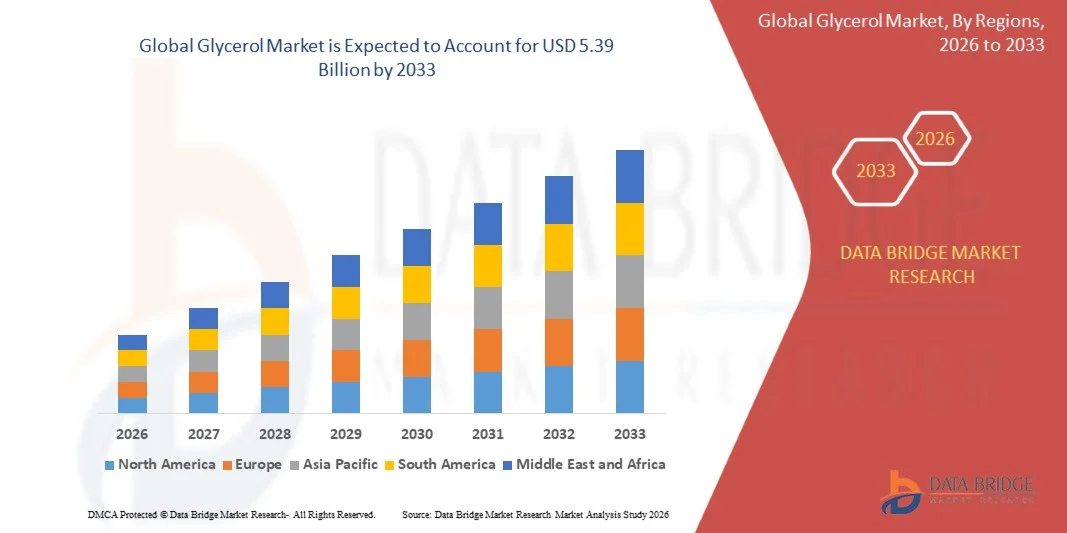
- As per Data Bridge Market Research analysis the glycerol market was valued at USD 3.27 billion in 2025 and is projected to reach USD 5.39 billion by 2033, growing at a CAGR of 6.45% from 2026 to 2033.
- The market is experiencing consistent growth driven by increasing demand for glycerol across food and beverages, pharmaceuticals, personal care, cosmetics, and industrial applications, along with its growing use as a humectant, solvent, and chemical intermediate.
- The expanding pharmaceutical and personal care industries, coupled with rising demand for bio-based and renewable raw materials, are supporting the adoption of glycerol and creating new opportunities for manufacturers across various end-use industries.
Market Size & Forecast
- Market Value (2025): USD 3.27 Billion
- Expected Market Value (2033): USD 5.39 Billion
- Forecast CAGR (2026–2033): 6.45%
- Leading Region in 2025: North America
- Fastest Growing Region: Asia-Pacific
What are the Major Takeaways of the Glycerol Market?
- North America glycerol market is expected to witness steady growth from 2026 to 2033, supported by strong demand from pharmaceutical, food and beverage, personal care, and industrial applications. The region benefits from established pharmaceutical and cosmetics industries, increasing consumption of refined glycerol, and growing adoption of bio-based raw materials.
- Asia-Pacific glycerol market is expected to witness the fastest growth rate from 2026 to 2033, supported by expanding biodiesel production, rapid industrialization, and rising demand from pharmaceutical, food, personal care, and chemical industries. Countries such as China, India, Japan, and Indonesia are experiencing increasing consumption of glycerol across diverse applications.
- The biodiesel segment held the largest market revenue share in 2025, driven by the increasing production of biodiesel and the generation of glycerol as a major coproduct during biodiesel manufacturing. Rising adoption of renewable fuels and expansion of biodiesel production capacity are supporting the availability of glycerol for pharmaceutical, personal care, food, and industrial applications.
- The fatty alcohol segment is projected to register the fastest growth at a CAGR from 2026 to 2033, driven by increasing demand for glycerol generated during fatty alcohol manufacturing and its growing utilization across cosmetics, detergents, and specialty chemical applications. Expanding oleochemical processing and rising demand for bio-based ingredients are further supporting segment expansion.
- The refined segment held the largest market revenue share in 2025, driven by its high purity, consistent quality, and extensive use across pharmaceutical, food and beverage, personal care, and cosmetic applications. Increasing demand for high-quality glycerol in regulated end-use industries is supporting segment growth.
- The crude segment is projected to register the fastest growth at a CAGR from 2026 to 2033, driven by its increasing utilization as a feedstock for chemical conversion and industrial applications. Growing biodiesel production and efforts to convert low-value crude glycerol into higher-value chemicals are accelerating segment expansion.
Report Scope and Glycerol Market Segmentation
|
Attributes |
Glycerol Key Market Insights |
|
Segments Covered |
|
|
Countries Covered |
North America
Europe
Asia-Pacific
Middle East and Africa
South America
|
|
Key Market Players |
|
|
Market Opportunities |
|
|
Value Added Data Infosets |
In addition to the insights on market scenarios such as market value, growth rate, segmentation, geographical coverage, and major players, the market reports curated by the Data Bridge Market Research also include import export analysis, production capacity overview, production consumption analysis, price trend analysis, climate change scenario, supply chain analysis, value chain analysis, raw material/consumables overview, vendor selection criteria, PESTLE Analysis, Porter Analysis, and regulatory framework. |
What is the Key Trend in the Glycerol Market?
- Glycerol is increasingly being utilized in circular and bio-based applications as manufacturers seek to convert biodiesel-derived glycerin into higher-value chemicals, fuels, and sustainable feedstocks.
- For instance, in January 2025, Be8 and Cemvita signed a memorandum of understanding to develop a low-carbon feedstock by converting glycerin, a biodiesel byproduct, into sustainable bio-oil for the Sustainable Aviation Fuel (SAF) value chain.
- Glycerol continues to maintain strong demand across pharmaceutical, food, home care, and personal care applications because of its properties as a humectant, solvent, and emollient.
- For instance, Godrej Industries reported in its 2024–25 annual report that glycerine is used across pharmaceutical, food, home and personal care applications, while domestic demand in India exceeded domestic manufacturing capacity and required imports of refined glycerine.
- As manufacturers increasingly prioritize renewable feedstocks and value-added applications, the development of glycerol-based chemicals, sustainable fuels, and personal care ingredients is expected to create new opportunities and strengthen demand across the global glycerol market.
What are the Key Drivers of the Glycerol Market?
- The expanding biodiesel industry is generating substantial quantities of glycerol as a coproduct, increasing the availability of glycerol for purification and downstream applications across chemicals, pharmaceuticals, food, and personal care.
- For instance, in February 2025, Aemetis announced that its India plant received approval to restart biodiesel and refined glycerin production, enabling the company to fulfill allocations to government-owned oil marketing companies and other customers.
- Pharmaceutical, food and beverage, cosmetics, and personal care manufacturers are increasingly using glycerol for its moisturizing, stabilizing, sweetening, lubricating, and solvent properties, supporting demand for refined grades.
- For instance, Aemetis reported that its Indian biodiesel operation generated USD 112 million in revenue from biodiesel and refined glycerin deliveries during the year ended September 2024, demonstrating the commercial value of refined glycerin alongside biodiesel production.
- With biodiesel production expanding and glycerol finding applications across multiple high-value industries, increasing availability of renewable glycerol feedstock and diversification into value-added products are expected to support continued market growth.
Which Factors are Challenging the Growth of the Glycerol Market?
- The growing production of biodiesel can create excess crude glycerol, particularly when downstream purification and value-added conversion capacity is insufficient, putting pressure on glycerol prices and producer margins.
- These supply-demand imbalances can make crude glycerol economically challenging to process because impurities such as water, salts, methanol, soaps, and fatty acids increase purification requirements and processing costs.
- For instance, in January 2025, Be8 and Cemvita highlighted the opportunity to convert crude glycerin from biodiesel operations into sustainable bio-oil, reflecting the need to develop higher-value outlets for glycerol generated as a biodiesel coproduct.
- The availability of lower-cost glycerol from biodiesel production, variations in feedstock prices, and the capital requirements for purification and advanced glycerol conversion technologies can continue to pressure conventional glycerol producers and limit profitability.
- These challenges make the development of efficient purification technologies and higher-value applications increasingly important for absorbing surplus glycerol and maintaining sustainable growth across the global glycerol market.
How is the Glycerol Market Segmented?
The market is segmented on the basis of source, type, downstream application, and end-use.
- By Source
On the basis of source, the glycerol market is segmented into biodiesel, fatty alcohol, fatty acid, and soap. The biodiesel segment held the largest market revenue share in 2025, driven by the increasing production of biodiesel and the generation of glycerol as a major coproduct during biodiesel manufacturing. Rising adoption of renewable fuels and expansion of biodiesel production capacity are supporting the availability of glycerol for pharmaceutical, personal care, food, and industrial applications.
The fatty alcohol segment is projected to register the fastest growth at a CAGR from 2026 to 2033, driven by increasing demand for glycerol generated during fatty alcohol manufacturing and its growing utilization across cosmetics, detergents, and specialty chemical applications. Expanding oleochemical processing and rising demand for bio-based ingredients are further supporting segment expansion.
- By Type
On the basis of type, the glycerol market is segmented into crude and refined. The refined segment held the largest market revenue share in 2025, driven by its high purity, consistent quality, and extensive use across pharmaceutical, food and beverage, personal care, and cosmetic applications. Increasing demand for high-quality glycerol in regulated end-use industries is supporting segment growth.
The crude segment is projected to register the fastest growth at a CAGR from 2026 to 2033, driven by its increasing utilization as a feedstock for chemical conversion and industrial applications. Growing biodiesel production and efforts to convert low-value crude glycerol into higher-value chemicals are accelerating segment expansion.
- By Downstream Application
On the basis of downstream application, the glycerol market is segmented into propylene glycol, epichlorohydrin, acrylic acid, 1,3-propanediol, and acrylonitrile. The epichlorohydrin segment held the largest market revenue share in 2025, driven by the increasing use of epichlorohydrin in epoxy resins, coatings, adhesives, and composite materials. Rising construction, automotive, and electronics manufacturing activities are supporting demand for glycerol-based epichlorohydrin production.
The 1,3-propanediol segment is projected to register the fastest growth at a CAGR from 2026 to 2033, driven by increasing demand for bio-based chemical intermediates and its use in polymers, coatings, and specialty materials. Growing interest in renewable feedstocks and sustainable chemical production is accelerating segment expansion.
- By End-Use
On the basis of end-use, the glycerol market is segmented into food and beverage, pharmaceutical, nutraceutical, personal care and cosmetics, industrial, and others. The personal care and cosmetics segment held the largest market revenue share in 2025, driven by the extensive use of glycerol as a humectant, moisturizer, emollient, and solvent in skincare, haircare, and cosmetic formulations. Rising consumer demand for moisturizing and natural personal care products is supporting segment growth.
The pharmaceutical segment is projected to register the fastest growth at a CAGR from 2026 to 2033, driven by increasing use of glycerol in pharmaceutical formulations, syrups, capsules, and topical products. Rising pharmaceutical production and growing demand for multifunctional excipients are accelerating segment expansion.
Which Region Holds the Largest Share of the Glycerol Market?
- North America glycerol market is expected to witness steady growth from 2026 to 2033, supported by strong demand from pharmaceutical, food and beverage, personal care, and industrial applications. The region benefits from established pharmaceutical and cosmetics industries, increasing consumption of refined glycerol, and growing adoption of bio-based raw materials.
- Rising biodiesel production is also increasing glycerol availability, while manufacturers are focusing on higher-value glycerol applications to improve resource utilization and support market expansion.
U.S. Glycerol Market Insight
U.S. glycerol market captured the largest revenue share in North America in 2025, fueled by strong demand from pharmaceutical, food, personal care, and chemical industries. The country has a well-established biodiesel industry that generates glycerol as a major coproduct, supporting domestic availability of glycerol feedstock. Moreover, increasing use of glycerol in pharmaceutical formulations, cosmetics, food products, and specialty chemicals is contributing to market growth.
Europe Glycerol Market Insight
Europe glycerol market is expected to witness significant growth from 2026 to 2033, primarily driven by increasing demand for renewable and bio-based raw materials across chemical, pharmaceutical, food, and personal care industries. The region's established biodiesel production provides a substantial source of glycerol, while sustainability initiatives are encouraging manufacturers to develop higher-value applications. Growing emphasis on circular economy practices and bio-based chemical production is further supporting market expansion.
Germany Glycerol Market Insight
Germany glycerol market is expected to witness steady growth from 2026 to 2033, fueled by the country's strong chemical, pharmaceutical, food, and personal care industries. Increasing adoption of bio-based feedstocks and growing biodiesel production are supporting glycerol availability. Moreover, Germany's focus on sustainable manufacturing and circular chemical production is encouraging the utilization of glycerol as a renewable feedstock for specialty chemicals and industrial applications.
U.K. Glycerol Market Insight
U.K. glycerol market is expected to witness significant growth from 2026 to 2033, driven by increasing demand for glycerol across pharmaceutical, food and beverage, personal care, and cosmetics applications. The country's expanding focus on sustainable ingredients and renewable chemical feedstocks is supporting the adoption of bio-based glycerol. In addition, growing demand for high-purity glycerol in pharmaceutical and cosmetic formulations is contributing to market development.
Asia-Pacific Glycerol Market Insight
Asia-Pacific glycerol market is expected to witness the fastest growth rate from 2026 to 2033, supported by expanding biodiesel production, rapid industrialization, and rising demand from pharmaceutical, food, personal care, and chemical industries. Countries such as China, India, Japan, and Indonesia are experiencing increasing consumption of glycerol across diverse applications. Furthermore, the region's growing chemical manufacturing base and increasing focus on renewable feedstocks are creating favorable opportunities for glycerol producers.
China Glycerol Market Insight
China glycerol market accounted for the largest market revenue share in Asia-Pacific in 2025, attributed to the country's large chemical manufacturing base, expanding pharmaceutical and personal care industries, and increasing demand for bio-based raw materials. Glycerol is increasingly utilized in food, cosmetics, pharmaceuticals, and industrial chemical production. The country's strong manufacturing capabilities and growing investment in sustainable chemical processes are further supporting market growth.
Japan Glycerol Market Insight
Japan glycerol market is expected to witness steady growth from 2026 to 2033, driven by increasing demand from pharmaceutical, personal care, cosmetics, food, and specialty chemical industries. The country's advanced pharmaceutical and cosmetics sectors support the consumption of high-purity refined glycerol, while growing interest in bio-based and sustainable raw materials is encouraging the use of glycerol in value-added applications. Moreover, Japan's focus on advanced chemical manufacturing and sustainable production technologies is expected to support continued market development.
Which are the Top Companies in Glycerol Market?
The glycerol industry is primarily led by well-established companies, including:
- Wilmar International Limited (Singapore)
- Archer Daniels Midland Company (U.S.)
- BASF SE (Germany)
- The Procter & Gamble Company (U.S.)
- KLK OLEO (Malaysia)
- Cargill, Incorporated (U.S.)
- Dow Inc. (U.S.)
- Emery Oleochemicals LLC (U.S.)
- Godrej Industries Limited (India)
- Kao Corporation (Japan)
- Oleon NV (Belgium)
- Sakamoto Yakuhin Kogyo Co., Ltd. (Japan)
- IOI Corporation Berhad (Malaysia)
- Aemetis, Inc. (U.S.)
- Stepan Company (U.S.)
What are Latest Developments in Glycerol Market?
- In October 2024, Argent Energy, product launch, officially launched its bio-based technical-grade glycerine from its 50,000-ton-per-year refinery at the Port of Amsterdam, upgrading crude glycerine from waste-based biodiesel into 99.7% pure glycerine. The development provides chemical producers with a renewable alternative to petrochemical feedstocks and strengthens the availability of sustainable glycerine for technical applications, supporting circular-economy development in the glycerol market.
- In July 2023, Louis Dreyfus Company, capacity expansion, announced the addition of glycerin refining capacity at its Lampung, Indonesia, complex, alongside edible oil packaging facilities. The plant is designed to produce USP-grade glycerin and offer different packaging options, strengthening LDC’s downstream presence and ability to serve growing global demand for refined glycerin. The expansion is expected to increase refined glycerin supply and reinforce Indonesia’s position as a production hub, supporting market growth.
- In May 2023, BASF SE and ORLEN Południe, technology commercialization, announced that ORLEN Południe had completed its first year of operation of a 30,000-metric-ton-per-year BioPG plant using BASF’s technology to convert glycerol into renewable propylene glycol. The BioPG offers the same quality as conventional propylene glycol while reducing its carbon footprint by at least 60%. The development creates a higher-value outlet for glycerol and expands demand for glycerol-based downstream products.
- In December 2022, Argent Energy, refinery construction, commenced groundworks for a 50,000-ton-per-year glycerine refinery at the Port of Amsterdam to convert biodiesel-derived glycerine into technical-grade products for the chemical industry. The facility supports Argent Energy’s strategy of transforming waste-derived by-products into valuable sustainable chemicals. The project was expected to increase European availability of bio-based glycerine and create additional downstream opportunities for glycerol.
- In July 2021, Eni and BASF SE, strategic R&D partnership, launched a joint initiative to develop technology for converting glycerin generated from industrial biodiesel production into advanced bio-propanol through catalytic hydrotreatment. The resulting bio-propanol was intended for use as a bio-component in fuel formulations and could potentially reduce greenhouse-gas emissions by 65% to 75% compared with fossil fuels. The initiative expanded the potential value-added applications of glycerin and supported the development of sustainable downstream glycerol technologies.

- Interactive Data Analysis Dashboard
- Company Analysis Dashboard for high growth potential opportunities
- Research Analyst Access for customization & queries
- Competitor Analysis with Interactive dashboard
- Latest News, Updates & Trend analysis
- Harness the Power of Benchmark Analysis for Comprehensive Competitor Tracking
Global Glycerol Market, Supply Chain Analysis and Ecosystem Framework
To support market growth and help clients navigate the impact of geopolitical shifts, DBMR has integrated in-depth supply chain analysis into its Global Glycerol Market research reports. This addition empowers clients to respond effectively to global changes affecting their industries. The supply chain analysis section includes detailed insights such as Global Glycerol Market consumption and production by country, price trend analysis, the impact of tariffs and geopolitical developments, and import and export trends by country and HSN code. It also highlights major suppliers with data on production capacity and company profiles, as well as key importers and exporters. In addition to research, DBMR offers specialized supply chain consulting services backed by over a decade of experience, providing solutions like supplier discovery, supplier risk assessment, price trend analysis, impact evaluation of inflation and trade route changes, and comprehensive market trend analysis.
Data collection and base year analysis are done using data collection modules with large sample sizes. The stage includes obtaining market information or related data through various sources and strategies. It includes examining and planning all the data acquired from the past in advance. It likewise envelops the examination of information inconsistencies seen across different information sources. The market data is analysed and estimated using market statistical and coherent models. Also, market share analysis and key trend analysis are the major success factors in the market report. To know more, please request an analyst call or drop down your inquiry.
The key research methodology used by DBMR research team is data triangulation which involves data mining, analysis of the impact of data variables on the market and primary (industry expert) validation. Data models include Vendor Positioning Grid, Market Time Line Analysis, Market Overview and Guide, Company Positioning Grid, Patent Analysis, Pricing Analysis, Company Market Share Analysis, Standards of Measurement, Global versus Regional and Vendor Share Analysis. To know more about the research methodology, drop in an inquiry to speak to our industry experts.
Data Bridge Market Research is a leader in advanced formative research. We take pride in servicing our existing and new customers with data and analysis that match and suits their goal. The report can be customized to include price trend analysis of target brands understanding the market for additional countries (ask for the list of countries), clinical trial results data, literature review, refurbished market and product base analysis. Market analysis of target competitors can be analyzed from technology-based analysis to market portfolio strategies. We can add as many competitors that you require data about in the format and data style you are looking for. Our team of analysts can also provide you data in crude raw excel files pivot tables (Fact book) or can assist you in creating presentations from the data sets available in the report.













