


Glycohemoglobin Analyzer Market Overview
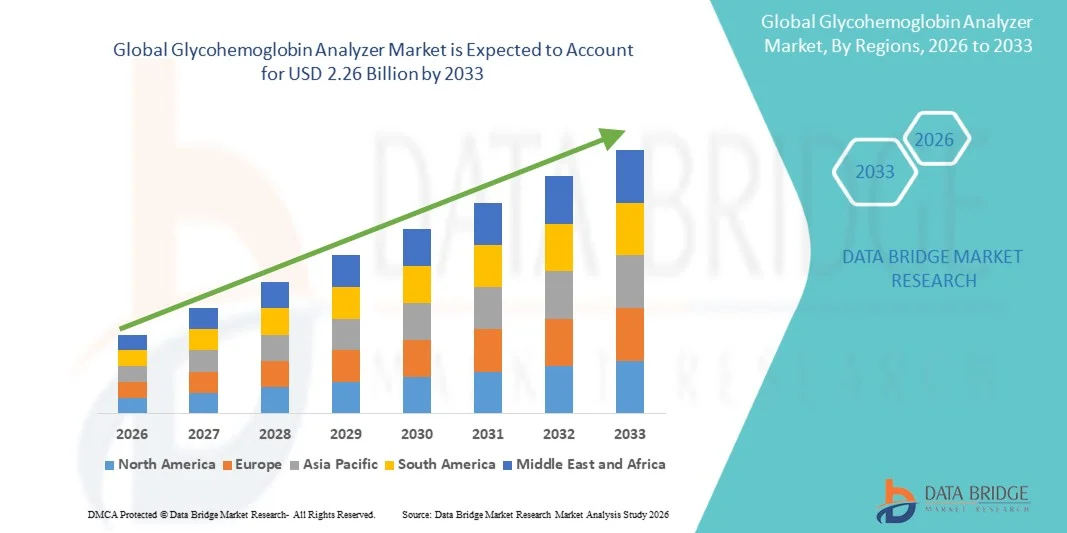
The Glycohemoglobin Analyzer Market was valued at USD 1.30 billion in 2025 and is projected to reach USD 2.26 billion by 2033, growing at a CAGR of 7.2% from 2026 to 2033. Themarket is witnessing steady growth driven by the rising global burden of diabetes, increasing adoption of HbA1c testing for long-term glycemic monitoring, and expanding deployment of point-of-care diagnostic systems across hospitals, diagnostic laboratories, and primary care settings.
The growing emphasis on early disease detection and continuous diabetes management, combined with technological advancements in high-performance liquid chromatography (HPLC), immunoassay-based analyzers, and automated testing platforms, is significantly boosting market adoption. In addition, the expansion of healthcare infrastructure in emerging economies and the increasing integration of rapid, accurate, and cost-effective glycohemoglobin testing solutions are further supporting market penetration across both developed and developing regions.
Key Market Trends & Insights
- North America dominated the Glycohemoglobin Analyzer Market with the largest revenue share of 38.6% in 2025, supported by high diabetes prevalence, strong diagnostic infrastructure, and widespread adoption of HbA1c testing in clinical practice.
- The Analyzers segment led the market with a 45.8% share in 2025, driven by their widespread use in hospitals and diagnostic laboratories for routine HbA1c testing.
- Asia-Pacific is expected to be the fastest-growing region at a CAGR of 8.1% from 2026 to 2033, fueled by rising diabetic population, improving healthcare access, and expanding diagnostic laboratory networks in China, India, and Southeast Asia.
- Portable are the fastest-growing product type, projected to register a CAGR of 8.3%, reflecting the surge in rising demand for point-of-care and decentralized testing solutions.
- The Diabetes segment dominated the application category with a 92.6% revenue share in 2025, led by the critical role of HbA1c testing in long-term glucose monitoring and diabetes diagnosis.
- Batch Analyzer accounted for 67.9% of the market, preferred by its ability to process multiple samples simultaneously with high efficiency.
- The Single Use Analyzer segment is the fastest-growing modality category, with a CAGR of 8.0%, driven by the rising demand for rapid and decentralized testing solutions.
Market Size & Forecast
- Global Market Value (2025): USD 1.30 Billion
- Expected Market Value (2033): USD 2.26 Billion
- Forecast CAGR (2026–2033): 7.2%
- Leading Region in 2025: North America
- Fastest Growing Region: Asia Pacific
Report Scope and Glycohemoglobin Analyzer Market Segmentation
|
Attributes |
Glycohemoglobin Analyzer Key Market Insights |
|
Segments Covered |
|
|
Countries Covered |
North America · U.S. · Canada · Mexico Europe · Germany · France · U.K. · Netherlands · Switzerland · Belgium · Russia · Italy · Spain · Turkey · Rest of Europe Asia-Pacific · China · Japan · India · South Korea · Singapore · Malaysia · Australia · Thailand · Indonesia · Philippines · Rest of Asia-Pacific Middle East and Africa · Saudi Arabia · U.A.E. · South Africa · Egypt · Israel · Rest of Middle East and Africa South America · Brazil · Argentina · Rest of South America |
|
Key Market Players |
· Roche Diagnostics (Switzerland) · Siemens Healthineers AG (Germany) · Abbott (U.S.) · Bio-Rad Laboratories, Inc. (U.S.) · Tosoh Corporation (Japan) · Trinity Biotech plc (Ireland) · EKF Diagnostics Holdings plc (U.K.) · ARAKAY Inc. (Japan) · Nova Biomedical Corporation (U.S.) · Danaher (U.S.) · HORIBA, Ltd. (Japan) · Sysmex Corporation (Japan) · Mindray Bio-Medical Electronics Co., Ltd. (China) · Randox Laboratories Ltd (U.K.) · QuidelOrtho Corporation (U.S.) · Sekisui Diagnostics LLC (U.S.) · PTS Diagnostics (U.S.) · A. Menarini Diagnostics S.r.l. (Italy) · HUMAN Diagnostics Worldwide GmbH (Germany) |
|
Market Opportunities |
· Expansion of point-of-care HbA1c testing in primary care and retail clinics · Growing adoption of fully automated analyzers in emerging economies · Integration of AI-enabled diagnostic platforms with glycohemoglobin analyzers for improved accuracy |
|
Value Added Data Infosets |
In addition to the insights on market scenarios such as market value, growth rate, segmentation, geographical coverage, and major players, the market reports curated by the Data Bridge Market Research also include in-depth expert analysis, patient epidemiology, pipeline analysis, pricing analysis, and regulatory framework. |
Glycohemoglobin Analyzer Market Trends
Trend: Rising Adoption of Point-of-Care HbA1c Testing
Healthcare providers are increasingly shifting toward point-of-care glycohemoglobin analyzers to enable rapid diabetes assessment and immediate clinical decision-making in outpatient clinics and primary care settings. These compact systems reduce turnaround time compared to centralized laboratories and improve patient compliance through real-time results, while integration with digital health platforms allows seamless data sharing for long-term disease monitoring and management. For instance, portable HbA1c testing devices are being widely deployed in community health programs and diabetes screening camps to improve early detection rates in high-risk populations.
Glycohemoglobin Analyzer Market Dynamics
Key Market Driver: Rising Global Diabetes Prevalence and Screening Programs
The increasing global burden of diabetes, driven by sedentary lifestyles, obesity, and aging populations, is significantly boosting demand for routine glycohemoglobin testing as a standard diagnostic and monitoring tool. Governments and healthcare organizations are expanding national diabetes screening initiatives, while hospitals and diagnostic laboratories are increasing test volumes, thereby accelerating adoption of advanced automated analyzers with high accuracy and throughput. For instance, large-scale diabetes screening programs in emerging economies are deploying automated HbA1c analyzers across public hospitals to identify undiagnosed diabetic patients earlier.
Key Restraint/Challenge: High Cost of Advanced Analytical Systems and Maintenance
A major challenge in the glycohemoglobin analyzer market is the high cost of advanced diagnostic systems, including automated HPLC and immunoassay-based platforms, along with ongoing expenses for reagents, calibration, and maintenance services. These costs limit adoption in small diagnostic laboratories and resource-constrained healthcare facilities, particularly in developing regions where budget allocations for advanced diagnostics remain limited. For instance, rural diagnostic centers often rely on basic or semi-automated testing methods due to the affordability constraints of fully automated HbA1c analyzer systems.
Key Market Opportunity: Integration of Digital Health and Automated Laboratory Systems
The integration of glycohemoglobin analyzers with digital health ecosystems, laboratory information systems, and AI-powered diagnostic platforms presents a strong growth opportunity for improved workflow efficiency and predictive diabetes management. Cloud-based data sharing and automation enable better patient tracking, remote diagnostics, and enhanced clinical decision support across healthcare networks. For instance, hospital networks are increasingly connecting HbA1c analyzers with electronic medical record systems to enable real-time diabetes monitoring and personalized treatment planning.
Glycohemoglobin Analyzer Market Scope
The glycohemoglobin analyzer market is segmented on the basis of product type, application, modality, and end user.
- By Product Type
On the basis of product type, the Glycohemoglobin Analyzer Market is segmented into analyzers, bench-top systems, portable devices, and software solutions. The Analyzers segment dominated the market with the largest share of 45.8% in 2025, driven by their widespread use in hospitals and diagnostic laboratories for routine HbA1c testing. These systems offer high accuracy, automation capability, and compatibility with large-scale testing environments, making them essential for chronic diabetes management. Increasing prevalence of diabetes and demand for high-throughput testing are further strengthening adoption. Continuous technological improvements in HPLC and immunoassay-based platforms are enhancing reliability and operational efficiency. Integration with laboratory information systems is improving workflow automation. However, high procurement and maintenance costs remain a limiting factor in smaller facilities.
The Portable segment is expected to witness the fastest growth at a CAGR of 8.3% from 2026 to 2033, driven by rising demand for point-of-care and decentralized testing solutions. These devices enable rapid HbA1c measurement outside traditional laboratory settings, improving accessibility in remote and primary care environments. Increasing focus on early diabetes detection and routine monitoring is boosting demand for compact testing devices. Technological advancements in microfluidics and biosensor-based systems are improving accuracy and usability. Growing adoption in home healthcare and community screening programs is further accelerating expansion. Declining device costs and improved connectivity features are also supporting broader market penetration.
- By Application
On the basis of application, the market is segmented into diabetes management and blood transfusion-related testing. The Diabetes segment dominated the market with a 92.6% share in 2025, driven by the critical role of HbA1c testing in long-term glucose monitoring and diabetes diagnosis. Glycohemoglobin analyzers are widely used to assess average blood sugar levels over extended periods, making them essential in clinical decision-making. Rising global diabetes prevalence and increasing screening programs are significantly boosting test volumes. Hospitals and diagnostic laboratories rely heavily on HbA1c testing as a standard diagnostic parameter. Growing awareness of preventive healthcare is further supporting routine testing adoption. Continuous improvements in testing accuracy and automation are enhancing clinical reliability.
The Diabetes segment is also expected to remain the fastest growing application at a CAGR of 7.4% from 2026 to 2033, driven by increasing early diagnosis initiatives and chronic disease management programs. Expanding government-led diabetes screening campaigns are improving detection rates worldwide. Integration of HbA1c testing into primary healthcare services is increasing accessibility. Rising adoption of point-of-care testing in outpatient clinics is further supporting growth. Advances in personalized medicine are increasing dependence on continuous glycemic monitoring. Expanding diabetic population across emerging economies is further accelerating demand.
- By Modality
On the basis of modality, the market is segmented into single-use analyzers and batch analyzers. The Batch Analyzer segment dominated the market with a 67.9% share in 2025, due to its ability to process multiple samples simultaneously with high efficiency. These systems are widely used in hospital and reference laboratories handling large patient volumes. They provide high throughput, reduced per-test cost, and improved operational productivity. Increasing demand for centralized diagnostic testing is further supporting adoption. Advanced automation and integration with laboratory systems enhance accuracy and workflow efficiency. However, longer processing times compared to single-use systems remain a limitation in urgent care settings.
The Single Use Analyzer segment is expected to witness the fastest growth at a CAGR of 8.0% from 2026 to 2033, driven by rising demand for rapid and decentralized testing solutions. These systems are particularly useful in emergency care, outpatient clinics, and home testing environments. They reduce contamination risk and eliminate the need for extensive calibration. Growing preference for immediate test results is boosting adoption in point-of-care settings. Increasing technological innovation in disposable diagnostic cartridges is improving usability. Expanding healthcare access in rural and underserved regions is further driving market growth.
- By End User
On the basis of end user, the market is segmented into hospital laboratories, diagnostic laboratories, physician offices, blood banks, home care settings, and others. The Hospital Laboratories segment dominated the market with a 46.9% share in 2025, driven by high patient inflow and routine diabetes screening requirements. These facilities are equipped with advanced automated analyzers capable of handling large sample volumes efficiently. Increasing prevalence of chronic diseases is driving continuous demand for HbA1c testing. Hospitals also benefit from integrated laboratory systems and skilled personnel, improving diagnostic accuracy. Growing adoption of automated workflow systems is further enhancing operational efficiency. However, infrastructure and operational costs remain relatively high.
The Home Care Settings segment is expected to witness the fastest growth at a CAGR of 8.6% from 2026 to 2033, driven by increasing demand for self-monitoring and remote patient care. Portable HbA1c testing devices are enabling patients to monitor diabetes levels without visiting healthcare facilities. Rising awareness of preventive healthcare and chronic disease management is supporting adoption. Integration of digital health platforms allows real-time data sharing with healthcare providers. Growing elderly population and preference for convenience-based care are further accelerating demand. Continuous innovation in user-friendly diagnostic devices is also expanding accessibility.
Glycohemoglobin Analyzer Market Regional Analysis
North America dominated the Glycohemoglobin Analyzer Market with the largest revenue share of 38.6% in 2025, supported by high diabetes prevalence, strong diagnostic infrastructure, and widespread adoption of HbA1c testing in clinical practice. The region benefits from widespread implementation of routine HbA1c screening programs across hospitals, diagnostic laboratories, and outpatient clinics. Increasing healthcare expenditure and strong reimbursement frameworks further support market growth. The presence of leading diagnostic companies and continuous technological innovation in automated analyzers also strengthens regional dominance. Rising awareness of early diabetes diagnosis and chronic disease management continues to drive testing demand. Expanding adoption of point-of-care diagnostic devices further reinforces market leadership.
U.S. Glycohemoglobin Analyzer Market Insight
The U.S. glycohemoglobin analyzer market is witnessing strong growth due to high diabetes prevalence, advanced diagnostic infrastructure, and widespread adoption of HbA1c testing in routine clinical practice. The country’s well-established hospital networks, strong reimbursement policies, and increasing focus on preventive healthcare are driving demand for automated and high-throughput analyzers. In addition, growing use of point-of-care testing devices and integration of digital health platforms is accelerating market expansion across hospitals, diagnostic laboratories, and physician offices.
Europe Glycohemoglobin Analyzer Market Insight
The Europe glycohemoglobin analyzer market remains a major contributor to global revenue, driven by strong healthcare systems, rising diabetic population, and widespread implementation of standardized diabetes screening programs. The region’s emphasis on early diagnosis and chronic disease management is supporting consistent demand for HbA1c testing across clinical settings. Increasing adoption of automated laboratory systems and immunoassay-based analyzers, along with strong regulatory focus on diagnostic accuracy, continues to enhance market penetration across hospitals and diagnostic centers.
U.K. Glycohemoglobin Analyzer Market Insight
The U.K. glycohemoglobin analyzer market is experiencing steady growth, supported by national diabetes prevention programs, expanding laboratory networks, and rising adoption of advanced diagnostic technologies. Increasing focus on early detection and long-term monitoring of diabetes is driving demand for reliable HbA1c testing solutions. Furthermore, integration of automated analyzers with digital laboratory information systems is improving workflow efficiency and diagnostic accuracy, strengthening the country’s position in the European diagnostics landscape.
Germany Glycohemoglobin Analyzer Market Insight
The Germany glycohemoglobin analyzer market is expanding steadily due to strong healthcare infrastructure, high diabetes awareness, and increasing use of advanced laboratory diagnostics. Hospitals and diagnostic laboratories are increasingly adopting automated HPLC and immunoassay-based systems for accurate and high-volume testing. Continuous technological advancements, combined with government support for preventive healthcare and chronic disease management, are further driving market growth across clinical and research settings.
Asia-Pacific Glycohemoglobin Analyzer Market Insight
The Asia-Pacific glycohemoglobin analyzer market is expected to witness rapid growth, driven by rising diabetes prevalence, improving healthcare access, and expanding diagnostic infrastructure in countries such as China, India, and Japan. Increasing awareness regarding early disease detection and growing adoption of point-of-care testing devices are supporting regional expansion. In addition, rising healthcare investments and the growing presence of private diagnostic chains are accelerating demand for cost-effective and automated HbA1c testing solutions.
Japan Glycohemoglobin Analyzer Market Insight
The Japan glycohemoglobin analyzer market is witnessing consistent growth due to a high aging population, strong focus on chronic disease management, and advanced healthcare system. Increasing adoption of automated analyzers and precision diagnostic technologies is supporting efficient diabetes monitoring across hospitals and laboratories. Moreover, integration of digital health systems and emphasis on preventive screening programs are further contributing to steady market expansion in the country.
China Glycohemoglobin Analyzer Market Insight
The China glycohemoglobin analyzer market is growing rapidly, driven by rising diabetes burden, expanding healthcare infrastructure, and increasing government focus on chronic disease screening programs. Growing adoption of automated diagnostic platforms in hospitals and laboratories is significantly improving testing capacity and efficiency. In addition, rising investments in healthcare modernization, expanding point-of-care testing adoption, and increasing awareness of diabetes management are positioning China as one of the fastest-growing markets globally.
Glycohemoglobin Analyzer Market Share
The glycohemoglobin analyzer industry is primarily led by well-established companies, including:
- Roche Diagnostics (Switzerland)
- Siemens Healthineers AG (Germany)
- Abbott (U.S.)
- Bio-Rad Laboratories, Inc. (U.S.)
- Tosoh Corporation (Japan)
- Trinity Biotech plc (Ireland)
- EKF Diagnostics Holdings plc (U.K.)
- ARAKAY Inc. (Japan)
- Nova Biomedical Corporation (U.S.)
- Danaher (U.S.)
- HORIBA, Ltd. (Japan)
- Sysmex Corporation (Japan)
- Mindray Bio-Medical Electronics Co., Ltd. (China)
- Randox Laboratories Ltd (U.K.)
- QuidelOrtho Corporation (U.S.)
- Sekisui Diagnostics LLC (U.S.)
- PTS Diagnostics (U.S.)
- Menarini Diagnostics S.r.l. (Italy)
- HUMAN Diagnostics Worldwide GmbH (Germany)
Latest Developments in Glycohemoglobin Analyzer Market
- In October 2025, Tosoh Bioscience received FDA 510(k) clearance for its next-generation HLC-723 GR01 glycohemoglobin analyzer, designed to deliver HbA1c results in about 50 seconds with high precision and full laboratory automation. This advancement enhances workflow efficiency in mid- to high-volume clinical laboratories and strengthens rapid diabetes diagnosis and monitoring capabilities globally
- In October 2025, Tosoh Bioscience announced the European launch of its GR01 HbA1c analyzer, expanding its HLC-723 series portfolio with improved ion-exchange HPLC technology, automated workflow functions, and LIS integration to support large-scale diabetes testing across hospital laboratories. This launch strengthens adoption of next-generation automated HbA1c systems in developed healthcare markets
- In March 2025, Roche Diagnostics expanded its HbA1c testing ecosystem through enhanced cobas analyzer modules and reagent integration, improving automation and standardization of glycohemoglobin testing in hospital laboratories worldwide. This development supports high-volume diabetes screening and strengthens Roche’s dominance in centralized laboratory diagnostics
- In May 2023, EKF Diagnostics introduced the HemoPoint® H2 point-of-care system expansion, improving rapid hemoglobin-related testing workflows and supporting faster screening in primary healthcare and decentralized diagnostic settings
- In June 2022, Siemens Healthineers enhanced its DCA Vantage HbA1c point-of-care system capabilities, improving connectivity, workflow integration, and usability for decentralized diabetes testing in clinics and physician offices

- Interactive Data Analysis Dashboard
- Company Analysis Dashboard for high growth potential opportunities
- Research Analyst Access for customization & queries
- Competitor Analysis with Interactive dashboard
- Latest News, Updates & Trend analysis
- Harness the Power of Benchmark Analysis for Comprehensive Competitor Tracking
Data collection and base year analysis are done using data collection modules with large sample sizes. The stage includes obtaining market information or related data through various sources and strategies. It includes examining and planning all the data acquired from the past in advance. It likewise envelops the examination of information inconsistencies seen across different information sources. The market data is analysed and estimated using market statistical and coherent models. Also, market share analysis and key trend analysis are the major success factors in the market report. To know more, please request an analyst call or drop down your inquiry.
The key research methodology used by DBMR research team is data triangulation which involves data mining, analysis of the impact of data variables on the market and primary (industry expert) validation. Data models include Vendor Positioning Grid, Market Time Line Analysis, Market Overview and Guide, Company Positioning Grid, Patent Analysis, Pricing Analysis, Company Market Share Analysis, Standards of Measurement, Global versus Regional and Vendor Share Analysis. To know more about the research methodology, drop in an inquiry to speak to our industry experts.
Data Bridge Market Research is a leader in advanced formative research. We take pride in servicing our existing and new customers with data and analysis that match and suits their goal. The report can be customized to include price trend analysis of target brands understanding the market for additional countries (ask for the list of countries), clinical trial results data, literature review, refurbished market and product base analysis. Market analysis of target competitors can be analyzed from technology-based analysis to market portfolio strategies. We can add as many competitors that you require data about in the format and data style you are looking for. Our team of analysts can also provide you data in crude raw excel files pivot tables (Fact book) or can assist you in creating presentations from the data sets available in the report.













