


GNSS (Global Navigation Satellite Systems) Simulators Market Size
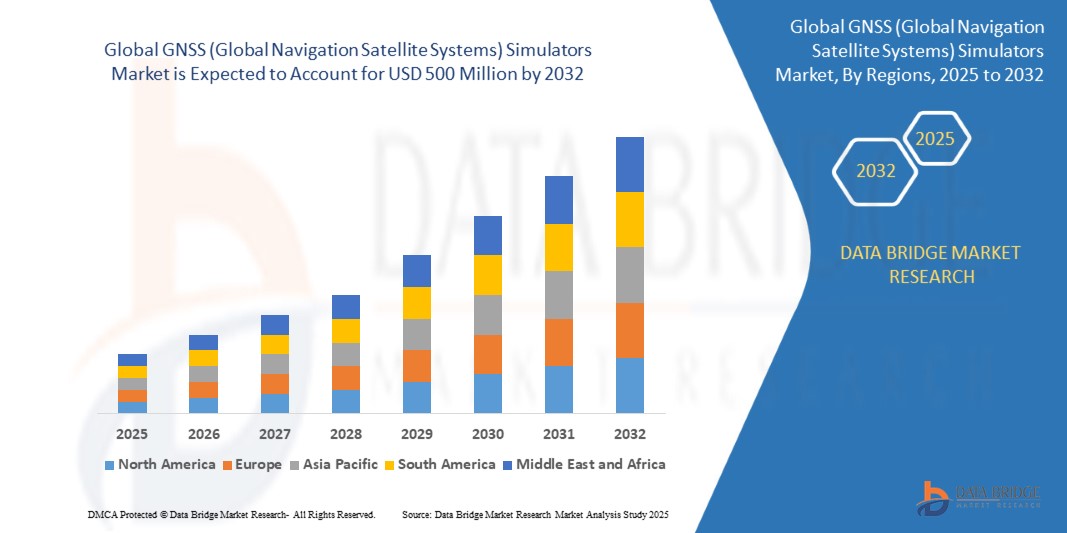
- The Global GNSS (Global Navigation Satellite Systems) Simulators Market Size was valued at USD 225.1 Million in 2024 and is expected to reach USD 500 Million by 2032, at a CAGR of 12.1% during the forecast period
- The growth of the Global GNSS Simulators Market is fueled by the rising demand for precise navigation in autonomous vehicles, defense systems, and advanced location-based services.
GNSS (Global Navigation Satellite Systems) Simulators Market Analysis
The Global GNSS Simulators Market is experiencing strong and sustained growth, driven by the increasing reliance on precise positioning, navigation, and timing (PNT) in various sectors such as aerospace & defense, automotive, telecommunications, agriculture, maritime, and consumer electronics. As real-world GNSS signals are vulnerable to jamming, spoofing, and environmental interference, simulators have become essential tools for testing, validating, and optimizing GNSS-enabled devices and systems in controlled environments.
A key driver of market growth is the rising demand for advanced testing environments in safety-critical applications such as autonomous vehicles, military navigation, UAVs, and aviation systems. GNSS simulators enable real-time signal emulation, scenario creation, and error simulation to ensure robustness, accuracy, and resilience under challenging signal conditions.
Technological advancements in multi-constellation and multi-frequency simulation, including support for GPS, GLONASS, Galileo, BeiDou, QZSS, and IRNSS, are expanding the capabilities of simulators to test next-generation devices. The integration of software-defined radios (SDRs), hardware-in-the-loop (HIL) testing, and cloud-based simulation is further enhancing performance, flexibility, and scalability.
The increasing proliferation of autonomous systems and IoT devices is fueling the need for precise GNSS validation during development and production. In the automotive sector, simulators are critical for ensuring accuracy and safety in ADAS, vehicle-to-everything (V2X) communication, and self-driving functionalities. In defense, GNSS simulators are used to test equipment under anti-jamming and anti-spoofing scenarios, ensuring mission readiness and operational integrity.
The market is also seeing adoption in academic and research institutions for space exploration, satellite communication testing, and GNSS algorithm development. Commercial aerospace companies are using simulators to validate navigation systems in drones, aircraft, and spacecraft before deployment.
However, the market faces challenges including high equipment costs, particularly for high-fidelity, multi-frequency simulators. Technical complexity in creating realistic and comprehensive test scenarios, along with the need for skilled operators and developers, can limit adoption, especially among smaller firms. Additionally, regulatory compliance and export restrictions for GNSS technologies, particularly in defense applications, can pose barriers in certain regions.
Despite these challenges, the future outlook is highly optimistic. The expansion of 5G, smart mobility, precision agriculture, and commercial space missions is driving increased investment in reliable PNT systems, thereby creating new opportunities for GNSS simulation solutions. Partnerships between simulator manufacturers and aerospace, automotive, and defense sectors are accelerating innovation and real-world deployment capabilities.
As GNSS-dependent applications become increasingly complex and mission-critical, the Global GNSS Simulators Market is poised for sustained growth, offering indispensable tools for ensuring accuracy, security, and resilience in a world that increasingly depends on precision navigation.
Report Scope and GNSS (Global Navigation Satellite Systems) Simulators Market Segmentation
|
Attributes |
GNSS (Global Navigation Satellite Systems) Simulators Market Insights |
|
Segments Covered |
|
|
Countries Covered |
North America
Europe
Asia-Pacific
Middle East and Africa
South America
|
|
Key Market Players |
|
|
Market Opportunities |
|
|
Value Added Data Infosets |
In addition to the insights on market scenarios such as market value, growth rate, segmentation, geographical coverage, and major players, the market reports curated by the Data Bridge Market Research also include in-depth expert analysis, pricing analysis, brand share analysis, consumer survey, demography analysis, supply chain analysis, value chain analysis, raw material/consumables overview, vendor selection criteria, PESTLE Analysis, Porter Analysis, and regulatory framework. |
GNSS (Global Navigation Satellite Systems) Simulators Market Trends
Increasing adoption of multi-constellation and multi-frequency simulation
- The increasing adoption of multi-constellation and multi-frequency simulation is a significant trend driving the evolution of the GNSS (Global Navigation Satellite Systems) Simulators Market. Traditionally, GNSS simulators focused primarily on the U.S. GPS system; however, the global landscape has expanded to include multiple satellite constellations such as GLONASS (Russia), Galileo (Europe), BeiDou (China), QZSS (Japan), and IRNSS/NavIC (India).
- To meet the growing need for global positioning accuracy, reliability, and coverage, modern simulators now support simultaneous testing across multiple constellations and frequencies (L1, L2, L5, etc.). This capability is critical for sectors such as automotive (especially autonomous vehicles), aerospace, military navigation, precision agriculture, and geospatial services, where dependable multi-source positioning data is essential.
- Multi-frequency simulation enables better ionospheric error correction, improves signal robustness, and supports faster time-to-first-fix (TTFF) in real-world environments. It also allows developers and manufacturers to test the resilience and performance of GNSS receivers under complex scenarios, such as urban canyons, interference-prone zones, or spoofing/jamming conditions.
- Overall, this trend reflects the industry's shift toward more comprehensive, realistic, and future-ready GNSS testing, accommodating the full spectrum of modern navigation needs in both civilian and defense applications.
GNSS (Global Navigation Satellite Systems) Simulators Market Dynamics
Driver
Rising Demand for Precise Positioning and Navigation
- The rising demand for precise positioning and navigation is a major driver of the Global GNSS Simulators Market. In today’s digitally connected and automation-driven world, industries such as automotive, aerospace, defense, agriculture, surveying, and marine rely heavily on accurate, real-time location data for their operations. From autonomous vehicles and drones to military navigation systems and precision farming, applications increasingly demand pinpoint positioning accuracy, even in complex and dynamic environments.
- Traditional GNSS receivers often struggle in scenarios like urban canyons, tunnels, dense forests, or areas with signal interference. To ensure reliability and performance in such conditions, developers and engineers use GNSS simulators to test their systems under controlled, repeatable, and customizable scenarios. These simulators can replicate various satellite constellations, signal distortions, multi-path effects, and environmental interferences allowing for robust validation before real-world deployment.
- Moreover, advancements in multi-constellation and multi-frequency GNSS systems (e.g., combining GPS with Galileo or BeiDou) have raised the standards for positioning accuracy, requiring simulators that can replicate diverse signal conditions. The demand for ultra-precise navigation is also growing in surveying, mining, logistics, and critical infrastructure monitoring, further boosting the need for advanced simulation tools.
- In essence, as businesses and governments adopt GNSS-based technologies for safety, automation, and efficiency, simulation becomes a vital tool to ensure the accuracy, resilience, and performance of their positioning systems—driving sustained market growth.
Restraint/Challenge
High Cost of Advanced Simulation Systems
- The high cost of advanced simulation systems represents a significant restraint for the Global GNSS (Global Navigation Satellite Systems) Simulators Market. GNSS simulators, especially those capable of multi-constellation, multi-frequency, and real-time simulation, require complex hardware configurations, precise signal generation capabilities, and sophisticated software platforms. These high-performance systems are often priced in the tens or even hundreds of thousands of dollars, making them a substantial investment.
- For many organizations particularly startups, academic institutions, or small-to-medium enterprises (SMEs) these costs can be prohibitive. Even large enterprises must weigh the return on investment, especially when simulator usage is not continuous or when testing requirements change frequently. The need for regular updates to accommodate new satellite systems, signal types, and evolving standards further adds to the long-term operational cost.
- In addition to upfront hardware and software expenses, advanced simulators also involve recurring costs such as calibration, maintenance, training, and technical support. Operating such systems typically demands highly skilled personnel, which adds to labor expenses and limits adoption in organizations lacking specialized expertise.
- This cost barrier can hinder the democratization of GNSS testing and restrict innovation in sectors like IoT, robotics, and consumer electronics, where precise location capabilities are increasingly needed but margins are tighter. While cloud-based and software-defined simulators are emerging as more affordable alternatives, they still may not match the accuracy and flexibility of high-end systems, especially for mission-critical or defense-related applications. As a result, the high cost remains a key challenge limiting widespread adoption across various market segments.
GNSS (Global Navigation Satellite Systems) Simulators Market Scope
The market is segmented on the basis of Component, Channel, GNSS Receiver, Application, End-User
- By Component
The Global GNSS (Global Navigation Satellite Systems) Simulators Market, when segmented by component into Hardware, Software, and Services, reflects the complete ecosystem required for precise GNSS signal emulation, testing, and validation. The hardware segment includes high-fidelity RF front-ends, signal generators, antenna components, and control units essential for replicating real-world satellite signals across various frequencies and environments. The software segment encompasses scenario creation tools, signal processing engines, simulation control platforms, and analysis suites designed to model complex signal interactions across constellations and spoofing scenarios. Finally, the services segment comprises professional support, system integration, calibration, training, and maintenance ensuring that organizations can effectively deploy and utilize GNSS simulators. As industries demand end-to-end, turnkey solutions for GNSS testing—from device validation to ongoing compliance the synergy between hardware, software, and services is increasingly crucial for market growth.
- By Channel
The Global GNSS (Global Navigation Satellite Systems) Simulators Market, segmented by channel into Single Channel and Multi Channel, defines the complexity and flexibility of simulation capabilities. Single channel simulators are typically used for basic testing and educational purposes, simulating signals from one satellite at a time. These are cost-effective and suitable for entry-level applications where limited positional accuracy or simple signal emulation is sufficient. In contrast, multi channel simulators can emulate multiple satellite signals simultaneously across different constellations (such as GPS, GLONASS, Galileo, and BeiDou), enabling more realistic and comprehensive testing of GNSS receivers under various conditions. These are essential for advanced applications like autonomous systems, aerospace, and defense, where high accuracy, robustness against interference, and dynamic environmental simulation are required. As demand for precise and reliable navigation grows, the multi-channel segment is expected to dominate due to its advanced capabilities.
- By GNSS Receiver
The Global GNSS (Global Navigation Satellite Systems) Simulators Market, segmented by GNSS receiver into GPS, Galileo, GLONASS, and BeiDou, reflects the growing need to test devices across multiple satellite constellations for enhanced global coverage and positioning accuracy. GPS, developed by the United States, remains the most widely used system, forming the backbone of many commercial and consumer applications. Galileo, the European Union's system, is valued for its high precision and growing role in regulated sectors like aviation and public safety. GLONASS, operated by Russia, provides strong performance in northern latitudes and is often used in combination with GPS for redundancy and improved reliability. BeiDou, China’s satellite navigation system, has rapidly expanded and is increasingly supported in both domestic and international devices, offering global coverage with growing influence in Asia-Pacific markets. As GNSS-dependent technologies expand—especially in automotive, aerospace, and defense the ability to simulate and validate across all these constellations becomes essential for global interoperability and performance assurance.
- By Application
The Global GNSS (Global Navigation Satellite Systems) Simulators Market, segmented by application into Navigation and Mapping, Surveying, and Vehicle Assistance Systems, underscores the versatile use of GNSS simulators across industries requiring precise positioning and spatial awareness. Navigation and mapping remain core applications, where simulators are used to test and validate the performance of navigation devices, smartphones, and wearable tech under varied signal conditions. In surveying, GNSS simulators play a critical role in ensuring the accuracy and reliability of high-precision positioning equipment used in construction, land measurement, and infrastructure development where even minor deviations can lead to costly errors. Vehicle assistance systems, including those used in automotive ADAS and autonomous driving, rely heavily on GNSS simulators to test vehicle positioning, route tracking, and environmental adaptability under dynamic road scenarios. As innovation accelerates in smart mobility, smart infrastructure, and geospatial intelligence, the role of GNSS simulators in these applications becomes increasingly vital to ensure functionality, safety, and compliance.
- By End-User
The Global GNSS (Global Navigation Satellite Systems) Simulators Market, segmented by end-user into Automotive, Consumer Electronics, Military and Defense, Aerospace, and Marine, demonstrates the diverse and expanding adoption of GNSS simulation technologies. The automotive sector leverages GNSS simulators to develop and validate advanced driver-assistance systems (ADAS), autonomous vehicles, and in-car navigation features, ensuring precise location tracking under various environmental and signal conditions. Consumer electronics including smartphones, wearables, and IoT devices use simulators to test GNSS chipsets for accuracy, responsiveness, and performance in real-world scenarios. The military and defense segment relies heavily on GNSS simulators for secure, anti-jamming testing of navigation and targeting systems critical to mission success in GPS-denied or spoofed environments. In aerospace, simulators are essential for testing aircraft navigation systems, satellite payloads, and timing synchronization, particularly under high-speed and high-altitude conditions. Meanwhile, the marine sector employs GNSS simulation to support navigation, vessel tracking, and collision avoidance systems across both commercial and defense maritime applications. Each of these sectors demands rigorous, reliable, and adaptable simulation tools to ensure safety, functionality, and resilience in GNSS-enabled systems.
GNSS (Global Navigation Satellite Systems) Simulators Market Regional Analysis
North America
North America stands at the forefront of the GNSS simulators market, driven by significant demand from autonomous vehicle development, defense testing, aerospace navigation, and research institutions. The United States, in particular, hosts extensive AV and ADAS test facilities, requiring highly accurate, real-time GNSS signal replication under controlled conditions. Military and defense agencies also rely on simulators to test resilience against jamming and spoofing threats, ensuring secure and reliable operation. With its strong ecosystem of GNSS equipment manufacturers, satellite navigation R&D initiatives, and supportive regulatory standards, North America continues to lead in both technological innovation and market maturity in GNSS simulation solutions.
Europe
Europe’s GNSS simulators market is witnessing strong growth driven by the development and operational expansion of the Galileo satellite navigation system. With Galileo offering high-precision, multi-frequency services, European industries including automotive, aerospace, agriculture, and defense require advanced simulators to test performance and resilience under various environmental and interference scenarios. Countries such as Germany, France, and the United Kingdom are investing in simulation technologies to validate GNSS-integrated applications ranging from autonomous vehicles to aviation systems. Additionally, Europe's emphasis on satellite authentication, anti-spoofing measures, and secure navigation is encouraging innovation in simulator capabilities. The presence of dedicated research institutions and strategic government support further positions the region as a key hub for GNSS simulation development.
Asia Pacific
Asia Pacific is currently the fastest-growing region in the GNSS simulators market, driven by rapid advancements in technology and infrastructure across multiple sectors. China’s BeiDou, India’s IRNSS/NavIC, and Japan’s QZSS are gaining traction alongside the global GPS, increasing the need for simulators capable of replicating multi-constellation, multi-frequency signals. The region's booming automotive industry is heavily investing in ADAS and autonomous vehicle testing facilities, while smart city projects and precision agriculture rely on robust GNSS validation environments. Additionally, significant defense modernization efforts are fueling demand for sophisticated anti-jamming and anti-spoofing simulation capabilities. With a growing base of GNSS device manufacturers and emerging R&D hubs in countries like South Korea, Japan, and India, Asia Pacific is poised to become a dominant force in the global GNSS simulators market.
Latin America
Latin America’s GNSS simulators market is emerging steadily, with growing investment from key countries like Brazil and Mexico in sectors such as transportation, agriculture, and public safety. As these nations strive to expand their logistics and mapping capabilities, there is increasing interest in reliable satellite navigation systems and associated validation tools. While the presence of local testing facilities remains limited, initiatives by government agencies and private enterprises to enhance disaster response and infrastructure tracking are fostering simulator adoption. Despite facing challenges like budget limitations and limited regional expertise, targeted growth in GNSS applications is laying the foundation for future expansion of simulation technologies across the region.
Middle East and Africa
The Middle East & Africa region is emerging as a high-potential market for GNSS simulators, underpinned by major investments in smart-city infrastructure and security modernization efforts. Countries like UAE and Saudi Arabia are deploying advanced simulation systems as part of autonomous mobility projects and urban planning initiatives, creating demand for high-fidelity, multi-channel GNSS tools. Although adoption remains limited in many African nations, early-stage growth is underway through collaborations with international research institutions and defense agencies. The increasing need to test GNSS resilience against jamming and spoofing especially in areas with critical infrastructure further boosts regional interest. Overall, MEA offers significant long-term opportunities as technological capacity expands and localized GNSS simulation capabilities develop.
GNSS (Global Navigation Satellite Systems) Simulators Market Share
The Global GNSS (Global Navigation Satellite Systems) Simulators industry is primarily led by well-established companies, including:
- Spirent Communications
- Rohde & Schwarz
- Orolia
- Hexagon AB
- VIAVI Solutions
- Keysight Technologies
- Syntony GNSS
- IFEN GmbH
- CAST Navigation
- Jackson Labs Technologies
- Averna
- Racelogic
- Accord Software & Systems
- u‑blox
- TeleOrbit
- WORK Microwave
- M3 Systems
Latest Developments in Global GNSS (Global Navigation Satellite Systems) Simulators Market
- In March 2025, Leading providers introduced AI/ML integration for enhanced signal processing and anomaly prediction in simulators, enabling more realistic scenario modeling and anti-jamming testing for autonomous vehicles and defense systems
- In January 2024, Orolia (Safran) launched its Skydel GNSS simulation engine, capable of generating over 500 satellite signals from a software-defined architecture that can be scaled with hardware modules
- In January 2024, Exwayz released the Exwayz 3D Mapping simulator software offering centimeter-accurate georeferenced mapping compatible with GNSS and LiDAR systems, ideal for ports, industrial sites, and city infrastructure testing

- Interactive Data Analysis Dashboard
- Company Analysis Dashboard for high growth potential opportunities
- Research Analyst Access for customization & queries
- Competitor Analysis with Interactive dashboard
- Latest News, Updates & Trend analysis
- Harness the Power of Benchmark Analysis for Comprehensive Competitor Tracking
Data collection and base year analysis are done using data collection modules with large sample sizes. The stage includes obtaining market information or related data through various sources and strategies. It includes examining and planning all the data acquired from the past in advance. It likewise envelops the examination of information inconsistencies seen across different information sources. The market data is analysed and estimated using market statistical and coherent models. Also, market share analysis and key trend analysis are the major success factors in the market report. To know more, please request an analyst call or drop down your inquiry.
The key research methodology used by DBMR research team is data triangulation which involves data mining, analysis of the impact of data variables on the market and primary (industry expert) validation. Data models include Vendor Positioning Grid, Market Time Line Analysis, Market Overview and Guide, Company Positioning Grid, Patent Analysis, Pricing Analysis, Company Market Share Analysis, Standards of Measurement, Global versus Regional and Vendor Share Analysis. To know more about the research methodology, drop in an inquiry to speak to our industry experts.
Data Bridge Market Research is a leader in advanced formative research. We take pride in servicing our existing and new customers with data and analysis that match and suits their goal. The report can be customized to include price trend analysis of target brands understanding the market for additional countries (ask for the list of countries), clinical trial results data, literature review, refurbished market and product base analysis. Market analysis of target competitors can be analyzed from technology-based analysis to market portfolio strategies. We can add as many competitors that you require data about in the format and data style you are looking for. Our team of analysts can also provide you data in crude raw excel files pivot tables (Fact book) or can assist you in creating presentations from the data sets available in the report.













