


What is the Consumer Active Optical Cable Market Size and Overview ?
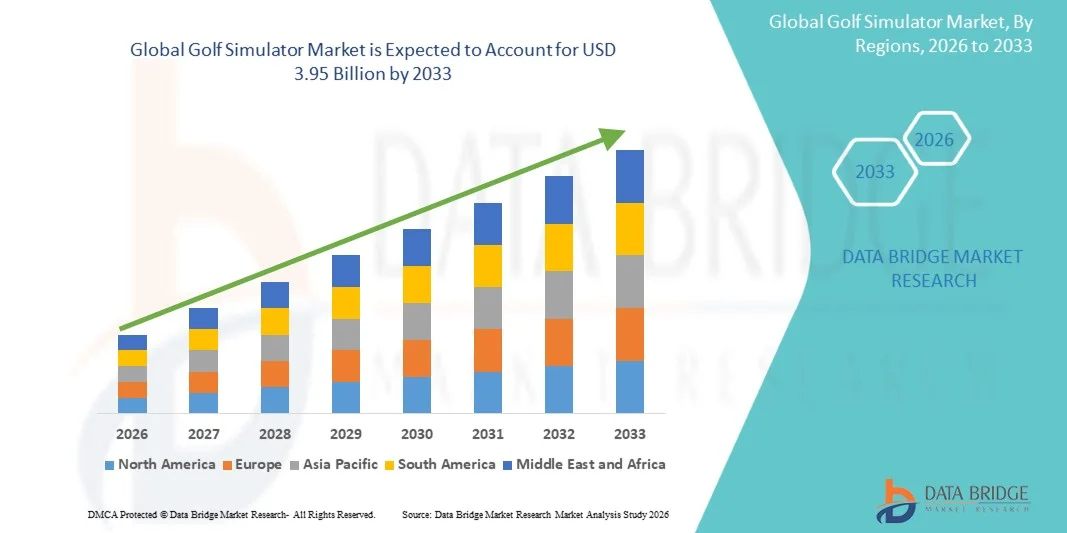
As per Data Bridge Market Research Analysis the Golf Simulator Market was valued at USD 2.06 Billion in 2025 and is projected to reach USD 3.95 Billion by 2033, growing at a CAGR of 8.50% from 2026 to 2033. The market is experiencing consistent growth driven by increasing demand for immersive sports training experiences, rising adoption of home-based entertainment systems, and growing popularity of golf as both a recreational and professional sport. Advancements in sensor technology, AI-powered swing analytics, and high-resolution simulation software are further accelerating market adoption across residential and commercial segments. Expanding investments in indoor sports infrastructure and premium golf training facilities are also supporting sustained market growth globally.
The rising focus on data-driven athletic performance improvement, combined with increasing consumer preference for year-round indoor training solutions, is significantly boosting demand for golf simulator systems. Growing integration of VR and cloud-based simulation platforms is enhancing user engagement and realism, making advanced training more accessible to both amateur and professional golfers. In addition, declining hardware costs and continuous innovation in portable and compact simulator systems are further expanding market penetration across emerging and developed regions.
Market Size & Forecast
- Global Market Value (2025): USD 2.06 Billion
- Expected Market Value (2033): USD 3.95 Billion
- Forecast CAGR (2026–2033): 8.50%
- Leading Region in 2025: North America
- Fastest Growing Region: Asia-Pacific
What are the Major Takeaways of Decorations and Inclusions Market ?
- North America dominated the Golf Simulator Market with the largest revenue share of 47.1% in 2025, supported by strong adoption of premium golf training technologies, high disposable income, and widespread integration of advanced sports simulation systems across residential and commercial facilities
- The hardware segment led the market with a 59.9% share in 2025, driven by strong demand for high-precision sensors, launch monitors, projectors, and impact screens used in premium simulator setups
- Asia-Pacific is expected to be the fastest-growing region at a CAGR of 10.4% from 2026 to 2033, fueled by rapid urbanization, rising disposable incomes, and increasing popularity of golf as a lifestyle and professional sport
- Virtual Reality (VR) simulator are the fastest-growing simulator type, projected to register a CAGR of 16.8% from 2026 to 2033, supported by rapid adoption of immersive gaming and experiential sports technology
- The indoor segment dominated the installation type category with a 58.6% revenue share in 2025, led by increasing demand for year-round training environments unaffected by weather conditions
- Full swing simulator accounted for 57.9% of the market in 2025, preferred by its high precision tracking, realistic ball physics, and widespread adoption in professional training environments
- The portable segment is the fastest-growing type category, with a CAGR of 15.6% from 2026 to 2033, driven by increasing demand for flexible and space-efficient golf training solutions
Report Scope and Golf Simulator Market Segmentation
|
Attributes |
Golf Simulator Key Market Insights |
|
Segments Covered |
|
|
Countries Covered |
North America
Europe
Asia-Pacific
Middle East and Africa
South America
|
|
Key Market Players |
|
|
Market Opportunities |
|
|
Value Added Data Infosets |
In addition to the insights on market scenarios such as market value, growth rate, segmentation, geographical coverage, and major players, the market reports curated by the Data Bridge Market Research also include in-depth expert analysis, geographically represented company-wise production and capacity, network layouts of distributors and partners, detailed and updated price trend analysis and deficit analysis of supply chain and demand. |
What is the Key Trend in the Consumer Active Optical Cable Market ?
Trend: Rising AI Driven Swing Analysis and Simulation Adoption
The Golf Simulator market is witnessing strong growth in AI powered swing analysis and immersive simulation technologies, improving training accuracy and player performance insights across both professional and amateur users. Integration of machine learning based motion tracking, high speed camera systems, and radar sensors is enabling real time feedback and highly realistic virtual gameplay experiences. Demand is increasing across golf academies, commercial training centers, and premium residential setups as users seek data driven performance improvement and year round practice solutions.
Companies such as Foresight Sports and Rapsodo Inc. are advancing AI enabled swing tracking systems through products such as GCQuad and MLM2PRO, which provide high precision ball and club data analytics for performance optimization.
Golf Simulator Market Dynamics
Key Market Driver: Growing Demand for Indoor and Home Golf Training Systems
The rising demand for indoor golf training and home based sports entertainment is a major driver of the Golf Simulator market, supported by increasing urbanization and limited access to outdoor golf facilities. Consumers are investing in compact simulator setups that offer realistic gameplay and professional level training experiences within residential spaces. Commercial facilities such as golf academies, sports lounges, and entertainment centers are also expanding simulator installations to enhance customer engagement.
Companies such as GOLFZON and Full Swing Golf are expanding indoor simulator ecosystems, with GOLFZON’s virtual golf centers and Full Swing’s Pro Series simulators widely adopted in training facilities and premium residential environments.
Key Restraint/Challenge: High Installation Cost and System Maintenance Complexity
A key challenge in the Golf Simulator market is the high initial installation cost and ongoing maintenance complexity associated with advanced simulation systems. High precision launch monitors, projection systems, VR components, and analytics software significantly increase total ownership cost, limiting adoption among price sensitive consumers. In addition, calibration requirements, space constraints, and periodic system upgrades add operational complexity for end users and commercial operators.
Full Swing Golf and aboutGOLF installations in premium golf academies highlight the high investment required for professional grade simulator setups, often limiting large scale adoption to high end commercial and luxury residential segments.
Key Market Opportunity: Growth of VR and Cloud Simulation Platforms
The expansion of VR and cloud based golf simulation platforms is creating strong growth opportunities by enhancing accessibility, scalability, and immersive user experiences. Cloud connected simulators allow users to access global golf courses, multiplayer modes, and performance tracking dashboards without requiring extensive on site infrastructure. VR integration further enhances realism by simulating course environments and gameplay dynamics in highly interactive formats.
GOLFZON’s cloud connected virtual golf platform and TruGolf’s E6 ecosystem integrated with Rapsodo MLM2PRO demonstrate how software driven simulation environments are expanding market reach and improving user engagement across residential and commercial applications.
How is the Consumer Active Optical Cable Market Segmented ?
The golf simulator market is segmented on the basis of offering, type, simulator type, installation type, and end use.
- By Offering
On the basis of offering, the Golf Simulator Market is segmented into hardware, software, and services. The Hardware segment dominated the market with the largest share of 59.9% in 2025, driven by strong demand for high-precision sensors, launch monitors, projectors, and impact screens used in premium simulator setups. Increasing adoption of advanced tracking technologies such as radar and camera-based systems is enhancing accuracy and realism, further strengthening hardware demand. Rising installation of home golf simulators and commercial training centers is expanding hardware deployment globally. Continuous innovation in immersive display systems and swing analytics solutions reinforces the segment’s leading position.
The Software segment is projected to register the fastest growth at a CAGR of 14.2% from 2026 to 2033, supported by rising demand for simulation realism, course libraries, and performance analytics. Integration of AI-driven swing analysis, cloud-based gameplay platforms, and multiplayer virtual golf environments is significantly boosting adoption. Expanding subscription-based software models is improving accessibility for residential users and training academies. Increasing focus on data-driven coaching and immersive virtual experiences is accelerating software penetration across both amateur and professional golfers.
- By Type
On the basis of type, the Golf Simulator Market is segmented into built-in, portable, and free standing systems. The Built-in segment dominated the market with a share of 44.7% in 2025, driven by strong installation in dedicated indoor golf studios, luxury homes, and commercial training facilities. These systems offer high stability, superior accuracy, and long-term performance, making them ideal for professional-grade simulation environments. Rising investments in premium home entertainment setups and golf academies is further strengthening demand. High customization capability and seamless integration with advanced hardware components reinforce segment leadership.
The Portable segment is projected to register the fastest growth at a CAGR of 15.6% from 2026 to 2033, driven by increasing demand for flexible and space-efficient golf training solutions. Portable simulators enable users to practice in multiple locations, making them highly attractive for residential users with limited space. Advancements in lightweight sensors, mobile-compatible software, and compact launch monitors are improving usability and accuracy. Growing popularity of at-home fitness and recreational sports technology is further accelerating adoption globally.
- By Simulator Type
On the basis of simulator type, the Golf Simulator Market is segmented into full swing simulators and virtual reality (VR) simulators. The Full Swing Simulator segment dominated the market with a share of 57.9% in 2025, driven by its high precision tracking, realistic ball physics, and widespread adoption in professional training environments. These systems are extensively used by golf academies and commercial sports centers due to their advanced analytics and performance feedback capabilities. Increasing demand for tournament-level training tools is strengthening segment growth. Continuous improvements in radar tracking and multi-sensor fusion technologies further reinforce its dominance.
The VR Simulator segment is projected to register the fastest growth at a CAGR of 16.8% from 2026 to 2033, driven by rapid adoption of immersive gaming and experiential sports technology. Integration of virtual reality headsets with real-time swing feedback systems is enhancing user engagement and realism. Expanding consumer interest in gamified fitness experiences is supporting adoption in residential settings. Declining hardware costs and improvements in VR motion tracking accuracy are further accelerating market expansion.
- By Installation Type
On the basis of installation type, the Golf Simulator Market is segmented into indoor and outdoor systems. The Indoor segment dominated the market with a share of 58.6% in 2025, driven by increasing demand for year-round training environments unaffected by weather conditions. Indoor simulators are widely adopted in residential basements, sports clubs, and commercial training facilities due to controlled lighting and space optimization. Rising urbanization and limited access to outdoor golf courses are further supporting indoor installations. Continuous advancements in compact simulation systems enhance their suitability for indoor environments.
The Outdoor segment is projected to register the fastest growth at a CAGR of 13.9% from 2026 to 2033, driven by growing adoption in golf courses, driving ranges, and recreational resorts. Outdoor simulators offer natural playing conditions combined with digital analytics, improving training realism. Increasing investments in smart golf course infrastructure is accelerating deployment. Integration of weather-resistant sensors and portable projection systems is further boosting outdoor usage.
- By End Use
On the basis of end use, the Golf Simulator Market is segmented into residential and commercial applications. The Commercial segment dominated the market with a share of 49.2% in 2025, driven by strong adoption in golf academies, sports training centers, hotels, and entertainment venues. High utilization rates and revenue-generating capabilities make commercial installations highly attractive for investors. Rising demand for professional coaching tools and indoor golf entertainment facilities is further strengthening segment growth. Continuous expansion of sports infrastructure and experiential entertainment centers reinforces its dominance.
The Residential segment is projected to register the fastest growth at a CAGR of 15.1% from 2026 to 2033, driven by increasing consumer interest in home-based sports training and entertainment systems. Growing adoption of smart home technologies and premium leisure setups is supporting simulator installations in private residences. Rising popularity of golf as a lifestyle sport among high-income households is further accelerating demand. Declining hardware costs and compact system designs are making residential adoption more accessible globally.
Which Region Holds the Largest Share of the Oncology Imaging Software Market ?
North America dominated the golf simulator market and accounted for the largest revenue share of 47.1% in 2025, driven by strong adoption of premium golf training technologies, high disposable income, and widespread integration of advanced sports simulation systems across residential and commercial facilities. The region benefits from a well established golf culture, extensive network of golf academies, and increasing demand for year round indoor training solutions. Rapid expansion of home entertainment systems and smart sports infrastructure is further strengthening market penetration. In addition, strong presence of leading simulator manufacturers and continuous technological innovation in tracking systems and immersive visualization platforms continues to reinforce North America’s leadership position in the global market.
U.S. Golf Simulator Market Insight
The U.S. Golf Simulator market is experiencing strong growth driven by increasing adoption of at home sports training systems, rising popularity of golf as a leisure and professional sport, and rapid expansion of indoor golf entertainment centers. Consumers are investing heavily in high end simulation setups integrated with AI powered swing analytics and real time performance tracking. The country’s strong sports infrastructure and presence of leading technology providers are enabling widespread availability of advanced simulator solutions. In addition, growing demand from golf academies, corporate entertainment venues, and fitness centers is further accelerating market expansion across the U.S.
Canada Golf Simulator Market Insight
The Canada Golf Simulator market is witnessing steady growth supported by long winter seasons that increase demand for indoor golf training and entertainment solutions. Rising interest in recreational golf activities and growing adoption of home based fitness and sports systems are further driving market penetration. Golf clubs and training academies are increasingly investing in simulator technologies to maintain year round engagement with players. In addition, expanding urbanization and rising disposable incomes are supporting adoption of premium golf simulator installations across residential and commercial segments.
Europe Golf Simulator Market Insight
The Europe Golf Simulator market is expanding steadily due to strong golfing culture, increasing investment in sports technology, and rising demand for indoor training facilities. Countries across the region are adopting advanced simulation systems to support professional training and recreational usage. The market benefits from growing focus on sports tourism, golf academies, and experiential entertainment centers. In addition, increasing integration of AI driven analytics and immersive visualization technologies is enhancing user experience and supporting regional market growth.
U.K. Golf Simulator Market Insight
The U.K. Golf Simulator market is growing steadily, driven by strong golf participation, rising demand for indoor sports entertainment, and increasing adoption of digital training tools. Golf clubs and private residences are increasingly installing simulators to enable year round practice despite weather constraints. The presence of established golf infrastructure and growing interest in premium home entertainment systems is further supporting market expansion. In addition, rising investments in smart sports venues and simulation based coaching solutions are strengthening growth in the U.K.
Germany Golf Simulator Market Insight
The Germany Golf Simulator market is expanding due to rising adoption of advanced sports technologies, increasing focus on performance based training, and growing investment in indoor recreational infrastructure. Golf academies and sports centers are integrating simulation systems to enhance training precision and player development. The country’s strong engineering base is supporting innovation in high accuracy tracking and simulation hardware. In addition, increasing consumer interest in premium indoor leisure activities is further accelerating market growth in Germany.
Asia-Pacific Golf Simulator Market Insight
The Asia-Pacific Golf Simulator market is expected to register the fastest growth with a CAGR of 10.4% from 2026 to 2033, driven by rapid urbanization, rising disposable incomes, and increasing popularity of golf as a lifestyle and professional sport. Expanding adoption of indoor sports entertainment centers and growing investments in luxury residential developments are significantly boosting demand. Countries such as China, Japan, South Korea, and India are witnessing strong expansion of golf training facilities and simulator-based coaching systems. In addition, rising digitalization of sports infrastructure and increasing penetration of advanced simulation technologies are further accelerating regional market growth.
Japan Golf Simulator Market Insight
The Japan Golf Simulator market is witnessing steady growth supported by high technology adoption, strong golfing culture, and limited availability of outdoor golf space in urban areas. Consumers are increasingly adopting compact and high precision simulator systems for residential and commercial use. Golf clubs and training centers are integrating advanced analytics based simulators to improve player performance. In addition, strong focus on innovation and immersive sports experiences is further driving market demand in Japan.
China Golf Simulator Market Insight
The China Golf Simulator market is growing rapidly due to increasing disposable income, expanding middle class population, and rising popularity of golf among professionals and enthusiasts. Strong growth of indoor sports entertainment venues and golf training academies is accelerating adoption of simulation systems. The presence of advanced manufacturing capabilities and domestic technology providers is enabling cost effective deployment of simulator solutions. In addition, increasing investments in smart sports infrastructure and digital training platforms is further driving market expansion in China.
Which are the Top Companies in Oncology Imaging Software Market ?
The golf simulator industry is primarily led by well-established companies, including:
- GOLFZON (South Korea)
- Garmin Ltd. (U.S.)
- FlightScope Golf (South Africa)
- BenQ (Taiwan)
- Foresight Sports (U.S.)
- X-GOLF AMERICA (U.S.)
- OptiShot Golf (U.S.)
- aboutGOLF (U.S.)
- Rapsodo Inc. (U.S.)
- Bushnell Golf (U.S.)
- Toptracer (Sweden)
- ErnestSports (U.S.)
- GOLFJOY LIMITED (China)
- Full Swing Golf (U.S.)
- SKYTRAK (U.S.)
What are Latest Developments in Consumer Active Optical Cable Markett ?
- In May 2025, IdeasLab launched XView AI, a markerless mobile application that delivers real-time, offline golf swing analysis by tracking body, shaft, and club movement through smartphone-based computer vision. This development strengthens the golf simulator ecosystem by expanding advanced performance analytics beyond traditional simulator hardware into mobile-first solutions. It enhances accessibility for amateur and professional golfers by enabling high-precision swing evaluation without dedicated simulator setups. The innovation supports growing demand for AI-driven coaching tools and accelerates adoption of data-centric training approaches across the Golf Simulator Market
- In February 2025, Bushnell Golf, in collaboration with Foresight Sports, introduced the Bushnell Launch Pro Indoor (LPi), a next-generation indoor golf simulation system designed to deliver Tour-level ball and club tracking accuracy at a more accessible price point. This launch significantly impacts the market by improving affordability and democratizing access to professional-grade simulation technology for both commercial and residential users. The system strengthens the indoor simulation segment by enhancing precision analytics and user experience in compact environments. It also supports broader adoption of high-performance training tools across golf academies and home simulation setups
- In February 2025, BenQ launched the AK700ST, a 4K laser projector specifically designed for golf simulation environments, featuring 4,000-lumen brightness and enhanced color accuracy for realistic gameplay visualization. This development positively impacts the Golf Simulator market by elevating immersive visual quality, which is a key factor in user engagement and simulation realism. It strengthens demand for high-end hardware components in premium simulator installations across residential and commercial segments. The product also reinforces the trend of dedicated display technologies tailored specifically for sports simulation applications
- In February 2025, Rapsodo Inc. partnered with TruGolf’s E6 APEX to expand simulation capabilities for its Mobile Launch Monitor 2 Pro (MLM2PRO), enhancing virtual course realism and interactive training features for premium users. This collaboration strengthens the software ecosystem of the Golf Simulator market by integrating advanced simulation environments with portable performance tracking devices. It improves user engagement through realistic gameplay conditions and skill-based training modules suitable for all skill levels. The partnership also accelerates adoption of hybrid hardware-software ecosystems in portable golf simulation solutions
- In February 2025, Canopy partnered with Full Swing to enhance remote monitoring and management capabilities across Full Swing’s global golf simulator installations through advanced RMM software integration. This development improves operational efficiency in the Golf Simulator market by enabling real-time system monitoring, predictive maintenance, and automated support services. It strengthens product reliability and reduces downtime for commercial simulator operators and training facilities. The collaboration also supports scalability as Full Swing expands its global footprint, reinforcing the importance of connected and service-enabled simulator ecosystems

- Interactive Data Analysis Dashboard
- Company Analysis Dashboard for high growth potential opportunities
- Research Analyst Access for customization & queries
- Competitor Analysis with Interactive dashboard
- Latest News, Updates & Trend analysis
- Harness the Power of Benchmark Analysis for Comprehensive Competitor Tracking
Global Golf Simulator Market, Supply Chain Analysis and Ecosystem Framework
To support market growth and help clients navigate the impact of geopolitical shifts, DBMR has integrated in-depth supply chain analysis into its Global Golf Simulator Market research reports. This addition empowers clients to respond effectively to global changes affecting their industries. The supply chain analysis section includes detailed insights such as Global Golf Simulator Market consumption and production by country, price trend analysis, the impact of tariffs and geopolitical developments, and import and export trends by country and HSN code. It also highlights major suppliers with data on production capacity and company profiles, as well as key importers and exporters. In addition to research, DBMR offers specialized supply chain consulting services backed by over a decade of experience, providing solutions like supplier discovery, supplier risk assessment, price trend analysis, impact evaluation of inflation and trade route changes, and comprehensive market trend analysis.
Data collection and base year analysis are done using data collection modules with large sample sizes. The stage includes obtaining market information or related data through various sources and strategies. It includes examining and planning all the data acquired from the past in advance. It likewise envelops the examination of information inconsistencies seen across different information sources. The market data is analysed and estimated using market statistical and coherent models. Also, market share analysis and key trend analysis are the major success factors in the market report. To know more, please request an analyst call or drop down your inquiry.
The key research methodology used by DBMR research team is data triangulation which involves data mining, analysis of the impact of data variables on the market and primary (industry expert) validation. Data models include Vendor Positioning Grid, Market Time Line Analysis, Market Overview and Guide, Company Positioning Grid, Patent Analysis, Pricing Analysis, Company Market Share Analysis, Standards of Measurement, Global versus Regional and Vendor Share Analysis. To know more about the research methodology, drop in an inquiry to speak to our industry experts.
Data Bridge Market Research is a leader in advanced formative research. We take pride in servicing our existing and new customers with data and analysis that match and suits their goal. The report can be customized to include price trend analysis of target brands understanding the market for additional countries (ask for the list of countries), clinical trial results data, literature review, refurbished market and product base analysis. Market analysis of target competitors can be analyzed from technology-based analysis to market portfolio strategies. We can add as many competitors that you require data about in the format and data style you are looking for. Our team of analysts can also provide you data in crude raw excel files pivot tables (Fact book) or can assist you in creating presentations from the data sets available in the report.













