


Gout Treatment Market Size
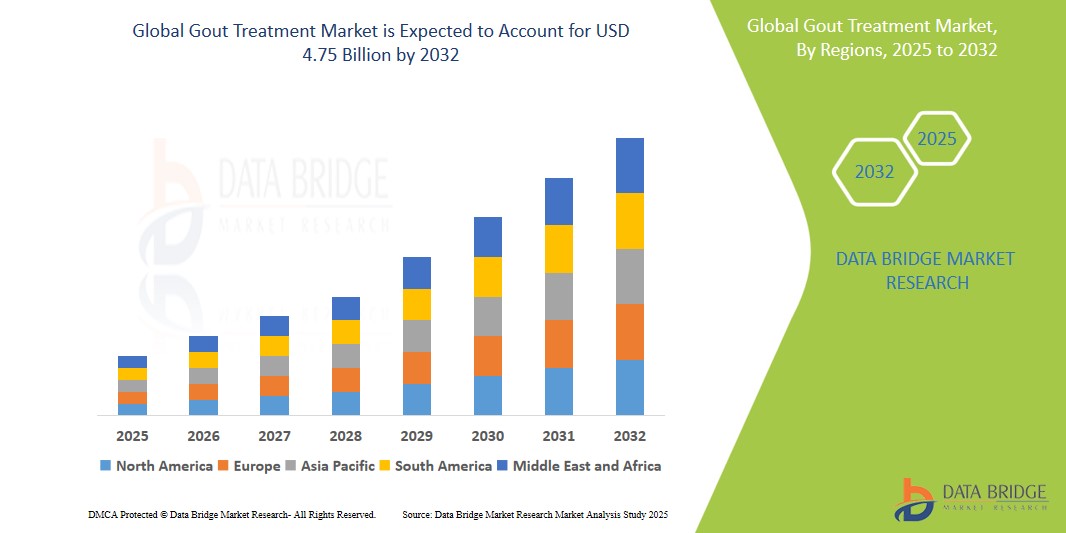
- The Global Gout Treatment Market size was valued at USD 2.40 Billion in 2024 and is expected to reach USD 4.75 Billion by 2032, at a CAGR of 8.9%during the forecast period
- This growth is driven by factors such as the rising prevalence of gout, increased awareness and diagnosis rates, growing demand for effective treatments, and advancements in uric acid-lowering therapies and diagnostic technologies.
Gout Treatment Market Analysis
- Gout is referred to as a general form of inflammatory arthritis. Gout is caused because of higher levels of uric acid in the blood. Main risk factors that are likely to cause gout are certain health factors such as high blood pressure, high cholesterol and specific medications that can cause high levels of uric acid. Also, the factors like diet containing red meat, obesity, and high consumption of alcohol can cause gout.
- The demand for gout treatment is significantly driven by the rising prevalence of gout, increasing awareness through public health campaigns, and advancements in diagnostic technologies such as uric acid level testing and imaging tools.
- North America is expected to dominate the gout treatment market with a share of 36.4%, attributed to advanced healthcare infrastructure, high adoption of innovative gout treatment therapies, and the presence of leading biopharmaceutical companies specializing in gout treatments.
- Asia-Pacific is projected to be the fastest-growing region in the gout treatment market during the forecast period due to improving healthcare access, growing awareness of gout, and the increasing availability of specialized treatments.
- The Tophaceous Gout segment is expected to lead the market with a share of 34.5% due to its higher prevalence in patients with long-term, untreated gout, early diagnosis rates, and established treatment protocols. The widespread use of urate-lowering therapies (ULTs) such as allopurinol and febuxostat, along with clinician familiarity, supports its dominant position in the market.
Report Scope and Gout Treatment Market Segmentation
|
Attributes |
Gout Treatment Key Market Insights |
|
Segments Covered |
|
|
Countries Covered |
North America
Europe
Asia-Pacific
Middle East and Africa
South America
|
|
Key Market Players |
|
|
Market Opportunities |
|
|
Value Added Data Infosets |
In addition to the insights on market scenarios such as market value, growth rate, segmentation, geographical coverage, and major players, the market reports curated by the Data Bridge Market Research also include import export analysis, production capacity overview, production consumption analysis, price trend analysis, climate change scenario, supply chain analysis, value chain analysis, raw material/consumables overview, vendor selection criteria, PESTLE Analysis, Porter Analysis, and regulatory framework. |
Gout Treatment Market Trends
“Increasing Adoption Of Personalized Medicine”
- One prominent opportunity in the Global Gout Treatment Market is the rising adoption of biologic therapies and novel gout medications.
- This shift is driven by the need for more effective and targeted treatments for gout, particularly for patients who have not responded to traditional therapies, allowing for better disease management and reduced flare-ups.
- For instance, the introduction of biologic drugs like Pegloticase for refractory gout has proven effective in reducing uric acid levels and minimizing the frequency of gout attacks in patients with chronic and severe gout, offering an advanced solution for those unresponsive to conventional treatments.
- This opportunity is significantly improving treatment efficacy, reducing the burden of disease, and enhancing patients' quality of life.
- The Global Gout Treatment Market is expected to benefit from increased research and development in biologic therapies, which will support the development of more precise, personalized, and effective treatment options for gout sufferers worldwide
Gout Treatment Market Dynamics
Driver
“Increasing prevalence of Gout Treatment”
- The increasing prevalence of gout is significantly driving demand for early diagnosis, comprehensive care, and effective long-term treatment strategies.
- As awareness of gout grows, more individuals are being diagnosed, particularly in regions with improving healthcare access, genetic testing capabilities, and better understanding of the disease’s risk factors.
- The rising number of diagnosed cases has prompted healthcare providers and policymakers to prioritize specialized rheumatology services and ensure the availability of essential treatments such as urate-lowering therapies, NSAIDs, and biologic agents.
- This growing disease burden underscores the need for robust healthcare infrastructure, patient education programs, and ongoing research to address diverse disease types and severities.
- With more cases being detected across all age groups, the market is seeing increased investments in targeted therapies, patient education, and comprehensive disease management approaches.
For instance,
- The American College of Rheumatology and EULAR guidelines have led to a surge in gout diagnosis and treatment by recommending the use of newer therapies like Febuxostat and Pegloticase, driving the demand for more personalized and advanced treatment options for gout patients
- As the prevalence continues to rise, the Global Gout Treatment market is expected to expand steadily, fueled by improved awareness, early intervention, and advancements in therapeutic solutions.
Opportunity
“Growing demand for personalized and biologic treatments for gout”
- The increase in research and development activities is significantly contributing to the advancement of Gout Treatment diagnostics and treatment
- Pharmaceutical companies, academic institutions, and healthcare organizations are heavily investing in R&D to discover novel therapies, improve existing treatment protocols, and develop gene-based solutions for long-term disease management.
- These efforts are accelerating innovation in biologic therapies, precision diagnostics, and combination treatments, aiming to offer more effective and personalized options for managing gout, reducing uric acid levels, and preventing flare-ups
For instance,
- Novartis has been developing new biologic therapies, such as Ilaris (canakinumab), that target the underlying inflammation caused by uric acid crystals, offering hope for patients with chronic gout who do not respond well to traditional treatments like NSAIDs and allopurinol
- The rise in R&D activities not only supports scientific breakthroughs but also opens up new opportunities for market expansion, especially as more treatment options become available for various forms of gout, benefiting both patients and healthcare providers
Restraint/Challenge
“High Treatment Costs and Limited Access to Care”
- The high cost of Gout Treatment presents a significant challenge for market growth, particularly in low- and middle-income countries. Advanced gout therapies, including biologics and targeted treatments, can be prohibitively expensive, limiting access to care for a large portion of the population.
- These treatments, especially biologics and uric acid-lowering drugs, often require long-term administration and monitoring, increasing both direct and indirect healthcare costs. This financial burden can deter healthcare systems and patients from opting for advanced therapies, particularly in regions with limited resources.
- Smaller healthcare facilities with limited budgets may struggle to adopt the latest therapies, often defaulting to older, less effective treatments that may not be as beneficial for long-term management of gout.
For instance,
- In countries like India and Brazil, the high cost of newer gout medications, such as biologic drugs like pegloticase, limits their availability, leaving many patients reliant on traditional, lower-cost treatments like allopurinol, which may not adequately control the condition in severe cases
- As a result, high treatment costs and financial barriers remain key restraints, impacting access to modern gout care and slowing overall market growth, particularly in emerging economies.
Gout Treatment Market Scope
The market is segmented on the basis of type, diagnosis type, treatment type, drugs type, route of administration, end users and distribution channel.
|
Segmentation |
Sub-Segmentation |
|
By Type |
|
|
By Diagnosis Type |
|
|
By Treatment Type |
|
|
By Drug Type |
|
|
By Route of Administration |
|
|
By End User |
|
|
By Distribution Channel |
|
In 2025, the Tophaceous Gout is projected to dominate the market with a largest share in type segment
The Tophaceous Gout segment is expected to dominate the Gout Treatment market with the largest share of 34.5% in 2025 due to its higher prevalence, ease of diagnosis, and effective response to initial treatments like allopurinol and colchicine. Tophaceous gout, characterized by the formation of urate crystal deposits in joints, is often more noticeable and easier to diagnose compared to other types of gout.
The X-Ray is expected to account for the largest share during the forecast period in diagnosis type segment
In 2025, the X-Ray segment is expected to dominate the market due to • In 2025, the X-Ray segment is expected to dominate the Gout Treatment market due to its effectiveness in diagnosing and assessing joint damage caused by chronic gout, particularly in patients with advanced tophaceous gout. X-ray imaging remains a crucial diagnostic tool for evaluating urate crystal deposits and joint erosion, essential for treatment planning.
Gout Treatment Market Regional Analysis
“North America Holds the Largest Share in the Gout Treatment Market”
-
North America dominates the Gout Treatment market with a share of 36.4%, driven by advanced healthcare infrastructure, high adoption of cutting-edge treatment options, and the strong presence of key pharmaceutical and biotechnology companies.
- The U.S. holds a significant share of 78.3%, due to the widespread use of advanced gout therapies like urate-lowering treatments and biologics. The high prevalence of gout and associated conditions, such as obesity and metabolic syndrome, are key factors in driving demand for effective treatments.
- The presence of leading companies, such as Novartis, Takeda, and Regeneron, alongside continuous clinical advancements, continues to drive innovation in gout treatment options. Ongoing investments in research and development (R&D) ensure the development of new, personalized therapies tailored to patients’ needs.
- The rising prevalence of gout, the increasing demand for targeted treatments, and a focus on personalized care support market growth in North America. As healthcare standards improve and more effective therapies become available, North America’s dominant position in the global gout treatment market is expected to strengthen.
“Asia-Pacific is Projected to Register the Highest CAGR in the Gout Treatment Market”
-
The Asia-Pacific region is expected to witness the highest growth rate in the Gout Treatment market, driven by rapid improvements in healthcare infrastructure, increasing awareness of the disease, and rising treatment adoption
- Countries such as China, India, and Japan are emerging as key markets for gout treatment due to the rising incidence of gout and associated conditions, such as metabolic syndrome. Increased awareness and early diagnosis are driving the adoption of urate-lowering therapies and advanced treatment options in these regions.
- Japan, with its advanced medical infrastructure, remains a critical market for gout treatments. The country continues to lead in the adoption of cutting-edge biologics and urate-lowering drugs, enhancing the effectiveness and safety of treatment options for gout patients.
- The growing focus on healthcare improvements and comprehensive care for gout patients is expected to drive demand for innovative treatments, positioning the APAC region as the fastest-growing market for gout therapies.
Gout Treatment Market Share
The market competitive landscape provides details by competitor. Details included are company overview, company financials, revenue generated, market potential, investment in research and development, new market initiatives, global presence, production sites and facilities, production capacities, company strengths and weaknesses, product launch, product width and breadth, application dominance. The above data points provided are only related to the companies' focus related to market.
The Major Market Leaders Operating in the Market Are:
- Takeda Pharmaceutical Company Limited (Japan)
- Mylan N.V. (U.S.)
- ALLERGAN (U.S.)
- Sun Pharmaceutical Industries Ltd. (India)
- Vintage Labs (India
- Ipca Laboratories Ltd. (India
- INDOCO REMEDIES LTD. (India)
- Zydus Cadila (India)
- Hikma Pharmaceuticals PLC (U.K.)
- Dr. Reddy’s Laboratories Ltd. (India)
- Casper Pharma (U.S.)
- Alembic Pharmaceuticals Limited (India)
- Macleods Pharmaceuticals Ltd. (India)
- Pfizer Inc. (U.S.
- Teva Pharmaceutical Industries Ltd. (Israel)
- Amneal Pharmaceuticals LLC. (U.S.
- Novartis AG (Switzerland
- Flexion Therapeutics Inc (U.S.
- Antares Pharma (U.S.)
- GlaxoSmithKline Plc. (U.K.)

- Interactive Data Analysis Dashboard
- Company Analysis Dashboard for high growth potential opportunities
- Research Analyst Access for customization & queries
- Competitor Analysis with Interactive dashboard
- Latest News, Updates & Trend analysis
- Harness the Power of Benchmark Analysis for Comprehensive Competitor Tracking
Data collection and base year analysis are done using data collection modules with large sample sizes. The stage includes obtaining market information or related data through various sources and strategies. It includes examining and planning all the data acquired from the past in advance. It likewise envelops the examination of information inconsistencies seen across different information sources. The market data is analysed and estimated using market statistical and coherent models. Also, market share analysis and key trend analysis are the major success factors in the market report. To know more, please request an analyst call or drop down your inquiry.
The key research methodology used by DBMR research team is data triangulation which involves data mining, analysis of the impact of data variables on the market and primary (industry expert) validation. Data models include Vendor Positioning Grid, Market Time Line Analysis, Market Overview and Guide, Company Positioning Grid, Patent Analysis, Pricing Analysis, Company Market Share Analysis, Standards of Measurement, Global versus Regional and Vendor Share Analysis. To know more about the research methodology, drop in an inquiry to speak to our industry experts.
Data Bridge Market Research is a leader in advanced formative research. We take pride in servicing our existing and new customers with data and analysis that match and suits their goal. The report can be customized to include price trend analysis of target brands understanding the market for additional countries (ask for the list of countries), clinical trial results data, literature review, refurbished market and product base analysis. Market analysis of target competitors can be analyzed from technology-based analysis to market portfolio strategies. We can add as many competitors that you require data about in the format and data style you are looking for. Our team of analysts can also provide you data in crude raw excel files pivot tables (Fact book) or can assist you in creating presentations from the data sets available in the report.












