


GPS (Global Positioning System) Chips Market Size
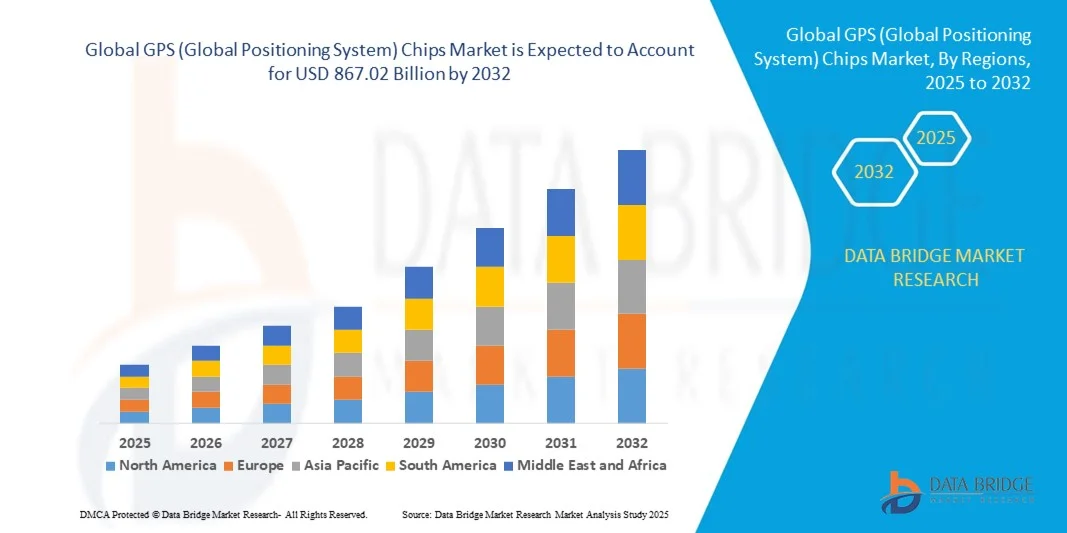
- The global GPS (Global Positioning System) chips market size was valued at USD 197.65 billion in 2024 and is expected to reach USD 867.02 billion by 2032, at a CAGR of 20.3% during the forecast period
- The market growth is largely fuelled by the rising adoption of location-based services, increasing use of GPS-enabled devices in consumer electronics, automotive, and industrial applications, and the growing demand for precision navigation and tracking solutions
- Advancements in GPS chip technology, such as miniaturization, low power consumption, and multi-constellation compatibility, are further driving market expansion
GPS (Global Positioning System) Chips Market Analysis
- The market is witnessing strong growth due to the proliferation of connected devices across automotive, aviation, defense, and consumer electronics sectors
- Increasing government initiatives for smart cities, fleet management, and transportation monitoring are boosting demand for advanced GPS chips
- North America dominated the GPS chips market with the largest revenue share of 38.5% in 2024, driven by the growing adoption of connected devices, autonomous vehicles, and advanced navigation systems
- Asia-Pacific region is expected to witness the highest growth rate in the global GPS (Global Positioning System) chips market, driven by rapid urbanization, rising disposable incomes, technological advancements, and government support for smart city and connected infrastructure projects
- The Professional Type segment held the largest market revenue share in 2024, driven by its high precision, multi-band functionality, and suitability for critical applications such as automotive navigation, aerospace, and industrial tracking systems. These chips offer advanced features such as low-power consumption, high sensitivity, and seamless integration with IoT and telematics platforms, making them a preferred choice for professional and enterprise-grade applications
Report Scope and GPS (Global Positioning System) Chips Market Segmentation
|
Attributes |
GPS (Global Positioning System) Chips Key Market Insights |
|
Segments Covered |
|
|
Countries Covered |
North America
Europe
Asia-Pacific
Middle East and Africa
South America
|
|
Key Market Players |
|
|
Market Opportunities |
|
|
Value Added Data Infosets |
In addition to the insights on market scenarios such as market value, growth rate, segmentation, geographical coverage, and major players, the market reports curated by the Data Bridge Market Research also include in-depth expert analysis, geographically represented company-wise production and capacity, network layouts of distributors and partners, detailed and updated price trend analysis and deficit analysis of supply chain and demand. |
GPS (Global Positioning System) Chips Market Trends
Rising Adoption of GPS Chips Across Multiple Applications
- The growing integration of GPS chips in automotive, consumer electronics, and industrial applications is transforming navigation and location-based services. High-precision GPS chips enable real-time tracking, improved route planning, and enhanced operational efficiency, benefiting sectors such as logistics, transportation, and autonomous vehicles. Their ability to support emerging applications such as connected cars, drones, and smart factories is further driving adoption across industries
- The demand for compact and low-power GPS chips is accelerating adoption in smartphones, wearables, and IoT devices. These chips provide seamless connectivity and accurate geolocation even in remote or urban environments, supporting applications such as fitness tracking, fleet management, and smart city solutions. In addition, integration with AI and cloud platforms enhances predictive analytics and real-time monitoring capabilities
- Advancements in multi-band and high-sensitivity GPS chips are making them increasingly reliable for critical applications, such as emergency response, aviation, and marine navigation. Enhanced signal reception in challenging environments improves safety, operational efficiency, and user experience. This also enables broader deployment in precision agriculture, autonomous drones, and defense applications requiring exact location data
- For instance, in 2023, several automotive manufacturers integrated next-generation GPS chips in connected and electric vehicles, enabling precise navigation, autonomous driving support, and optimized fleet management. This has reduced fuel consumption, enhanced safety, and improved driver experience. The move also stimulated partnerships between chipmakers and automotive OEMs to co-develop optimized solutions
- While GPS chips are expanding across industries, their impact depends on continued innovation in miniaturization, power efficiency, and multi-constellation compatibility. Manufacturers must focus on localized deployment, industry-specific solutions, and cost-effective production to capitalize on growing demand. Ongoing R&D in satellite signal processing and error correction is also vital for sustaining market growth
GPS (Global Positioning System) Chips Market Dynamics
Driver
Increasing Demand for Connected Devices and Autonomous Systems
- The rapid adoption of connected devices, autonomous vehicles, drones, and robotics is driving the demand for highly accurate and reliable GPS chips. These systems require precise location data to function effectively, accelerating investments in advanced GPS chip technologies. The surge in smart logistics and automated warehouse management further boosts the need for reliable chips
- Industries such as automotive, logistics, aerospace, and agriculture are increasingly relying on GPS chips for operational efficiency, safety, and compliance with regulatory standards. This has led to heightened R&D efforts for chips with improved accuracy, power efficiency, and multi-band support. Integration with AI-enabled platforms allows predictive tracking, route optimization, and fleet performance analysis
- Government initiatives promoting smart cities, digital mapping, and autonomous transportation are further supporting market growth. Public and private investments in infrastructure for navigation and tracking systems are boosting GPS chip adoption. Initiatives for disaster management, connected highways, and IoT-enabled public services also create new growth avenues
- For instance, in 2022, several European countries integrated GPS-enabled traffic management and smart city applications, increasing demand for high-performance chips in connected urban infrastructure. The integration enabled better traffic flow, optimized public transportation routes, and real-time incident management
- While demand is robust, integrating GPS chips into diverse devices and industries requires continuous innovation in chip design, miniaturization, and cost optimization. Stakeholders must focus on scalable solutions to maintain market momentum. Developing low-latency chips for emerging 5G networks and autonomous systems is also crucial for future adoption
Restraint/Challenge
High Cost and Technical Complexity of Advanced GPS Chips
- The increasing sophistication of GPS chips, including multi-band, high-sensitivity, and low-power designs, leads to higher production costs, limiting adoption among cost-sensitive consumer electronics and small-scale industrial users. The cost factor also affects large-scale IoT deployment in emerging markets, slowing penetration
- Technical complexities in integrating GPS chips with other sensors and IoT platforms, while ensuring high accuracy and reliability, can hinder deployment in certain applications. Manufacturers need skilled engineers and optimized design processes to overcome these challenges. Testing and calibration requirements for diverse environments further increase operational complexity
- Supply chain constraints, including semiconductor shortages and dependence on specialized fabrication technologies, further restrict large-scale production and timely delivery of GPS chips, affecting market growth. Geopolitical tensions and logistics bottlenecks also exacerbate the challenges of sourcing critical materials for chip manufacturing
- For instance, in 2023, several wearable device manufacturers reported delays in product launches due to limited availability of advanced GPS chips and integration challenges with other communication modules. These delays impacted revenue growth and slowed innovation cycles in competitive segments such as smartwatches and connected fitness devices
- While GPS technology continues to advance, addressing cost, integration, and supply chain challenges remains critical. Companies must invest in scalable manufacturing, collaborative R&D, and localized solutions to unlock long-term growth potential in the global market. Partnerships with regional suppliers and investments in in-house fabrication capabilities are becoming increasingly important for market stability
GPS (Global Positioning System) Chips Market Scope
The market is segmented on the basis of product type, application, and end user.
- By Product Type
On the basis of product type, the GPS chips market is segmented into Simple Type, Professional Type, and Others. The Professional Type segment held the largest market revenue share in 2024, driven by its high precision, multi-band functionality, and suitability for critical applications such as automotive navigation, aerospace, and industrial tracking systems. These chips offer advanced features such as low-power consumption, high sensitivity, and seamless integration with IoT and telematics platforms, making them a preferred choice for professional and enterprise-grade applications.
The Simple Type segment is expected to witness the fastest growth rate from 2025 to 2032, driven by its cost-effectiveness, compact size, and easy integration into consumer electronics, mobile devices, and wearables. Simple GPS chips are particularly popular for applications requiring basic location tracking, fitness monitoring, and navigation, allowing broader adoption across emerging markets and portable device ecosystems.
- By Application
On the basis of application, the GPS chips market is segmented into Navigation, Mobile Phone, and Others. The Navigation segment led the market in 2024, supported by growing demand in automotive, logistics, and fleet management sectors. Navigation-enabled GPS chips provide real-time tracking, route optimization, and enhanced operational efficiency, contributing to improved safety and productivity across industries.
The Mobile Phone segment is expected to witness the fastest growth rate from 2025 to 2032, driven by the proliferation of smartphones, tablets, and wearable devices with location-based services. GPS chips embedded in mobile devices support mapping, geotagging, fitness tracking, and augmented reality applications, expanding their adoption among consumers globally.
- By End User
On the basis of end user, the GPS chips market is segmented into Consumer Electronics, Automotive, Military and Defence, Transportation, Aerospace, and Others. The Automotive segment held a significant market share in 2024 due to increasing integration of connected vehicle technologies, autonomous driving features, and smart fleet management systems. GPS chips enhance vehicle navigation, telematics, and real-time monitoring, providing safer and more efficient transportation solutions.
The Consumer Electronics segment is expected to witness the fastest growth rate from 2025 to 2032, fueled by rising demand for smartwatches, fitness trackers, drones, and IoT-enabled devices. GPS chips in consumer electronics enable precise location tracking, improved connectivity, and seamless integration with mobile applications and cloud-based services, driving adoption among tech-savvy users.
GPS (Global Positioning System) Chips Market Regional Analysis
- North America dominated the GPS chips market with the largest revenue share of 38.5% in 2024, driven by the growing adoption of connected devices, autonomous vehicles, and advanced navigation systems
- The region’s robust industrial, automotive, and consumer electronics sectors are increasingly integrating GPS chips for precise tracking, fleet management, and location-based services
- High disposable incomes, strong technological infrastructure, and government initiatives supporting smart city and IoT applications further contribute to widespread adoption, establishing GPS chips as critical components across multiple industries
U.S. GPS Chips Market Insight
The U.S. GPS chips market captured the largest revenue share in 2024 within North America, fueled by rapid growth in automotive telematics, mobile devices, and connected applications. Increasing demand for autonomous vehicles, drones, and smart city projects is driving the integration of high-precision GPS chips. In addition, the growing focus on real-time tracking, logistics optimization, and IoT-enabled navigation systems is propelling market expansion. Strategic investments in advanced GPS chip technologies and collaborations between semiconductor and device manufacturers further accelerate growth.
Europe GPS Chips Market Insight
The Europe GPS chips market is expected to witness the fastest growth rate from 2025 to 2032,, driven by increasing adoption in automotive, aerospace, and defense sectors. Stringent safety and navigation regulations, coupled with the growth of connected vehicles and industrial automation, are supporting market demand. European countries are also investing in smart city initiatives, digital mapping, and location-based infrastructure, fostering GPS chip integration across commercial and public applications.
U.K. GPS Chips Market Insight
The U.K. GPS chips market is expected to witness the fastest growth rate from 2025 to 2032,, supported by rising demand in automotive navigation systems, consumer electronics, and transportation management solutions. The increasing focus on vehicle tracking, fleet optimization, and drone applications is driving adoption. In addition, government-backed smart city projects and IoT infrastructure development are anticipated to boost the GPS chips market in the country.
Germany GPS Chips Market Insight
The Germany GPS chips market is expected to witness the fastest growth rate from 2025 to 2032, fueled by the country’s strong automotive sector, industrial automation, and defense applications. Germany’s emphasis on technological innovation, smart transportation, and precision navigation solutions is promoting GPS chip deployment. Integration of advanced GPS chips with connected vehicles, autonomous machinery, and IoT-enabled industrial solutions is expected to enhance operational efficiency and safety.
Asia-Pacific GPS Chips Market Insight
The Asia-Pacific GPS chips market is expected to witness the fastest growth rate from 2025 to 2032,, driven by rapid urbanization, increasing disposable incomes, and technological advancements in countries such as China, Japan, and India. Rising adoption of connected devices, smartphones, wearable electronics, and automotive navigation systems is fueling market growth. Government initiatives supporting smart cities, digital mapping, and autonomous transportation further enhance GPS chip adoption.
Japan GPS Chips Market Insight
The Japan GPS chips market is expected to witness the fastest growth rate from 2025 to 2032, due to the country’s high technological adoption, automotive innovation, and focus on connected infrastructure. High demand for navigation systems in vehicles, drones, and robotics is accelerating GPS chip integration. In addition, Japan’s smart city and IoT initiatives are encouraging widespread deployment of precise and reliable GPS solutions across residential, commercial, and industrial applications.
China GPS Chips Market Insight
The China GPS chips market accounted for the largest revenue share in the Asia-Pacific region in 2024, driven by rapid urbanization, a growing middle class, and high technological adoption. Strong demand in consumer electronics, automotive telematics, and industrial automation is supporting market growth. Government investments in smart city projects, autonomous transportation, and navigation infrastructure, along with the presence of domestic GPS chip manufacturers, are further propelling market expansion.
GPS (Global Positioning System) Chips Market Share
The GPS (Global Positioning System) Chips industry is primarily led by well-established companies, including:
- Unictron Technologies Corporation (Taiwan)
- Broadcom Inc. (U.S.)
- SPK Electronics Co., Ltd. (Taiwan)
- Maxim Integrated (U.S.)
- SparkFun Electronics (U.S.)
- FURUNO Electric Co. Ltd. (Japan)
- ROADPOINT Limited (U.K.)
- Skyworks Solutions, Inc. (U.S.)
- SkyTraq Technology, Inc. (Taiwan)
- Central Electronics Limited (India)
- NovAtel Inc. (Canada)
- ROAD POINT India (India)
- Isecuro (U.K.)
- ESINO (Germany)
- Shenzhen Zhonghe Electronic Co. Ltd. (China)
- OriginGPS Ltd. (Israel)
- Shenzhen Dragon Bridge Technology Co., Ltd. (China)
- VLSI Solution Oy (Finland)
- Analog Devices, Inc. (U.S.)
- Shenzhen Eelink Communication Technology Co., Ltd. (China)
- ThinkRace Technology (China)

- Interactive Data Analysis Dashboard
- Company Analysis Dashboard for high growth potential opportunities
- Research Analyst Access for customization & queries
- Competitor Analysis with Interactive dashboard
- Latest News, Updates & Trend analysis
- Harness the Power of Benchmark Analysis for Comprehensive Competitor Tracking
Global Gps Chips Market, Supply Chain Analysis and Ecosystem Framework
To support market growth and help clients navigate the impact of geopolitical shifts, DBMR has integrated in-depth supply chain analysis into its Global Gps Chips Market research reports. This addition empowers clients to respond effectively to global changes affecting their industries. The supply chain analysis section includes detailed insights such as Global Gps Chips Market consumption and production by country, price trend analysis, the impact of tariffs and geopolitical developments, and import and export trends by country and HSN code. It also highlights major suppliers with data on production capacity and company profiles, as well as key importers and exporters. In addition to research, DBMR offers specialized supply chain consulting services backed by over a decade of experience, providing solutions like supplier discovery, supplier risk assessment, price trend analysis, impact evaluation of inflation and trade route changes, and comprehensive market trend analysis.
Data collection and base year analysis are done using data collection modules with large sample sizes. The stage includes obtaining market information or related data through various sources and strategies. It includes examining and planning all the data acquired from the past in advance. It likewise envelops the examination of information inconsistencies seen across different information sources. The market data is analysed and estimated using market statistical and coherent models. Also, market share analysis and key trend analysis are the major success factors in the market report. To know more, please request an analyst call or drop down your inquiry.
The key research methodology used by DBMR research team is data triangulation which involves data mining, analysis of the impact of data variables on the market and primary (industry expert) validation. Data models include Vendor Positioning Grid, Market Time Line Analysis, Market Overview and Guide, Company Positioning Grid, Patent Analysis, Pricing Analysis, Company Market Share Analysis, Standards of Measurement, Global versus Regional and Vendor Share Analysis. To know more about the research methodology, drop in an inquiry to speak to our industry experts.
Data Bridge Market Research is a leader in advanced formative research. We take pride in servicing our existing and new customers with data and analysis that match and suits their goal. The report can be customized to include price trend analysis of target brands understanding the market for additional countries (ask for the list of countries), clinical trial results data, literature review, refurbished market and product base analysis. Market analysis of target competitors can be analyzed from technology-based analysis to market portfolio strategies. We can add as many competitors that you require data about in the format and data style you are looking for. Our team of analysts can also provide you data in crude raw excel files pivot tables (Fact book) or can assist you in creating presentations from the data sets available in the report.













