


What is the GPU Programming Platform Market Size and Growth Rate?
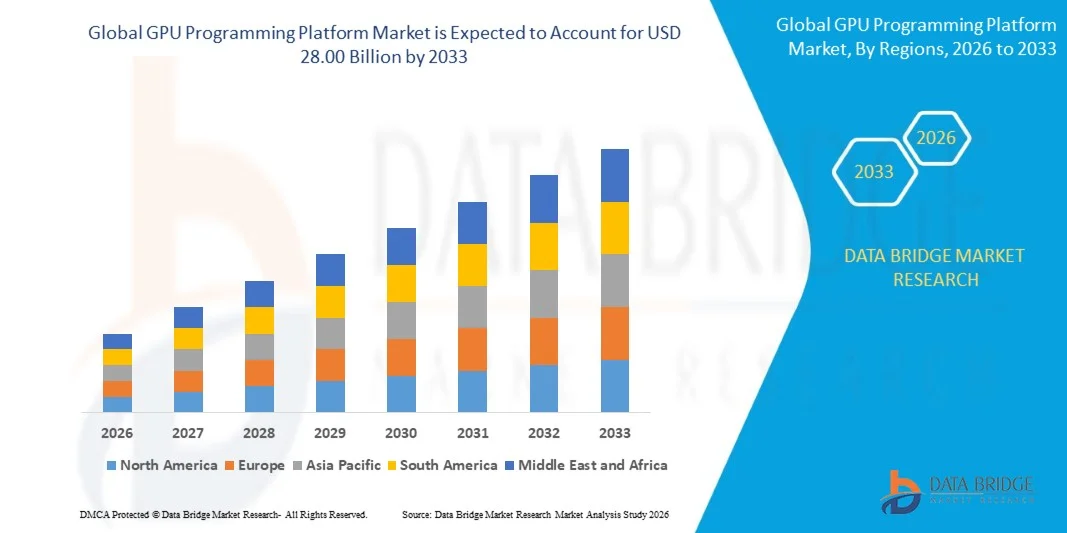
- As per Data Bridge Market Research analysis, the GPU programming platform market was valued at USD 5.67 billion in 2025 and is projected to reach USD 28.00 billion by 2033, growing at a CAGR of 22.10% from 2026 to 2033.
- The market is experiencing consistent growth driven by rising demand for accelerated computing, rapid advancements in artificial intelligence and high-performance computing, and expanding adoption of GPU programming platforms across data centers, cloud computing, scientific research, and enterprise applications.
- The increasing demand for AI model training and inference, combined with the growing deployment of large-scale data analytics, machine learning, and high-performance computing workloads, is compelling enterprises and cloud service providers to adopt advanced GPU programming platforms. CUDA, ROCm, OpenCL, and other programming frameworks are increasingly being used to improve GPU utilization, accelerate application development, and support scalable heterogeneous computing environments.
Market Size & Forecast
- Global Market Value (2025): USD 5.67 Billion
- Expected Market Value (2033): USD 28.00 Billion
- Forecast CAGR (2026–2033): 22.10%
- Leading Region in 2025: North America
- Fastest Growing Region: Asia Pacific
What are the Major Takeaways of the GPU Programming Platform Market?
- North America dominated the GPU programming platform market with the largest revenue share of 42.5% in 2025, supported by the strong presence of GPU technology providers, hyperscale data centers, advanced AI infrastructure, and substantial investments in high-performance computing.
- Asia-Pacific is expected to be the fastest-growing region at a CAGR of 24.0% from 2026 to 2033, fueled by rapid AI adoption, expanding cloud infrastructure, increasing semiconductor investments, and growing demand for accelerated computing across China, Japan, South Korea, and India.
- The software segment led the market with a 62.38% share in 2025, driven by the increasing adoption of programming frameworks, compilers, libraries, runtimes, and development tools for GPU-accelerated workloads
- Services are the fastest-growing component type, projected to register a CAGR of 20.8%, reflecting the surge in demand for GPU integration, application migration, optimization, consulting, and technical support.
- The public cloud segment dominated the deployment mode category with a 46.51% revenue share in 2025, led by the flexibility, scalability, and accessibility of cloud-based GPU infrastructure.
- CUDA accounted for 66.43% of the market share in 2025, preferred by its mature ecosystem, extensive developer community, optimized libraries, and broad adoption across AI and high-performance computing application
- The oneAPI and SYCL segment is the fastest-growing programming model category, with a CAGR of 24.1%, driven by demand for portable programming across CPUs, GPUs, and other accelerators.
Report Scope and GPU Programming Platform Market Segmentation
|
Attributes |
GPU Programming Platform Key Market Insights |
|
Segments Covered |
|
|
Countries Covered |
North America
Europe
Asia-Pacific
Middle East and Africa
South America
|
|
Key Market Players |
|
|
Market Opportunities |
|
|
Value Added Data Infosets |
In addition to the insights on market scenarios such as market value, growth rate, segmentation, geographical coverage, and major players, the market reports curated by the Data Bridge Market Research also include in-depth expert analysis, geographically represented company-wise production and capacity, network layouts of distributors and partners, detailed and updated price trend analysis and deficit analysis of supply chain and demand. |
What is the Key Trend in the GPU Programming Platform Market?
- GPU programming platforms are increasingly evolving toward portable, AI-focused, and heterogeneous programming environments that enable developers to optimize workloads across different GPU architectures while supporting rapidly expanding AI and high-performance computing applications.
- For instance, in May 2025, NVIDIA announced DGX Cloud Lepton, a global AI compute marketplace connecting developers with tens of thousands of GPUs from multiple cloud providers, supporting on-demand and long-term GPU computing for AI development.
- The integration of specialized AI libraries, compilers, profilers, and runtime environments is becoming a major trend as developers seek to improve GPU utilization, accelerate model development, and optimize increasingly complex generative AI and machine learning workloads.
- Cloud-based GPU programming environments are also gaining momentum, enabling developers to access scalable GPU resources, development tools, containers, and optimized software stacks without making substantial investments in dedicated computing infrastructure.
- For instance, in May 2025, AMD announced HIP 7.0 development plans, focusing on closer alignment between HIP C++ and CUDA and integrating HIPIFY to simplify the migration of CUDA applications to AMD GPUs, demonstrating the industry's growing emphasis on cross-platform programming portability.
- Cross-platform programming is becoming increasingly important as enterprises seek to reduce dependence on a single GPU architecture and improve application portability across NVIDIA, AMD, and other accelerator environments.
What are the Key Drivers of the GPU Programming Platform Market?
- The rapid expansion of generative AI, large language models, and high-performance computing workloads has significantly increased demand for GPU programming platforms capable of accelerating model training, inference, scientific computing, and large-scale data processing.
- For instance, in January 2025, NVIDIA released CUDA Toolkit 12.8 with support for its Blackwell architecture, adding updated compilers, libraries, performance tools, and CUDA Graph capabilities designed to accelerate AI training and inference workloads.
- Cloud service providers and enterprises are increasingly deploying GPU-accelerated infrastructure to support AI workloads, creating greater demand for programming tools, optimized libraries, compilers, runtimes, and performance-monitoring solutions that improve GPU utilization.
- For instance, in 2025, AMD's ROCm platform expanded its programming stack across HIP, OpenCL, OpenMP, compilers, libraries, debuggers, and profilers, while supporting AI frameworks such as PyTorch and TensorFlow, strengthening the development ecosystem for GPU-accelerated AI and HPC applications
- The growing adoption of heterogeneous computing is encouraging organizations to use programming platforms that can coordinate workloads across CPUs, GPUs, and other accelerators while improving application performance and scalability.
What Factors are Challenging the Growth of the GPU Programming Platform Market?
- GPU programming platforms can involve significant development complexity because applications often require specialized knowledge of GPU architectures, parallel programming techniques, memory management, kernel optimization, and performance profiling.
- For instance, in May 2025, AMD stated that differences between HIP C++ and CUDA C++ often require manual intervention when porting code between GPU platforms, creating additional work for software developers and highlighting the technical complexity of cross-platform GPU programming.
- Compatibility and portability challenges between competing GPU programming ecosystems can increase development time, particularly when organizations need to migrate applications between proprietary and open-source programming frameworks.
- For instance, in October 2026, CNBC reported that demand for specialized CUDA engineers remains strong and that the scarcity of deep CUDA expertise continues to be a challenge, reflecting the shortage of skilled developers required to optimize GPU workloads
- The substantial learning requirements for GPU programming, combined with shortages of developers experienced in CUDA, HIP, OpenCL, and heterogeneous computing, can restrict adoption among organizations without specialized technical teams.
How is the GPU Programming Platform Market Segmented?
The GPU programming platform market is segmented on the basis of component, deployment mode, programming model, and end user.
- By Component
On the basis of component, the GPU programming platform market is segmented into software and services. The software segment dominated the market with a 62.38% share in 2025, owing to the increasing adoption of programming frameworks, compilers, libraries, runtimes, and development tools for GPU-accelerated workloads. Software platforms provide the core environment required to develop, optimize, and execute applications on GPUs. Growing demand for artificial intelligence, machine learning, and high-performance computing is increasing the need for specialized GPU software. Enterprises are also investing in software tools that improve GPU utilization and application performance. The availability of mature development ecosystems further supports software adoption.
The services segment is projected to register the fastest growth at a CAGR of 20.8% from 2026 to 2033, driven by increasing demand for GPU integration, application migration, optimization, consulting, and technical support. Organizations adopting GPU-based infrastructure often require specialized expertise to convert and optimize existing applications. Service providers help enterprises address programming complexity and improve the performance of GPU workloads. Growing adoption among organizations with limited internal GPU expertise is further supporting demand. Migration between different GPU architectures is also creating opportunities for specialized implementation services. Increasing deployment of AI and high-performance computing workloads is expanding the need for ongoing technical assistance.
- By Deployment Mode
On the basis of deployment mode, the GPU programming platform market is segmented into on-premises, public cloud, private cloud, and hybrid and multicloud. The public cloud segment dominated the market with a 46.51% share in 2025, supported by the flexibility, scalability, and accessibility of cloud-based GPU infrastructure. Public cloud platforms allow organizations to obtain GPU computing resources without substantial investments in dedicated infrastructure. Cloud providers increasingly offer integrated programming environments, development tools, libraries, and GPU instances. This model is particularly attractive for organizations managing variable AI and high-performance computing workloads. On-demand access allows users to scale GPU resources according to computational requirements. The growing availability of managed GPU services is further supporting public cloud adoption.
The hybrid and multicloud segment is projected to register the fastest growth at a CAGR of 22.7% from 2026 to 2033, driven by increasing demand for flexible GPU infrastructure across multiple environments. Enterprises are combining private infrastructure with public cloud resources to balance security, scalability, and performance. Hybrid deployment enables organizations to retain sensitive workloads within controlled environments while accessing additional GPU capacity through cloud platforms. Multicloud strategies also provide access to different GPU architectures and specialized computing services. Growing concerns about vendor dependency are encouraging organizations to distribute workloads across multiple providers. The need for portable programming environments is further supporting hybrid and multicloud adoption.
- By Programming Model
On the basis of programming model, the GPU programming platform market is segmented into CUDA, ROCm and HIP, oneAPI and SYCL, OpenCL, directive-based models, GPU kernel and AI compiler toolchains, and other programming models. The CUDA segment dominated the market with a 66.43% share in 2025, supported by its mature ecosystem, extensive developer community, optimized libraries, and broad adoption across AI and high-performance computing applications. CUDA provides an established programming environment for developing and optimizing GPU-accelerated applications. Its extensive collection of development tools and libraries supports a wide range of computing workloads. A large base of existing CUDA applications also encourages continued adoption. Strong integration with major AI frameworks further strengthens its market position.
The oneAPI and SYCL segment is projected to register the fastest growth at a CAGR of 24.1% from 2026 to 2033, driven by increasing demand for portable programming across CPUs, GPUs, and other accelerators. SYCL enables developers to use modern C++ programming approaches for heterogeneous computing environments. Organizations are increasingly seeking programming models that reduce dependence on a particular hardware architecture. The ability to develop portable applications is particularly valuable as enterprises adopt heterogeneous computing infrastructure. Growing interest in open standards is also supporting adoption of SYCL-based programming. Increasing use of accelerators for AI and high-performance computing is expanding the addressable application base.
- By End User
On the basis of end user, the GPU programming platform market is segmented into cloud service providers and data center operators, IT, software, internet, and SaaS providers, telecommunications, healthcare and life sciences, manufacturing, and other end users. The cloud service providers and data center operators segment dominated the market with a 34.47% share in 2025, driven by extensive deployment of GPUs for artificial intelligence, machine learning, cloud computing, and high-performance workloads. These organizations operate large-scale GPU infrastructures requiring sophisticated programming environments. Programming platforms help them maximize GPU utilization and optimize computational workloads. They also rely on compilers, libraries, runtimes, and performance-monitoring tools to manage GPU-intensive applications. The expansion of AI infrastructure is increasing demand for GPU resources among data center operators.
The healthcare and life sciences segment is projected to register the fastest growth at a CAGR of 24.3% from 2026 to 2033, driven by increasing use of GPU acceleration for medical imaging, drug discovery, genomics, computational biology, and AI-based diagnostics. Healthcare organizations are increasingly processing large and complex datasets that require high-performance computing capabilities. GPU programming platforms enable researchers to accelerate image reconstruction, molecular simulations, and machine-learning workloads. Growing adoption of AI-assisted medical research is further increasing demand for accelerated computing. Pharmaceutical companies are also using GPU-based computing to improve computational drug-development workflows. Increasing investment in precision medicine and advanced biomedical research is supporting adoption.
Which Region Holds the Largest Share of the GPU Programming Platform Market?
- North America dominated the GPU programming platform market with the largest revenue share of 42.5% in 2025, supported by the strong presence of GPU technology providers, hyperscale data centers, advanced AI infrastructure, and substantial investments in high-performance computing.
- The region also benefits from substantial investments in artificial intelligence, cloud computing, and high-performance computing, along with widespread deployment of GPU-based workloads across enterprises and research institutions. Increasing demand for AI model training, machine learning, and scalable data-center computing continues to strengthen North America's leadership position in the global market.
U.S. GPU Programming Platform Market Insight
The U.S. GPU programming platform market is witnessing strong growth due to rising investments in artificial intelligence, accelerated computing, cloud infrastructure, and high-performance computing technologies. The country’s strong ecosystem of GPU developers, technology providers, hyperscale data centers, and software companies, along with increasing adoption of CUDA, ROCm, and other programming frameworks, is driving demand across enterprise and research applications. In addition, growing emphasis on AI model training, machine learning, and scalable GPU workloads is accelerating the adoption of advanced GPU programming platforms across industries.
Asia-Pacific GPU Programming Platform Market Insight
The Asia-Pacific GPU programming platform market is expected to witness rapid growth, driven by increasing investments in artificial intelligence, expanding data center infrastructure, and rising adoption of accelerated computing across countries such as China, Japan, and India. Growing demand for cloud-based computing, machine learning, and high-performance computing, along with increasing development of domestic semiconductor and AI ecosystems, is supporting regional market expansion. Additionally, the growing deployment of GPUs for enterprise applications, scientific research, and generative AI workloads is accelerating the adoption of GPU programming platforms across the region.
Japan GPU Programming Platform Market Insight
The Japan GPU programming platform market is witnessing consistent growth due to rising investments in artificial intelligence, high-performance computing, and advanced semiconductor technologies. Technology companies, automotive manufacturers, research institutes, and data center operators are increasingly adopting GPU programming platforms for AI development, scientific computing, simulation, and data-intensive applications. Moreover, increasing integration of GPU acceleration into cloud and enterprise workloads, along with Japan’s focus on advanced computing infrastructure and AI innovation, is further contributing to market growth.
China GPU Programming Platform Market Insight
The China GPU programming platform market is growing rapidly, driven by increasing investments in artificial intelligence, data center infrastructure, and domestic accelerated computing technologies. Growing adoption of GPU-based platforms across cloud computing, machine learning, scientific research, and enterprise applications is significantly boosting market demand. In addition, rising investments in semiconductor development, AI infrastructure, and high-performance computing, together with increasing demand for locally developed computing ecosystems, are positioning China as one of the fastest-growing markets for GPU programming platforms globally.
U.K. GPU Programming Platform Market Insight
The U.K. GPU programming platform market is experiencing steady growth, supported by rising adoption of accelerated computing technologies in artificial intelligence, cloud computing, scientific research, and enterprise applications. Increasing investments in advanced data center infrastructure and growing demand for scalable computing solutions are contributing to market growth. Furthermore, integration of GPU programming frameworks with AI development tools, machine learning libraries, and high-performance computing environments is improving computational efficiency and supporting the U.K.’s position as a key innovation hub in the GPU programming platform industry.
Germany GPU Programming Platform Market Insight
The Germany GPU programming platform market is expanding steadily due to the country’s strong industrial base, advanced research capabilities, and increasing adoption of artificial intelligence and high-performance computing technologies. Automotive companies, manufacturers, research organizations, and technology providers are increasingly utilizing GPU programming platforms for AI development, simulation, data analytics, and computational workloads. Continuous advancements in heterogeneous computing, GPU acceleration, and AI software ecosystems, along with strong government and industrial focus on digitalization and technological innovation, are further driving market growth in Germany.
Which are the Top Companies in GPU Programming Platform Market?
The GPU programming platform industry is primarily led by well-established companies, including:
- NVIDIA Corporation (U.S.)
- Advanced Micro Devices, Inc. (U.S.)
- Intel Corporation (U.S.)
- Google LLC (U.S.)
- Microsoft Corporation (U.S.)
- IBM Corporation (U.S.)
- Qualcomm Technologies, Inc. (U.S.)
- Apple Inc. (U.S.)
- Arm Limited (U.K.)
- Huawei Technologies Co., Ltd. (China)
- Samsung Electronics Co., Ltd. (South Korea)
- Baidu Inc (China)
- Alibaba Group Holding Limited (China)
- Tencent (China)
- Oracle (U.S.)
- Amazon Web Services, Inc. (U.S.)
- The MathWorks, Inc. (U.S.)
- Altair Engineering, Inc. (U.S.)
- Red Hat, Inc. (U.S.)
- Imagination Technologies Limited (U.K.)
What are Latest Developments in GPU Programming Platform Market?
- In January 2025, NVIDIA announced the availability of CUDA Toolkit 12.8, introducing comprehensive support for its Blackwell architecture across CUDA libraries, compilers, performance tools, and developer tools. The release also enhanced CUDA Graphs, CUTLASS, cuBLAS, Nsight Compute, and CUDA Python capabilities, strengthening the platform for artificial intelligence, high-performance computing, data science, and other GPU-accelerated workloads.
- In February 2024, AMD expanded its machine learning development ecosystem with AMD ROCm 6.0, adding support for additional Radeon GPUs and ONNX Runtime while broadening the software stack available to AI researchers and machine learning engineers. The development strengthened ROCm as an alternative GPU programming platform for local AI development and inference workloads.
- In July 2023, NVIDIA released CUDA Toolkit 12.2 with new programming model capabilities and enhanced support for Hopper-based GPU applications. The release introduced heterogeneous memory management, confidential computing capabilities, lazy loading, application prioritization through CUDA Multi-Process Service, and updates to Nsight developer tools, supporting increasingly complex accelerated-computing workloads.
- In December 2022, NVIDIA released CUDA Toolkit 12.0, marking a major update to its GPU programming environment with support for Hopper and Ada Lovelace architecture features, new programming capabilities, enhanced libraries, and C++20 host compiler support. The release strengthened CUDA's capabilities for developing and optimizing applications across artificial intelligence, high-performance computing, and other accelerated workloads.
- In October 2021, NVIDIA introduced CUDA Toolkit 11.5 with enhancements to the CUDA programming model, CUDA Graphs, Cooperative Groups, CUDA Python, and developer tools. The release also improved compiler performance and introduced updates to GPUDirect Storage, helping developers build and optimize GPU-accelerated applications for artificial intelligence, machine learning, high-performance computing, and data science workloads.

- Interactive Data Analysis Dashboard
- Company Analysis Dashboard for high growth potential opportunities
- Research Analyst Access for customization & queries
- Competitor Analysis with Interactive dashboard
- Latest News, Updates & Trend analysis
- Harness the Power of Benchmark Analysis for Comprehensive Competitor Tracking
Global Gpu Programming Platform Market, Supply Chain Analysis and Ecosystem Framework
To support market growth and help clients navigate the impact of geopolitical shifts, DBMR has integrated in-depth supply chain analysis into its Global Gpu Programming Platform Market research reports. This addition empowers clients to respond effectively to global changes affecting their industries. The supply chain analysis section includes detailed insights such as Global Gpu Programming Platform Market consumption and production by country, price trend analysis, the impact of tariffs and geopolitical developments, and import and export trends by country and HSN code. It also highlights major suppliers with data on production capacity and company profiles, as well as key importers and exporters. In addition to research, DBMR offers specialized supply chain consulting services backed by over a decade of experience, providing solutions like supplier discovery, supplier risk assessment, price trend analysis, impact evaluation of inflation and trade route changes, and comprehensive market trend analysis.
Data collection and base year analysis are done using data collection modules with large sample sizes. The stage includes obtaining market information or related data through various sources and strategies. It includes examining and planning all the data acquired from the past in advance. It likewise envelops the examination of information inconsistencies seen across different information sources. The market data is analysed and estimated using market statistical and coherent models. Also, market share analysis and key trend analysis are the major success factors in the market report. To know more, please request an analyst call or drop down your inquiry.
The key research methodology used by DBMR research team is data triangulation which involves data mining, analysis of the impact of data variables on the market and primary (industry expert) validation. Data models include Vendor Positioning Grid, Market Time Line Analysis, Market Overview and Guide, Company Positioning Grid, Patent Analysis, Pricing Analysis, Company Market Share Analysis, Standards of Measurement, Global versus Regional and Vendor Share Analysis. To know more about the research methodology, drop in an inquiry to speak to our industry experts.
Data Bridge Market Research is a leader in advanced formative research. We take pride in servicing our existing and new customers with data and analysis that match and suits their goal. The report can be customized to include price trend analysis of target brands understanding the market for additional countries (ask for the list of countries), clinical trial results data, literature review, refurbished market and product base analysis. Market analysis of target competitors can be analyzed from technology-based analysis to market portfolio strategies. We can add as many competitors that you require data about in the format and data style you are looking for. Our team of analysts can also provide you data in crude raw excel files pivot tables (Fact book) or can assist you in creating presentations from the data sets available in the report.













